


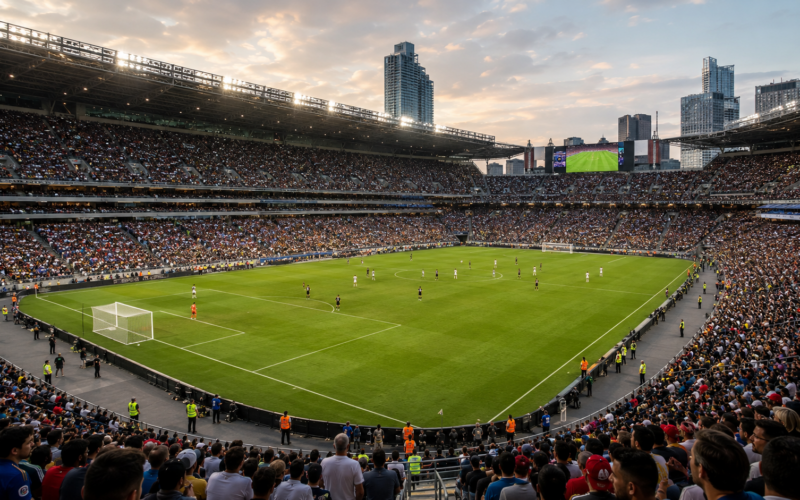
England secured third place at the FIFA World Cup 2026 with a wild 6-4 win over France at Miami Stadium in Miami Gardens, Florida, on Saturday, July 18, 2026. Declan Rice, Ezri Konsa, Bukayo Saka and Jude Bellingham scored for England, while Kylian Mbappé, Bradley Barcola and Ousmane Dembélé led France’s second-half fightback.
The match looked finished at half-time, with England 4-0 ahead after Rice scored in the third minute, Konsa headed in from Rice’s corner, and Saka struck twice before the break. France then turned the third-place match into a chaotic spectacle, with Mbappé scoring twice and assisting Barcola as Didier Deschamps’ side cut the deficit to 4-3.
Saka settled England’s nerves from the penalty spot in the 87th minute to complete his hat-trick, but Dembélé scored in stoppage time to keep France alive. Substitute Bellingham finally ended the contest in the eighth minute of stoppage time, giving England their best men’s World Cup finish since winning the tournament in 1966.
The result gave England the bronze medal and left France fourth in Deschamps’ final match as head coach. Mbappé’s two goals still made history, taking him to 22 career World Cup goals and 10 at this tournament, two ahead of Lionel Messi before Argentina’s final against Spain.
FIFA World Cup 2026 France 4-6 England full match scorecard and decisive incidents
How did England’s first-half aggression turn the third-place match into a 4-0 shock?
England’s opening half was the clearest answer to criticism of their semi-final passivity against Argentina. Tuchel’s team did not wait for France to dictate rhythm. They attacked from the first whistle, moved the ball forward quickly and used direct running to punish a French defence that looked badly disconnected.
Rice’s third-minute goal set the tone. England’s captain charged forward and finished early, giving his side the emotional control they had lost late against Argentina. The goal also forced France to defend a more open match than Deschamps would have wanted in his final game.
The second goal came from an England set piece, with Rice turning provider and Konsa heading in from the corner in the 18th minute. France’s reshuffled back line, featuring Maignan, Gusto, Konaté, Lacroix and Theo Hernández, struggled badly with runners, spacing and basic recovery positions.
Saka then turned a strong England half into a rout. Rashford assisted his first goal in the 37th minute before Eze set him up again in first-half stoppage time. At 4-0, England looked less like a team nursing semi-final disappointment and more like a side determined to prove that the bronze medal still mattered.
Why did France’s half-time changes completely alter the direction of the match?
France’s first-half performance was so poor that Deschamps had little choice but to act. He introduced Digne, Upamecano, Dembélé and Barcola at half-time, and the changes immediately gave France more structure, speed and attacking connection.
Mbappé scored in the 48th minute from Olise’s assist, which changed the match psychologically. The goal did not make the comeback likely yet, but it reminded England that France still had enough attacking quality to punish any drop in intensity.
Barcola’s goal in the 54th minute made the comeback real. Mbappé created it, and France suddenly had width, movement and the kind of direct threat that had been absent before the interval. England’s defenders, who had looked comfortable in the first half, began defending backward under pressure.
Mbappé’s second in the 66th minute from another Olise assist cut the score to 4-3 and turned Miami Stadium into chaos. France had scored three times in 18 second-half minutes, and England’s four-goal lead had been reduced to one because Deschamps’ changes restored urgency and exposed England’s defensive nerves.
How did Bukayo Saka’s penalty complete the hat-trick and stop France’s comeback surge?
Saka’s penalty in the 87th minute was the decisive emotional moment of the match. France had spent most of the second half dragging England into panic, but Saka’s third goal restored a two-goal cushion and allowed Tuchel’s side to breathe.
The hat-trick was also a personal statement. Saka had scored twice in the first half when England were flying, but the penalty arrived when pressure was at its peak and a miss could have handed France another late wave of belief. Instead, he converted and gave England control again.
His performance underlined why he remains one of England’s most important tournament players. Saka did not simply benefit from a loose French defence. He attacked space intelligently, finished cleanly and stayed composed when the game turned from celebration into survival.
The timing mattered because England were in danger of being remembered for another collapse. Saka’s penalty changed that narrative. It transformed the match from a near-disaster into a dramatic but successful bronze-medal performance.
Why did Mbappé make World Cup history even as France finished fourth?
Mbappé’s two goals ensured that France’s defeat still carried a major individual milestone. His brace took him to 22 career World Cup goals, moving him ahead of Messi on the all-time list before Argentina’s final against Spain. It also lifted him to 10 goals at FIFA World Cup 2026.
That achievement matters because it came in a match where France had been humiliated in the first half. Mbappé could have been swallowed by the team’s poor start, but his second-half performance dragged France back into the contest and nearly turned a 4-0 deficit into one of the most improbable World Cup comebacks.
His first goal, assisted by Olise, came three minutes after the restart and gave France hope. His second, also from Olise’s service, made it 4-3 and briefly made England look emotionally vulnerable. His assist for Barcola further showed how central he was to France’s second-half revival.
Still, the history came with frustration. Mbappé’s record did not deliver a medal, and France ended the tournament fourth. That split between individual greatness and team disappointment will define how this match is remembered from a French perspective.
How did the tactical shape of both teams change after the semi-final disappointments?
Both managers rotated significantly, which gave the match a different personality from a final or semi-final. England started Dean Henderson in goal and used a back line of Quansah, Konsa, Guéhi and Spence, while Rice captained a side featuring Eze, Rogers, Rashford, Saka and Ivan Toney.
France also made changes, with Maignan behind Gusto, Konaté, Lacroix and Theo Hernández, and with Zaïre-Emery, Rabiot, Olise, Cherki, Doué and Mbappé forming the starting structure. The first-half problem for France was that the new-look defence never settled before England had already done serious damage.
England’s tactical success in the first half came from verticality. They passed forward earlier, attacked the channels and used Saka and Rashford to stretch France before the defensive line was organised. That was a major contrast with the retreat that hurt England against Argentina.
France’s second-half response came from speed and width. Barcola and Dembélé gave the attack more natural threat, while Upamecano and Digne helped stabilise the back line enough to let the forwards play higher. The match became wildly open because both teams were chasing emotional repair rather than tactical perfection.
What did Jude Bellingham’s stoppage-time goal say about England’s tournament identity?
Bellingham’s goal in the eighth minute of stoppage time was not just the final strike in a 10-goal match. It was the moment that closed out England’s best World Cup finish since 1966 and gave Bellingham a personal record of seven goals at the tournament.
The goal came after England had been forced to survive France’s comeback and Dembélé’s stoppage-time strike. France had made it 5-4 in the 96th minute, which meant England still needed one more moment of control. Bellingham provided it with the ruthlessness that defined much of his tournament.
His seven-goal return is extraordinary for a midfielder, even one with his attacking instincts. It also places him ahead of England’s previous single-tournament scoring benchmarks, giving his campaign historic weight despite the semi-final defeat.
For England, the goal was a fitting final image. They were imperfect, emotionally drained and vulnerable at times, but they had enough attacking depth to keep answering France. Bellingham’s finish made sure the tournament ended with a win rather than another scar.
What does England 6-4 France mean for both teams after FIFA World Cup 2026?
England finish third, which is not the dream they brought to North America but is still a meaningful result. After losing third-place playoffs in 1990 and 2018, this win gives them a bronze medal and their strongest men’s World Cup placing since 1966.
Tuchel’s team will still be judged partly by the semi-final collapse against Argentina, because England were close to the final before Messi changed the match. But the response against France showed that the group did not emotionally fold. They played with ambition, survived chaos and left the tournament with a statement win.
France leave with a more complicated story. They reached the final four again, Mbappé made history, and their attack showed frightening power after half-time. Yet the first-half collapse and fourth-place finish leave an uncomfortable ending to Deschamps’ era.
The broader implication is that both teams remain major forces, but neither leaves with complete satisfaction. England can build around Saka, Bellingham, Rice, Gordon, Rogers and Kane. France must transition from Deschamps while ensuring Mbappé’s prime is supported by a more reliable collective structure.
FIFA World Cup 2026 England and France third-place progression table after the playoff
What must England improve after securing third place at the World Cup?
England’s tournament ends with a bronze medal, but the defensive swings in Miami will still need analysis. A 4-0 half-time lead should not become a 4-3 survival exercise, especially against a France side that had looked disorganised before the break.
Tuchel will be pleased with the response, the vertical passing and the attacking energy from Saka, Rice, Eze, Rashford and Bellingham. But England’s second-half retreat showed that the same issue from the Argentina semi-final has not disappeared. When under pressure, they can still lose the ball too quickly and invite elite opponents back into games.
The positive is that England now have a wider attacking base. Saka delivered a hat-trick, Bellingham scored seven goals across the tournament, Rice led by example, and Rogers, Gordon, Eze and others gave the squad signs of renewal.
The next cycle will be about converting talent and depth into a title. Third place is progress, but England’s own standards have shifted. The team no longer wants to be praised for competing with the best. It wants to beat them when the final is within reach.
What must France address after a fourth-place finish and the end of Deschamps’ era?
France’s first-half collapse will be the uncomfortable final chapter of Deschamps’ long tenure. His team were not just beaten early. They were opened repeatedly by forward passes, beaten at a set piece and exposed by England’s direct movement.
The second-half response showed that France still have elite attacking resources. Mbappé, Olise, Barcola and Dembélé turned the match around almost by force, proving that the forward line remains one of the strongest in world football.
The issue is balance. France looked like two different teams in the same match: passive and disorganised before half-time, explosive and dangerous after the changes. The next coach will inherit enormous talent, but the structure around that talent needs sharper clarity.
Mbappé’s record gives France a historic marker, but it will not soften the team’s disappointment. France came to FIFA World Cup 2026 trying to reach a third consecutive final. They leave fourth, with a legendary coach departing and a major tactical reset ahead.
Key takeaways from France vs England at FIFA World Cup 2026
- England beat France 6-4 at Miami Stadium on Saturday, July 18, 2026, to secure third place at the FIFA World Cup 2026.
- Declan Rice opened the scoring in the third minute and later assisted Ezri Konsa’s 18th-minute header from a corner.
- Bukayo Saka scored in the 37th minute, again in first-half stoppage time and from the penalty spot in the 87th minute to complete his hat-trick.
- England led 4-0 at half-time after one of their most aggressive attacking halves of the tournament.
- France changed the match after the break by introducing Lucas Digne, Dayot Upamecano, Ousmane Dembélé and Bradley Barcola.
- Kylian Mbappé scored in the 48th and 66th minutes, assisted by Michael Olise on both goals, and also set up Barcola’s 54th-minute strike.
- Ousmane Dembélé scored in the 90+6th minute from Dayot Upamecano’s assist, briefly making it 5-4 before England struck again.
- Jude Bellingham scored in the 90+8th minute after coming on as a substitute, finishing the tournament with seven goals.
- Mbappé moved to 22 career World Cup goals and 10 at FIFA World Cup 2026, strengthening his Golden Boot position before the final.
- The 10-goal match became the highest-scoring third-place playoff in World Cup history.
Discover more from Business-News-Today.com
Subscribe to get the latest posts sent to your email.