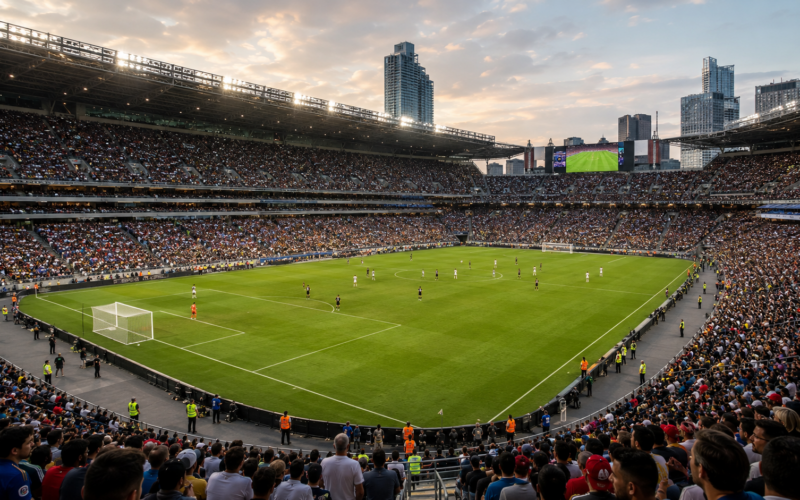
England reached the FIFA World Cup 2026 semi-finals with a 2-1 extra-time win over Norway at Miami Stadium in Miami Gardens, Florida, on Saturday, July 11, 2026. Andreas Schjelderup gave Norway the lead in the 36th minute, but Jude Bellingham equalised in first-half stoppage time and then scored the winner in the 93rd minute.
The quarter-final was level at 1-1 after 90 minutes, with Norway threatening a historic semi-final appearance and England struggling to turn possession into control. Norway had a second-half goal by Torbjørn Heggem disallowed after a VAR review identified a foul by Erling Haaland, while a late England penalty award for Djed Spence was later overturned after another review.
Bellingham’s first goal came after England recovered possession following a Norway goal-kick phase that sparked questions over a possible overhead camera cable incident. FIFA later indicated that connected-ball data showed no contact with the cable, allowing the goal to stand, before Bellingham settled the match in extra time by reacting quickest after Ørjan Nyland spilled Morgan Rogers’ long-range strike.
England will now face the winner of Argentina vs Switzerland in the semi-finals in Atlanta, while Norway exit after their deepest World Cup run. Ståle Solbakken’s side pushed England hard, kept Erling Haaland involved without giving him a goal, and forced Thomas Tuchel’s team into one of their most uncomfortable matches of the tournament.
FIFA World Cup 2026 Norway 1-2 England full match scorecard and key incidents
How did Norway turn England’s early possession into a first-half tactical problem?
England began with the larger share of possession, but Norway’s compact defensive structure ensured that the ball did not automatically become control. Tuchel’s side tried to probe through midfield and wide rotations, yet the tempo stayed low in the heat and humidity of South Florida, giving Norway time to defend their box and choose pressing triggers carefully.
The first major warning came when England’s build-up became loose under pressure. John Stones and Jordan Pickford both had uncomfortable moments, and Norway gradually realised that England could be forced into errors if Haaland, Schjelderup and Martin Ødegaard pressed with enough aggression.
Norway’s goal in the 36th minute came from that pattern. Patrick Berg helped force a turnover, Norway shifted the ball to the left, and Schjelderup’s cross-shot flew beyond Pickford and into the far corner. The finish had the look of a delivery that became a shot, but it rewarded Norway’s willingness to attack England’s hesitation.
That goal changed the mood of the quarter-final. England had the tournament pedigree, but Norway had the sharper emotional rhythm, the louder momentum and the belief that their first World Cup quarter-final could become something even bigger.
Why did Bellingham’s first goal survive controversy and reset England before half-time?
Bellingham’s equaliser arrived at the most important possible time for England. Norway were threatening to reach half-time ahead, but England moved the ball quickly after a debated goal-kick phase, with Elliot Anderson involved before Anthony Gordon found Bellingham’s run into the box.
The finish was pure Bellingham: direct, controlled and timed to punish a defensive seam before Norway could reset. He drove into the left side of the area and beat Nyland with a low strike across goal, changing England’s half-time team talk from panic management into tactical repair.
The controversy centred on claims that the ball may have touched an overhead camera cable earlier in the attacking phase. That mattered because if the ball had struck external equipment, play would have been stopped and restarted with a dropped ball. FIFA later indicated that connected-ball data showed no contact, so the equaliser stood.
For England, the goal was less a reward for sustained quality than a rescue act from their most decisive midfielder. For Norway, it was a painful interruption to a spell in which they had begun to look like the more dangerous side.
Why did Norway’s disallowed goal and Ajer’s crossbar chance keep the match on edge?
Norway did not retreat after half-time. If anything, the second half of normal time exposed England’s fragility more clearly, with Tuchel’s tactical adjustments creating new attacking options but also leaving the team open in midfield.
The biggest moment came when Heggem turned in a rebound after a Norway corner. For a few seconds, Norway appeared to have restored the lead, but VAR identified a foul by Haaland in the penalty area and the goal was disallowed. It was a decisive intervention because England were struggling to control Norway’s set-piece threat at that stage.
Norway also went close through Ajer, whose header struck the crossbar in the 76th minute. That chance underlined how close Solbakken’s team came to changing the match without needing extra time. England were not cruising toward the semi-finals. They were surviving pressure, heat and their own uneven rhythm.
The pattern of the second half explains why Tuchel was not fully satisfied despite the result. England had possession and stronger individual talent, but Norway created enough danger to make the match feel like a genuine escape.
How did Tuchel’s substitutions change England without fully solving their control issues?
Tuchel changed the match repeatedly, but not always cleanly. Saka and Eze were introduced at half-time, Declan Rice was withdrawn after battling illness, and Bellingham was shifted into different midfield and attacking roles as England tried to find a more aggressive rhythm.
The reshuffle gave England more individual threat, especially when Saka began finding pockets on the right and Eze looked for central combinations. But it also made the midfield feel stretched, allowing Norway to attack second balls and create pressure from set pieces.
Later, Reece James was used at the base of midfield before returning to a wider role, while Morgan Rogers added fresh energy and became central to the winning goal. These changes showed Tuchel’s willingness to adjust aggressively, but they also reflected how unsettled England looked for long stretches.
The decisive point is that England’s bench contributed to the outcome even when the broader system looked imperfect. Rogers’ shot created the rebound for Bellingham’s winner, while Saka and Eze helped keep Norway’s defence moving when fatigue began to open spaces.
Why did Bellingham’s 93rd-minute winner turn a flawed England display into a semi-final passage?
The extra-time winner came from a simple but ruthless sequence. Rogers struck from distance, Nyland failed to hold the shot, and Bellingham anticipated faster than Norway’s defenders to finish the rebound in the 93rd minute.
It was not England’s prettiest goal of the tournament, but it was one of their most valuable. Knockout football often rewards the player who reacts first to chaos, and Bellingham again looked like the one England player most ready to turn uncertainty into a decisive moment.
The goal also pushed Bellingham to six goals at FIFA World Cup 2026, level with Harry Kane in England’s scoring charts and within reach of the Golden Boot conversation. More importantly, it reinforced his status as England’s emotional engine, not only their midfield star.
England still had to survive another review when Spence appeared to win a penalty in extra time, only for the award to be reversed after VAR. Saka then forced another save from Nyland, and England finally closed out a match that had threatened to slide away from them more than once.
How did England keep Haaland scoreless despite Norway’s strong attacking spells?
Keeping Haaland scoreless was one of England’s biggest tactical wins. Norway’s striker had arrived with huge momentum after his tournament form and round-of-16 impact, yet England prevented him from turning the quarter-final into a personal showcase.
That did not mean Haaland was quiet in every sense. He forced Pickford into a first-half save with a close-range header, occupied England’s centre-backs, and was involved in the disallowed second-half goal through the foul identified by VAR.
England’s centre-backs deserve credit for refusing to lose physical concentration. Stones, Marc Guéhi and the covering midfielders had difficult moments, but they generally prevented Haaland from receiving clean service with room to turn or attack the six-yard box freely.
The image of Haaland being substituted during extra time told its own story. Norway had pushed England hard, but their biggest attacking weapon had been contained at the decisive stage, and that left them needing moments from others to keep the dream alive.
What does Norway 1-2 England mean for the FIFA World Cup 2026 semi-final route?
England’s win moves them into the semi-finals for the first time since 2018 and into the final four of a major tournament yet again. The route now sends them toward a meeting with the winner of Argentina vs Switzerland, with the semi-final scheduled in Atlanta.
The result also completes one side of England’s immediate recovery from their uneven knockout path. They had already survived a dramatic 3-2 win over Mexico in the previous round, and now they have added another narrow, emotionally draining victory against a dangerous Norway side.
Norway leave the tournament with pride rather than regret, even if the controversy around the cable incident, the disallowed goal and the reversed penalty will remain part of the post-match conversation. Their run included a historic return to the World Cup stage, a win over Brazil in the round of 16 and a serious challenge to England in the quarter-finals.
The bigger implication is that England remain alive despite not yet delivering a fully convincing complete performance. That can be read two ways: either as a warning sign before facing Argentina or Switzerland, or as proof that this team has enough individual match-winners to survive imperfect nights.
FIFA World Cup 2026 England and Norway knockout progression table after the quarter-final
What must England improve before facing Argentina or Switzerland in the semi-final?
England must improve their control between the boxes. They had 52.4% possession, 14 shots and eight efforts on target, but the match still felt unstable because Norway repeatedly turned defensive moments into dangerous spells.
The first concern is build-up security. England nearly gifted Norway chances through loose back passes and hesitant goalkeeper distribution, and a sharper opponent in the semi-finals could punish those errors more ruthlessly.
The second issue is balance after substitutions. Tuchel’s changes helped England create the winning goal, but the midfield spacing became fragile during the second half, especially when Norway began winning second balls and attacking set-piece rebounds.
The positive is that England have elite problem-solvers. Bellingham delivered twice, Pickford made key saves, and the bench eventually produced the decisive rebound sequence. That is a powerful tournament trait, but England will need more than survival instincts to beat Argentina or Switzerland.
What must Norway address after a historic but painful World Cup exit?
Norway’s first response should be pride. They reached their first World Cup quarter-final, beat Brazil in the previous round, and pushed England into extra time in a match shaped by narrow margins and major review decisions.
The next step is game management when momentum is theirs. Norway had England rattled after Schjelderup’s opener and again after half-time, but they could not convert that dominance into a second legal goal. At this level, a strong spell has to become scoreboard pressure.
Norway also need more scoring variety beyond Haaland. Schjelderup delivered a major moment and Ødegaard influenced possession, but when Haaland was contained and later withdrawn, Norway lacked one more decisive penalty-box finisher.
Still, this campaign changes how Norway will be viewed. They are no longer just a team with a superstar striker. They are a tournament side with structure, identity, energy and a fan culture that made a genuine impression on FIFA World Cup 2026.
Key takeaways from Norway vs England at FIFA World Cup 2026
- England beat Norway 2-1 after extra time at Miami Stadium on Saturday, July 11, 2026, to reach the FIFA World Cup 2026 semi-finals.
- Andreas Schjelderup gave Norway the lead in the 36th minute with a cross-shot that beat Jordan Pickford and rewarded Norway’s pressing.
- Jude Bellingham equalised in first-half stoppage time after England moved the ball through Elliot Anderson and Anthony Gordon.
- Bellingham scored again in the 93rd minute after Ørjan Nyland spilled Morgan Rogers’ long-range effort into his path.
- Norway had a second-half goal by Torbjørn Heggem disallowed after VAR identified a foul by Erling Haaland in the box.
- England had a late extra-time penalty award for Djed Spence overturned after VAR review.
- FIFA indicated connected-ball data showed no contact with the overhead camera cable before Bellingham’s first goal, allowing the equaliser to stand.
- England edged the possession battle 52.4% to 47.6% and had eight shots on target compared with Norway’s four.
- Haaland was kept scoreless for the first time at FIFA World Cup 2026 and was substituted during extra time.
- England will face the winner of Argentina vs Switzerland in the semi-finals in Atlanta, while Norway’s historic run is over.
Discover more from Business-News-Today.com
Subscribe to get the latest posts sent to your email.