
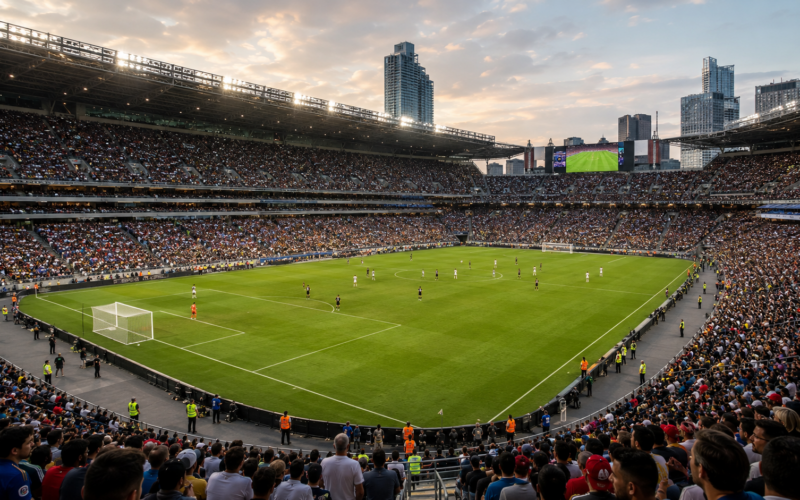
Gonçalo Ramos scored a 90+4-minute header as Portugal came from behind to defeat Croatia 2-1 in their FIFA World Cup 2026 Round of 32 match at Toronto Stadium in Toronto, Canada, on Thursday, July 2, 2026. Ivan Perišić gave Croatia the lead in the 53rd minute before Cristiano Ronaldo equalised from a VAR-awarded penalty in the 68th.
Croatia briefly placed the ball in the net again through Nikola Vlašić after Perišić’s opener, but the move was ruled out for offside. Ronaldo also had a finish disallowed by a narrow offside decision, while Petar Sučić later suffered the same outcome after appearing to restore Croatia’s lead.
The match remained level after Diogo Costa produced decisive saves from Mateo Kovačić and Igor Matanović, with the Portugal goalkeeper tipping Kovačić’s strike against the post. Mario Pašalić then headed a major late opportunity wide before Rafael Leão created the winner with a measured delivery towards Ramos.
Portugal advanced to the Round of 16 and eliminated Croatia from FIFA World Cup 2026. Roberto Martínez’s team will face Spain at Dallas Stadium in Arlington, Texas, on Monday, July 6, at 2pm local time after Spain defeated Austria 3-0 in the corresponding Round of 32 fixture.
FIFA World Cup 2026 Portugal 2-1 Croatia full match scorecard and key incidents
How did Portugal dominate the first half without turning possession into a goal?
Portugal began by moving the ball quickly through João Neves and Vitinha, with Bruno Fernandes attempting to receive behind Croatia’s central midfield. Rafael Leão held the width on the left, while Pedro Neto repeatedly attacked the opposite side and looked for Ronaldo inside the penalty area.
That structure allowed Portugal to control territory and force Croatia into two narrow defensive lines. Modrić and Kovačić protected the area in front of Šutalo and Pongračić, while Perišić and Stanišić resisted the temptation to follow Portugal’s wide players too far from the back four.
Portugal produced nine first-half attempts but struggled to convert possession into clean shots. Fernandes received two early opportunities after Leão carried the ball down the left, yet Croatia placed enough defenders between the midfielder and Livaković to prevent a decisive finish.
Neto later delivered across the six-yard area, but neither Ronaldo nor the supporting runner could connect. The chance summarised Portugal’s first-half problem because the build-up created promising positions without supplying the precise final touch required to break Croatia’s defensive structure.
Why did Croatia’s compact midfield keep Cristiano Ronaldo isolated before half-time?
Croatia defended Ronaldo by reducing the space from which Portugal could cross or pass rather than marking the striker with one player. Pongračić and Šutalo remained close to him, while Modrić and Kovačić blocked the direct passing lanes from Vitinha and Fernandes.
Ronaldo frequently moved towards the near post when Portugal attacked from wide positions, but Croatia’s centre-backs protected the delivery zone and allowed Livaković to remain close to his line. Perišić and Stanišić also prevented Portugal’s wingers from reaching the byline consistently.
Portugal’s captain therefore spent much of the first half waiting for crosses that either failed to arrive or travelled behind him. He attempted to drop towards the ball at times, but that movement removed the focal point Portugal needed inside the penalty area.
The structure demonstrated Croatia’s experience in knockout football. Zlatko Dalić’s team conceded possession but avoided being stretched, keeping the score level until the interval despite Portugal’s territorial superiority.
How did Ivan Perišić’s opening goal expose Portugal’s defensive transition?
Croatia emerged after half-time with greater aggression and began progressing the ball before Portugal could establish its press. Stanišić advanced on the right and delivered towards the far side, where Perišić arrived behind Portugal’s defensive attention.
The left-back controlled the ball before finishing through the crowded area and beyond Costa. Portugal had enough defenders close to the penalty box, but their positioning remained focused on the central runner rather than Perišić’s movement from the opposite side.
The goal reflected a change in Croatia’s attacking ambition. During the first half, Perišić had prioritised containing Neto and Cancelo, but after the interval he attacked higher and gave Croatia an additional player inside the final third.
Portugal’s defensive line also became disorganised during the transition. Cancelo was caught higher, the central defenders narrowed towards Budimir’s replacement and Perišić entered the scoring position without facing immediate pressure.
Why did three disallowed goals make the second half unusually difficult to control?
Croatia appeared to have doubled the lead shortly after Perišić scored when Vlašić raced beyond Portugal’s defence and completed the move. The assistant referee identified a clear offside position, preventing Portugal from falling two goals behind.
Ronaldo then finished at the opposite end following a sharp Portugal attack, but the semi-automated offside decision showed that his shoulder had moved marginally beyond the final defender. The ruling was much tighter than the earlier Croatia decision, yet the outcome remained the same.
Sučić produced the third disallowed finish in the 81st minute. Portugal’s defensive organisation had weakened after Martínez’s substitutions, allowing the Croatia midfielder to run through and place the ball beyond Costa before seeing the offside flag.
The sequence created a match in which both teams repeatedly believed they had changed the score. Each overturned finish increased the emotional intensity while showing how both defensive lines were struggling to control forward runs during the second half.
Was the VAR-awarded penalty against Nikola Vlašić the correct decision?
Portugal’s penalty followed a corner during which Veiga attempted to attack the delivery inside the crowded area. Vlašić placed his arms around the defender and restricted his movement before the ball reached their position.
The original decision allowed play to continue, but the video assistant referee recommended an on-field review. The replay showed sustained holding rather than brief contact caused by two players competing normally for space.
The referee concluded that Vlašić had prevented Veiga from reaching the delivery and awarded Portugal the penalty. Croatia could question whether similar contact occurs frequently during set pieces, but the defender’s grip remained visible and materially affected Veiga’s movement.
Ronaldo delayed during his approach before driving the ball centrally as Livaković committed to his right. The penalty became Ronaldo’s first goal in a FIFA World Cup knockout match and restored parity at a moment when Portugal’s control had begun to disappear.
Why were Diogo Costa’s saves more decisive than Portugal’s possession advantage?
Portugal held 62% possession, but Croatia produced 17 penalty-area touches compared with Portugal’s 14. The statistic reflected the quality of Croatia’s second-half transitions and showed why Costa became central to the result.
Kovačić created the most dangerous sequence in the 75th minute by driving through midfield and striking from outside the penalty area. Costa reached the low effort with his fingertips and diverted it against the post rather than allowing the ball to enter the corner.
The rebound returned to Kovačić, who struck again from a similar position. Costa recovered quickly and pushed the second effort over, preventing Croatia from converting sustained pressure into another lead.
Matanović then capitalised on an uncertain Portugal clearance and advanced one-on-one from a narrowing angle. Costa remained upright, reduced the available target and blocked the striker’s attempt.
Those interventions gave Portugal time to recover. Without them, Croatia could have established a lead during the period when Martínez’s changes temporarily weakened the team’s possession and defensive balance.
How did Roberto Martínez’s four substitutions change Portugal’s attacking structure?
Martínez responded to Croatia’s lead by introducing Ramos, Semedo, Bernardo Silva and Francisco Conceição together in the 62nd minute. Cancelo, Fernandes, Vitinha and Neto were removed in one extensive tactical reset.
The changes placed Ramos alongside Ronaldo rather than leaving one striker isolated against Croatia’s centre-backs. Conceição supplied direct dribbling on the right, while Bernardo moved between midfield and attack to improve Portugal’s control around the penalty area.
Semedo replaced Cancelo and initially provided a more conservative defensive position, allowing Leão and Conceição to take greater attacking risks. Portugal’s structure became less dependent on Fernandes’ central passing and more focused on stretching Croatia before delivering towards two forwards.
The immediate result was not complete control. Croatia found greater space in midfield and created several of its best opportunities after the changes, partly because Portugal’s new combinations lacked the relationships established during the first hour.
However, one of the substitutes ultimately decided the match. Ramos remained between Croatia’s defenders during the final attack and produced the movement and aerial finish Portugal had lacked for most of the evening.
Why did removing Cristiano Ronaldo not reduce Portugal’s late attacking threat?
Ronaldo left in the 81st minute after converting the equalising penalty and having another finish ruled out. Rúben Neves entered as Martínez attempted to restore midfield control and protect Portugal from Croatia’s increasingly dangerous transitions.
The decision shifted Ramos into the central striking role. Instead of sharing the penalty area with Ronaldo, the substitute became Portugal’s primary target and could time his runs without another centre-forward occupying the same zones.
Neves gave Portugal another passer behind the attack, while Bernardo and João Neves could advance with greater freedom. Leão remained the principal wide threat and continued receiving in positions from which he could attack Stanišić or deliver towards Ramos.
Portugal therefore became more balanced after Ronaldo’s departure. The captain had supplied the equaliser and historical significance, but the final tactical phase required fresh movement and greater control rather than another fixed presence inside the penalty area.
The outcome validated the change without diminishing Ronaldo’s contribution. Portugal needed his penalty to remain in the match and Ramos’ movement to finish it.
How did Rafael Leão and Gonçalo Ramos create the 90+4-minute winner?
Portugal regained possession during stoppage time and moved the ball towards Leão on the left. Croatia’s defenders had retreated into the penalty area, but the winger resisted the temptation to force a low cross through the nearest opponent.
Leão lifted a measured delivery towards the central corridor between Pongračić and the recently introduced Gvardiol. Ramos positioned himself between the defenders and attacked the ball before either could establish aerial control.
The striker produced a glancing header that redirected the cross inside the post. Livaković was unable to adjust because the contact changed the ball’s direction while retaining enough pace to carry it beyond him.
The goal reflected two qualities Portugal had not combined earlier. Leão supplied accuracy rather than relying only on acceleration, while Ramos attacked the delivery with the conviction of a conventional centre-forward.
Croatia had defended crosses effectively for most of the match, but one moment of uncertain spacing proved decisive. Ramos did not need multiple opportunities because his first major chance became the goal that sent Portugal into the Round of 16.
Why did Croatia lose despite creating the stronger second-half opportunities?
Croatia improved considerably after the interval and came close to scoring through Kovačić, Matanović, Sučić and Pašalić. The team’s 17 penalty-area touches showed that the second-half threat was sustained rather than limited to Perišić’s goal.
The problem was conversion. Kovačić encountered an outstanding goalkeeper, Matanović could not beat Costa from the one-on-one and Pašalić headed wide when directing the ball on target could have created an 88th-minute lead.
Croatia were also punished by offside timing. Vlašić and Sučić both completed moves successfully but had begun their runs beyond Portugal’s defensive line, removing two potential goals from the contest.
At the opposite end, Portugal converted its decisive moments. Ronaldo punished the set-piece infringement, and Ramos scored from Leão’s late delivery despite Croatia having multiple defenders around him.
The difference was therefore not general superiority across 90 minutes. It was Portugal’s greater efficiency during the two moments that remained valid after all the saves, offside decisions and VAR interventions were completed.
What did Luka Modrić still contribute during Croatia’s final FIFA World Cup 2026 match?
Modrić operated beside Kovačić and helped Croatia survive Portugal’s first-half pressure by controlling the distance between midfield and defence. His positioning reduced the room available to Fernandes and prevented Portugal from finding central combinations close to Livaković’s goal.
He also offered composure after Croatia took the lead. While Portugal increased the tempo, Modrić attempted to slow possession, draw pressure and release Stanišić or Perišić into wider areas.
The midfielder received a yellow card around the hour after stopping a Portugal transition. The caution reflected the increasing physical demands of a match that became more open and less controlled after Perišić’s goal.
Croatia’s elimination should not obscure Modrić’s contribution to another knockout appearance. He helped organise a team that remained within moments of defeating Portugal and repeatedly competed against opponents with greater attacking depth.
The result ended Croatia’s FIFA World Cup 2026 campaign, although no assumption should be made about Modrić’s international future without an official announcement.
What must Croatia improve after allowing a stoppage-time winner?
Croatia must become more clinical when a knockout match produces several high-value opportunities. The chances created after Portugal equalised were sufficient to restore the lead, but none became the goal that would have transformed the outcome.
The team must also improve its control of defensive substitutions. Gvardiol entered shortly before the winner, yet Croatia’s back line failed to establish clear responsibility for Ramos as Leão prepared the cross.
Dalić’s side had moved from a compact back four into a more cautious closing structure, but the additional defender did not prevent the decisive delivery. The issue was not the number of players inside the area but the failure to control the striker positioned between them.
Croatia’s younger midfielders nevertheless supplied positive evidence for the future. Sučić threatened with forward runs, Baturina contributed to the attacking movement and Matanović gave Portugal a different physical problem after replacing Budimir.
The next cycle must retain Croatia’s technical control while increasing the speed and finishing quality around the penalty area. The experienced foundation remains valuable, but future knockout success will depend on younger players becoming decisive rather than merely competitive.
What must Portugal change before facing Spain in the Round of 16?
Portugal cannot allow Spain the same second-half space that Croatia exploited in Toronto. Luis de la Fuente’s team possess midfielders and wide attackers capable of converting defensive disorganisation into sustained pressure rather than isolated chances.
Martínez must decide whether Ramos’ winner earns him a starting position. Ronaldo remains an elite finisher and penalty taker, but Portugal appeared more mobile when Ramos operated as the only central striker during the final phase.
The midfield balance will be equally important. Removing Fernandes and Vitinha together reduced Portugal’s control, even though the wider substitution package eventually produced the winning goal.
Spain will attempt to dominate possession through Rodri and Pedri while stretching Portugal with Lamine Yamal and the advancing full-backs. João Neves, Vitinha and the defenders behind them must prevent Spain from progressing through the central areas before the wingers can isolate Portugal’s full-backs.
Leão’s performance provides Portugal with an essential counterattacking route. His speed can threaten the space behind Spain’s advanced defensive line, while the precision shown for Ramos’ winner demonstrates that he can also become a creator when direct dribbling is unavailable.
Portugal advanced through resilience, goalkeeping and a decisive substitute. Against Spain, they will require cleaner defensive transitions, greater control of midfield and a more consistent attacking structure from the opening whistle.
How does Portugal’s victory shape the FIFA World Cup 2026 knockout bracket?
Portugal advanced to face Spain at Dallas Stadium on Monday, July 6, at 2pm local time. Spain reached the Round of 16 by defeating Austria 3-0 through two Mikel Oyarzabal goals and Pedro Porro’s header.
The fixture brings together Iberian neighbours with contrasting Round of 32 experiences. Spain controlled Austria and allowed no shot on target, while Portugal required a VAR-awarded penalty, three major Costa interventions and a stoppage-time winner to eliminate Croatia.
Croatia were eliminated after reaching the knockout stage for a fourth consecutive FIFA World Cup. Their departure followed a campaign containing an opening defeat against England and victories over Panama and Ghana.
The winner of Spain vs Portugal will advance to the quarter-finals. The identity of the next opponent remains dependent on the completion of the corresponding Round of 16 branch and should not yet be treated as confirmed.
Key takeaways from Portugal vs Croatia at FIFA World Cup 2026
- Portugal defeated Croatia 2-1 through Gonçalo Ramos’ 90+4-minute header and advanced to the Round of 16.
- Ivan Perišić gave Croatia the lead in the 53rd minute after arriving unmarked on the left side of Portugal’s penalty area.
- Nikola Vlašić appeared to double Croatia’s advantage shortly afterwards, but his involvement was ruled offside.
- Rafael Leão struck the crossbar before Cristiano Ronaldo had a finish disallowed by a narrow offside decision.
- A VAR review identified Vlašić’s hold on Renato Veiga and resulted in Portugal’s 68th-minute penalty.
- Ronaldo converted the spot kick to score his first goal in a FIFA World Cup knockout match.
- Diogo Costa tipped Mateo Kovačić’s shot against the post and later denied Igor Matanović one-on-one.
- Petar Sučić had another Croatia goal ruled out for offside, while Mario Pašalić headed a major late chance wide.
- Leão created the winner with a precise cross that Ramos headed beyond Dominik Livaković.
- Portugal will face Spain at Dallas Stadium on July 6, while Croatia were eliminated from FIFA World Cup 2026.
Discover more from Business-News-Today.com
Subscribe to get the latest posts sent to your email.