

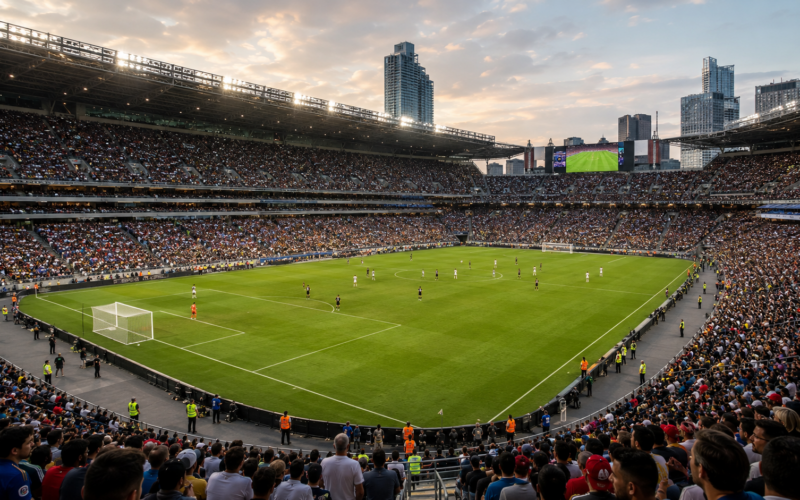
Sasa Kalajdzic scored a dramatic 96th-minute equaliser as Austria drew 3-3 with Algeria in the final FIFA World Cup 2026 Group J match at Kansas City Stadium on Saturday, June 27, 2026. The six-goal contest sent both countries into the Round of 32 in front of 69,045 spectators.
Marko Arnautović gave Austria the lead in the 28th minute after running onto David Alaba’s lofted pass. Rafik Belghali produced an outstanding individual equaliser on the stroke of half-time, cutting inside before driving the ball into the roof of Alexander Schlager’s net.
Marcel Sabitzer restored Austria’s advantage ten minutes after the interval, but Riyad Mahrez responded five minutes later from Houssem Aouar’s cutback. Mahrez then appeared to win the match for Algeria in the third minute of stoppage time, finishing another Aouar pass to make the score 3-2.
Austria were temporarily heading out of the tournament before substitute Kalajdzic headed Michael Gregoritsch’s knockdown into the bottom corner with virtually the final action. Austria finished second in Group J and will face Spain, while third-placed Algeria advanced to meet Switzerland.
FIFA World Cup 2026 Algeria 3-3 Austria full match scorecard and key incidents
Why did Austria threaten more directly despite Algeria controlling most of the possession?
Algeria completed more than twice as many accurate passes as Austria and controlled 65% of possession. Much of that circulation took place between the defenders and midfielders as Austria protected the central areas and waited for opportunities to press.
Ralf Rangnick’s team did not require prolonged possession to create danger. Alaba’s passing from the defensive line allowed Austria to bypass Algeria’s midfield, while Laimer and Sabitzer accelerated forward whenever possession was recovered.
The opening goal demonstrated the strategy. Alaba recognised Arnautović’s run behind Ramy Bensebaini and Aïssa Mandi and delivered over the entire Algerian midfield.
Arnautović’s first touch was imperfect, but Benbot hesitated before leaving his goal. The striker recovered and guided the ball into the bottom corner with Austria’s first shot on target.
Austria’s attacking efficiency contrasted with Algeria’s patient approach. The European side placed only three shots on target but scored from all three, including the stoppage-time header that preserved their tournament.
How did Rafik Belghali turn an unusual corner-flag bounce into a spectacular equaliser?
Algeria gradually increased the pace after Austria scored. Chaïbi struck the post from distance, while Maza forced Schlager into a close-range save as the first half approached stoppage time.
The equaliser developed after a long pass bounced unusually off the corner-flag area and remained in play. Mahrez reacted before Austria’s defenders and prevented the ball from crossing the line.
Belghali collected possession, moved inside and beat several defenders through quick changes of direction. He then drove a left-footed shot into the top corner from the central-right area of the box.
The goal rewarded Algeria’s stronger closing period and sent the teams into half-time level. Belghali also became Algeria’s youngest FIFA World Cup scorer since the country’s first tournament appearance in 1982.
His willingness to advance from right-back created risk behind him, but it gave Algeria another player capable of breaking Austria’s compact midfield structure.
Why did Austria make three substitutions at half-time despite the score being level?
Rangnick removed Arnautović, Xaver Schlager and Romano Schmid at the interval. Gregoritsch, Grillitsch and Wanner entered as Austria attempted to refresh several areas simultaneously.
Arnautović had scored but was already carrying a yellow card. His removal reduced the risk of Austria losing their central striker to a second booking during a match where a draw was sufficient.
Grillitsch provided a calmer passing option at the base of midfield, while Wanner offered fresher movement between Algeria’s midfield and defence. Gregoritsch gave Austria another aerial target and later supplied the decisive assist.
The substitutions also reflected the demanding heat and humidity in Kansas City. Austria’s pressing required repeated high-intensity movements, making fresh legs essential during the second half.
The immediate reward arrived in the 55th minute as Austria restored their lead through a rapid transition involving Laimer and Sabitzer.
How did Marcel Sabitzer punish Algeria’s defensive transition after half-time?
Laimer carried possession down the right and moved beyond Algeria’s initial pressure. Rather than crossing towards the crowded six-yard area, he cut the ball back towards the edge of the box.
Sabitzer arrived from the opposite side without an Algerian midfielder tracking his run. His first-time shot travelled into the top-right corner before Benbot could adjust.
The goal highlighted one of Algeria’s main defensive weaknesses. Their full-backs and midfielders had advanced during the preceding phase, leaving space for Austria to attack before the structure could recover.
Sabitzer’s finish was another example of his ability from distance. It was his ninth goal from outside the penalty area for Austria since 2019, more than twice the total recorded by any teammate during that period.
Austria’s advantage lasted only five minutes, but the move offered Spain a clear indication of how dangerous Rangnick’s side can be during transitions.
Why was Houssem Aouar central to both of Riyad Mahrez’s goals?
Aouar operated as the most advanced member of Algeria’s midfield and repeatedly moved towards the left to combine with Chaïbi, Maza and Hadjam. His ability to carry the ball beyond Austria’s first pressure created the equaliser in the 60th minute.
The midfielder accelerated down the left and delivered across the penalty area. Mahrez remained unmarked on the far side and guided the ball beyond Schlager.
The second assist arrived during stoppage time after a long Algeria possession sequence. Aouar identified Mahrez’s run between Austria’s defenders and supplied a precise through ball.
Mahrez finished with his right foot into the bottom-left corner. Austria’s defenders appeared to have relaxed as the match moved beyond the announced four minutes of added time.
Aouar’s two assists demonstrated why Algeria were reluctant to remove him until after the third goal. His eventual substitution was immediately followed by Austria’s final attack and equaliser.
Why did the match appear to slow down before exploding during stoppage time?
A 2-2 draw was sufficient for both teams. Austria would remain second, while Algeria’s four points would move them ahead of Iran in the ranking of third-placed sides.
The incentive structure became visible during the final 15 minutes. Algeria retained possession safely across the defensive line, while Austria reduced the aggression of their press.
Supporters expressed frustration as the tempo fell, but neither team completely abandoned attacking opportunities. Austria continued threatening from set pieces, and Mahrez remained positioned to exploit space behind the defence.
The balance changed in the third minute of stoppage time. Aouar’s pass released Mahrez, whose finish would have moved Algeria into second place and eliminated Austria.
That goal forced Austria to abandon all caution. Rangnick introduced Kalajdzic, sent additional defenders forward and ordered the ball to be delivered directly into Algeria’s penalty area.
How did Sasa Kalajdzic score only 61 seconds after entering the match?
Kalajdzic replaced Mwene in the fifth minute of stoppage time as Austria made its final attempt to avoid elimination. His height immediately gave the team a target against Algeria’s tiring defenders.
Austria sent the ball forward, and Gregoritsch won the first aerial contest. His headed pass dropped towards Kalajdzic in the centre of the penalty area.
The substitute reacted ahead of the defenders and directed his header down towards the bottom-right corner. Benbot was unable to reach the ball before it crossed the line.
The equaliser arrived 61 seconds after Kalajdzic entered. It was among the fastest goals by a substitute during FIFA World Cup 2026 and the eighth-fastest such goal in the competition’s history.
Austria became the first team in men’s FIFA World Cup history to avoid defeat after conceding a go-ahead goal in the 90th minute or later.
Why did the 3-3 draw carry special historical significance for Algeria and Austria?
The fixture was the first FIFA World Cup meeting between the teams since the events surrounding Algeria’s elimination in 1982. Austria and West Germany had played after Algeria completed their group matches, meaning both European teams knew the exact result required to advance.
West Germany won 1-0 in a match criticised for its lack of attacking intent after the opening goal. Algeria were eliminated despite winning two group matches.
The controversy contributed to the rule requiring final group matches to be played simultaneously. Algeria and Austria entered their 2026 meeting knowing another draw would benefit both teams.
The six-goal contest removed any suggestion that the teams had approached the match passively from the start. Austria led twice, Algeria moved ahead in stoppage time and Kalajdzic equalised with virtually the final touch.
Rather than another slow mutually convenient result, the teams produced one of the most dramatic matches of the group stage.
How did the result eliminate Iran from the FIFA World Cup 2026 knockout stage?
Iran finished third in Group G with three points and a neutral goal difference after drawing all three matches. They occupied the final qualifying position among third-placed teams before Group J concluded.
A victory for either Algeria or Austria could have left the losing team below Iran, depending on the score. The 3-3 draw instead gave both Group J teams four points.
Austria remained second because their goal difference was better than Algeria’s. Algeria moved into the best-third-place qualification positions with four points, pushing Iran below the eight-team cut-off.
The final group-stage match therefore completed the Round of 32 field. Algeria became the ninth African team to advance from the opening stage of FIFA World Cup 2026.
FIFA World Cup 2026 Group J final points table
What do Spain vs Austria and Switzerland vs Algeria mean for the Round of 32?
Austria will face Spain in Los Angeles on Thursday, July 2. Spain completed Group H unbeaten, won the section with seven points and did not concede a goal.
Rangnick’s team will need to reproduce the pressing intensity shown against Argentina while avoiding the spaces Algeria exploited. Spain’s midfield movement and wide combinations will punish uncoordinated pressure more severely.
Austria’s transition threat provides a possible route into the match. Alaba can release Laimer, Sabitzer and the forwards quickly, while Kalajdzic and Gregoritsch offer aerial options if Spain force Austria towards crosses.
Algeria will meet Switzerland in Dallas later on July 2. Switzerland won Group B after defeating Canada and Bosnia and Herzegovina and drawing with Qatar.
Mahrez and Aouar give Algeria the individual quality required to threaten Switzerland, but Vladimir Petković must improve his team’s defensive recovery. Switzerland are capable of exploiting the same spaces used by Austria for their first two goals.
Key takeaways from Algeria vs Austria at FIFA World Cup 2026
- Algeria and Austria drew 3-3 in one of the most dramatic matches of the group stage.
- Marko Arnautović opened the scoring from David Alaba’s lofted pass in the 28th minute.
- Farès Chaïbi struck the post before Rafik Belghali produced a brilliant equaliser.
- Marcel Sabitzer restored Austria’s lead with a powerful finish from Konrad Laimer’s cutback.
- Houssem Aouar assisted Riyad Mahrez’s two second-half goals.
- Mahrez’s 90+3-minute finish briefly moved Algeria into second place and placed Austria outside the knockout stage.
- Sasa Kalajdzic entered during stoppage time and equalised only 61 seconds later.
- Austria advanced in second place and will face Spain in the Round of 32.
- Algeria qualified as a best third-placed team and will meet Switzerland.
- The draw eliminated Iran and completed the FIFA World Cup 2026 knockout field.
Discover more from Business-News-Today.com
Subscribe to get the latest posts sent to your email.