






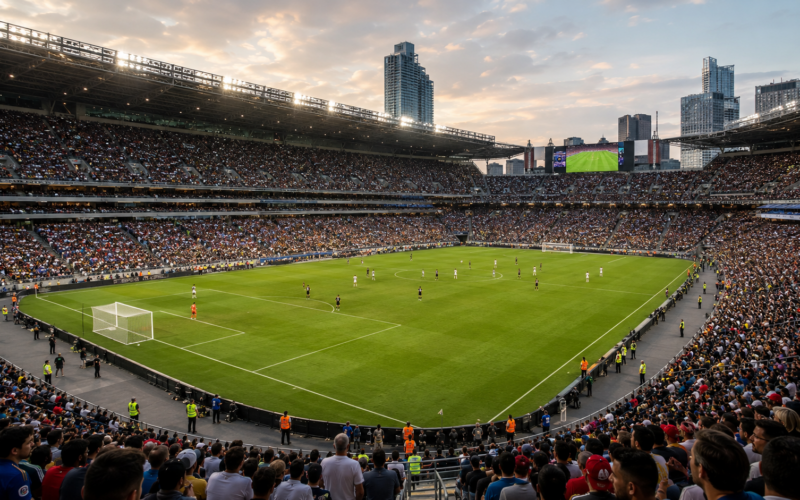
Colombia finished first in FIFA World Cup 2026 Group K after an energetic 0-0 draw with Portugal at Miami Stadium in Miami Gardens, Florida, on Saturday, June 27, 2026. Néstor Lorenzo’s team created the clearer opportunities, registered 24 attempts and came within a marginal offside decision of winning during stoppage time.
Davinson Sánchez appeared to score the decisive goal after meeting a late delivery at the far post. The assistant referee raised the flag, and a VAR review confirmed that the Colombian defender had moved fractionally beyond Portugal’s defensive line before heading past Diogo Costa.
Portugal survived largely because of Costa’s goalkeeping and several important defensive interventions. The goalkeeper denied Jhon Córdoba, Jefferson Lerma, Jhon Arias and James Rodríguez, while Rúben Neves cleared an Arias effort near the line during the first half.
The result gave Colombia seven points and first place, while Portugal finished second with five. Colombia will face Ghana in the Round of 32, Portugal will meet Croatia, and DR Congo’s simultaneous victory over Uzbekistan secured a knockout match against England.
FIFA World Cup 2026 Colombia 0-0 Portugal full match scorecard and key incidents
Why did Colombia create the clearer chances despite needing only a draw to win Group K?
Colombia entered the match knowing one point would preserve first place, but Lorenzo did not instruct his team to defend the existing table. Luis Díaz and Jhon Arias pressed Portugal’s full-backs, while James Rodríguez moved into spaces behind Vitinha and Rúben Neves.
The approach immediately created attacking momentum. Jhon Córdoba headed over during the opening minute before Arias released the striker for a powerful attempt that forced Costa into a difficult save.
Arias then produced one of Colombia’s strongest first-half moments. His low effort travelled beyond Costa, but Rúben Neves recovered towards the line and diverted the ball away before it could cross.
Colombia’s willingness to attack also prevented Portugal from establishing control through Bruno Fernandes. Whenever Portugal attempted to circulate possession centrally, Jefferson Lerma and Gustavo Puerta closed the first forward passing option.
The performance showed that Colombia were not satisfied merely to protect qualification. Their principal disappointment was converting territorial and statistical superiority into no goals.
How did Diogo Costa preserve Portugal’s position during Colombia’s strongest spells?
Costa was Portugal’s most important player. His first major intervention came when Córdoba moved beyond the defensive line and struck powerfully towards goal from the right side of the penalty area.
The goalkeeper remained balanced and pushed the shot away. He later dealt with Lerma’s powerful long-range attempt and reacted quickly when Arias’ second-half effort changed direction.
Costa also controlled his penalty area during Colombia’s late pressure. Portugal’s defenders struggled to clear several crosses completely, but the goalkeeper repeatedly reached loose balls before the Colombian attackers could finish.
The six saves reflected more than shot volume. Several arrived from dangerous positions where a slower reaction would have changed both the result and Portugal’s immediate knockout route.
Portugal had already qualified, but defeat would have increased questions around their form. Costa ensured that a difficult collective performance still produced a clean sheet and second place.
Why did Cristiano Ronaldo struggle to influence Portugal’s attacking performance?
Cristiano Ronaldo began centrally, supported by Pedro Neto, João Félix and Bruno Fernandes. Portugal’s problem was delivering the ball to him before Colombia’s defenders could organise.
Davinson Sánchez and Jhon Lucumí maintained close distances and prevented Ronaldo from receiving cleanly with his back to goal. Lerma also dropped into the defensive line whenever Portugal attempted an early cross.
Ronaldo’s only shot on target was a long-range free kick that Vargas handled comfortably. He moved into a promising position after Félix found space during the second half, but the forward had drifted offside before shooting.
Portugal’s attacking structure frequently became disconnected. Fernandes and Vitinha circulated possession, but the space between the midfield and Ronaldo remained too large.
The match offered another warning before the knockout stage. Ronaldo remains an elite penalty-area finisher, but Portugal must create faster combinations around him rather than expecting isolated crosses to solve compact defensive structures.
How did Camilo Vargas stop Portugal from scoring during their best first-half opportunity?
Portugal’s clearest opportunity arrived in the 39th minute. João Cancelo progressed along the right and moved the ball towards Fernandes inside the penalty area.
Fernandes controlled before shooting from approximately 12 yards. Vargas closed the space and produced a strong point-blank save, denying Portugal a lead that would have moved them above Colombia in the live standings.
The save carried tactical importance because Colombia were committing players forward. Conceding immediately before half-time could have forced Lorenzo to abandon the balanced approach and chase an equaliser.
Vargas faced only two official shots on target, but the low total should not diminish his contribution. Goalkeepers in possession-dominant teams must remain prepared during long periods without direct involvement.
João Félix also threatened shortly before the interval, controlling on his chest before sending an acrobatic volley over the crossbar. Colombia reached half-time level because Vargas handled the one effort Portugal placed accurately.
Why did Richard Ríos miss Colombia’s best chance immediately after entering?
Ríos replaced Lerma in the 60th minute as Lorenzo attempted to add more forward running from midfield. His movement quickly created one of the match’s highest-quality chances.
Santiago Arias advanced beyond Portugal’s left side and delivered towards the central area. Ríos arrived without a defender directly between him and goal but directed his attempt wide.
The chance accounted for a substantial part of Colombia’s expected-goals total. It also illustrated the finishing problem that Lorenzo later identified as an area requiring improvement.
Ríos strengthened Colombia’s pressing and carried possession through midfield, but the missed shot prevented his substitute appearance from becoming decisive.
Against Ghana, Colombia may not receive 24 attempts. Greater efficiency will therefore be required if they are to convert a strong group-stage performance into a sustained knockout run.
How did Rafael Leão change Portugal’s threat without finding the winning finish?
Roberto Martínez introduced Leão for Félix in the 70th minute. The substitution gave Portugal greater speed against Colombia’s increasingly advanced defensive line.
Leão immediately attempted to isolate Santiago Arias and later Daniel Muñoz. His acceleration forced Colombia to retreat more quickly than they had during Portugal’s slower positional attacks.
The strongest opportunity arrived during stoppage time. Leão carried the ball across the edge of the area and drove his effort narrowly beyond the far post.
That chance came shortly after Sánchez’s goal had been disallowed. Portugal therefore moved from nearly losing to almost winning within a short period.
Leão’s impact strengthens his case for a larger role against Croatia. Portugal’s attack requires a player capable of breaking defensive organisation through direct running rather than relying exclusively on passing combinations.
Why was Davinson Sánchez’s stoppage-time header ruled out after the VAR review?
Colombia recycled a late corner towards the edge of Portugal’s penalty area before returning the ball into the box. Sánchez moved beyond the defensive line and headed down past Costa at the far post.
The assistant referee immediately raised the flag. Replays showed that only a very small part of Sánchez’s body had moved beyond the final defender.
VAR reviewed the position and upheld the on-field decision. The goal was therefore cancelled, leaving Colombia without the victory their performance had appeared to merit.
The incident did not change the group order because a draw was already enough for Colombia to finish first. It nevertheless reinforced the frustration created by their missed chances.
Sánchez had also delivered an excellent defensive performance against Ronaldo. His potential winning goal would have completed one of the strongest individual displays of the final group-stage round.
What did the Miami heat reveal about the conditioning and tactical discipline of both teams?
The match was played in demanding heat and humidity, with hydration breaks required during both halves. The conditions could have encouraged a slower contest because both teams had already qualified.
Instead, Colombia and Portugal continued attacking into stoppage time. The match repeatedly moved from one penalty area to the other, particularly after both coaches introduced fresh midfielders and wide players.
Colombia handled the conditions more effectively because their press remained coordinated. The nearest midfielder supported the initial pressure, reducing the distance individual players had to cover.
Portugal appeared more fragmented. Their attacking players frequently accelerated without the midfield advancing close enough to collect second balls.
The conditions cannot fully explain Portugal’s performance because Colombia faced the same environment. The difference came from Colombia’s clearer structure and greater collective intensity.
Why does Portugal enter the Round of 32 with unresolved tactical questions?
Portugal completed Group K unbeaten, drawing with DR Congo and Colombia before defeating Uzbekistan 5-0. The five-goal victory remains their only win.
Martínez possesses several elite attacking options, including Ronaldo, Fernandes, Félix, Leão, Neto and Bernardo Silva. The challenge is combining them without weakening midfield control or creating duplicated roles.
Against Colombia, Fernandes often received too deep to influence the final pass. Félix moved into similar central areas, while Ronaldo remained separated from both.
Portugal also allowed 24 attempts despite knowing victory was required to win the group. A stronger knockout opponent could punish that defensive exposure more severely.
Croatia will attempt to control possession through Luka Modrić, Mateo Kovačić and Petar Sučić. Portugal must press with greater coordination and ensure their forward players remain connected to the midfield.
How did DR Congo’s comeback complete the final Group K qualification order?
Colombia entered the final round with six points and remained first after the draw. Their victories over Uzbekistan and DR Congo gave them a final total of seven.
Portugal finished second with five points after one victory and two draws. The 5-0 success against Uzbekistan ensured a strong goal difference despite the two stalemates.
DR Congo recovered from a half-time deficit to defeat Uzbekistan 3-1 in the simultaneous match. That victory gave them four points and qualification as one of the best third-placed teams.
Uzbekistan finished without a point after losing all three matches. They scored twice and conceded 11 goals during their first FIFA World Cup campaign.
FIFA World Cup 2026 Group K final points table
What do Colombia vs Ghana and Portugal vs Croatia mean for the Round of 32?
Colombia will meet Ghana in Kansas City on Friday, July 3. The matchup places one of the group stage’s most energetic attacking teams against a Ghana side that qualified from third place with four points.
Ghana possess speed through Antoine Semenyo, Ernest Nuamah and Abdul Fatawu. Colombia’s control of defensive transitions will therefore be important whenever Díaz, Arias or the full-backs move forward.
Portugal will face Croatia in Toronto on Thursday, July 2. That contest presents a different tactical challenge because Croatia are comfortable controlling matches through Modrić, Kovačić and Sučić.
Portugal’s individual attacking quality may make them favourites, but their inability to connect midfield and attack against Colombia will concern Martínez. Croatia have repeatedly shown that they can exploit opponents who become impatient or structurally unbalanced.
DR Congo’s 3-1 victory secured a meeting with England. The result also completed the eight-team third-place ranking and eliminated Iran from the tournament.
Key takeaways from Colombia vs Portugal at FIFA World Cup 2026
- Colombia drew 0-0 with Portugal and finished first in Group K with seven points.
- Colombia created 24 attempts and registered six shots on target.
- Diogo Costa was Portugal’s outstanding player and made six saves.
- Jhon Arias repeatedly troubled Portugal and had an effort cleared near the goal line.
- Camilo Vargas made a point-blank save from Bruno Fernandes during Portugal’s best chance.
- Cristiano Ronaldo registered only one shot on target and received limited service.
- Richard Ríos missed a major opportunity shortly after entering in the 60th minute.
- Rafael Leão improved Portugal’s counterattacking threat after his introduction.
- Davinson Sánchez’s stoppage-time header was disallowed for a marginal offside position after VAR review.
- Colombia will face Ghana, while Portugal will meet Croatia in the Round of 32.
Share this:
Discover more from Business-News-Today.com
Subscribe to get the latest posts sent to your email.
