




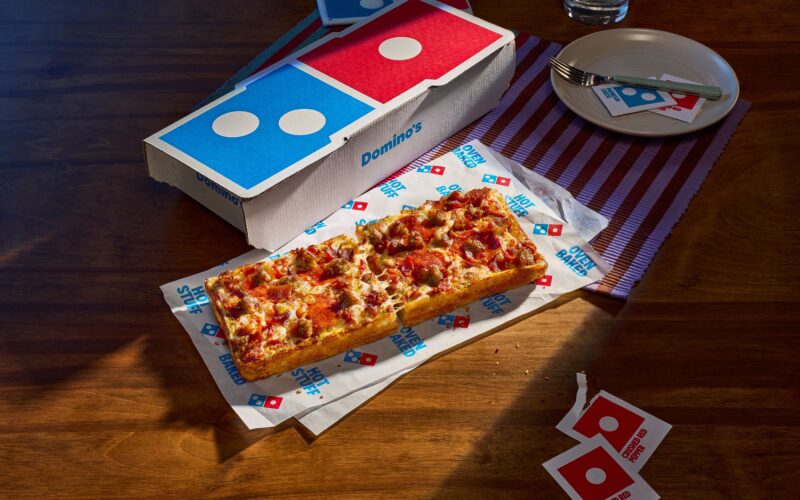
Domino’s Pizza Inc. (Nasdaq: DPZ) is turning its own name and logo into a new menu platform, launching a Detroit-style personal pizza called the Domino across U.S. stores on August 31, 2026. The rectangular pizza is designed for one person, offers a choice of sauce and as many as three toppings, and will enter the chain’s established Mix and Match promotion at $6.99 for a two-topping version when customers buy at least two qualifying items. The launch looks playful, but its timing is commercially important because U.S. same-store sales increased only 0.1% in the second quarter even as Domino’s reported order-count growth across delivery and carryout. The real test is therefore whether the Domino creates additional eating occasions and transactions rather than simply shifting existing customers from one Domino’s pizza format to another.
The Domino is made with buttery-flavored pan dough encrusted with Parmesan cheese and baked in a rectangular pan, creating a crispy Detroit-style crust. It carries two layers of cheese, a customer-selected sauce, up to three toppings and garlic seasoning, while its shape deliberately mirrors Domino’s familiar tile logo and the finished pizza is divided into two large slices. Domino’s says independent consumer testing placed the product among the most highly rated products it has introduced, although that remains a company-reported testing result rather than evidence of how frequently customers will reorder the product once it reaches the national menu.
Why is Domino’s launching a pizza for one when the traditional pizza business was built around sharing?
The more interesting element of the Domino is its portion architecture. Pizza has traditionally benefited from its position as a group meal, but that strength can also become a constraint when consumers in the same household want different toppings, sauces or portion sizes. Incoming chief executive officer Joe Jordan, currently Domino’s chief operating officer and president of Domino’s U.S., said the company sees the product as filling a gap created when individual preferences make sharing a conventional pizza less attractive.
Domino’s is consequently trying to make the pizza category work more like other quick-service restaurant formats where each customer orders an individual entrée. A family that previously compromised on one or two large pizzas could potentially purchase several Domino pizzas customized separately. The same format could also compete for occasions such as an individual lunch, a late-night snack or a meal ordered by somebody eating alone, all use cases Domino’s specifically identified when announcing the product.
That distinction matters financially because restaurant growth is not determined only by gaining new customers. Increasing the number of occasions in which an existing customer considers the brand can also lift transactions. Domino’s reported meaningful order-count growth in the second quarter across both delivery and carryout even though U.S. same-store sales increased just 0.1%, compared with 3.4% a year earlier. Management has emphasized transaction growth as a core long-term driver, making an individually portioned product strategically consistent with the company’s current focus.
The risk is cannibalization. If customers who already intended to buy Domino’s simply substitute the new format for another pizza without ordering more frequently or adding additional items, the launch may generate excitement without materially changing system sales. The product becomes economically more interesting if it attracts lunchtime business, generates multiple individually customized orders within one household or expands purchasing among consumers who regard a conventional pizza as too large for a solo meal.

How does the $6.99 Mix and Match price turn the Domino into more than a premium menu experiment?
Domino’s has not positioned its namesake pizza as a standalone premium product detached from its existing value platform. A two-topping Domino will be available through the Mix and Match promotion at $6.99 each when customers select two or more qualifying menu items, with pricing potentially higher at some locations. That connection should reduce the barrier to trial and places the new format directly inside an offer already familiar to Domino’s customers.
The economics are more interesting than the $6.99 headline suggests because the promotion requires multiple qualifying items. A customer cannot necessarily treat the advertised number as a simple $6.99 transaction. The structure encourages a larger basket while allowing different people to personalize their meals, potentially making two or three Domino pizzas an alternative to ordering a traditional shared pizza.
For Domino’s, that creates a useful tension between value perception and ticket generation. The consumer sees a sub-$7 entry point, while the franchisee can potentially capture a multi-item order. If customization encourages households to order separate pizzas rather than negotiate over toppings, the total transaction could become larger even though each individual item remains positioned as value-oriented.
That strategy is especially relevant in the current restaurant environment. Domino’s management said the broader U.S. quick-service restaurant industry continued to face pressure on consumer demand during the second quarter. Against that backdrop, expensive product innovation alone could struggle to generate traffic, whereas attaching a new format to an established value bundle gives Domino’s a clearer route to trial.
Why does Domino’s need new ordering occasions when second-quarter revenue still increased 4.3%?
Domino’s second-quarter numbers initially look stronger than the 0.1% U.S. same-store sales figure might imply. Revenue increased 4.3% to $1.194 billion, income from operations rose 3.1% to $232 million and diluted earnings per share increased 6.8% to $4.07. Global retail sales reached $4.85 billion for the quarter, while global retail sales growth excluding foreign-currency effects was 3%.
However, much of the system’s expansion is coming from factors other than strong comparable-store growth. Domino’s added 209 net stores globally during the second quarter, including 26 in the United States and 183 internationally. U.S. franchise same-store sales were flat, while company-owned U.S. stores increased 2.1%. International same-store sales declined 0.1% excluding currency effects.
Revenue growth was also supported by higher supply-chain sales, including increased order volumes and a 2.2% increase in the food-basket pricing charged to stores. Supply-chain revenue increased 6.5%, while U.S. franchise royalty and fee revenue rose partly because Domino’s had more franchised stores operating. The distinction is important because a growing store estate can support corporate revenue even when sales growth at mature locations remains modest.
That makes product innovation commercially relevant rather than cosmetic. More than 22,500 Domino’s stores were operating globally at the end of the second quarter, and 99% of the system consisted of independently owned franchised locations. With a network that large, even modest improvements in transaction frequency can feed franchise royalties, U.S. advertising revenue and supply-chain demand. Domino’s reported more than $20.6 billion in global retail sales for the trailing four quarters ended June 14, 2026.
The Domino therefore does not have to become the chain’s largest-selling pizza to be strategically useful. A product capable of creating incremental transactions across thousands of U.S. stores could have a meaningful system effect, particularly if it draws traffic into digital ordering and the Domino’s Rewards ecosystem.
Could a personal Domino pizza strengthen the economics of Domino’s heavily franchised business model?
Menu innovation carries an additional requirement at Domino’s because the economic customer is not only the person buying the pizza. Franchisees must be able to prepare the product consistently and profitably across a large decentralized network.
The Domino uses a dedicated rectangular pan format and a Parmesan-encrusted pan dough while allowing sauce selection and up to three toppings. Greater customization can improve consumer appeal but also adds operational combinations inside stores where speed, labor efficiency and consistency matter. The product will therefore need to generate enough incremental demand to justify any additional complexity associated with preparation, equipment, inventory or training.
There is nevertheless an important advantage in using ingredients that broadly overlap Domino’s existing pizza system rather than creating an entirely separate food category. The chain already operates a major supply-chain business feeding its U.S. franchise network, and second-quarter supply-chain revenue increased $44.6 million, or 6.5%, from the prior-year period. Supply-chain segment adjusted income from operations increased 18.1% during the quarter.
Successful new menu items can therefore affect Domino’s at multiple points. Franchisees can generate additional retail sales, corporate royalties can increase with franchise sales, advertising contributions can expand and additional ingredient volume can move through the supply-chain network. Conversely, weak adoption means the operational work behind a national rollout generates little incremental economic benefit.
Why does the Domino launch matter as Joe Jordan prepares to become Domino’s next chief executive officer?
There is also a leadership dimension to the August launch. Joe Jordan, who presented the commercial rationale for the Domino, is scheduled to become chief executive officer on October 1, succeeding Russell Weiner. Weiner will move to executive chairman designate before becoming executive chairman following the company’s 2027 annual shareholder meeting.
Jordan has spent nearly 15 years in Domino’s leadership roles spanning marketing, U.S. and international operations, technology and franchise support. He has also overseen initiatives including the company’s loyalty and e-commerce relaunches and digital marketplace partnerships. The Domino rollout therefore arrives weeks before his formal elevation to chief executive officer and provides an early example of how the U.S. business may pursue product, value and digital traffic growth under his leadership.
The new product also fits within the broader Hungry for MORE strategy developed under Weiner. Domino’s said that during Weiner’s tenure as chief executive officer the company added more than 3,200 net locations, increased global retail sales by nearly $3 billion and delivered close to a 30% increase in operating income. Jordan inherits a much larger system, but one now facing slower comparable-store momentum and a value-conscious consumer.
The strategic challenge is consequently shifting from building scale alone toward extracting more transactions from that scale. A namesake pizza aimed at new meal occasions may look like a small menu decision, but it sits directly inside that larger problem.
What is Domino’s Pizza stock signaling ahead of the nationwide Domino launch?
Domino’s Pizza shares were trading around $344 on August 19, up roughly 2.4% during the session at the latest market check, giving the company a market capitalization of approximately $11.4 billion. The stock remains substantially below its 52-week high of $469 but above its 52-week low of $282, leaving it roughly 27% below the high despite the recovery from June’s lows.
That positioning illustrates why operational execution matters. Domino’s shares have not returned to their previous valuation peak even though the second quarter produced better revenue and earnings growth than the same-store sales number alone would suggest. The stock rose sharply after the July 20 earnings release as investors responded to the company’s resilience and order growth despite pressured industry demand, but it remains well below the levels reached during the previous year.
The Domino launch is unlikely to determine the equity story by itself. Investors will instead look for whether menu innovation, value promotions, loyalty engagement and digital ordering combine to produce stronger U.S. comparable-store sales without sacrificing franchise economics.
The company’s second-quarter free cash flow declined 5.5% to $313.6 million for the first two fiscal quarters of 2026, while Domino’s repurchased $231.3 million of stock during the same period and retained approximately $1.23 billion of authorized repurchase capacity at June 14. Those figures underline that Domino’s remains highly cash-generative, but the market is still asking how quickly transaction growth can translate into stronger mature-store sales.
What will show whether the Domino becomes a genuine growth platform rather than a short-lived menu novelty?
The first measurable test begins after August 31. Domino’s needs the product to generate trial, but repeat purchasing will matter considerably more than the novelty created by a pizza shaped like the company’s logo.
The strongest result would be evidence that the Domino expands occasions rather than cannibalizes existing pizzas. Increased lunch ordering, solo meals, late-night transactions and households purchasing multiple personalized Domino pizzas would support the logic behind the format. Growth in order counts alongside improving U.S. same-store sales would provide stronger evidence than social-media attention or initial launch volumes alone.
Franchise economics will provide another important signal. Domino’s has built a system in which independently owned stores represent 99% of locations, so successful innovation must work at store level as well as in national advertising. A product that is easy to prepare, drives incremental transactions and moves additional ingredients through Domino’s supply chain would have a much stronger strategic case than one that simply reshuffles existing pizza demand.
For a company founded in 1960, waiting more than six decades to put its own name on a pizza gives Domino’s a convenient marketing hook. The more consequential experiment is whether an individual Detroit-style pizza can alter what a Domino’s order looks like. If it increases the number of occasions in which consumers choose Domino’s, the logo-shaped product could become a useful transaction-growth tool. If consumers merely photograph it once and return to their existing orders, the Domino will have been clever branding without changing the economics underneath.
What are the key takeaways from Domino’s new $6.99 personal Domino pizza launch?
- Domino’s Pizza will launch the Domino nationwide across the United States on August 31, 2026.
- The Domino is a Detroit-style rectangular personal pizza designed around the shape of the company’s logo.
- Customers can choose sauce and as many as three toppings, while the pizza includes two layers of cheese and a Parmesan-encrusted crust.
- A two-topping Domino will enter the Mix and Match promotion at $6.99 each when customers purchase at least two qualifying items, with higher prices possible in some locations.
- The product targets individual meals, customized family orders, lunch and late-night occasions rather than only traditional shared-pizza occasions.
- U.S. same-store sales increased just 0.1% in the second quarter of 2026, compared with 3.4% in the prior-year quarter.
- Domino’s nevertheless reported order-count growth across both delivery and carryout and increased second-quarter revenue 4.3% to $1.194 billion.
- Domino’s operated 22,531 stores globally at June 14, with 99% of its system consisting of independently owned franchise locations.
- Incoming chief executive officer Joe Jordan will take over from Russell Weiner on October 1, shortly after the nationwide Domino rollout.
- The key commercial test is whether the Domino creates incremental transactions and eating occasions rather than merely cannibalizing other Domino’s pizzas.
Discover more from Business-News-Today.com
Subscribe to get the latest posts sent to your email.