DCM Nouvelle Limited (NSE: DCMNVL), a New Delhi-based manufacturer and exporter of cotton yarn with a manufacturing base in Hisar, Haryana, has completed its 10th Annual General Meeting (AGM) as attention shifts from a difficult fiscal 2026 toward a dramatically stronger start to fiscal 2027. The AGM covered adoption of the company’s fiscal 2026 standalone and consolidated financial statements, the proposed reappointment of director Jitendra Tuli and ratification of remuneration for cost auditor KG Goyal & Associates. Those governance matters are relatively routine, but the financial backdrop is not: DCM Nouvelle Limited reported consolidated profit after tax of ₹27.53 crore in the June 2026 quarter after earning only ₹1.64 crore during the whole of fiscal 2026. The central question for shareholders is whether the Q1 earnings rebound represents the beginning of a sustained improvement in textile profitability or a particularly strong quarter that will prove difficult to repeat while the specialty-chemicals business remains in its stabilisation phase.
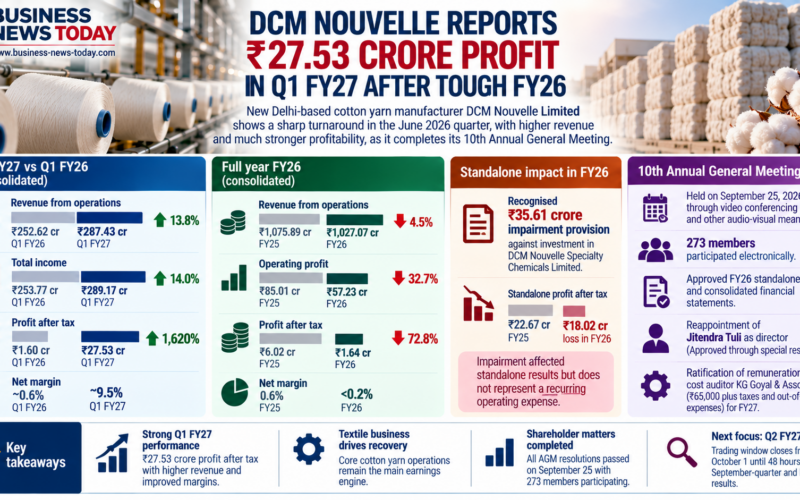
The Annual General Meeting was held on September 25 through video conferencing and other audio-visual means, with 273 members participating electronically. DCM Nouvelle Limited subsequently filed its shareholder-meeting disclosures with the exchanges, while a separate September 26 notification confirmed that the trading window will close from October 1 until 48 hours after declaration of the September-quarter and half-year results. That puts Q2 FY27 firmly into focus because another quarter of strong textile profitability would materially strengthen the case that the company has moved beyond the weak earnings pattern of fiscal 2026.
What did DCM Nouvelle place before shareholders at its 10th Annual General Meeting?
The AGM agenda contained three principal resolutions. Shareholders were asked to consider the audited standalone and consolidated financial statements for the year ended March 31, 2026, together with the reports of the board and auditors. They were also asked to consider the reappointment of Jitendra Tuli, who retires by rotation and was eligible for another term, through a special resolution reflecting the applicable governance requirements.
The third resolution concerned ratification of remuneration payable to KG Goyal & Associates as cost auditors for the financial year ending March 31, 2027. The proposed remuneration was ₹65,000 plus applicable taxes and reimbursement of out-of-pocket expenses. None of those resolutions independently changes DCM Nouvelle Limited’s operating outlook, which makes the latest financial performance considerably more important for understanding where the business may be heading.
The AGM nevertheless marks a useful transition point between two very different financial periods. Fiscal 2026 produced weak bottom-line performance despite revenue remaining above ₹1,000 crore, while the first three months of fiscal 2027 generated more consolidated profit than several recent full financial years combined. The September-quarter result will therefore be important in separating structural improvement from quarterly volatility.
Why does DCM Nouvelle’s Rs 27.53 crore Q1 profit look so different from fiscal 2026?
DCM Nouvelle Limited reported consolidated revenue from operations of approximately ₹1,027.07 crore in fiscal 2026, down about 4.5% from ₹1,075.89 crore in the previous financial year. Consolidated profit after tax declined to only ₹1.64 crore from ₹6.02 crore, leaving the group with a net margin of less than 0.2%. Consolidated operating profit was approximately ₹57.23 crore, meaning a substantial portion of operating earnings was absorbed before reaching the bottom line.
The standalone numbers were considerably weaker because DCM Nouvelle Limited recognised a ₹35.61 crore impairment provision against the value of its investment in DCM Nouvelle Specialty Chemicals Limited. Standalone profit after tax consequently swung from a ₹22.67 crore profit in fiscal 2025 to a ₹18.02 crore loss in fiscal 2026. The impairment is important when comparing periods because it affected the parent-company accounts but does not represent the same recurring operating expense as cotton, labour, electricity or finance costs.
Q1 FY27 changed the picture sharply. Consolidated revenue from operations increased 13.8% year on year to ₹287.43 crore from ₹252.62 crore, while consolidated profit after tax climbed to ₹27.53 crore from approximately ₹1.60 crore. Total income reached ₹289.17 crore and operating profitability strengthened substantially, producing a consolidated net margin of roughly 9.5%.
The percentage increase in profit is spectacular because the comparison period was close to break-even, so the more useful signal is the absolute improvement in margins. DCM Nouvelle Limited generated almost ₹26 crore more consolidated profit than in the comparable quarter while adding roughly ₹35 crore of revenue. That indicates that improved operating economics, rather than revenue growth alone, drove the Q1 earnings acceleration.
How much of DCM Nouvelle’s Q1 FY27 rebound came from its core textile business?
The textile operation remains overwhelmingly responsible for group revenue and currently generates essentially all of the operating profit. On a standalone basis, DCM Nouvelle Limited reported Q1 revenue from operations of ₹283.45 crore, up 13.5% from ₹249.69 crore a year earlier. Standalone profit after tax increased more than fourfold to ₹31.45 crore from ₹6.66 crore, while EBITDA rose to approximately ₹52.96 crore from ₹20.01 crore.
The segment data reinforce the same conclusion. The textile business generated approximately ₹283.45 crore of revenue and a segment result of around ₹42.05 crore during the June quarter. By contrast, the chemicals segment produced only about ₹3.98 crore of revenue and recorded a loss of approximately ₹3.96 crore.
That gap explains why consolidated profit of ₹27.53 crore remained below standalone profit of ₹31.45 crore even during an exceptionally strong quarter for the parent business. The chemicals operation is still consuming part of the earnings generated by textiles, meaning further improvement at group level can come from either stronger textile profitability, narrower chemical losses or preferably a combination of both.
DCM Nouvelle Limited’s textile manufacturing platform is substantial relative to the size of the listed company. Its Hisar facility has 157,872 spindles and annual production capacity of approximately 40,000 metric tonnes of cotton yarn. The company sells carded, combed and compact yarn across different counts and markets products under brands including FUTURO, PRIMERO and DINERO.
Can DCM Nouvelle sustain stronger textile margins after FY26 cotton-yarn volumes weakened?
Fiscal 2026 cotton-yarn sales volume was approximately 35,712 metric tonnes, down 6.98% from the previous year. Against a nameplate annual output capability of around 40,000 metric tonnes, the numbers show that DCM Nouvelle already operates a large manufacturing platform, so future profit improvement does not depend solely on constructing significantly more spinning capacity. Product mix, cotton procurement, energy costs, export demand and pricing can all have a powerful effect on earnings generated from the existing asset base.
The Q1 results demonstrate how sensitive the business can be to those variables. A 13.5% increase in standalone revenue was accompanied by a much larger rise in EBITDA and profit after tax, showing strong operating leverage when market conditions and costs move favourably. The reverse can also occur in cotton spinning, where raw-material prices and yarn realisations can change faster than manufacturers can adjust inventory and customer pricing.
DCM Nouvelle Limited has been taking smaller steps to improve the cost structure. During fiscal 2026 it commissioned a 500-kilowatt ground-mounted solar power plant, adding to its broader energy-efficiency initiatives. Energy is an important manufacturing input in spinning, although the financial effect of a 500-kilowatt project should be considered incremental rather than a fundamental change to group economics.
The September quarter should therefore be judged through gross and operating margins alongside revenue growth. If the company can preserve much of the Q1 margin improvement without relying on an unusually favourable cotton-price cycle, the earnings rebound would look more structural. A sharp reversal in operating margins would instead show that the June quarter benefited from conditions that may not repeat consistently.
Can DCM Nouvelle Specialty Chemicals stop diluting the profitability of the textile business?
DCM Nouvelle Specialty Chemicals Limited remains the largest unresolved component of the group story. The subsidiary was incorporated in 2022 and established a manufacturing operation in Ujjain, Madhya Pradesh, focused on specialty amines used across industries including pharmaceuticals, agrochemicals, rubber chemicals and water treatment. The business is still described as being in a stabilisation phase rather than operating at mature utilisation and profitability.
Revenue from the specialty-chemicals subsidiary was approximately ₹11.90 crore in fiscal 2026, compared with ₹17.43 crore in fiscal 2025. The first quarter of fiscal 2027 generated around ₹3.98 crore of chemical-segment revenue but also a segment loss of approximately ₹3.96 crore. In other words, the subsidiary remained a meaningful drag on the otherwise strong earnings produced by the textile operation.
That drag becomes particularly visible when standalone and consolidated results are compared. DCM Nouvelle Limited earned ₹31.45 crore at the standalone level during Q1, while consolidated profit was ₹27.53 crore. The difference of almost ₹4 crore closely reflects the continuing negative contribution from the chemicals operation.
The strategic argument for diversification remains understandable because specialty chemicals can potentially offer different demand drivers and margins from commodity-linked cotton yarn. The financial case, however, will become considerably stronger only when DCM Nouvelle Specialty Chemicals Limited demonstrates rising utilisation, higher revenue and narrowing operating losses. Until then, the textile operation effectively has to generate enough earnings to support both shareholders and the development of a second business that has not yet reached profitability.
How important is DCM Nouvelle’s debt position after the sharp improvement in Q1 earnings?
DCM Nouvelle Limited ended fiscal 2026 with consolidated debt of approximately ₹327.22 crore. That is a substantial figure for a company whose current equity-market value is only modestly above ₹330 crore, even though comparing debt directly with market capitalisation does not capture cash, working capital, asset values or the different economic roles of debt and equity.
The debt burden becomes more manageable when operating profitability improves because a larger earnings base increases interest coverage and cash available for repayment, investment and working capital. Q1 finance costs were around ₹5 crore at the consolidated level, meaning continued EBITDA around the June-quarter level would provide much stronger coverage than the weak profitability recorded during parts of fiscal 2026.
Working capital is particularly relevant for a cotton-yarn manufacturer because purchases of raw cotton and inventory positioning can require significant funding. A stronger margin cycle can therefore improve both reported profit and internally generated liquidity, while an adverse combination of high cotton prices, weak yarn realisations and rising inventories can increase financing requirements.
The next few quarters should show whether DCM Nouvelle Limited can convert stronger accounting profit into cash generation. Sustained earnings without corresponding improvement in operating cash flow would make the rebound less convincing, especially given the capital already committed to the specialty-chemicals diversification.
Has DCM Nouvelle’s share price already reflected the Q1 FY27 earnings rebound?
DCM Nouvelle Limited shares closed at ₹179.15 on the National Stock Exchange of India on September 25, up 0.29% for the session. The stock has traded between approximately ₹95.60 and ₹198.58 over the past 52 weeks, placing the latest close about 9.8% below the annual high but roughly 87% above the 52-week low.
The market had already begun repricing the company following the June-quarter results. DCM Nouvelle shares were around the ₹140 level when the Q1 numbers were released in early August and subsequently climbed as high as ₹198.58 on August 27. Even after retreating from that peak, the September 25 close remained materially above pre-result levels.
More recently, momentum has moderated. The stock closed at ₹189.67 on September 1, meaning it declined approximately 5.5% between the beginning of September and September 25. That combination, a strong three-month recovery but a pullback from the August high, suggests that part of the earnings improvement has been recognised while the market waits for another quarter of evidence.
DCM Nouvelle Limited’s market capitalisation at the latest price is approximately ₹335 crore. Q1 consolidated profit of ₹27.53 crore alone represents more than 8% of that market value, but simply annualising one unusually strong quarter would produce a misleading valuation comparison. Q2 and Q3 profitability will be much more informative in establishing a sustainable earnings base.
What will DCM Nouvelle’s September-quarter results need to prove after the AGM?
The first test will be the textile margin. Revenue does not need to accelerate dramatically if DCM Nouvelle Limited can preserve a healthier level of operating profit from the existing manufacturing platform. A second quarter of strong standalone profitability would indicate that Q1 was not merely a short-lived improvement caused by temporary raw-material or pricing conditions.
The second test will be the chemical subsidiary. DCM Nouvelle Specialty Chemicals Limited does not need to reach full profitability immediately, but higher revenue accompanied by a smaller operating loss would demonstrate movement through the stabilisation phase. Continued losses close to current levels would keep reducing the earnings generated by the core textile business.
Debt and cash generation provide the third test. With consolidated debt of more than ₹300 crore at the end of fiscal 2026, stronger EBITDA has greater strategic value if it translates into improved cash flows and eventually reduces balance-sheet pressure. Investment in chemicals and working capital must therefore be balanced against the opportunity to strengthen the financial position.
DCM Nouvelle Limited has entered fiscal 2027 with considerably better earnings momentum than its fiscal 2026 accounts suggested. The AGM closes the governance cycle around a year in which consolidated profit was barely positive, while the June quarter has already generated ₹27.53 crore of profit and driven a significant share-price rerating. The September-quarter results will provide the clearest evidence yet of whether DCM Nouvelle has moved into a sustainably higher earnings phase or whether Q1 represented an unusually favourable quarter within a still-volatile textile and specialty-chemicals transition.
Key takeaways from DCM Nouvelle’s AGM and Q1 FY27 earnings rebound
- DCM Nouvelle Limited completed its 10th Annual General Meeting on September 25, 2026.
- The AGM agenda covered fiscal 2026 financial statements, Jitendra Tuli’s proposed reappointment and cost-auditor remuneration.
- Consolidated Q1 FY27 revenue from operations increased 13.8% year on year to ₹287.43 crore.
- Consolidated profit after tax reached ₹27.53 crore compared with approximately ₹1.60 crore in Q1 FY26 and ₹1.64 crore for the whole of fiscal 2026.
- Standalone Q1 profit increased to ₹31.45 crore as the core textile operation delivered significantly stronger profitability.
- The textile segment generated approximately ₹283.45 crore of Q1 revenue and remained the principal group earnings engine.
- The chemicals segment generated only about ₹3.98 crore of revenue while recording a roughly ₹3.96 crore segment loss.
- DCM Nouvelle’s Hisar textile facility has 157,872 spindles and annual cotton-yarn capacity of approximately 40,000 metric tonnes.
- DCM Nouvelle shares closed at ₹179.15 on September 25, about 9.8% below their 52-week high of ₹198.58 but roughly 87% above the annual low.
- Q2 textile margins, specialty-chemicals losses, debt servicing and operating cash generation will determine whether the Q1 earnings rebound is sustainable.
Discover more from Business-News-Today.com
Subscribe to get the latest posts sent to your email.