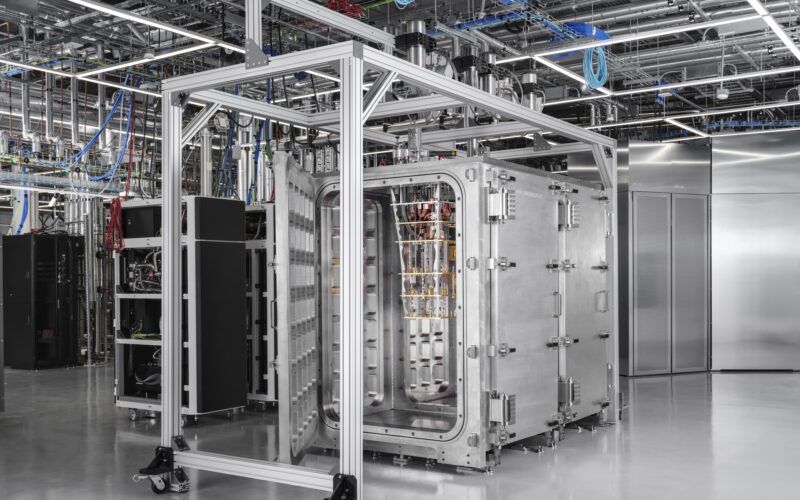
International Business Machines Corporation (NYSE: IBM) said on August 19, 2026 that it has successfully joined and cooled two of its new modular cryogenic systems into a single ultra-cold environment, a hardware step it describes as essential to linking hundreds of quantum chips inside a future fault-tolerant machine. The combined enclosure stands more than eight feet tall and eight feet wide, reaches four kelvin in under five days, and settles below fifteen millikelvin, more than one hundred and eighty times colder than deep space. IBM said the architecture is the shared cold platform intended to underpin IBM Quantum Starling, the company’s targeted 2029 delivery of what it expects to be the world’s first large-scale fault-tolerant quantum computer. Shares opened around $232.74 on the New York Stock Exchange, a rise of roughly 1.7 percent on the day, still well below the $332.46 all-time high reached on June 2, 2026 when investor enthusiasm for the wider quantum roadmap peaked. The central tension is straightforward: IBM is systematically clearing engineering checkpoints, but the commercial pay-off remains several years away and the equity has already given back most of the quantum-driven premium built earlier this year.
Why does joining two cryogenic modules matter for IBM’s fault-tolerant quantum ambitions?
Superconducting quantum processors only operate when cooled to a fraction of a degree above absolute zero, and until now IBM’s most widely deployed systems have been anchored around a single dilution refrigerator hosting a single quantum chip. Scaling that model into a machine capable of hundreds or thousands of interconnected qubits runs into a physical wall: a single fridge cannot accommodate the wiring, cabling, control electronics, and cryogenic plumbing required for that many qubits without compromising thermal performance. Joining two boxes together into one shared cold environment is therefore not a public-relations gesture, it is the hardware precondition for a genuinely modular design. IBM said each module’s vacuum enclosure offers up to twelve times more wiring space than its most widely used quantum systems, and the box-shaped geometry lets modules dock in a tight row rather than sit as isolated cylinders.
The engineering test that matters is not simply reaching temperature, it is reaching temperature reliably at joined-module scale without the connection point introducing thermal noise, mechanical drift, or vibration that could disrupt fragile quantum states. IBM said initial tests showed the combined system reached liquid-helium temperature in under five days and then settled at the operating range for superconducting qubits shortly after. Independent replication and sustained uptime remain to be demonstrated over months rather than days, and the shift from two modules to the hundreds implied by the Starling roadmap will introduce its own class of integration risks.

How does the L-coupler design change what scale IBM can realistically target by 2027?
The larger wiring capacity per module is intended to feed directly into IBM’s “L-coupler” technology, which the company describes as the physical link that lets separate quantum chips share information and operate as parts of a larger computer. Chip-to-chip coupling has been one of the field’s harder problems, because the moment quantum information moves between processors the potential for decoherence rises sharply. IBM said its 2027 milestone envisages using L-couplers to link multiple processors into a machine with at least one thousand programmable qubits, a category that excludes ancillary qubits used purely for error correction and other overhead.
That specification matters because raw qubit counts have been an unreliable measure of quantum progress. A machine with several thousand physical qubits can still deliver only a handful of logical, error-corrected qubits once overhead is stripped out. IBM’s stated target of one thousand programmable qubits by 2027, if delivered, would put it in the running to demonstrate quantum advantage on selected industrial workloads before the fully fault-tolerant Starling arrives. The company also said that IBM Quantum Nighthawk processors will be installed into the cryogenic modules later this year to expand operational performance testing, which sets up an observable near-term checkpoint before the more speculative 2027 and 2029 targets.
Why does the Starling roadmap depend on modular engineering rather than qubit count alone?
IBM’s 2025 disclosures around Starling emphasised a new error-correction code that reduces the physical resources required for fault tolerance, a mathematical and software advance rather than a hardware one. What today’s announcement adds is the corresponding hardware substrate. Error correction schemes only translate into usable logical qubits if the underlying machine can host enough physical qubits at the required error rates, and can do so in a shared cold environment without the interconnects themselves becoming the bottleneck. IBM said three essential components of its IBM Quantum System Two environment are built into the new architecture, but in a way that allows each part to be independently tested, improved, and iterated. That modularity is what turns a decade-long research programme into something that can be delivered against a public roadmap.
The company said Starling is expected to house thousands of qubits per cryogenic module at delivery. Reaching that density will require sustained progress in fabrication yield, control electronics density, wiring bandwidth, and cryogenic engineering all in parallel. Any single one of those subsystems slipping by a year could push out the aggregate delivery date, and management has not publicly detailed the sensitivity of the 2029 target to individual subsystem timelines.
How is the market pricing the gap between quantum progress and 2029 commercial delivery?
IBM shares reacted positively to the announcement, opening around $232.74 on August 19 for a gain of roughly 1.7 percent. On a longer view the equity is a very different story. The stock reached an all-time high of $332.46 on June 2, 2026, when IBM formally committed more than $10 billion to quantum over five years and several sell-side firms upgraded their targets. From that peak the stock has surrendered roughly a third of its value, moving from around 26.5 times forward earnings back toward its historical multiple in the low twenties. In effect, the market has recycled the quantum optionality it had briefly capitalised into the share price and returned to valuing IBM primarily on its software, consulting, and infrastructure earnings streams.
Recent quarterly disclosures showed Software growing eleven percent, Infrastructure fifteen percent, and Consulting four percent, a mix that continues to shift IBM’s earnings weight toward higher-margin businesses. The consensus analyst view remains “Moderate Buy” with an average price target close to $265.40, a level that implies upside but not the exuberant re-rating implied by the June high. What the current valuation signals is investor willingness to reward genuine quantum milestones without paying in advance for a 2029 outcome that still carries meaningful execution risk.
What are the competitive implications for the wider quantum computing race?
IBM is not the only company pursuing fault-tolerant quantum computing at scale, and today’s announcement reads as an attempt to reassert timeline leadership in an increasingly crowded field. Alphabet’s Google Quantum AI group has published its own error-correction milestones, IonQ and Rigetti Computing continue to pursue trapped-ion and superconducting approaches respectively, and China-linked programmes have periodically published competitive benchmarks. What differentiates IBM’s current position is the combination of a stated end-date, a stated intermediate qubit count, a published error-correction code, and now a physical hardware substrate that has demonstrably scaled from one module to two.
The commercial market for quantum computing remains embryonic, largely limited to research access, pharmaceutical and materials-science experimentation, financial risk modelling proofs of concept, and government-linked cryptography programmes. Whichever vendor first delivers a fault-tolerant machine capable of running commercially valuable algorithms will likely define the early standards, developer ecosystem, and enterprise procurement patterns for the sector. IBM’s disciplined cadence of roadmap execution is intended to reinforce that first-mover positioning; whether it converts into revenue is a separate question that only late-decade operating data will settle.
What proof points should investors look for before the next Starling checkpoint?
The near-term observable milestones fall into a fairly compact list. First, installation and operational testing of IBM Quantum Nighthawk processors in the new cryogenic modules later in 2026, with any peer-reviewed data on error rates, coherence times, and coupled-module performance. Second, the 2027 target of at least one thousand programmable qubits linked through L-couplers, which if delivered on schedule would be one of the strongest validation events for the modular architecture. Third, evidence that customers are contracting for early Starling-generation access at pricing that justifies the ten-billion-dollar plus capital commitment IBM has announced over five years.
On the downside, the risks that would materially weaken the thesis include any slippage in cryogenic module scaling beyond two units, delays to the Nighthawk installation, error-correction performance that falls short of the published theoretical bounds, or a competitor delivering a comparable fault-tolerant machine ahead of Starling. Investors would also watch for any indication that quantum spending is starting to weigh on IBM’s free cash flow generation or its capacity to support the current dividend, which yields close to 2.94 percent at recent prices.
What does the modular cryogenic milestone add to IBM’s investment case?
The announcement is best read as incremental engineering evidence that IBM’s quantum programme is more than aspiration. It does not, on its own, alter earnings, cash flow, or near-term valuation. What it does is preserve credibility in a roadmap that the equity market briefly capitalised aggressively and has since discounted. IBM continues to build a distinctive combination of hybrid cloud, generative AI partnerships including the recently announced elite tier arrangement with OpenAI, and a long-dated quantum option that few competitors can match. The 2029 Starling target remains ambitious, and the path there depends on further modular scaling, sustained yield improvements, error-correction validation, and disciplined capital allocation. Today’s news does not resolve those questions, but it narrows the range of technical uncertainty by one meaningful step.
Key takeaways from IBM’s modular cryogenic milestone and its impact on the Starling roadmap
- IBM has joined and cooled two of its new modular cryogenic systems into a single environment, cooling below fifteen millikelvin and reaching four kelvin in under five days.
- The design offers up to twelve times more wiring space than IBM’s most widely used quantum systems and is intended to host hundreds of quantum chips at scale.
- L-coupler technology is the interconnect that will link separate processors, with a 2027 target of at least one thousand programmable qubits across linked modules.
- IBM Quantum Nighthawk processors are scheduled for installation into the cryogenic modules later in 2026 as the next operational test point.
- The milestone advances IBM Quantum Starling, the company’s targeted 2029 delivery of what it expects to be the world’s first large-scale fault-tolerant quantum computer.
- Shares opened around $232.74 on August 19 for a gain of roughly 1.7 percent, still well off the $332.46 all-time high reached on June 2, 2026.
- The market has effectively recycled the earlier quantum premium and now values IBM close to its historical forward multiple of around twenty times earnings.
- Consensus analyst opinion remains “Moderate Buy” with an average target price near $265.40, implying upside but not a full re-rating.
- Competitive positioning against Google Quantum AI, IonQ, Rigetti Computing, and government-linked programmes hinges on IBM’s continued cadence of visible roadmap execution.
- Key risks include slippage in modular scaling, delays to Nighthawk testing, error-correction performance below theoretical bounds, or capital-allocation strain from sustained quantum investment.
Discover more from Business-News-Today.com
Subscribe to get the latest posts sent to your email.