






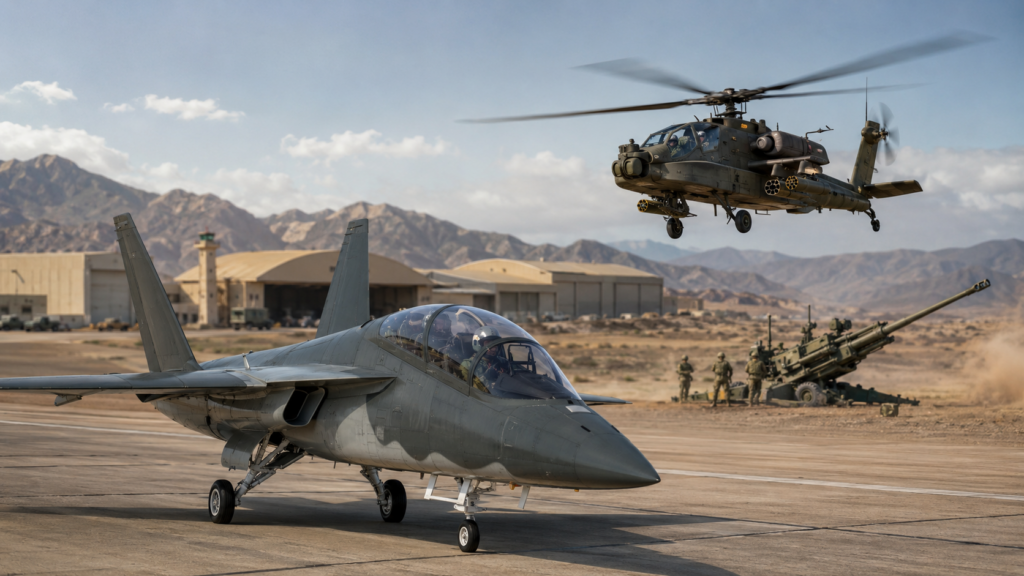
Boeing Company (NYSE: BA) has secured two distinct defense awards totaling roughly $647 million that anchor the manufacturer to two of the United States military’s most contested sustainment and training programs. The first is a $219 million United States Air Force contract for the first 14 low-rate initial production T-7A Red Hawk advanced trainer jets, released after the Milestone C decision on April 23, 2026. The second is a $428 million package of Foreign Military Sales sustainment approvals notified to the United States Congress on May 19, 2026, of which approximately $198.2 million covers follow-on support for India’s AH-64E Apache attack helicopter fleet under Boeing Company and Lockheed Martin Corporation, and around $230 million covers BAE Systems-led M777A2 ultra-light howitzer sustainment. For Boeing, which closed at $215.01 on May 19, down 2.54 percent on the session and roughly 15 percent below its 52-week high of $254.35, the awards reinforce the defense and services franchise that institutional investors increasingly treat as the structural counterweight to commercial aircraft delivery volatility.
What does the $219 million T-7A Red Hawk Milestone C award actually unlock for Boeing Defense, Space and Security in 2026 and beyond?
The Milestone C decision on the T-7A Red Hawk is operationally larger than the headline contract value suggests. The $219 million award funds only 14 aircraft, but it formally transitions the program from engineering and manufacturing development into low-rate initial production, opening the door to a full programme of 351 aircraft and 46 simulators destined for five United States Air Force bases over the next decade. The initial operational capability target is 2027.
For Boeing, this is less a revenue event than a balance-sheet event. The T-7A has been one of the most painful fixed-price development contracts in Boeing’s defense portfolio. The original $9.2 billion T-X award in 2018 carried a $400 million reach-forward loss at inception, and Boeing’s first-quarter 2026 Form 10-Q discloses approximately $400 million of capitalized precontract costs alongside about $1 billion of potential termination liabilities to suppliers tied to long-lead items on future production lots. Every additional production lot that the Air Force exercises reduces the probability of those termination liabilities crystallising and improves the unit economics of the remaining tail of the program.
The strategic significance lies in pilot pipeline economics. The T-38C Talon is more than 60 years old. Replacing it materially changes the cost-per-flight-hour of preparing aviators for fifth-generation and sixth-generation platforms such as the F-35 Lightning II, F-22 Raptor, F-15EX Eagle II, and eventually the Northrop Grumman B-21 Raider and the Boeing-led Next Generation Air Dominance fighter. Air Education and Training Command has framed the T-38 replacement as a top priority because the avionics gap between the legacy trainer and frontline cockpits has widened to the point of imposing a real readiness cost on initial fighter conversion squadrons.
There is also a digital engineering signal in this award that the market has under-weighted. The T-7A is the first United States Air Force aircraft developed using a closed-loop digital engineering toolchain co-built with Saab AB. If low-rate production validates the cost and schedule benefits Boeing has claimed for that toolchain, it strengthens Boeing’s pitch on future fixed-price competitions where digital design maturity is increasingly a discriminator. If production reveals concurrency risk that testing did not surface, the credibility of digital engineering as a procurement reform argument takes a hit that extends well beyond Boeing.
Why does the $198 million India Apache sustainment notification matter more than its headline value implies for Boeing Defense and the Indo-Pacific posture?
The Apache portion of the May 19 Foreign Military Sales notification is small in dollar terms relative to Boeing’s recent helicopter wins, but the strategic geometry is large. India operates 28 AH-64E Apache helicopters across the Indian Air Force and the Indian Army, having received 22 between 2019 and 2020 and six more for the Army from late 2025. The new $198.2 million package covers engineering, technical and logistics support, personnel training, technical data and publications, and broader programme assistance. It locks Boeing Company in as the principal contractor, alongside Lockheed Martin Corporation, for the long-term operational readiness of those aircraft.
This award sits inside a much larger Boeing Apache franchise that has expanded sharply over the past six months. The United States Army awarded Boeing a $4.68 billion firm-fixed-price contract in late November 2025 for new-build AH-64E aircraft, Longbow crew trainers, and accessories, with about $2.29 billion of that allocated to Foreign Military Sales for Poland, Egypt, and Kuwait. The Army then followed with a $2.7 billion post-production support contract on December 31, 2025, locking in Apache sustainment activity through 2030. Layered on top, the United States Department of Defense in early December 2025 placed a separate $4.7 billion multi-year Apache award covering deliveries to Poland, Egypt, and Kuwait. The Indian sustainment package adds another anchor in the Indo-Pacific.
Sustainment economics are the quiet driver. Boeing’s Global Services segment posted $5.4 billion in revenue and an 18.1 percent operating margin in the first quarter of 2026, with services backlog reaching a record $33 billion. Service revenue on installed military fleets is structurally higher-margin than new aircraft production because Boeing competes against itself rather than against rival prime contractors. Each new Apache sustainment package extends that high-margin annuity and strengthens the case for treating Boeing Defense, Space and Security plus Global Services as a single defense aftermarket franchise.
The Indo-Pacific positioning is the second-order effect. Washington has explicitly framed the Apache sustainment approval as supporting a major defence partner critical to Indo-Pacific stability. For Boeing, this means the Apache platform is being institutionalised as a hedge against Chinese rotorcraft and unmanned systems development in South Asia, increasing the probability that India eventually orders additional AH-64Es or AH-64F variants beyond the current fleet of 28.
How do these contracts intersect with Boeing’s wider defense portfolio recovery story heading into the second half of 2026?
Boeing reported a $1.06 billion swing to positive free cash flow in 2025 from a $12 billion outflow the prior year, and management has guided to further free cash flow improvement in 2026. The defense segment, which delivered $233 million in operating profit in the first quarter of 2026 on 21 percent higher revenue, is central to that narrative. Chief Executive Officer Kelly Ortberg has framed 2025 and 2026 as the recovery years after the cumulative impact of the 737 MAX manufacturing flaws, the machinist strike, fixed-price defense losses on T-7A, KC-46, MQ-25, VC-25B, and Commercial Crew, and broader supply chain disruption.
The T-7A and Apache awards reinforce a clear strategic pattern. Boeing is being progressively reset away from the loss-making fixed-price development programs that defined the past five years and toward production ramps, sustainment annuities, and Foreign Military Sales-anchored backlog. The total backlog at Boeing reached $694.7 billion as of March 31, 2026, with $85.8 billion in Defense, Space and Security and $33 billion in Global Services. That backlog mix is, in aggregate, a more durable revenue stream than the commercial-only profile Boeing carried before the 2019 inflection.
Execution risk remains material. Reuters reported on May 19, 2026 that India will monitor a Boeing fuel-switch test tied to the Air India London incident, which keeps regulatory and engineering attention on Boeing platforms even as defense awards stack up. The T-7A program itself entered production almost three years late relative to its original 2023 initial operational capability target, and the Air Force has structured the Milestone C award as a phased approach requiring separate approvals before each of the first three production lots. Concurrency between development testing and production has historically been the failure point on programs of this kind.
What are the second-order industry implications of Pentagon awarding parallel training and helicopter support contracts to a single prime in the current threat environment?
The parallel awards reveal a Pentagon procurement preference that competitors should read carefully. The Apache franchise is now effectively non-contestable in the western export market for the relevant attack-helicopter class. Sikorsky, a Lockheed Martin Corporation subsidiary, competes principally with the CH-53K King Stallion in the heavy-lift category. Bell Textron Incorporated’s V-280 Valor sits in a different mission profile. There is no current, ready-now western competitor to the AH-64E Apache for the foreign military sales customers that constitute Boeing’s growth lane, including Poland, Egypt, Kuwait, India, the United Kingdom, Japan, South Korea, the Netherlands, and the United Arab Emirates.
In trainer aircraft, the T-7A faces no domestic United States competitor for the lead-in fighter trainer mission now that the Air Force has committed to Milestone C. Leonardo’s M-346 and Korea Aerospace Industries’ T-50 remain credible export competitors, but the United States Air Force commitment is the anchor reference that drives export adoption. Boeing has effectively recovered the Air Force training franchise from incumbent Northrop Grumman, which produced the T-38 Talon, even though it has done so several years late and at significant cost to its own balance sheet.
The third implication is geopolitical. Foreign Military Sales activity through May 2026 has trended toward high-utilisation legacy platform sustainment rather than novel acquisitions. Poland is buying 96 Apaches. Egypt and Kuwait are modernising existing fleets. India is sustaining its existing 28 aircraft. The United States is consolidating a Pentagon strategy that prioritises operational availability of proven platforms over the procurement risk of unproven systems. For Boeing, that strategy is uniquely favourable because Boeing built most of the legacy fixed-wing and rotorcraft platforms in question.
What should institutional investors and defense analysts watch next as Boeing executes against these awards through the remainder of 2026?
The next two catalysts are the Apache multi-year contracting decision and the T-7A second-lot production approval. Boeing executives have publicly hinted that the Apache multi-year structure may be replaced by alternative contracting arrangements rather than a conventional multi-year deal, reflecting both supply chain pressure and Pentagon preference for flexibility. The fiscal 2027 budget request, which will be the foundation document for Pentagon procurement under the Trump administration’s $1.2 trillion baseline defense budget, will indicate how the Army intends to fund the next Apache production tranche.
For the T-7A, the second low-rate initial production lot decision will determine whether the Milestone C ramp is genuine or whether the Air Force throttles output to manage operational risk. The current acquisition strategy explicitly preserves the right to approve each of the first three production lots separately. Boeing’s earnings call commentary in the second-quarter 2026 results, expected in late July, will be the next opportunity for management to update markets on T-7A reach-forward loss provisions and the trajectory of capitalized precontract costs.
The market reaction so far has been muted. Boeing shares closed at $215.01 on May 19, 2026, down 2.54 percent on the session, with the decline driven principally by the Sean Duffy travel show controversy and a Reuters report on the India fuel-switch monitoring rather than the defense awards themselves. Citigroup analysts raised the Boeing price target to $260 from $256 in the days preceding the awards, and the consensus 12-month target across 16 analysts sits at $269.75, implying approximately 22 percent upside from the closing price. The strong-buy consensus has not been disrupted by the latest contracts, but neither has it been measurably improved by them, suggesting that defense awards in this size range are now priced into the recovery narrative rather than treated as positive surprises.
Key takeaways on what these defense awards mean for Boeing, its peers, and the broader defense procurement landscape
- The combined $647 million in awards is small in absolute Boeing Defense terms but materially de-risks two strategically critical programmes: the T-7A training franchise and the Indo-Pacific Apache sustainment annuity.
- T-7A Milestone C approval reduces the probability of Boeing crystallising approximately $1 billion in potential supplier termination liabilities related to long-lead production items, which is the single most important capital structure implication of the May 4 award.
- The Apache sustainment package for India embeds Boeing Company and Lockheed Martin Corporation as the long-term aftermarket partners for India’s 28 AH-64E aircraft and raises the probability of follow-on Indian orders for additional Apache helicopters.
- Boeing Global Services delivered an 18.1 percent operating margin in the first quarter of 2026 on $5.4 billion in revenue, validating the strategic logic of growing the high-margin sustainment annuity rather than chasing new fixed-price development programmes.
- Sikorsky and other western rotorcraft competitors face an effectively non-contestable Apache franchise in the foreign military sales export market, with implications for capital allocation in their own rotorcraft research and development.
- The Pentagon’s procurement pattern through 2026 favours legacy platform sustainment and modest production ramps over high-risk novel acquisitions, which is structurally favourable to Boeing given the breadth of platforms it has fielded.
- T-7A digital engineering execution under low-rate initial production is the variable to watch most closely because it determines whether digital design tools translate into manufacturing economics or remain a procurement marketing claim.
- Boeing shares closed at $215.01 on May 19, 2026, roughly 15 percent below the 52-week high of $254.35 and roughly 22 percent below the consensus 12-month price target of $269.75, leaving room for further re-rating if defense execution holds and commercial deliveries continue to ramp.
- The fiscal 2027 defense budget request will be the most important external catalyst for Boeing Defense over the remainder of 2026 and will indicate Pentagon intent on the next Apache contracting structure.
- The cumulative Boeing defense and sustainment backlog of approximately $118 billion at the end of the first quarter of 2026, across Defense, Space and Security plus Global Services, is now a structural floor under the recovery thesis that the market has not yet fully discounted.
Discover more from Business-News-Today.com
Subscribe to get the latest posts sent to your email.

