




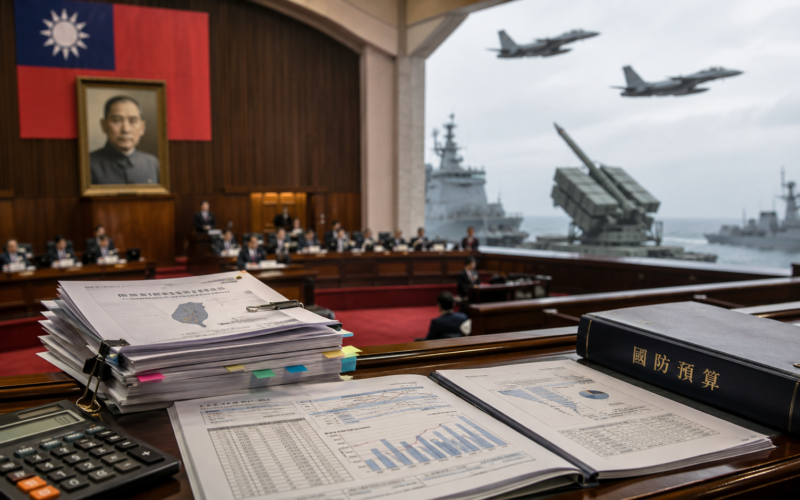
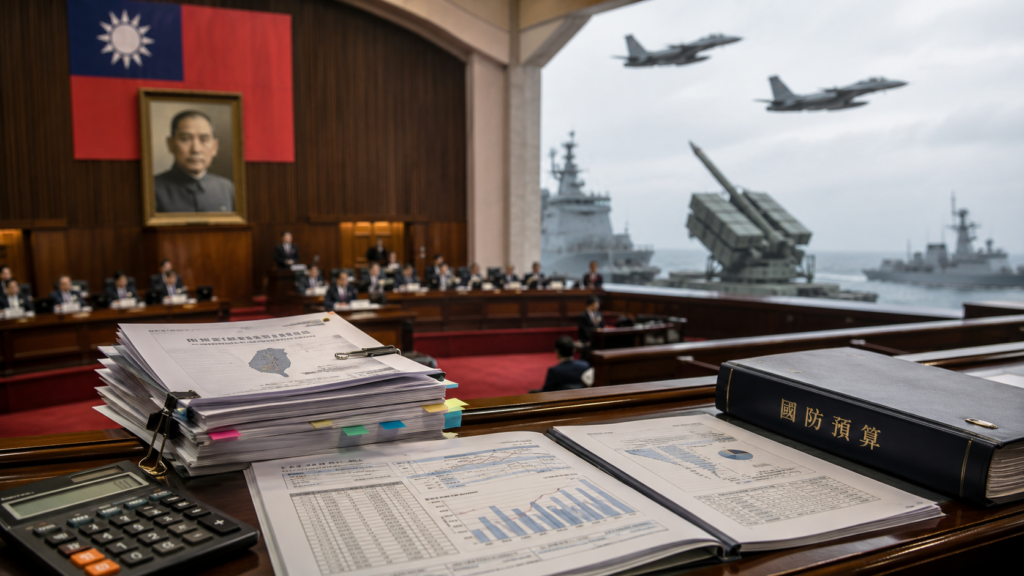
Taiwan’s Legislative Yuan on 8 May 2026 passed a NT$780 billion (US$24.8 billion) special defence budget for United States arms purchases, ending a six-month standoff between President Lai Ching-te’s Democratic Progressive Party administration and the opposition-controlled chamber. The package, structured across two procurement tranches capped at NT$300 billion and NT$480 billion respectively, runs through 2033 and sits alongside a regular 2026 defence budget projected at 3.32 percent of gross domestic product under Taiwan’s newly adopted NATO-style accounting. President Lai Ching-te has committed Taiwan to reaching 5 percent of GDP on defence by 2030, a near-doubling from the 2.38 percent recorded in 2025 and a trajectory implying compound annual growth of close to 10 percent in real defence outlays over the next five fiscal years. The trajectory marks the most aggressive sustained military spending build-up Taiwan has attempted since the early 1990s and lands at the moment when Pentagon officials including Under Secretary for Defense Policy Elbridge Colby have publicly suggested the figure should sit closer to 10 percent of GDP given the threat profile from the People’s Republic of China.
What the 8 May 2026 vote actually authorised and where the cuts came from
The bill cleared the 113-seat Legislative Yuan by 59 votes to 51, with the joint Kuomintang and Taiwan People’s Party caucus prevailing over the Democratic Progressive Party. The original Executive Yuan request, tabled by President Lai Ching-te in November 2025, sought NT$1.25 trillion across eight years to fund both United States foreign military sales and a parallel domestic procurement programme covering drone manufacturing, integrated air defence, and command-and-control upgrades. The opposition stripped the domestic procurement portion almost entirely, restricting the special budget to weapons systems certified under United States Letters of Offer and Acceptance. First-tranche items include M109A7 self-propelled howitzers, High Mobility Artillery Rocket Systems, Javelin anti-tank missile launchers and missiles, and tube-launched optically tracked wire-guided 2B anti-armour missiles. The second tranche, with a NT$480 billion ceiling, covers anti-ballistic missile systems, low- and medium-altitude air defence, soft- and hard-kill counter-drone systems, and replenishment stocks of anti-tank guided munitions.
The vote contains a structural feature that matters for execution risk. The Act prohibits any reduction in central government social welfare spending below the 2026 baseline for the duration of the programme, and caps combined central government borrowing at 15 percent of total annual expenditures. The Executive Yuan must submit a five-year retrospective procurement performance report to the legislature within one month of promulgation, with budget drawdowns conditional on that report being approved. Procurement is annual rather than block-funded, with each subsequent appropriation requiring fresh legislative approval. The structure gives the Kuomintang and Taiwan People’s Party a continuing veto over how the money is spent, a procedural fact that markets and Washington should not overlook.
How Taiwan’s planned 5 percent of GDP target compares with regional and NATO peers
The Stockholm International Peace Research Institute recorded Taiwan’s 2025 military expenditure at US$18.2 billion, or 2.1 percent of GDP under SIPRI’s methodology, an increase of 14.2 percent year-on-year and Taiwan’s largest single-year jump since at least 1988. Taiwan’s planned 2026 figure of US$31.08 billion at 3.32 percent of GDP under the NATO accounting model represents a 22.9 percent year-on-year nominal increase, of which roughly half a percentage point of GDP comes from reclassifying Coast Guard Administration spending and military retirement costs into the defence envelope. Under the previous accounting method, the underlying 2026 increase is 20.1 percent and the GDP share sits at 2.84 percent.
The benchmark Lai Ching-te has committed to is structurally the same as the 5 percent NATO pledge agreed at the 2025 Hague summit, which separates a 3.5 percent core defence floor from a 1.5 percent allocation for related security infrastructure, civil resilience, and defence industrial base investment. The Heritage Foundation has noted that Taiwan is the first non-NATO state to align with the 5 percent commitment. By comparison, Japan under Prime Minister Sanae Takaichi has accelerated its 2 percent of GDP target by two years and faces growing United States pressure to move higher, while South Korea already spends approximately 2.7 percent of GDP and is being pushed by Washington toward 5 percent. None of Taiwan’s regional peers has yet committed publicly to a 5 percent benchmark by 2030. Only Israel, Ukraine, Saudi Arabia, and Algeria currently sit at or above 5 percent of GDP on military spending under SIPRI’s data, and three of those four are actively at war or in protracted conflict.
Why Pentagon pressure for 10 percent of GDP collides with Taiwan’s fiscal reality
The 10 percent figure cited by Under Secretary Elbridge Colby during his 2025 confirmation hearing, and earlier by then-candidate Donald Trump in 2024, would imply roughly US$93 billion in annual defence spending against Taiwan’s 2025 GDP base. That is approximately three times the 2026 budgeted figure and would exceed Taiwan’s entire current central government revenue base. It would also push Taiwan above the defence burden of every nation globally except Ukraine and Russia, both of which are at war. Strategy scholar Jie Zhong, cited in publicly available Legislative Yuan testimony, has argued that even sustaining 3 percent of GDP through annual budgets rather than special appropriations would seriously crowd out welfare, transport, education, and economic development outlays.
The fiscal arithmetic exposes a tension the special budget structure has only partially resolved. The Acquisition Special Regulations explicitly ring-fence social welfare spending, but Taiwan has no equivalent statutory protection for capital expenditure, education, or healthcare line items if defence absorbs an additional 1.7 percentage points of GDP between 2026 and 2030. The Executive Yuan has not published a public sequencing plan for how the 5 percent target would be financed across regular and special appropriations, and the Lai Ching-te administration’s failure to fund a legislatively mandated military pay increase in the 2026 general budget has already exposed the political difficulty of pairing rapid spending growth with personnel cost commitments.
What the special budget signals for Taiwan’s domestic defence industrial base
The most consequential omission in the 8 May 2026 vote is the domestic procurement carve-out. The Executive Yuan’s original NT$1.25 trillion request earmarked substantial funding for indigenous drone manufacturing, with a stated target of monthly production of 15,000 unmanned aerial vehicles by 2028 and industrial output value of NT$30 billion in that segment. Taiwan’s Ministry of National Defense placed an NT$50 billion order for 48,750 military drones in July 2025 across five aircraft types for delivery in 2026 and 2027, and the Executive Yuan in October 2025 announced orders for an additional 50,000 dual-use drones primarily for civil agency use. The Taiwan Excellence Drone Industry Business Opportunities Alliance, coordinated by state-owned Aerospace Industrial Development Corporation, has organised more than 200 component and platform manufacturers around the procurement programme.
By restricting the special budget to United States foreign military sales, the legislature has shifted the financing burden for the indigenous drone, unmanned surface vessel, and air defence integration programmes back onto the regular annual budget, which itself faces opposition scrutiny each fiscal cycle. Listed defence-exposed names on the Taiwan Stock Exchange, including Aerospace Industrial Development Corporation, CSBC Corporation, Lungteh Shipbuilding, and Air Asia Co., along with private sector drone specialists Thunder Tiger, Coretronic Intelligent Robotics, and Geosat Aerospace, retain access to existing programmes but lose the multi-year visibility that the original NT$1.25 trillion proposal would have provided. CSBC Corporation, which leads the Indigenous Defense Submarine programme valued at approximately NT$284 billion (US$9.18 billion), conducted its eighth round of dive tests on the lead-of-class Narwhal submarine in 2025 and has reported revenue growth of approximately eight times since the programme began.
Where United States arms sales policy creates the largest execution risk
Taiwan’s accelerated spending profile assumes a functioning United States foreign military sales pipeline. The United States Defense Security Cooperation Agency announced eight separate arms sales packages to Taiwan totalling approximately US$11 billion on 17 December 2025, and Congress has authorised US$1 billion in Taiwan Security Cooperation Initiative funding for fiscal 2026 under the National Defense Authorization Act, with the House-passed Department of Defense appropriations bill providing US$500 million. The Consolidated Appropriations Act 2026 also funded a US$300 million Foreign Military Financing grant to Taiwan. However, the Trump administration’s late February 2026 decision to pause new arms sales pending a prospective Trump-Xi summit creates a sequencing problem the special budget cannot resolve from Taipei alone.
A Bloomberg analysis of the 8 May vote noted that the opposition’s insistence on Letter of Offer and Acceptance certification before any drawdown effectively ties Taiwan’s defence build-up to United States executive branch decisions on individual sales approvals. If the pause extends through the second half of 2026, first-tranche procurement timelines slip and the optics of the 3.32 percent of GDP figure become harder to defend politically inside Taiwan. The procurement is also vulnerable to United States production capacity constraints. The Patriot missile, HIMARS, and Stinger production lines remain backlogged from Ukraine and Israel commitments, and the M109A7 self-propelled howitzer line at BAE Systems faces multi-year delivery schedules. Public Pentagon estimates of the existing United States arms backlog to Taiwan run to approximately US$19 billion before the 8 May vote.
What Taiwan’s defence trajectory means for cross-strait deterrence and regional security
The structural significance of the special budget extends beyond the dollar figure. Taiwan is shifting from platform-heavy procurement toward asymmetric capabilities, with the first procurement tranche dominated by mobile artillery and anti-armour systems suited to denying a People’s Liberation Army landing rather than contesting air or sea superiority directly. The shift aligns with public commentary from former Pentagon officials, Australian Strategic Policy Institute analysts, and the 2026 edition of the International Institute for Strategic Studies Military Balance. China’s announced 2025 defence budget of approximately US$248 billion, growing 7.4 percent year-on-year, remains roughly eight times Taiwan’s 2026 baseline figure even before any People’s Liberation Army off-budget spending. Taiwan cannot achieve quantitative parity and is no longer attempting to.
The political durability of the trajectory is the open question. The Kuomintang and Taiwan People’s Party have demonstrated that they can shape, delay, and reshape the executive’s defence ambitions. The 2028 presidential election will determine whether Lai Ching-te’s 5 percent of GDP commitment survives a potential change of administration, and the Trump-Xi diplomatic track in the United States will shape arms availability independently of Taiwan’s appropriations. Taiwan has bought itself a credible budget envelope and an asymmetric procurement plan. Whether it has bought itself effective deterrence depends on factors that neither the special budget nor the regular budget controls.
Key takeaways from Taiwan’s 5 percent of GDP defence trajectory and the 8 May 2026 special budget vote
- Taiwan’s Legislative Yuan passed a NT$780 billion (US$24.8 billion) special defence budget on 8 May 2026, capped below the NT$1.25 trillion the Lai Ching-te administration had originally sought.
- The 2026 regular defence budget reaches NT$949.5 billion (US$31.08 billion), or 3.32 percent of GDP under the newly adopted NATO accounting method that includes Coast Guard Administration and military retirement costs.
- President Lai Ching-te has committed Taiwan to 5 percent of GDP defence spending by 2030, the first non-NATO state to align with the 2025 Hague summit benchmark.
- The trajectory implies compound annual growth approaching 10 percent in real defence outlays through 2030, an unprecedented sustained build-up for Taiwan since the early 1990s.
- Pentagon Under Secretary Elbridge Colby has publicly suggested Taiwan’s defence spending should sit closer to 10 percent of GDP, a level that would imply roughly US$93 billion annually and exceed every country except Ukraine and Russia.
- The special budget restricts procurement to United States Letter of Offer and Acceptance certified items, stripping out the domestic drone, unmanned surface vessel, and integrated air defence programmes from the original Executive Yuan proposal.
- First-tranche procurement is concentrated in asymmetric land-warfare systems, including M109A7 howitzers, HIMARS, Javelin and TOW 2B anti-armour missiles, signalling a strategic shift away from force-on-force conventional platforms.
- Taiwan’s listed defence-exposed names, including Aerospace Industrial Development Corporation and CSBC Corporation, retain access to regular budget programmes but lose the multi-year visibility the original NT$1.25 trillion package would have provided.
- The Trump administration’s late February 2026 pause on Taiwan arms sales pending a prospective Trump-Xi summit creates execution risk that Taiwan’s appropriations cannot resolve unilaterally.
- China’s announced 2025 defence spending of US$248 billion remains approximately eight times Taiwan’s 2026 baseline, confirming that quantitative parity is no longer the Taiwanese strategic objective.
Share this:
Discover more from Business-News-Today.com
Subscribe to get the latest posts sent to your email.