




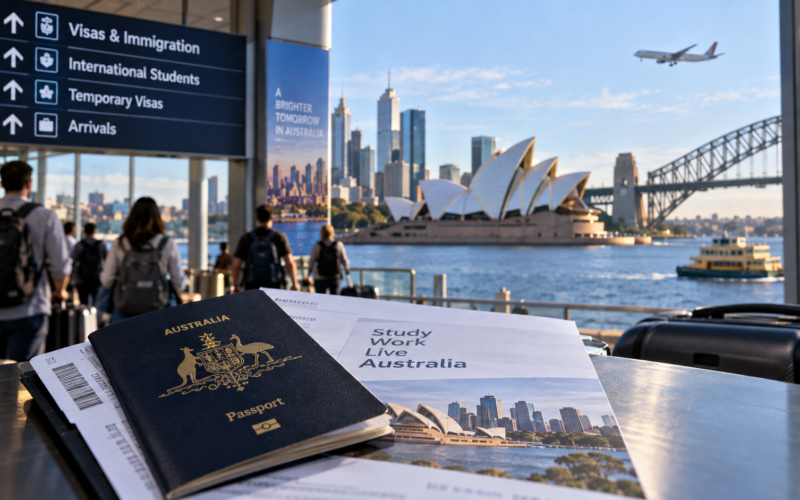
Australia has announced another major tightening of temporary migration rules, restricting secondary applicants on most international student visas, introducing competitive ballots for second- and third-year working holiday extensions and placing a No Further Stay condition on future visitor visas. Home Affairs Minister Tony Burke said the package is intended to reduce net overseas migration toward 245,000 this financial year and 225,000 in 2027-28, after official data showed migration falling to 292,000 from the post-pandemic peak. The measures will be progressively implemented over the next 12 months rather than all beginning immediately on September 17.
The reform is significant for universities because international education is one of Australia’s largest exports and generated A$53.6 billion in the year to June 2025, according to figures cited by Reuters. International students also accounted for more than half of net overseas migration in the year to June 2025, when the total stood at about 306,000 under the measurement used in the Reuters report. Canberra is therefore trying to reduce migration without undermining an education industry that contributes heavily to university finances, employment and services exports.
Can international students still bring partners and children to Australia?
The new policy substantially restricts that option for most future student and graduate visa applicants, but it is not an absolute ban covering every international student. Burke said secondary applicants will generally no longer be attached automatically to most student or graduate visas, while exceptions will remain for certain groups, including eligible students from Pacific and ASEAN countries and people undertaking specified courses such as PhDs. Families already attached to visas and currently in Australia will not be separated under the new rule.
That qualification is important for prospective students planning postgraduate or family relocation. A blanket description suggesting every international student is prohibited from bringing any dependant would be inaccurate because Canberra has deliberately retained exceptions. The practical impact will depend on the final implementation details for different visa subclasses and the date on which applications are lodged.
What changes for backpackers seeking a second or third year in Australia?
Australia will retain the regional-work requirement but introduce a ballot for access to additional years under the Working Holiday Maker programme. Burke said second-year places will be capped at 45,000 through the ballot, compared with approximately 57,000 people who qualified last year, while third-year places will be limited much more sharply to 5,000 compared with roughly 31,000 qualifying last year. Applicants will still need to complete the relevant regional work before they become eligible to enter those ballots.
That represents a fundamental change from a system in which completing specified work could provide a comparatively predictable route to an additional year. Regional employers in agriculture, tourism and hospitality have historically relied on working holiday makers, so restricting extensions could tighten labour availability in some areas. Canberra says it will preserve the regional-work connection while gaining greater certainty over the number of temporary migrants remaining in Australia.
What does the new No Further Stay condition mean for Australian visitor visas?
The government plans to apply a No Further Stay condition to future visitor visas, preventing most visitors from using an Australian visit as an onshore pathway into another visa category. Protection applications are treated separately, and Burke said the measure will apply to future visas rather than retrospectively changing the status of people already in Australia. The government says the change should reduce visa hopping while making it easier to assess genuine short-term visitors who intend to leave as required.
The reform addresses a recurring weakness in migration management in which some temporary entrants shift between visa categories and remain much longer than originally expected. Canberra increasingly wants decisions about longer-term migration to be made before arrival rather than after an individual has entered on a visitor visa. That approach provides greater control over net migration but reduces flexibility for people whose personal circumstances change after arriving.
Why is Australia tightening migration when it still needs skilled workers?
Australia is simultaneously confronting labour shortages and intense pressure on housing, infrastructure and public services, which means the policy objective is not simply to reduce every form of immigration. The government says it will continue prioritising skilled applicants in healthcare, construction, education, defence, resources, agriculture, law enforcement and several other sectors. Updated processing directions are intended to direct available migration capacity toward those occupations while restricting pathways considered easier to exploit.
This is why the reform combines restrictions with targeted migration rather than imposing a fixed numerical border closure. Australia’s ageing population and skills needs still support substantial immigration over the long term, while rapid post-pandemic population growth has intensified political concerns about rents, housing availability and urban congestion. The challenge for Canberra is determining which temporary arrivals produce the largest economic benefits relative to those pressures.
How far has Australian net overseas migration already fallen from its post-pandemic peak?
Burke said the latest Australian Bureau of Statistics data put net overseas migration at 292,000, which the government describes as 47% below the post-COVID peak reached in 2023. Reuters separately cited net migration of 306,000 in the year ended June 30, 2025, compared with a peak of about 518,000 in 2023, reflecting the different reporting periods used as numbers are updated. The policy objective is to push the measure lower toward 245,000 and eventually 225,000.
Migration has therefore already fallen substantially before all of the September measures take effect. That makes the coming year important because policymakers will be able to test whether additional restrictions continue lowering arrivals without creating major shortages in universities, regional industries or skilled occupations. The economic effect will depend not just on the number of migrants but on which categories decline most sharply.
What should international students and temporary migrants watch over the next 12 months?
Implementation dates will matter because the Australian government says the reforms will be progressively rolled out rather than applied simultaneously. Prospective students should pay particular attention to secondary-applicant rules, permitted exceptions and requirements for changing courses or extending study, while working holiday makers will need details governing the new ballot timetable. Future visitors considering another visa after arrival will also need to understand how the No Further Stay condition affects their options.
The reforms represent one of Australia’s clearest attempts to move from a demand-driven temporary migration system toward stronger numerical control. Universities and employers will now test whether the government can reach its 225,000 migration target without weakening sectors that have become highly dependent on international students and temporary workers. For prospective migrants, the practical message is that eligibility may increasingly depend on the purpose and economic priority of a visa rather than simply meeting the previous formal requirements.
Discover more from Business-News-Today.com
Subscribe to get the latest posts sent to your email.