

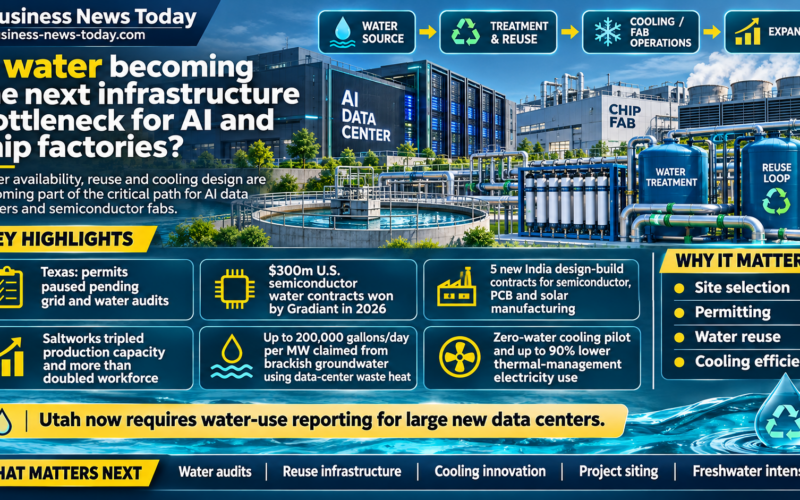
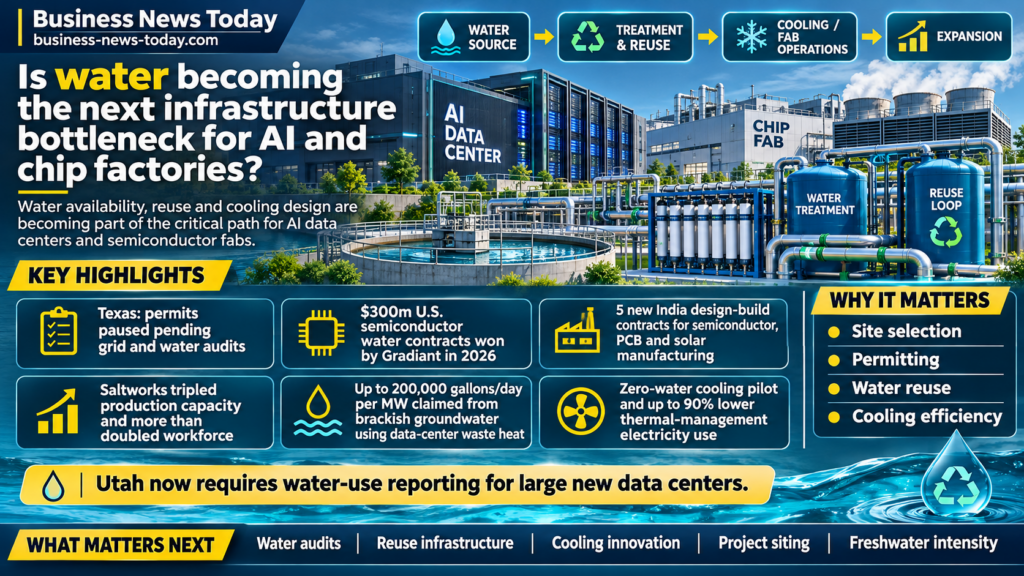
Artificial intelligence and semiconductor investment are creating an infrastructure challenge that extends beyond electricity, grid connections and construction capacity. Data centers need thermal-management systems capable of removing enormous quantities of heat, while semiconductor fabrication plants require highly purified water for critical manufacturing processes. As projects grow larger and move into regions where freshwater is constrained, water availability is beginning to influence permitting, engineering and site development rather than remaining a secondary utility consideration.
The response is creating a new industrial layer around ultrapure-water production, wastewater recycling, desalination, zero liquid discharge and water-efficient cooling. Gradiant secured $300 million of new semiconductor water contracts in the United States during 2026 and is expanding across India, while Saltworks Technologies has tripled production capacity as demand rises from semiconductor fabs, data centers and other industrial customers. At the same time, Texas has subjected proposed data centers to additional scrutiny around their water sources and consumption, and Utah has introduced mandatory water-use reporting for large new developments.
That does not mean every AI data center is becoming a water-intensive project. Cooling technologies differ substantially, closed-loop systems can minimise onsite consumption, and Hitachi Vantara is now piloting a thermal-management system requiring no water for cooling. The structural change is subtler: developers increasingly need a credible water strategy before they can assume a site will support future computing or semiconductor capacity.
Why is water joining electricity as an infrastructure question for data centers?
The rapid expansion of AI computing has concentrated attention on electricity because high-density servers consume enormous amounts of power. Yet the electricity problem and the water problem can be connected through cooling.
Computing equipment turns much of the electricity it consumes into heat. That heat has to be removed continuously if servers are to operate within acceptable temperature ranges. Some cooling systems use water directly, while others rely primarily on air, refrigerants or closed loops. Even systems designed to minimise onsite water consumption can shift part of the resource requirement elsewhere if additional electricity generation needs water upstream.
The practical issue is therefore not simply how many gallons a generic data center consumes. There is no single meaningful number because water use changes with cooling architecture, local climate, server density, electricity supply and whether recycled or non-potable sources are available.
What is becoming more important is whether developers can demonstrate that large campuses will not compete excessively with communities for freshwater. That question is particularly consequential in dry regions where AI infrastructure may otherwise have attractive land, energy and connectivity characteristics.
Water can consequently become a site-selection variable. A location with access to treated wastewater, brackish groundwater or reliable reclaimed-water infrastructure may support a project that would be significantly harder to justify using drinking-water supplies.
Why has Texas put water directly into the data-center approval process?
Texas provides the clearest recent evidence that water availability is moving from corporate sustainability reporting into infrastructure regulation. Governor Greg Abbott directed state agencies in September to intensify scrutiny of data-center development, including detailed examination of electricity demand and water requirements.
The Texas Water Development Board was instructed to enforce existing water-use reporting requirements and obtain information about anticipated water consumption, sources of supply and water-efficient technologies. Data centers advancing through the Electric Reliability Council of Texas interconnection process are also required to provide water information as part of the broader state audit.
The scrutiny escalated on September 21 when Abbott directed the Texas Commission on Environmental Quality to halt permits sought by data centers until required grid and water audits were completed. The regulator has subsequently changed how applications involving data centers are processed while systems are modified to ensure staff review.
The significance is larger than any individual Texas project. Texas is one of the most attractive U.S. markets for data-center development because of its scale, energy system, land availability and expanding digital infrastructure. If projects in such a major growth market increasingly need to demonstrate credible water sourcing and reuse alongside electricity plans, water engineering becomes part of development risk.
The state is effectively asking developers two related questions before approving enormous new loads: where will your electricity come from, and where will your water come from?
Is water transparency becoming a wider regulatory requirement rather than a Texas exception?
Utah provides independent evidence that water scrutiny is broadening. From July 1, 2026, new large data-center projects exceeding specified size and water-use thresholds must report planned water withdrawals to the Utah Division of Water Rights before construction.
The reporting framework requires information about estimated annual withdrawals, wastewater treatment, water reuse and replacement efforts. Once qualifying facilities become operational, operators must submit annual information on actual withdrawals and verifiable efforts to reduce consumption.
Utah’s approach differs from Texas because it is primarily a transparency and water-planning system rather than the same type of broad project audit. The common mechanism, however, is important. State authorities increasingly want project-level information on how large digital infrastructure developments affect water resources.
Other U.S. jurisdictions are monitoring the same issue. The Delaware River Basin Commission is tracking planned data-center growth to assess potential water-resource implications, while environmental regulators in several states are clarifying how existing withdrawal, wastewater and stormwater rules apply to large campuses.
This does not establish a national regulatory barrier to data-center construction. It does show that water use is becoming sufficiently material for regulators to build dedicated reporting and monitoring frameworks around an industry historically discussed mainly through electricity demand.
Why are semiconductor fabs creating an even more specialised water infrastructure market?
Semiconductor manufacturing presents a different challenge because water is used directly in highly controlled production processes. Semiconductor wafers must repeatedly be cleaned during fabrication, and the water involved has to meet extraordinarily high purity standards because microscopic contaminants can damage yields.
That creates demand for ultrapure-water systems as well as wastewater treatment and reclamation infrastructure. The economic objective is increasingly to treat water several times inside the facility rather than continually drawing fresh supplies and discharging large wastewater volumes.
Gradiant announced in September that it had secured $300 million of new semiconductor water contracts in the United States since the beginning of 2026. The projects cover five fabrication sites across New York, Virginia, Idaho and Utah.
The systems include ultrapure-water production, high-recovery wastewater treatment, local scrubber-water reclamation and zero liquid discharge. That mix shows why semiconductor water infrastructure cannot simply be reduced to purchasing more municipal water.
A fab can require one system to create extremely pure process water and another to recover usable water from complex industrial waste streams. The larger the facility and the tighter the surrounding water supply, the stronger the economic incentive to recover more water internally.
The water plant increasingly becomes part of the fab itself.
Is India building a water-treatment layer alongside its electronics manufacturing ambitions?
The same pattern is appearing in India as investment expands across semiconductors, printed circuit boards, solar manufacturing and adjacent electronics industries.
Gradiant announced five new Indian design-build contracts in October covering semiconductor, printed-circuit-board and solar manufacturing. The contracts include a repeat award from a global semiconductor company expanding a fabrication operation and involve technologies including ultrapure water, wastewater treatment and zero liquid discharge.
That is commercially important because India’s electronics-manufacturing ambitions require much more than factories and equipment. Advanced manufacturing clusters need electricity, logistics, specialist labour, gases, chemicals and reliable process-water infrastructure.
Water conditions also vary considerably between Indian industrial regions. Projects built in locations experiencing seasonal scarcity or pressure on municipal resources may require greater wastewater recovery than facilities in regions with abundant supply.
The emerging opportunity therefore extends beyond selling treatment equipment. Providers capable of designing, operating and digitally optimising complete water systems can become part of the industrial infrastructure that allows manufacturing capacity to expand.
Gradiant plans to increase its India workforce by more than 40% during 2026 as it expands in semiconductors, data centers and energy. That hiring programme does not prove water has become a binding constraint across Indian manufacturing, but it provides another demand signal from a company positioned directly inside the industrial water market.
Why is Saltworks tripling production capacity for industrial water systems?
Saltworks Technologies offers another independent indication that demand is moving through the water-equipment supply chain. On October 29, the Canadian company said it had opened a second manufacturing facility and tripled production capacity while more than doubling its workforce over the previous year.
The company is assembling multiple industrial water-treatment plants across its facilities in Richmond, British Columbia. Demand spans semiconductor fabs, data centers, power generation and critical-mineral projects.
The semiconductor market is particularly relevant. Saltworks secured another major fab water-reclamation and zero-liquid-discharge project in September and says modern systems can recycle more than 99% of water in appropriate zero-liquid-discharge configurations.
That figure should not be interpreted as meaning every semiconductor facility can automatically eliminate 99% of freshwater demand. Recovery depends on wastewater chemistry, process design, energy requirements and site-specific economics.
The strategic direction is nevertheless clear. Rather than treating industrial wastewater as material that must simply be discharged after treatment, manufacturers increasingly view it as a resource capable of being processed and returned to the facility.
That changes the water equation from linear consumption toward circular infrastructure.
Could wastewater and brackish groundwater open new data-center locations?
Gradiant’s West Texas work provides a useful example of how water technology could influence where AI infrastructure is built. The company is delivering the water and wastewater package for a hyperscale AI data-center campus in a region where water availability is already constrained.
The system is designed around zero discharge to surface water and can incorporate alternative water sources rather than depending entirely on conventional freshwater supplies. Gradiant has highlighted treated wastewater and brackish groundwater as potential inputs for water-constrained developments.
That matters because the ability to use lower-quality water changes site economics. A developer may no longer need to ask only whether sufficient potable municipal water is available. The relevant question becomes whether local water can be treated economically to the quality required for cooling and other site operations.
The implication resembles what onsite power generation is beginning to do for electricity-constrained data centers. Water engineering can potentially expand the set of locations capable of supporting large projects.
This does not make water availability irrelevant. Treatment plants require capital, electricity, chemicals, maintenance and discharge strategies. Difficult source water can create significant operating costs.
What changes is the definition of usable water. Technology can convert resources previously considered unsuitable into industrial supply.
Can data centers eventually produce more usable water than they consume?
Endeavour and Trevi Systems are testing a much more ambitious version of that idea. Their October partnership combines data-center thermal infrastructure with desalination technology designed to use waste heat from computing facilities.
The companies say their proposed system could create up to 200,000 gallons of clean water per day for every megawatt of computing capacity when processing brackish groundwater. When applied to oilfield produced water, the stated potential is about 50,000 gallons per day per megawatt.
Those figures are company performance claims and should not yet be treated as standard commercial outcomes. Endeavour intends to begin deployments at its own U.S. data centers, meaning the economics and reliability still need broader real-world validation.
The concept is nevertheless strategically interesting because it attempts to turn one data-center waste stream into an input for another infrastructure process. Servers create low-grade heat that normally has to be rejected into the environment. Desalination systems need energy to separate water from dissolved salts.
If those two processes can be integrated economically, a data center could become part of local water infrastructure rather than merely another large industrial customer.
That would materially alter the political and commercial debate around water-intensive computing, but the model remains at an earlier stage than conventional wastewater recycling.
Could waterless cooling prevent water from becoming a universal AI bottleneck?
Technology provides the strongest counterargument to the entire Signal.
Hitachi Vantara and Duraflow announced an October 27 pilot in the Netherlands using phase-change-material thermal storage. The companies say the system requires zero water for cooling and can reduce electricity used for thermal management by as much as 90% under the demonstrated architecture.
The system stores thermal energy in specialised material and shifts cooling demand away from periods when electrical infrastructure is most constrained. Hitachi Vantara is testing it at its Zaltbommel data center.
The claimed electricity reduction is application-specific and should not be extrapolated to every facility. More importantly, zero onsite cooling water does not necessarily mean a data center has no water footprint because the electricity supplying the facility may itself rely on water elsewhere in the energy system.
Nevertheless, the pilot demonstrates why water should not be framed as an unavoidable ceiling on AI growth. Engineers can redesign cooling systems, increase closed-loop operation, reuse wastewater or choose non-potable supplies.
The more defensible thesis is that water is becoming a design constraint that developers increasingly need to solve.
Could water infrastructure become a new beneficiary of the AI capital cycle?
The first waves of AI infrastructure investment primarily benefited semiconductor manufacturers, server suppliers, data-center developers and electricity infrastructure companies. As projects move toward construction and operation, spending is spreading into less obvious enabling systems.
Industrial water is one of those systems.
Semiconductor fabs require ultrapure-water plants before they can manufacture wafers at scale. Large data centers increasingly need engineered cooling and wastewater solutions that satisfy regulators and communities. Water-constrained sites may require desalination, reclaimed-water pipelines or zero-discharge systems.
That expands the addressable market for companies providing membranes, pumps, filtration equipment, digital controls, chemical treatment and engineering services.
The opportunity differs fundamentally from software. Water-treatment businesses have to manufacture physical equipment, deploy it onsite and maintain systems whose reliability directly affects customer production.
That creates high execution requirements but also potentially deeper customer integration. Once a semiconductor fab’s ultrapure-water and recycling systems are embedded inside the manufacturing process, water infrastructure becomes difficult to treat as a commodity purchase.
What could prevent water from becoming the next major infrastructure bottleneck?
Technology can reduce consumption faster than expected. Waterless cooling, closed-loop liquid systems, wastewater reuse and improved heat-management architecture could allow data-center capacity to grow without proportional increases in freshwater withdrawals.
Regulators may also respond differently depending on local conditions. Water-rich regions have very different constraints from West Texas, Utah or drought-prone manufacturing clusters. A global AI expansion does not imply a global water shortage.
Semiconductor manufacturers have decades of experience improving process efficiency and reclaiming water. Larger fabs can justify sophisticated treatment infrastructure that might be uneconomic for smaller industrial sites.
There is also a risk of confusing corporate water announcements with proven environmental outcomes. A system capable of extremely high recovery under engineered conditions still needs to operate consistently at scale, manage concentrated residual waste and remain economically competitive.
Some technologies can reduce water consumption while increasing electricity use, chemicals or capital expenditure. The full resource trade-off matters more than a single water-recovery percentage.
The Signal should therefore remain geographically and technologically conditional. Water is most likely to become a binding constraint where extremely large projects intersect with limited local supply, sensitive communities or stringent discharge requirements.
What would confirm that water has become a strategic constraint on AI and chip expansion?
Project siting will provide the clearest evidence. If developers increasingly favour locations with reclaimed-water networks, brackish groundwater or dedicated industrial treatment infrastructure, water availability will have become part of competitive site economics.
Regulatory behaviour offers another measurable indicator. More states or countries requiring project-level water reporting, reuse plans or evidence that data centers will not compete with community supplies would strengthen the thesis.
Contract values should also be watched. Continued growth in large ultrapure-water, wastewater-recovery and zero-liquid-discharge awards would show that semiconductor and AI infrastructure spending is reaching deeper into industrial water systems.
Production capacity at suppliers such as Saltworks provides another signal. Additional factory expansions, hiring and equipment backlogs would indicate that water-treatment manufacturing itself is experiencing a demand cycle.
Technology outcomes matter just as much. Endeavour’s desalination concept needs to demonstrate its claimed water-production economics in commercial operation, while Hitachi Vantara’s waterless thermal system needs repeat deployment beyond a pilot environment.
Freshwater withdrawal per unit of computing or semiconductor output would ultimately provide the best confirmation or disconfirmation. Rapid declines in water intensity could mean engineering innovation is solving the constraint faster than capacity grows.
The deeper infrastructure story is therefore not that AI and semiconductor factories are destined to consume unsustainable quantities of water. It is that water can no longer be assumed to be an unlimited background utility.
Developers increasingly have to know where their water will come from, how many times it can be reused, what happens to the residual wastewater and whether local communities and regulators will accept the resulting resource footprint.
That creates a new engineering race alongside the better-known race for electricity.
The next AI campus or semiconductor fab may have the chips, capital, land and power it needs to proceed. In increasingly water-constrained markets, the final question may be whether it also has a credible way to secure and recycle the water required to operate.
Discover more from Business-News-Today.com
Subscribe to get the latest posts sent to your email.