



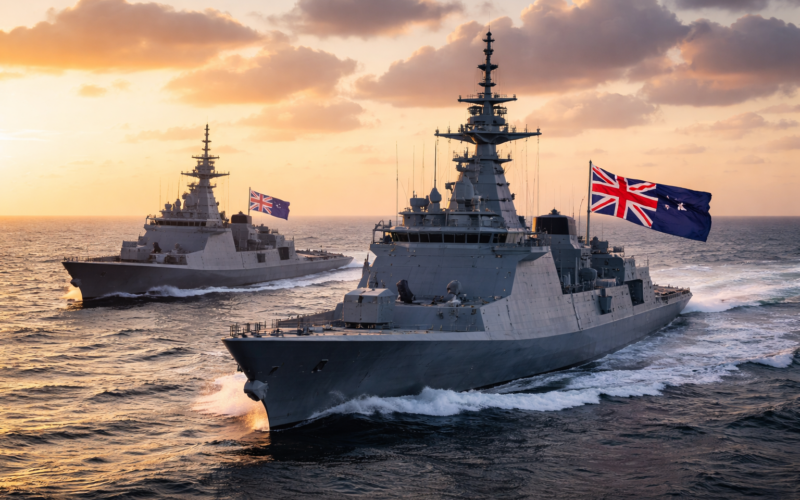
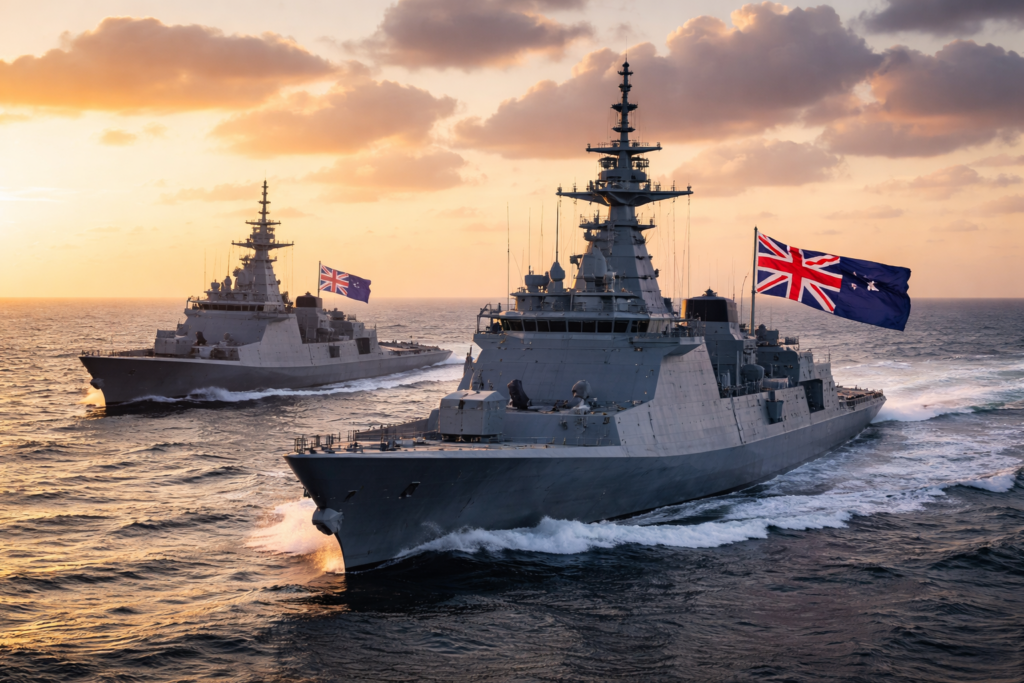
Mitsubishi Heavy Industries, Ltd. (TYO: 7011) has moved from contender to anchor contractor in one of the Indo-Pacific’s most politically significant naval procurement programs, after Australia and Japan signed contracts for the first three upgraded Mogami-class general purpose frigates under a wider A$10 billion, roughly $6.5 billion to $7 billion, 11-ship program. The deal gives Japan its most consequential defence export since Tokyo loosened long-standing postwar restrictions on overseas military sales, while giving Australia a faster path to recapitalise an ageing surface fleet. The first three vessels will be built in Japan, with the remaining eight intended for construction in Western Australia, creating a hybrid model that blends urgent capability delivery with domestic industrial policy. Mitsubishi Heavy Industries shares rose into the news cycle around the contract signing, though the stock still sits below its 52-week high after a volatile month for Japanese defence names.
Why does the Australia Japan Mogami frigate agreement matter beyond three warships today?
This is not simply a ship order. It is a statement about how middle powers in the Indo-Pacific now want to buy security, build deterrence, and spread industrial risk. Australia needs to replace its ageing ANZAC-class frigates and do it on a timetable that avoids the usual defence procurement comedy of errors, except nobody is laughing when fleet readiness slips. Japan, for its part, has spent years trying to translate growing strategic influence into exportable defence manufacturing credibility. This contract is where those ambitions finally meet steel.
The agreement matters because it solves three problems at once. First, it gives Canberra a relatively quick off-ramp from surface fleet capability erosion by bringing in a platform already rooted in an operating Japanese design rather than starting from an entirely clean-sheet domestic program. Second, it gives Tokyo a proof point that its defence industry can compete internationally on more than diplomacy alone. Third, it builds another layer of practical military-industrial interdependence between two U.S.-aligned regional powers that increasingly see maritime security as a shared long-cycle challenge rather than a string of isolated procurements.
The choice of the Mogami platform also signals that Australia is prioritising deployable mass and flexible mission utility, not just exquisite top-end ships. In the current strategic environment, a navy that can field more useful hulls sooner often beats a navy that spends a decade designing perfection and gets shortage instead.
What does Mitsubishi Heavy Industries really gain from Australia ordering three Mogami frigates first?
For Mitsubishi Heavy Industries, the immediate gain is revenue visibility in a segment investors increasingly treat as structurally advantaged. Defence is no longer a side note inside the conglomerate story. It is becoming one of the group’s clearest valuation drivers as Japan raises defence spending, regional demand for military platforms expands, and industrial policy increasingly favours sovereign or allied supply chains.
The strategic gain may be even bigger than the near-term contract economics. Export success validates Mitsubishi Heavy Industries as a systems integrator with relevance beyond Japan’s home market. That matters because defence exports have a multiplier effect inside industrial conglomerates. A ship sale does not only create shipyard work. It strengthens the case for adjacent sustainment, systems integration, upgrades, training, lifecycle support, and future exports to other aligned buyers who prefer proven platforms with government backing.
There is also a reputation dividend. Japan’s defence industry has often been seen as technically capable but commercially constrained by politics, export controls, and limited overseas sales experience. Winning a major Australian naval program begins to soften that perception. Investors do not usually reward symbolism forever, but they do pay attention when symbolism starts turning into backlog.
Why is Australia splitting construction between Japan and Western Australia instead of building everything locally?
Because Australia wants two things that do not naturally arrive together. It wants speed, and it wants domestic industrial development. The first three frigates being built in Japan helps with schedule credibility because Mitsubishi Heavy Industries can start from an existing industrial base at Nagasaki Shipyard and move toward the first delivery by December 2029. The remaining eight being slated for Western Australia keeps faith with Canberra’s long-running insistence that major defence spending should also deepen local shipbuilding capability.
This split model is a policy compromise, but a rational one. If Australia insisted on building all 11 from day one domestically, schedule slippage risk would probably rise, especially given workforce, infrastructure, and learning-curve realities. If it outsourced all 11 to Japan, it would get capability faster but politically undercut its own industrial strategy and lose a chance to develop local sustainment and production depth.
The challenge is execution. Hybrid build models look elegant in ministerial statements and become less elegant when design transfer, standards harmonisation, labour training, and supply chain localisation begin. The industrial handoff from Japanese construction to Australian production will be the part analysts should watch most closely. That is where strategic intent either becomes a durable industrial partnership or an expensive PowerPoint.
How does the Mogami frigate program fit into Indo-Pacific deterrence and China risk calculations?
The program is part fleet recapitalisation and part geopolitical signalling. Australia and Japan are both responding to a security environment shaped by maritime competition, long-range strike concerns, and the need to defend sea lines of communication across the Indian and Pacific Oceans. Neither government needs to say China in every sentence for the strategic context to be obvious.
For Australia, the frigates help support a force structure designed for longer-range operations and better maritime denial options. For Japan, the deal demonstrates that its security role is no longer confined to homeland defence and alliance dependence. It is now willing to act as a supplier of military capability to trusted regional partners. That is a meaningful shift in the political economy of Asian defence.
This also matters for alliance architecture. The United States remains the central security player, but Washington increasingly wants capable allies that can do more together and source from each other. A Japan-built warship for the Royal Australian Navy is not just a transaction. It is evidence that the regional security web is becoming more networked, more industrially integrated, and less dependent on one-country procurement pipelines.
What operational and industrial risks could still derail the Australia Mitsubishi Heavy frigate timeline?
Defence investors know the standard warning label. Contract signed does not mean friction removed. The first risk is schedule translation. Building the first three ships in Japan is supposed to accelerate delivery, but naval programs remain vulnerable to supply chain tightness, subsystem integration delays, and evolving customer specifications.
The second risk sits in Australia. Creating the conditions for local construction of the next eight frigates in Western Australia requires workforce scaling, infrastructure readiness, and a disciplined transfer of know-how. Defence shipbuilding ecosystems are not instant noodles. Add hot water and optimism, and you still do not get a sovereign industrial base overnight.
The third risk is political continuity. Large naval programs outlive news cycles and sometimes outlive the politicians who launch them. Budget pressure, strategic reprioritisation, and changes in industrial policy can all reshape program economics. The bigger and longer the program, the more it becomes exposed to inflation, labour shortages, and future capability creep.
There is also competitive risk. If the handover to Australian construction proves messy, critics of offshore-first procurement will say Canberra compromised local industry. If Australia insists on too much redesign or local customisation, critics of domestic build ambition will say it sacrificed speed. Defence programs have a special talent for disappointing both sides at once.
Why did Mitsubishi Heavy Industries shares react, and does the stock move match the deal’s significance?
The market reaction makes sense, but it should not be overstated. Mitsubishi Heavy Industries shares were trading around ¥4,371 on April 17, according to Reuters-linked market data, with a 52-week range around ¥2,522.50 to ¥5,208.00. Third-party market snapshots indicated the stock was down roughly 8.6 percent over one week and about 8.8 percent over one month going into the deal, despite remaining sharply higher over 12 months. That backdrop matters. The contract arrived as a supportive strategic catalyst, but not from a depressed long-term base.
Investors like this deal for good reason. It reinforces the thesis that Mitsubishi Heavy Industries is one of the clearest listed beneficiaries of Japan’s defence normalization and rising allied procurement demand. It also adds credibility to future export optionality, which markets often value before it fully appears in earnings.
Still, one frigate contract does not rewrite the entire equity story. Mitsubishi Heavy Industries is a diversified industrial group spanning aerospace, defence, energy, infrastructure, and machinery. The stock is influenced by more than naval exports alone. Defence momentum helps, but valuation discipline still matters, especially after the strong longer-run re-rating the company has already seen. In plain English, investors are cheering the win, but they are not discovering the defence story for the first time.
What does this Australia Japan frigate deal signal for future defence exports and allied shipbuilding models?
The broader signal is that defence trade among U.S.-aligned Indo-Pacific partners is becoming more practical, not just aspirational. If this program stays on track, it could become a template for how allied governments balance urgent military need with domestic industry promises. Buy some capability fast from a trusted partner, localise later, and use the process to build a longer-term sustainment and production ecosystem.
That model will attract attention well beyond Australia. Other regional buyers facing naval recapitalisation pressures may study whether Japan can combine credible delivery, acceptable political terms, and interoperable systems. If the answer is yes, Mitsubishi Heavy Industries and Japan’s wider defence sector may find the Australian contract functioning as a reference sale, which in arms exports can be worth nearly as much as the initial revenue.
For Canberra, the deal may also shape future procurement logic. If hybrid offshore-plus-domestic builds prove workable, Australia may rely more often on this approach for urgent capability gaps. If the transition struggles, the political backlash could harden arguments for deeper domestic build requirements even when they slow delivery. In that sense, these frigates are not only ships. They are a test case for how allied defence industrial policy gets done in the late 2020s.
Key takeaways on what the Australia Japan Mitsubishi Heavy frigate deal means for defence markets and naval strategy
- Australia’s contract for the first three Mogami frigates is as much a strategic alignment move as a procurement decision.
- Mitsubishi Heavy Industries has gained a high-visibility export win that strengthens its defence-growth narrative with investors.
- Japan has secured its most important defence export milestone in years, which could improve future bid credibility.
- The split-build structure gives Australia faster initial capability while preserving domestic shipbuilding politics.
- The real execution test is not the signing ceremony, it is the transfer from Japanese production to Australian industrialisation.
- The program supports a broader Indo-Pacific trend toward allied capability pooling and regional defence supply chain integration.
- For Australia, replacing ANZAC-class ships faster now appears to have taken priority over a slower all-local build approach.
- For investors, the contract is strategically positive for Mitsubishi Heavy Industries, but the stock already reflects substantial defence optimism.
- If the schedule holds, the deal could become a reference model for future allied naval procurement across the region.
- If localisation or delivery slips, the program could quickly turn into a case study in how defence industrial ambition collides with timetable reality.
Discover more from Business-News-Today.com
Subscribe to get the latest posts sent to your email.