


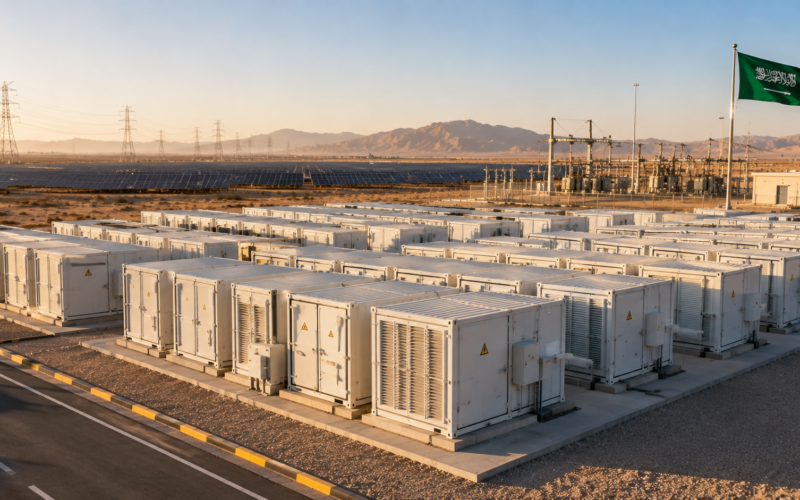
Saudi Power Procurement Company has signed four Storage Services Agreements covering 2,000 MW and 8,000 MWh of battery energy storage capacity, committing more than SAR4.35 billion, approximately $1.16 billion, to the first group of independent storage projects under Saudi Arabia’s build-own-operate model. Three 500 MW/2,000 MWh projects have been awarded to a consortium comprising Saudi Energy, ACWA Power Company, and Al Sharif Contracting and Commercial Development Company, while a fourth project of the same size will be developed by an ENGIE-led consortium with Haji Abdullah Alireza & Co. The four-hour systems will be located across the Makkah, Hail and Qassim regions and represent one of the clearest steps yet in turning Saudi Arabia’s rapidly expanding renewable-generation programme into a power system capable of shifting electricity across the day.
The agreements cover Al Muwyah and Haden in the Makkah region, Al Kahafa in Hail and Al Khushaybi in Qassim. Each project has a rated power capacity of 500 MW and energy capacity of 2,000 MWh, meaning the entire group can theoretically discharge at full output for four hours. Saudi Power Procurement Company acts as the Principal Buyer and will purchase storage services rather than own the facilities directly, leaving the winning developer groups responsible for financing, construction, ownership and operation.
Why is Saudi Arabia spending more than $1.16 billion on its first BESS group?
Saudi Arabia is simultaneously adding large amounts of solar and wind generation while attempting to maintain a reliable electricity system capable of serving peak demand, industrial expansion and rapidly increasing cooling loads. Batteries provide a mechanism for absorbing electricity when supply exceeds immediate demand and returning it to the grid during periods when renewable production declines or demand rises. The first group’s 8 GWh of stored energy is therefore more useful as an operating tool than the 2 GW power rating alone suggests.
At the announced investment level, the four projects carry average investment of roughly SAR1.09 billion each, although actual project costs need not be identical. Across the full group, the implied investment intensity is approximately $145 per kWh of storage capacity based purely on the announced $1.16 billion aggregate figure. That calculation should not be treated as a battery-equipment price because total project investment can include land, grid connection, civil works, financing and other infrastructure, but it provides a useful indication of the capital scale required to build multi-gigawatt storage quickly.

Who won Saudi Arabia’s first independent storage projects?
Saudi Energy, ACWA Power Company and Al Sharif Contracting and Commercial Development Company secured the Al Muwyah, Haden and Al Kahafa projects, giving the consortium 1.5 GW of power capacity and 6 GWh of storage across three sites. The remaining 500 MW/2 GWh Al Khushaybi project went to ENGIE and Haji Abdullah Alireza & Co.
The awards strengthen ACWA Power Company’s already extensive role in Saudi Arabia’s power build-out while giving ENGIE another foothold in a market where conventional generation, renewables and flexibility services are all expanding. The commercial model is also significant because storage revenue will be tied to contracted services with the Principal Buyer rather than relying entirely on volatile merchant arbitrage between low-price and high-price hours.
How much larger is Saudi Arabia’s second BESS procurement?
The first 8 GWh group is already being followed by a larger second procurement. Saudi Power Procurement Company opened qualification in April for six additional 500 MW battery projects, each designed for four-hour operation. Together, Group Two would add 3,000 MW and 12,000 MWh across Samha, Al-Leeth, Al-Henakiyah, Khulis, Sadawi and Ashyrah.
Combining the two independent-storage rounds gives 5 GW of power capacity and 20 GWh of energy storage either contracted or progressing through procurement. The second group alone is 50% larger than the first in both MW and MWh terms, suggesting that Saudi Arabia is not treating the initial four projects as a demonstration programme. The build-own-operate structure will again place ownership in special-purpose project companies, with Storage Services Agreements providing the commercial interface with the Principal Buyer.
How does 8GWh of new storage fit Saudi Arabia’s wider 2030 power strategy?
Saudi Arabia has set an objective of reaching around 50% renewable generation capacity in its electricity mix by 2030, subject to demand growth, while battery storage is increasingly being developed alongside that generation programme. The government has also been associated with an approximately 48 GWh storage objective by the end of the decade, with multiple procurement tracks already under way.
That scale reflects the operational reality of building very large solar capacity in a system with steep evening demand. Solar output peaks during daylight hours, while air-conditioning and other electricity requirements can remain elevated after sunset. Four-hour batteries can move part of that daytime production into the evening period, reducing the need to keep an equivalent amount of conventional capacity running solely to cover shorter peaks.
Storage does not remove the requirement for transmission, dispatchable generation or longer-duration flexibility, particularly during extended periods of low renewable production. It does, however, allow the same grid to accommodate more variable generation before curtailment, congestion and ramping requirements become severe.
What changes once the Storage Services Agreements are signed?
The signing moves the first group beyond competitive selection into a contracted development phase. Developers must now secure financing, complete detailed engineering, procure battery systems and power-conversion equipment, build grid connections and deliver performance that satisfies the storage-service obligations. The build-own-operate framework gives the developers long-term asset responsibility rather than ending their role at EPC completion.
That creates a different risk profile from a conventional equipment supply award. Battery degradation, system availability, augmentation requirements and operating performance can influence economics over many years, so the winning groups must optimise not merely initial construction cost but lifecycle performance. The Principal Buyer, meanwhile, receives dispatchable flexibility without putting the full capital requirement directly onto the state procurement entity’s balance sheet.
Why could this first $1.16bn battery round matter beyond Saudi Arabia?
The Middle East is moving from a region dominated by isolated renewable projects toward one where storage is becoming a mainstream grid asset. Saudi Arabia’s 8 GWh first group and 12 GWh second group place storage procurement at a scale comparable with major generation programmes, while the involvement of ACWA Power Company and ENGIE creates platforms that could carry experience into other markets.
The immediate headline is $1.16 billion of investment, but the larger change is structural. Saudi Arabia is beginning to procure batteries as independent infrastructure with their own contracted revenue model, rather than treating storage merely as an accessory attached to a solar plant. If Group Two and subsequent rounds proceed at similar speed, the Kingdom could become one of the world’s most important markets for utility-scale battery developers, system integrators and equipment suppliers well before 2030.
Discover more from Business-News-Today.com
Subscribe to get the latest posts sent to your email.