





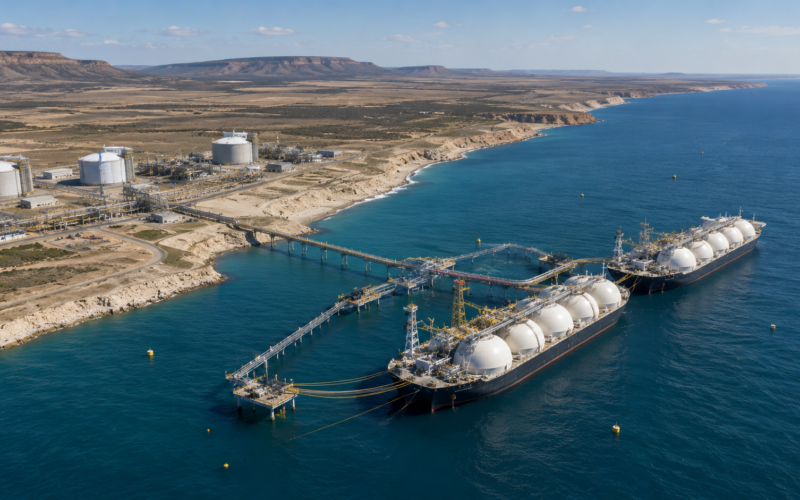
Eni S.p.A. (BIT: ENI; NYSE: E), Argentina’s state-controlled YPF S.A. (NYSE: YPF) and XRG, the international investment arm of Abu Dhabi National Oil Company (ADNOC), confirmed on August 14, 2026 that their jointly promoted Argentina LNG venture has filed to join Argentina’s Large Investment Incentive Regime, or RIGI. The filing covers a $51 billion integrated liquefied natural gas value chain that would draw shale gas from Argentina’s Vaca Muerta formation and export it through two floating liquefaction units offshore Río Negro province. It marks the largest single project submitted under RIGI to date and locks in the framework’s 30-year fiscal, customs and foreign-exchange stability as a precondition for a final investment decision the partners still expect by the end of 2026. The strategic significance is straightforward. Argentina LNG is now the reference case for whether the Milei administration’s flagship investment regime can anchor multi-decade export infrastructure at scale, while for Eni it is the largest single addition to a floating LNG franchise that has become central to its production and cash-flow trajectory into the 2030s.
How the $51 billion Argentina LNG programme is structured across the consortium
The consortium holding the project’s three upstream blocks was set up with YPF at 36% and Eni and XRG at 32% each, following sale and purchase agreements signed on June 29, 2026 and covering the Meseta Buena Esperanza, Aguada Villanueva and Las Tacanas unconventional gas licences in Neuquén province. Argentina LNG plans a fully integrated chain: rich gas production onshore in Neuquén, dedicated pipeline transportation, midstream processing and liquids fractionation trains, and two 6 million tonnes per year floating liquefaction vessels moored offshore Río Negro in the San Matías Gulf. Phase one totals 12 million tonnes per year of capacity, with a stated scale-up path to 18 million tonnes per year over time. YPF has said that construction is envisaged for 2026 to 2030 and that liquefaction is targeted to come on stream in 2031. The state company also disclosed an initial investment envelope of roughly $29 billion by start-up, with the $51 billion figure representing the full lifetime commitment, and forecast about $10 billion in annual export revenues over a 20-year window under its own base case.

Why joining RIGI is more than a routine regulatory step for the consortium
The RIGI framework was created by Law 27,742 (Ley de Bases) in July 2024 and offers qualifying special-purpose vehicles a 30-year package of tax, customs and foreign-exchange stability, a corporate income tax rate reduced from 35% to 25%, phased liberalisation of foreign-currency retention obligations on export proceeds, exemptions from import and export duties, and access to international arbitration seated outside Argentina. It applies to strategic sectors including oil and gas, mining, energy and infrastructure and requires a minimum investment of $200 million, a threshold Argentina LNG exceeds by more than two orders of magnitude. For an integrated LNG project whose economics depend on stable fiscal, customs and FX treatment over the full life of two 20-year offtake profiles, a granted RIGI status is close to a prerequisite for lender due diligence, offtaker credit committees and final investment decision materials. Approval is described in the enabling statute as a regulated and non-discretionary procedure administered by the Ministry of Economy, but it is not automatic and the Ministry must verify that the investment plan and SPV meet the criteria. The consortium has therefore chosen to move the RIGI decision to the front of the FID sequence, rather than treating it as a downstream administrative step.
How the Argentina LNG plan fits into Eni’s global floating LNG franchise
For Eni, Argentina LNG is being layered onto an already active floating LNG portfolio anchored in Coral South and the recently starting Coral North units in Mozambique and Congo LNG’s operating and second-phase floating units offshore Congo. Chief executive Claudio Descalzi flagged at the July 29, 2026 first-half results call that the Argentina upstream acquisition was one of a series of near-simultaneous positive project events, alongside final investment decisions on Baleine Phase 3 offshore Côte d’Ivoire, the Greater PAJ block off Angola through the Azule Energy joint venture, the Cronos gas project off Cyprus and the Searah joint venture with Petronas across Indonesia and Malaysia. Second-quarter pro forma EBIT of about €5.4 billion doubled year on year, second-quarter net income reached €2.3 billion, and cash flow from operations climbed more than 60% to €4.5 billion. The Global Gas and LNG Portfolio segment more than doubled its adjusted pro forma EBIT to about €1.04 billion in the quarter, and Eni raised its full-year segment guidance by 40%. Gearing dropped to about 10%, near the low end of the target range, and management raised the 2026 share buyback authorisation from €1.5 billion to €3.4 billion while keeping organic capex at around €9 billion. In that context, the Argentina commitment does not stretch Eni’s balance sheet, and it lengthens the visibility of production growth beyond the current 5% underlying 2026 uplift into a project cycle running through 2031 and beyond.
What XRG’s 32% stake reveals about Abu Dhabi’s expanding LNG portfolio
XRG’s participation is not incidental. The Abu Dhabi vehicle, wholly owned by ADNOC and structured to include Abu Dhabi Development Holding Company (ADQ) and Carlyle exposure, has been methodically acquiring positions across the global LNG value chain. Argentina LNG joins XRG’s existing interests in Phase 1 of NextDecade Corporation’s Rio Grande LNG project in Texas, in Azerbaijan’s Southern Gas Corridor CJSC transporting Caspian gas to Europe, and in Eni’s Rovuma LNG development in Mozambique. It sits alongside a broader Gulf pattern in which QatarEnergy holds a stake in Golden Pass LNG on the US Gulf Coast and Saudi Aramco has taken an interest in Port Arthur LNG. For Eni, having XRG rather than a purely financial partner alongside YPF matters commercially, because ADNOC’s affiliate can support long-term offtake, marketing and shipping optionality into Asia, Europe and the Middle East as physical volumes materialise later this decade. Mohamed Al Aryani, president of international gas at XRG, framed the Argentina LNG structure at inception as a combination of Eni’s floating LNG capability with YPF’s upstream position in Vaca Muerta, and the June 2026 SPA and the August 2026 RIGI filing are the operational follow-through on that framing.
How Argentina LNG’s floating design compares with land-based Gulf and Qatari competition
Choosing floating liquefaction rather than an onshore terminal is a deliberate cost-and-timing decision, not just an engineering preference. Eni’s Coral South and Congo floating LNG units have taken shorter build cycles and lower per-tonne capex than comparable land-based liquefaction trains, which is one of the reasons the Argentina programme has been designed around two 6 million tonnes per year vessels moored in the San Matías Gulf rather than around a new grassroots plant. This positions Argentina LNG to reach first cargoes in 2031, into a market where Qatar’s North Field expansion and multiple US Gulf projects, including several Rio Grande and Port Arthur phases in which XRG and Aramco already sit, will be adding tens of millions of tonnes per year of capacity between 2027 and 2030. The competitive question is therefore whether Argentina LNG can arrive with low delivered-to-Asia costs that reflect Vaca Muerta’s stated resource scale and FLNG capital efficiency, and whether the project’s phased 12 million to 18 million tonnes per year trajectory can be marketed against contracted volumes from lower-latency US and Qatari supply. The consortium’s stated ambition to build a competitive export platform is a claim about landed cost, not just about resource endowment, and the Vaca Muerta upstream productivity of the three blocks named in the SPA will be one of the earliest external tests of that claim.
What the filing means for YPF, President Milei and Argentina’s export strategy
For YPF and for the government, Argentina LNG is now the highest-visibility test case of the RIGI framework. YPF chairman and chief executive Horacio Marín framed the filing as a foundational milestone toward repositioning Argentina as a global energy exporter, citing local supplier development and international integration as expected downstream benefits. The consortium projects roughly 20,000 direct, indirect and induced jobs a year during construction, peaking at up to 40,000 in the third year, and around 8,000 operational roles once liquefaction is running. In parallel, YPF filed a separate RIGI application in May 2026 for a $25 billion oil-focused Vaca Muerta programme, and law-firm and government pipeline trackers put the current formal RIGI applications at roughly $95 billion, with economy minister Luis Caputo publicly pointing to a possible $140 billion total once expected filings including Chevron’s more than $10 billion Vaca Muerta expansion are formalised. President Javier Milei’s government has anchored a large part of its investment narrative on RIGI, and having a $51 billion, multi-decade export project as the reference case sharpens the political stakes on both sides, since a slow, contested or partial approval would send a negative signal to the rest of the pipeline while a clean, timely approval would materially validate the regime.
Which execution risks between now and 2031 first-gas remain most material
The main uncertainties fall into four buckets that the consortium and its lenders will spend the next 12 to 18 months working through. First, RIGI approval itself must land on the timetable that supports a FID within calendar 2026, and the Ministry of Economy’s process, while non-discretionary in principle, has not yet been tested on a project of this scale. Second, upstream productivity across Meseta Buena Esperanza, Aguada Villanueva and Las Tacanas must underwrite the offtake volumes required to fill two 6 million tonnes per year FLNG vessels through the 2030s, and any well-performance disappointment would flow directly into the project economics. Third, the LNG market Argentina LNG is targeting for 2031 first cargoes is being built out simultaneously by lower-risk US Gulf and Qatari competitors, and offtake pricing negotiated in 2027-28 will need to reflect that competitive backdrop rather than a tighter early-decade market. Fourth, the 30-year RIGI stability is a legislative construct that spans several Argentine electoral cycles, and while the law contains internal protections against more burdensome future regulation, the political durability of the framework is a factor lenders and export credit agencies will price into the debt package. None of these risks is on its own an obvious blocker, but each will need clean external evidence before a FID can be defended internally at Eni’s Rome board, at ADNOC and at YPF’s own board and majority shareholder.
Key takeaways for investors from Argentina LNG’s RIGI filing and Eni’s role
- Argentina LNG has filed the largest RIGI application on record at a $51 billion lifetime commitment, with roughly $29 billion of capital expected by start-up in 2031.
- The venture is held YPF 36%, Eni 32% and XRG 32%, following the June 29, 2026 upstream sale and purchase agreements on three Vaca Muerta blocks.
- Phase one capacity is 12 million tonnes per year through two 6 million tonnes per year floating LNG vessels in the San Matías Gulf, with a stated scale-up path to 18 million tonnes per year.
- RIGI status offers 30-year fiscal, customs and foreign-exchange stability, a 25% corporate income tax rate and phased FX liberalisation, and is being treated as a precondition for the final investment decision.
- Eni is committing the Argentina programme on the back of a Q2 2026 result in which pro forma EBIT and net income doubled year on year and Global Gas and LNG Portfolio EBIT more than doubled to about €1.04 billion.
- The 2026 buyback has been raised to €3.4 billion, organic capex is being held at around €9 billion and gearing is near 10%, giving Eni room to fund its share without stretching the balance sheet.
- XRG’s involvement plugs Argentina LNG into a global Abu Dhabi-anchored gas platform that already includes stakes in Rio Grande LNG, Southern Gas Corridor and Rovuma LNG.
- The main execution risks are timely RIGI approval, upstream productivity across the three named blocks, offtake pricing into a well-supplied 2031 market and the political durability of RIGI across Argentine electoral cycles.
- The immediate proof point is the Ministry of Economy’s handling of the RIGI application on a schedule consistent with a final investment decision by the end of 2026.
- The longer-term proof point is delivered LNG cost from Vaca Muerta to Asian and European buyers competitive with US Gulf and Qatari expansion volumes coming to market between 2027 and 2030.
Discover more from Business-News-Today.com
Subscribe to get the latest posts sent to your email.

