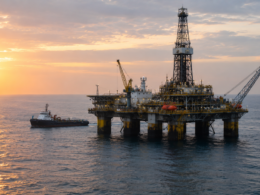




Eni S.p.A., listed on Euronext Milan under the ticker ENI, and TotalEnergies SE, listed on Euronext Paris and the New York Stock Exchange under the ticker TTE, have taken the final investment decision for the Cronos gas field in Cyprus offshore Block 6. Eni operates the licence with a 50% interest, while TotalEnergies owns the remaining 50%. The partners plan to develop Cronos through four subsea wells, transport the gas to Egypt and export it as liquefied natural gas through the Damietta LNG terminal, with first production targeted for 2028. Plateau output is expected to reach approximately 500 million cubic feet per day, equivalent to around 2.8 million tonnes of LNG annually. The central tension is whether reusing the Zohr and Damietta infrastructure can deliver a genuinely low-cost, fast-track development while coordinating construction, gas transit and commercial obligations across Cyprus and Egypt.
Why does the Cronos final investment decision represent a historic change for Cyprus?
Cronos will become the first offshore gas discovery in Cyprus to advance into commercial development. The decision moves the country beyond exploration, appraisal and resource announcements toward infrastructure construction, production and exports.
The field was discovered in 2022 and successfully appraised through the Cronos-2 well in 2024. Cyprus’ Hydrocarbons Service currently estimates the best-case gas-in-place resource at approximately 3.1 trillion cubic feet. Gas in place is not the same as recoverable reserves, meaning the full 3.1 trillion cubic feet should not be treated as commercially producible volume.
That distinction matters because the economic value of Cronos will depend on reservoir recovery, well productivity, operating availability and the costs required to transport and process the gas. The final investment decision indicates that the partners believe sufficient commercial certainty has been achieved, but neither company disclosed the final recoverable reserve estimate or total development expenditure.
For Cyprus, the project creates a potential new revenue stream from hydrocarbons and establishes a route through which additional offshore discoveries could eventually be commercialised. Block 6 also contains the Zeus and Calypso discoveries, while other operators are evaluating separate resources elsewhere in the Cypriot exclusive economic zone.
Cronos therefore matters as both an individual project and an infrastructure precedent. If the development performs reliably, later discoveries may be able to use a similar route rather than waiting for Cyprus to build its own large-scale liquefaction terminal.
The project does not automatically convert every Cypriot discovery into an economic development. Resource size, distance, reservoir quality and available capacity in Egypt will still determine which fields can be connected profitably.
How will four deepwater wells connect Cyprus gas with the Egyptian LNG system?
Cronos lies approximately 185 kilometres southwest of Cyprus in deep offshore waters. The development will use four subsea production wells connected to a new subsea pipeline transporting gas from Cypriot waters toward Egypt.
Once in Egypt, the gas will use facilities associated with the Zohr field for processing before being delivered to the Damietta LNG terminal for liquefaction and export. The commercial agreements cover access to the offshore Zohr facilities, gas transit through Egypt, liquefaction at Damietta and the sale of the resulting LNG.
This development model avoids the need to construct a new standalone processing and liquefaction complex in Cyprus. Large onshore LNG terminals can cost billions of dollars and require substantial feed-gas certainty before financiers will commit capital.
Using infrastructure already installed in Egypt should reduce the amount of new equipment required, shorten the construction schedule and lower the emissions associated with building and operating duplicate facilities. TotalEnergies has characterised Cronos as consistent with its preference for lower-cost and lower-emission upstream projects.
The approach also introduces several interfaces. The subsea production system must deliver gas at the required pressure and quality. The pipeline must connect safely across maritime jurisdictions. Zohr facilities must have sufficient processing availability, while Damietta must be capable of receiving and liquefying the volumes when scheduled.
Any disruption at one part of the chain could affect the rest of the system. Cronos may be located in Cyprus, but its commercial performance will depend partly on facilities, contracts and operating decisions in Egypt.
That interdependence is the price of infrastructure reuse. The partners can avoid constructing an entirely independent export chain, but they must manage more cross-border contractual and operational relationships.
Can existing infrastructure make Cronos commercially stronger without revealing the project cost?
Eni and TotalEnergies have not disclosed the total capital expenditure, expected internal rate of return, operating cost or breakeven LNG price for Cronos. Investors therefore cannot calculate a precise project valuation from the final investment decision announcement.
The strongest economic argument is infrastructure efficiency. Four subsea wells and a pipeline should require less capital than developing the reservoir alongside a dedicated processing plant and new liquefaction terminal.
Damietta has nominal liquefaction capacity of approximately 5.2 million tonnes per year. Cronos’ planned 2.8 million tonnes of annual LNG-equivalent production would represent more than half that nameplate capacity if the field reaches plateau and all production is directed through the terminal.
Existing capacity does not mean the service will be free. Cronos will incur processing, transportation, liquefaction and marketing charges under agreements whose financial terms remain confidential.
The partners must also invest in the new subsea wells, gathering infrastructure, controls and offshore pipeline. Deepwater drilling and subsea construction involve specialised vessels, long-lead equipment and significant technical risk.
The development appears relatively capital efficient compared with a standalone LNG scheme, but describing it as cheap would go beyond the disclosed evidence. The more defensible conclusion is that infrastructure reuse should lower the capital and schedule burden relative to building a complete export system from scratch.
Commercial proof will emerge when the companies disclose investment guidance, contractor awards or project-level economics, and ultimately when Cronos begins generating cash flow.
Why does the Cronos project matter for Egypt’s Damietta LNG terminal and gas balance?
Egypt has two LNG export terminals, but domestic production and consumption have repeatedly affected their utilisation. When domestic gas availability tightens, feed gas can be diverted away from exports to support local electricity and industrial demand.
Cronos introduces a new source of gas that originates outside Egypt’s domestic resource base. This could support more consistent utilisation at Damietta without requiring the same volume to be withdrawn from Egyptian consumers.
Eni said the project would enable the restart of the Damietta LNG plant and restore structural LNG exports from Egypt. That language indicates the company expects Cronos to provide a more dependable long-term feed-gas source than the terminal has recently received.
The arrangement can benefit Egypt through transit, processing and liquefaction income while reinforcing the country’s role as the Eastern Mediterranean’s principal gas-processing and LNG-export hub.
Egypt already possesses infrastructure that would be expensive and time-consuming to duplicate elsewhere in the region. Cyprus possesses offshore resources but lacks an operating LNG export terminal. Cronos brings the two positions together.
The risk is that Egypt’s domestic gas requirements, infrastructure availability and policy priorities could change during the project’s operating life. The contractual framework will need to protect Cypriot gas transit and liquefaction even when domestic energy conditions become more challenging.
The main commercial agreements have now been signed, which materially reduces uncertainty. Their detailed provisions, including capacity rights, interruption protections and tariff structures, remain confidential.
How does Cronos expand Eni’s LNG portfolio and Eastern Mediterranean strategy?
Eni expects to market 50% of the LNG produced from Cronos, equivalent to approximately 1.4 million tonnes annually at plateau. The company said those volumes would support its objective of expanding its contracted LNG portfolio beyond 20 million tonnes per year by 2030.
This is strategically important because Eni is not treating LNG solely as a liquefaction business. It is building an integrated portfolio connecting equity gas production, processing plants, LNG facilities, shipping, trading and customer contracts.
Equity-linked LNG can give Eni greater control over supply and potentially allow the company to capture margin at several stages of the chain. The profitability of that model still depends on development costs, liquefaction charges, shipping expenses and destination-market prices.
Cronos also strengthens Eni’s Eastern Mediterranean position around Egypt. The company operates the Zohr gas field, holds an interest in Damietta and has exploration positions across Cyprus and Egypt.
This concentration creates operational and commercial synergies. Discoveries can potentially be connected to infrastructure Eni already understands and partly controls, rather than requiring entirely new export systems.
Eni’s first-quarter 2026 production increased 9% year on year to approximately 1.8 million barrels of oil equivalent per day. The company reported €3.5 billion of pro forma adjusted EBIT, €1.3 billion of adjusted net profit and €2.9 billion of cash flow from operations before working-capital movements.
Those figures indicate that Eni has the financial capacity to fund its 50% share of Cronos alongside other projects. However, its second-quarter results are scheduled for July 29, meaning the first-quarter figures remain the latest fully disclosed financial position at the time of the Cronos announcement.
The project will not materially change Eni’s near-term production because first gas is two years away. Its value lies in supporting post-2028 gas growth and expanding LNG volumes close to European markets.
What does TotalEnergies gain from marketing 1.4 million tonnes of Cronos LNG annually?
TotalEnergies will also market 50% of Cronos LNG production, equivalent to approximately 1.4 million tonnes annually. The company expects its global LNG portfolio to reach around 60 million tonnes per year by 2030, making Cronos a relatively modest but strategically placed addition.
Location is an important advantage. Damietta sits in the Mediterranean, significantly closer to European customers than many Gulf Coast, East African or Pacific LNG projects.
Shorter shipping distances can lower transport costs and allow cargoes to respond more quickly to European demand. The route may be particularly valuable when regional storage levels are low or competition with Asian buyers increases.
TotalEnergies reported second-quarter adjusted net income of approximately $6 billion and cash flow before working-capital movements of $9.8 billion. Exploration and production generated $3.2 billion of adjusted net operating income, while the Integrated LNG segment produced $807 million after being affected by weaker gas-trading performance.
The weaker LNG trading quarter demonstrates that owning and marketing LNG does not guarantee stable quarterly earnings. Results can move with pricing, trading positions, contract structures and demand conditions.
Cronos adds equity-linked supply that may strengthen the physical foundation beneath TotalEnergies’ trading portfolio. It will not eliminate market volatility, but it gives the company additional volumes that can be directed between customers and regions.
TotalEnergies’ strong cash generation and 13.1% gearing ratio indicate that its 50% project commitment is manageable within the wider capital programme. The company maintained annual net investment guidance of approximately $15 billion.
The investment test will be whether Cronos can meet TotalEnergies’ stated preference for projects with competitive costs and lower operating emissions, while delivering acceptable returns across different LNG-price environments.
Will Europe still need Cronos LNG when production begins in 2028?
Cronos is being positioned as a source of diversified gas supply for Europe. The argument is based on geography, existing Mediterranean infrastructure and Europe’s continuing need to replace or reduce exposure to less secure pipeline sources.
The field’s expected 2.8 million tonnes of annual LNG is meaningful for Cyprus and Damietta but relatively small within the wider European gas market. It will diversify supply rather than transform the continent’s energy balance.
Demand uncertainty remains a central commercial issue. European renewable generation, efficiency policies, electrification and climate targets are intended to reduce long-term fossil-fuel consumption. At the same time, gas continues to support power generation, industrial demand, heating and system flexibility.
The project’s 2028 start date places it within a period when Europe is likely to continue importing substantial LNG, even if overall gas demand declines. The commercial question is not simply whether Europe consumes gas, but whether Cronos can compete against United States, Qatari, African and other Mediterranean LNG supplies.
Its proximity provides an advantage. The existing infrastructure route may support lower costs. However, the undisclosed LNG pricing and contract structure prevent a definitive conclusion about competitiveness.
Eni and TotalEnergies can also market cargoes beyond Europe when economics favour other destinations, subject to contractual terms. LNG’s value lies partly in its ability to move between markets rather than being tied permanently to one pipeline destination.
The strongest long-term position would combine competitively priced production with flexible sales arrangements. The project would be more exposed if its economics required consistently elevated European spot prices.
What execution risks remain before Cronos can deliver first Cypriot gas in 2028?
The final investment decision removes a major commercial uncertainty but begins the most capital-intensive stage of the project.
The partners must drill and complete four deepwater production wells, manufacture and install subsea equipment, construct the export pipeline and connect it with Egyptian infrastructure. Each activity requires specialised contractors and equipment that may have constrained global availability.
Subsea pipeline installation must also account for seabed conditions, water depth, route engineering and the connection between two national jurisdictions.
The 2028 target is relatively fast for a cross-border deepwater gas development. Existing Egyptian facilities make that schedule possible, but they also create interface dependencies that must be resolved in parallel.
Zohr processing availability will be critical. Damietta must be prepared to receive the gas, and commercial agreements must translate into practical scheduling and operating procedures.
Reservoir performance will provide another test. The four-well design assumes each well can deliver sufficient sustained output to reach the 500 million cubic feet per day plateau. The Cronos-2 appraisal demonstrated strong reservoir deliverability, but long-term performance will only become clear after production begins.
Cost inflation could also affect returns. Offshore construction vessels, subsea equipment and skilled personnel are in demand across several global projects.
The investment thesis would strengthen if major engineering and construction contracts are awarded promptly, drilling proceeds without significant complications and the pipeline remains on schedule. It would weaken if equipment delays, cost overruns or infrastructure constraints push first gas beyond 2028.
How did Eni and TotalEnergies shares trade after the Cronos investment decision?
Eni’s New York-listed depositary shares traded around $50.85 during the July 28 session, approximately 0.4% above the previous close. The price was around 1.3% higher than the July 21 close and about 9.1% above the June 29 level. The shares remained approximately 12% below their 52-week high of $58.
TotalEnergies shares traded around $84.98 in New York, up approximately 1% during the session. The stock was around 1.7% above its July 21 close and approximately 9.4% higher than on June 29. It remained close to 10% below its 52-week high of $94.17.
The positive movements coincided with the Cronos announcement, but they should not be attributed entirely to the project. Both companies are influenced by crude oil prices, European gas markets, geopolitical conditions and broader investor sentiment toward integrated energy producers.
TotalEnergies had also reported strong second-quarter results on July 23, while investors were awaiting Eni’s second-quarter results on July 29. Cronos is strategically important, but its cash-flow contribution will not begin until 2028.
The initial market response therefore reflects a broader energy and earnings environment rather than a pure valuation of the Cypriot project.
A sustained project-related valuation benefit will require evidence that Cronos remains on schedule, costs remain controlled and the LNG volumes are supported by commercially attractive arrangements.
Which milestones will determine whether Cronos becomes a successful Eastern Mediterranean gas hub?
The first milestones will be major contractor awards and the start of subsea equipment manufacturing. These disclosures should provide greater clarity on project execution and may reveal more about capital requirements.
Drilling progress will provide the next test. Four reliable, high-deliverability wells are essential to achieving the planned production plateau.
Pipeline installation and connection to Egyptian infrastructure will be equally important. A delay in the export route would prevent commercial production even if the wells were completed.
The partners must also confirm that the Zohr processing and Damietta liquefaction facilities are ready when Cronos gas arrives. Coordinated commissioning across all parts of the chain will determine whether the 2028 target is achieved.
Commercial evidence will come from LNG sales agreements and the realised margin between upstream production costs, Egyptian infrastructure charges and LNG sales prices.
The project would gain further strategic value if the partners appraise and develop additional Block 6 resources using the same infrastructure. TotalEnergies said future appraisal campaigns could establish whether other discoveries can follow Cronos through the Egyptian route.
What has improved is that the governments, partners and infrastructure owners have moved from preliminary agreements to a sanctioned development with a defined export route. What remains unresolved is total capital expenditure, recoverable reserves, contractor execution and the long-term LNG margin.
The decisive proof point will be first gas in 2028. Success would establish Cyprus as a commercial gas producer and demonstrate that Eastern Mediterranean discoveries can be monetised through existing Egyptian infrastructure rather than waiting for new LNG megaprojects.
What are the key takeaways from the Eni and TotalEnergies Cronos gas decision?
- Eni and TotalEnergies have taken the final investment decision for the Cronos gas development in Cyprus offshore Block 6.
- Eni operates the project with a 50% interest, while TotalEnergies owns the remaining 50%.
- Cronos will become Cyprus’ first commercial offshore gas development.
- The field contains a best-estimate 3.1 trillion cubic feet of gas in place, which should not be confused with recoverable reserves.
- Four subsea wells are expected to deliver plateau production of approximately 500 million cubic feet per day.
- Gas will travel through a new subsea pipeline to Egypt for processing through Zohr-linked facilities.
- The Damietta LNG terminal will liquefy the gas, producing the equivalent of around 2.8 million tonnes of LNG annually.
- Eni and TotalEnergies will each market approximately 1.4 million tonnes of LNG per year at plateau.
- Existing Egyptian infrastructure should reduce capital intensity and development time, although total project expenditure remains undisclosed.
- Contractor awards, subsea drilling, pipeline completion and first gas in 2028 are the next measurable milestones.
Discover more from Business-News-Today.com
Subscribe to get the latest posts sent to your email.