



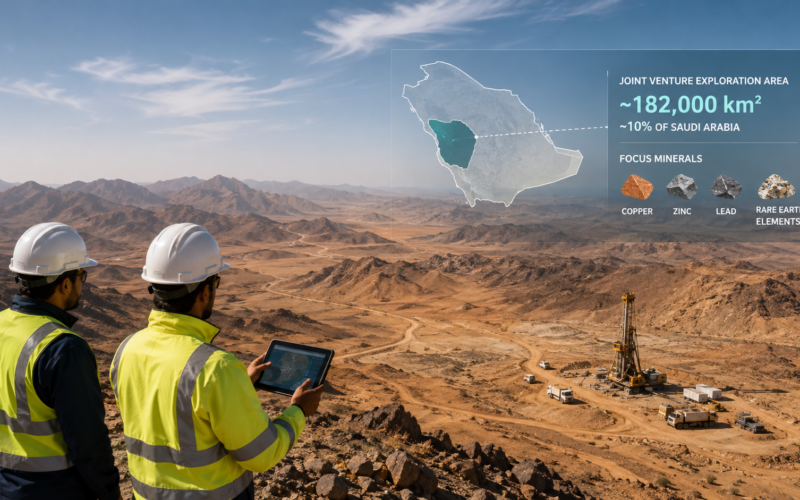
Saudi Aramco (Tadawul: 2222) and Saudi Arabian Mining Company Ma’aden (Tadawul: 1211) signed a shareholders agreement on 18 August 2026 to form a joint venture focused on mineral exploration and hard-rock mining across roughly 182,000 square kilometres of the Kingdom’s western interior, an area equivalent to close to 10 per cent of Saudi Arabia’s total land mass. The joint venture will be owned 51 per cent by Ma’aden and 49 per cent by Aramco, with exploration concentrated on copper alongside zinc, lead and rare earth elements rather than the lithium-led programme first sketched out at the Future Minerals Forum in January 2025. The transaction converts an 18-month-old non-binding framework into a formal corporate structure and commits Aramco, one of the world’s largest integrated energy producers, to sustained investment in an adjacent extractive industry for the first time on a defined footprint. The strategic logic combines Aramco’s 90 years of geological and geophysical data from the Arabian Platform with Ma’aden’s mining and processing expertise. The arithmetic, however, remains that of a greenfield exploration story: high optionality, distant cash flows, and a scope that has quietly moved from a specific transition-metal thesis to a broader base-metal and critical-minerals hunt.
Why does the Aramco and Ma’aden shareholders agreement matter more than the January 2025 heads of terms?
The January 2025 announcement at the Future Minerals Forum in Riyadh committed the two companies only to a non-binding statement of intent. It described a proposed joint venture concentrated on lithium extraction from high-concentration deposits and on the development of cost-effective direct lithium extraction technology. Aramco characterised the arrangement as an adjacent-sector move that would leverage its technological innovation and its resource and data-management capabilities. Ma’aden framed it as a way to accelerate Saudi Arabia’s ambition to serve global critical-mineral demand. Neither party disclosed capital commitments, ownership percentages, or specific milestones at that stage. The shareholders agreement signed on 18 August 2026 attaches specific terms: 51-49 ownership favouring Ma’aden, a defined 182,000 square kilometre exploration area within the Arabian Platform known as Zone-4 or the Transition Zone, and an explicit copper-first exploration mandate that reaches into zinc, lead and rare earth elements. For minority shareholders on both sides of the register, the shareholders agreement is the moment the venture becomes real corporate activity rather than aspiration. It also fixes the governance geometry, with Ma’aden as majority operator and Aramco as a minority strategic partner contributing data and computational capability rather than mining execution.
What does the 182,000 square kilometre Zone-4 exploration area actually offer for base metal discovery?
Zone-4 is a 100-kilometre-wide corridor running parallel to the Arabian Shield along the sedimentary and structural boundary where the shield transitions into the Arabian Platform. The Arabian Shield is the exposed Precambrian basement rock that hosts most of Ma’aden’s existing gold and base-metal operations in the western region. The Transition Zone remains comparatively under-explored because commercial mining historically concentrated on outcropping mineralisation within the shield itself. Regional exploration theory in Saudi Arabia treats the transition boundary as prospective for structurally controlled copper deposits, volcanogenic massive sulphide styles, and potentially rare earth mineralisation associated with alkaline intrusive complexes. The 182,000 square kilometre licence area is unusually large by global comparison; it exceeds the combined national mining licence footprint of several producing jurisdictions. The scale means that discovery odds compound with area, but exploration costs and time to first-pass evaluation compound with it as well. Regional-scale coverage typically requires multi-year airborne geophysics campaigns, systematic geochemical sampling, target-generation drilling and staged resource definition before a maiden resource can be published. Nothing in the shareholders agreement signals a timeline to first resource statement, and both companies have declined to guide on when regional work will translate into drill-ready targets.
How has the joint venture’s scope shifted from lithium extraction to copper and rare earth exploration?
The most analytically significant feature of the August 2026 announcement is not the ownership split but the change in commodity focus. The January 2025 non-binding heads of terms placed lithium and direct lithium extraction technology at the centre of the proposed collaboration, with a stated aspiration that commercial lithium production could potentially commence by 2027. The 18 August 2026 shareholders agreement makes no reference to that timeline and describes the primary target as copper, followed by zinc, lead and rare earth elements. Direct lithium extraction, as originally framed, was to have been developed largely from oilfield brines, a technical extension of Aramco’s produced-water handling capability. The reframing towards hard-rock exploration for copper and base metals implies a different technical partnership, weighted more heavily towards Ma’aden’s mining engineering capability and less towards Aramco’s fluid-processing expertise. Two readings are possible. The first is that the lithium brine thesis has proved more technically or economically challenging than the January 2025 announcement suggested, prompting a broadening rather than an abandonment of the mineral basket. The second is that copper’s macro backdrop, characterised by structural supply concerns from ageing mines in Chile and Peru and rising energy-transition demand, has become a more pressing strategic priority for the Kingdom’s mining ambitions. Both readings can be true simultaneously. What matters for shareholders is that the joint venture now has an exploration objective aligned with a base-metal market where new discoveries are genuinely scarce, and a copper price cycle that many operators expect to remain firm through the second half of the decade.

What does Aramco’s subsurface data and computational stack add to a mining exploration campaign?
Aramco has spent nine decades acquiring seismic, gravity, magnetic and well-log data across the Arabian Platform for hydrocarbon exploration. The company describes this holding as the largest single-basin geological and geophysical dataset ever acquired for the Kingdom. Applied to mineral exploration, that dataset can be reprocessed to identify structural traps, alkaline intrusions, hydrothermal alteration zones and other geophysical signatures relevant to base-metal and rare earth mineralisation. Aramco’s sustained investment in artificial intelligence, machine learning and high-performance computing gives the venture the capacity to run large-scale pattern-recognition workflows across that legacy dataset in a way that few pure-play miners could match. The commercial question is whether this data advantage compresses the discovery timeline meaningfully. Historically, machine-learning-assisted exploration has improved target ranking rather than reduced the need for physical drilling. Ma’aden’s operational role, from target generation through drilling to resource estimation and metallurgical work, remains the binding constraint on how quickly a discovery could reach a scoping study. The value of the Aramco contribution therefore lies less in shortening the fundamental exploration cycle and more in improving the strike rate on early-stage targets, which reduces wasted drilling metres and improves the capital efficiency of the campaign over the medium term.
How does the joint venture fit Ma’aden’s wider consolidation of Saudi Arabia’s critical minerals footprint?
Ma’aden has been aggressively reshaping its portfolio over the past 18 months. In July 2025 it completed the acquisition of Alcoa Corporation’s 25.1 per cent stake in the Ma’aden Bauxite and Alumina Company and Ma’aden Aluminium Company for total consideration of approximately 1.35 billion United States dollars, comprising roughly 86 million newly issued Ma’aden shares valued at closing and a cash element related to taxes and transaction costs. That transaction consolidated full ownership of the Kingdom’s integrated aluminium business inside Ma’aden. Ma’aden has also signed a memorandum of understanding with MP Materials Corporation of the United States to explore an integrated rare earth supply chain in the Kingdom, and it participates alongside Saudi Arabia’s Public Investment Fund in Manara Minerals, the vehicle that has been in discussions over a minority stake in First Quantum Minerals. The Aramco joint venture adds a very early-stage exploration engine to a portfolio that already spans phosphates, gold, aluminium, ammonia and downstream rare earth ambitions. Investors evaluating Ma’aden are increasingly buying into a national mining champion whose growth is being financed and directed through a combination of Public Investment Fund backing, portfolio consolidation and partnerships with strategically aligned corporate players. The Aramco venture is consistent with that pattern, though it is important to distinguish between the operating assets Ma’aden already produces revenue from today and the exploration acreage that the current shareholders agreement covers.
Where does the Aramco-Ma’aden partnership sit within the Vision 2030 critical minerals strategy?
Saudi Arabia estimates the value of its unexploited mineral resources at approximately 9.3 trillion Saudi riyal, or roughly 2.5 trillion United States dollars, on the basis of updated surveys carried out during the Future Minerals Forum cycle. Under Vision 2030, the Kingdom’s mining strategy targets a contribution of approximately 64 billion United States dollars to gross domestic product by the end of the decade, up from a starting point measured in single-digit billions. The critical minerals agenda is one of the more explicit pillars of the Kingdom’s economic diversification, and it has attracted state-directed capital, regulatory reform and international partnerships. The Aramco-Ma’aden joint venture is directly aligned with that policy architecture. It gives the Kingdom a mechanism to accelerate exploration on a scale that neither company would attempt alone, using domestic corporate capital and existing legacy datasets rather than fresh sovereign spending, and it positions Saudi Arabia as an emerging source of copper, zinc, lead and rare earth production in a market segment where allied and Western consumers are increasingly focused on diversification away from concentrated Chinese, Congolese and Latin American supply. The policy alignment is favourable and the regulatory pathway inside the Kingdom is unlikely to obstruct progress. Policy tailwinds, however, do not shorten geological, metallurgical or permitting timelines in absolute terms.
What execution and timeline risks do shareholders in Aramco and Ma’aden need to price into the joint venture?
Greenfield exploration ventures typically require ten to fifteen years to move from initial regional work to first commercial production, assuming a discovery of economic scale is made along the way. Neither party has disclosed the initial capital commitment to the joint venture, the expected annual exploration budget, or the timeline to first resource estimate. That absence of quantified milestones limits the ability of shareholders to model a probability-weighted contribution to future earnings. For Aramco, a company that reported adjusted net income of 33.4 billion United States dollars in the second quarter of 2026 and maintained annual capital expenditure guidance in the 50 to 55 billion United States dollar range, the exploration budget is unlikely to be material to consolidated financials in the near term. For Ma’aden, with a market capitalisation of roughly 245 billion Saudi riyal and a portfolio weighted towards mature phosphate, gold and aluminium operations, incremental exploration commitments over a decade are absorbable, but success or failure at Zone-4 becomes progressively more consequential to long-run growth positioning. Other risks include commodity-price volatility during the exploration window, the possibility that geological work fails to identify a resource of economic scale despite the geological prospectivity of the transition boundary, and the governance dynamics of a 51-49 partnership between two entities with different corporate cultures, capital priorities and shareholder bases. The venture is subject to customary regulatory approvals in the Kingdom, which appear procedural in this instance but remain a formal condition of completion.
What does the shareholders agreement leave unresolved, and what would strengthen the investment case?
The 18 August 2026 announcement improves the strategic clarity of what both companies intend to build together, but it leaves significant questions open. The shareholders agreement fixes ownership but has not disclosed capital commitment, funding structure, exploration budget, exclusivity terms with respect to other partners, or milestones for progressing from regional work through target definition to drilling. Nothing in the disclosed terms indicates whether royalty payments, offtake rights, or downstream processing rights sit with the joint venture, Ma’aden or Aramco. The lithium extension of the January 2025 heads of terms has not been publicly retracted, and it remains unclear whether direct lithium extraction remains a longer-term ambition of the vehicle or has been shelved altogether in favour of the hard-rock focus. The investment case for both Aramco and Ma’aden would strengthen if the parties disclosed initial capital commitments, if early-year exploration produces meaningful geophysical targets, if a first resource statement emerges within the first three to four years of activity, and if the venture attracts either offtake commitments from strategic customers or a defined role in the Kingdom’s rare earth value chain. It would weaken if drilling campaigns yield sub-economic results across the priority targets, if commodity prices soften materially during the exploration window, or if governance friction between the partners slows the pace of decision-making. The next measurable proof point for both sets of shareholders is the disclosure of an initial exploration programme and budget, which typically follows a shareholders agreement within a defined near-term window.
Key takeaways from the Aramco and Ma’aden shareholders agreement covering Zone-4 mineral exploration
- Aramco and Ma’aden signed a shareholders agreement on 18 August 2026 to form a joint venture focused on mineral exploration and hard-rock mining across Zone-4 of the Arabian Platform.
- The joint venture will be owned 51 per cent by Ma’aden and 49 per cent by Aramco, giving Ma’aden operational majority control.
- The exploration area covers approximately 182,000 square kilometres, close to 10 per cent of Saudi Arabia’s total land mass, in a 100-kilometre-wide corridor parallel to the Arabian Shield.
- The commodity focus has shifted from the January 2025 lithium and direct lithium extraction emphasis to copper as the primary target, alongside zinc, lead and rare earth elements.
- Aramco contributes 90 years of subsurface geological and geophysical data plus AI and high-performance computing capability; Ma’aden contributes mining engineering and operational execution.
- The transaction converts an 18-month-old non-binding framework into formal corporate activity but does not disclose initial capital commitments, annual exploration budgets, or milestones to a first resource estimate.
- Saudi Arabia values its unexploited mineral wealth at approximately 2.5 trillion United States dollars and targets 64 billion United States dollars of mining GDP contribution by 2030 under Vision 2030.
- The venture aligns with Ma’aden’s broader portfolio consolidation, including the July 2025 Alcoa buy-in for approximately 1.35 billion United States dollars and the MP Materials rare earth memorandum of understanding.
- Greenfield exploration ventures typically require 10 to 15 years from initial regional work to first commercial production, and the venture is subject to customary Saudi regulatory approvals.
- Key forward proof points are disclosure of an initial exploration budget, first regional geophysical results, and eventual maiden resource statement, which will together determine whether the strategic option value translates into cash-generating assets.
Discover more from Business-News-Today.com
Subscribe to get the latest posts sent to your email.