



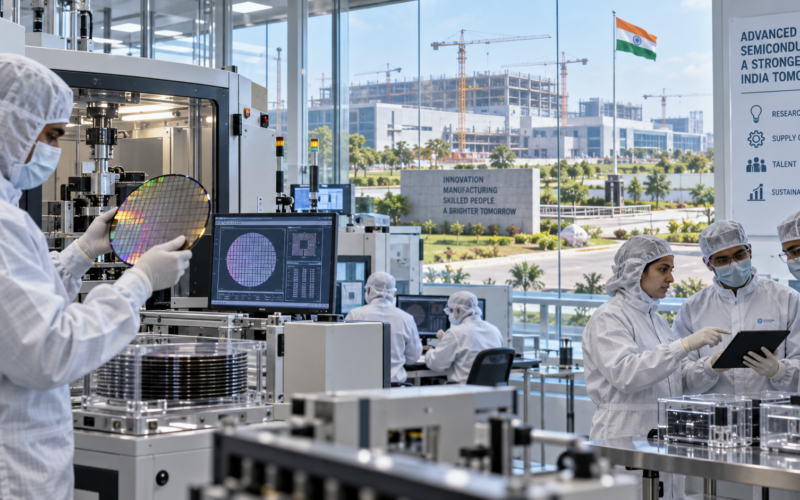
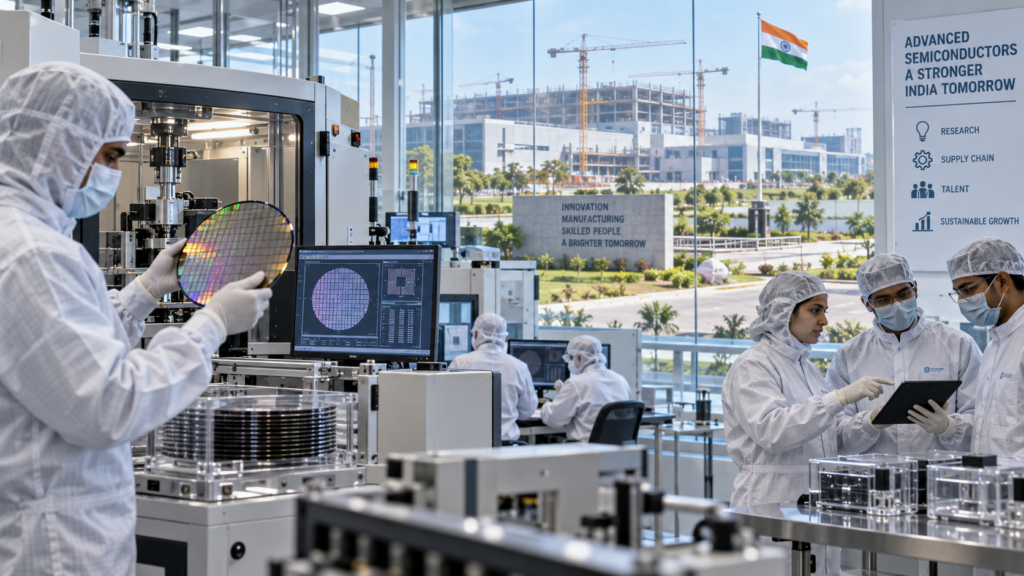
Applied Materials Inc. (NASDAQ: AMAT) will invest $5 billion in India over the next decade, giving the country one of its largest new commitments from a global semiconductor equipment company as India attempts to move from chip design and packaging toward a deeper manufacturing ecosystem. The investment will focus on research, scaling the local supply chain and developing semiconductor talent rather than simply financing a single fabrication plant. Applied Materials disclosed the programme at SEMICON India in New Delhi on September 17, where more than 600 companies and representatives from 52 countries gathered around India’s growing semiconductor ambitions.
The scale matters because Applied Materials sits close to the foundation of the semiconductor industry. Its equipment is used to deposit, remove, modify and inspect materials during chip manufacturing, giving the company exposure to virtually every major semiconductor investment cycle. Applied Materials reported record fiscal third-quarter 2026 revenue of $9.12 billion, up 25% year over year, while non-GAAP earnings per share increased 41% to a record $3.50. The $5 billion India commitment therefore comes from a company already benefiting materially from global investment in artificial intelligence, memory, logic and advanced packaging.
Why is Applied Materials expanding so aggressively in India now?
India is trying to position itself as an additional semiconductor manufacturing location at a time when companies and governments are reassessing geographic concentration across Taiwan, China, South Korea and other established semiconductor centres. Government estimates cited by Reuters suggest Indian semiconductor consumption could reach $110 billion by 2030, compared with roughly $45 billion to $50 billion in 2025. India has already committed more than $21 billion through two semiconductor incentive programmes and approved 12 projects, although large-scale wafer fabrication remains at an early stage.
Applied Materials has been building an Indian technology base for much longer than the latest policy push. The company established its Indian operations in 2002 and now has activities across Bengaluru, Chennai, Mumbai and Pune. Its teams work on product design, engineering, software, validation and semiconductor equipment development, making India more than a sales location for the US company.
In 2023, Applied Materials announced a planned $400 million collaborative engineering centre in Bengaluru intended to connect its engineers with semiconductor suppliers, universities and research institutions. The company said at the time that the centre could support more than $2 billion of additional planned investment over its first five years, create at least 500 advanced engineering jobs and potentially support another 2,500 jobs across the manufacturing ecosystem. Applied Materials subsequently opened an India Validation Center and, in early 2026, inaugurated a new Bengaluru campus exceeding 800,000 square feet.
The latest $5 billion commitment therefore looks less like an entry into India than an acceleration of a long-term localisation strategy. Applied Materials already possesses engineering capabilities in the country; the next phase involves connecting those engineers with suppliers, component manufacturers and potential semiconductor fabs.
Why does semiconductor equipment matter more than headline chip-factory announcements?
A fabrication plant cannot operate without hundreds of highly specialised pieces of equipment, materials and subsystems. Countries seeking semiconductor sovereignty therefore need much more than one expensive fab. They need chemicals, gases, precision components, clean-room infrastructure, process-control systems, skilled engineers and suppliers capable of meeting extraordinarily tight specifications.
That is where Applied Materials could have an outsized ecosystem effect. The company previously said it wanted global suppliers from Japan, South Korea, the United States and Europe to assess India as a manufacturing location, effectively using its own expansion to encourage parts of its supplier network to localise. A stronger equipment supply chain could reduce dependence on imported components and make Indian semiconductor projects easier to operate at commercial scale.
This distinction is especially relevant because India’s fabrication ambitions have progressed more slowly than its packaging projects. Three chip-packaging plants, including a Micron Technology Inc. facility, have begun commercial production, but India has yet to produce chips from a large-scale wafer fabrication plant under its current incentive programme. Reuters reported that the marquee Tata Electronics fabrication project in Gujarat, valued at approximately $10 billion, has experienced a delay approaching two years.
Packaging plants can establish workforce capabilities and supplier relationships, but fabrication represents a significantly harder industrial step. Applied Materials’ expansion gives India expertise on precisely that side of the semiconductor value chain.
How does the India investment fit Applied Materials’ AI-driven growth?
Artificial-intelligence investment is increasing semiconductor complexity rather than simply increasing chip volumes. Advanced processors require sophisticated materials engineering, new transistor structures, advanced packaging and high-bandwidth memory, all areas where semiconductor manufacturing equipment becomes economically critical.
Applied Materials’ latest quarterly numbers show the financial consequence. Fiscal third-quarter revenue reached a record $9.12 billion, GAAP operating income climbed to $3.08 billion and non-GAAP operating margin reached 34%. The company’s EPIC Center research programme had also expanded to 11 partnerships involving chipmakers, universities and innovation partners, reflecting its strategy of developing manufacturing technologies alongside customers.
India could increasingly participate in that innovation network rather than competing only for mature manufacturing. The planned investment specifically includes research and workforce development, which potentially connects India’s large engineering base with next-generation semiconductor equipment development.
That matters for long-term industrial positioning. Competing primarily through incentives can attract individual factories, but research capability and supplier clusters are harder for rivals to replicate once established.
Can India convert $5 billion of Applied Materials investment into an operating semiconductor ecosystem?
The answer will depend on execution across several companies rather than Applied Materials alone. Equipment suppliers need customers operating fabs at sufficient scale, while fabs need reliable utilities, skilled labour, logistics and supporting suppliers. Delays at individual flagship projects demonstrate how difficult it is to coordinate those elements.
India nevertheless now has more pieces of the chain than it did several years ago. Micron Technology has entered commercial packaging production, Tata Electronics is pursuing fabrication, Applied Materials is expanding equipment engineering and supply-chain capability, and government incentives have drawn a broader set of companies into semiconductor projects.
For Applied Materials, the ten-year structure reduces the need for India’s semiconductor market to mature immediately. The company can add capabilities as customer investment expands, while using Indian engineering resources to support global operations in the meantime.
The key milestones will be how much of the $5 billion converts into local facilities and supplier capacity, whether additional equipment suppliers follow Applied Materials into India and when India’s first major wafer fabs move into sustained commercial production.
What does the investment mean for Applied Materials shareholders?
Applied Materials shares were down around 1.4% in trading reflected in market data accompanying the September 17 announcement, suggesting investors did not treat the Indian commitment as an immediate earnings catalyst. That is reasonable because the $5 billion will be deployed over approximately a decade rather than appearing as a sudden capital charge or revenue event.
The longer-term financial question is whether India develops enough semiconductor manufacturing activity to create an additional durable market for equipment, services and supply-chain infrastructure. Applied Materials already generates record revenue without a large Indian wafer-fabrication industry, meaning management is effectively investing ahead of prospective market development.
That gives the programme asymmetric strategic value. If India becomes a substantial semiconductor manufacturing centre, Applied Materials will already possess engineering infrastructure, supplier relationships and workforce capabilities on the ground. If progress remains slower, much of the company’s Indian research and engineering capacity can still support its global business.
Discover more from Business-News-Today.com
Subscribe to get the latest posts sent to your email.