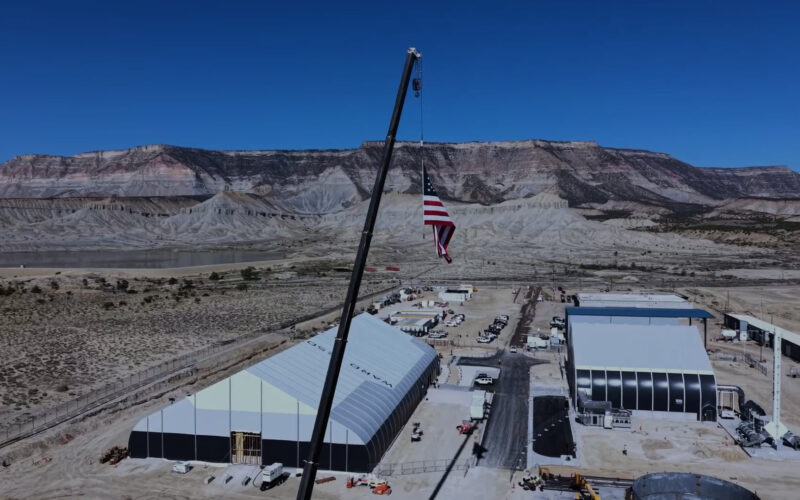
Valar Atomics has closed a $1 billion fundraising round and a separate $200 million credit facility, giving the three-year-old nuclear energy startup one of the largest private capital raises in the advanced reactor sector. Sequoia Capital led the round, with Sequoia partner Shaun Maguire joining the Valar Atomics board. Other investors include Apandion Capital, Atreides Management, Point72 and Valor Equity Partners. The financing comes after Valar Atomics’ Ward 250 advanced reactor design completed a zero-power fueled criticality demonstration in June at the Utah San Rafael Energy Lab in Emery County, Utah, under the U.S. Department of Energy’s Reactor Pilot Program. The strategic question is whether Valar Atomics can convert a fast technical milestone and deep private capital into repeatable reactor manufacturing for data centres, heavy industry, hydrogen and clean hydrocarbon fuels.
The funding arrives during a dramatic change in nuclear energy sentiment. Artificial intelligence data centres are increasing demand for large amounts of reliable electricity, while industrial customers are looking for high-temperature heat that renewable power and batteries cannot easily provide alone. Advanced nuclear startups are trying to capture that demand with smaller reactors, faster deployment models and factory-style production concepts.
Valar Atomics is not pitching itself as a conventional nuclear project developer. Its stated strategy is to build nuclear “gigasites” containing clusters of high-temperature reactors that can supply grid-independent products including data-centre power, hydrogen, industrial heat and clean fuels. That model is ambitious, capital intensive and still technically unproven at commercial scale.
Why does Valar Atomics’ $1 billion funding round matter to the advanced nuclear market?
Valar Atomics’ funding round matters because it shows how quickly private capital is moving toward nuclear energy as an AI infrastructure and industrial-power theme. A few years ago, most advanced reactor companies relied heavily on government grants, strategic partners or slow-moving utility relationships. The new round suggests venture and growth investors now see private nuclear deployment as a potential scale market.
The size of the financing is important. A $1 billion round and $200 million credit facility give Valar Atomics the ability to fund engineering, site development, supply-chain commitments, hiring, fuel-related work, reactor testing and early manufacturing capacity. Nuclear startups need far more capital than software companies because their products involve licensed sites, fuel systems, safety analysis, equipment fabrication, materials testing and long regulatory pathways.
The investment also reflects a shift in how nuclear startups are framing their markets. Instead of selling only electricity to the grid, Valar Atomics is targeting customers that need dedicated energy supply. These include data centres, industrial producers, hydrogen users and fuel manufacturers.
That is commercially significant because grid interconnection is becoming a bottleneck for new power projects. If a nuclear startup can serve large customers behind the meter or through dedicated industrial sites, it may reduce dependence on traditional utility procurement and transmission queues.
The risk is that the commercial story is moving faster than operational proof. Criticality is a major milestone, but it is not the same as commercial power production, recurring revenue or fleet manufacturing. Investors are funding a pathway, not a finished business.

What does Ward 250’s criticality milestone prove, and what does it not prove?
Ward 250’s zero-power fueled criticality demonstration is an important technical milestone. The U.S. Department of Energy said the reactor design successfully completed the demonstration at the Utah San Rafael Energy Lab in June, marking the first DOE-authorized reactor built outside a national laboratory.
Criticality means a reactor can sustain a controlled nuclear chain reaction. That is a foundational step before a reactor can generate heat and power. For Valar Atomics, it validates core physics assumptions and shows that the company has moved beyond a purely paper design.
However, zero-power criticality does not prove commercial operation. It does not demonstrate sustained high-temperature performance, heat removal, power conversion, fuel-cycle economics, maintenance requirements or fleet manufacturability.
This distinction is central to the investment case. Cold criticality proves that the physics can work in a controlled setting. Power operations must prove that the system can produce useful energy reliably, safely and economically.
Valar Atomics has already built credibility by reaching a milestone under DOE oversight. The next phase is harder because energy customers care about uptime, delivered cost, licensing confidence and long-term support.
Nuclear markets have seen many promising demonstration projects fail to become financeable commercial systems. Valar Atomics’ challenge is to avoid becoming another impressive prototype company and instead prove that its reactor design can be built repeatedly.
How does the DOE Reactor Pilot Program shape Valar Atomics’ strategy?
The DOE Reactor Pilot Program is central to Valar Atomics’ momentum. The programme was created to accelerate testing of advanced reactor designs and aims to leverage DOE authority to support faster demonstration outside national laboratories.
Valar Atomics is one of the companies selected for the programme, alongside other advanced nuclear developers such as Aalo Atomics, Antares Nuclear, Oklo, Radiant Industries, Terrestrial Energy and others.
This framework matters because nuclear startups face a classic timing problem. They need regulatory certainty to attract capital, but they need capital to complete the technical work that supports regulatory confidence. The DOE pathway helps reduce part of that early-stage friction by creating a structured route for demonstration.
The programme does not eliminate long-term licensing requirements. A company that demonstrates a first reactor still needs a commercial deployment pathway, customer agreements, safety analysis, operational procedures, fuel supply and future regulatory approvals.
For Valar Atomics, DOE involvement provides credibility and urgency. It also places the company in a competitive group of reactor startups racing to prove that advanced nuclear can move faster than traditional nuclear development.
The market will judge the programme not by announcements, but by whether it leads to operating reactors that can generate useful power. Valar Atomics has cleared one milestone. It must now show the pathway from milestone to market.
Why is Valar Atomics targeting data centres, hydrogen and industrial power?
Valar Atomics is targeting sectors where the value of reliable, high-density energy is unusually high. Data centres need dependable power, especially as AI workloads increase electricity demand. Heavy industry needs large amounts of heat and electricity. Hydrogen production and synthetic fuels require energy inputs that can dominate operating costs.
This is why Valar Atomics’ high-temperature gas reactor approach matters. The company says its reactors use TRISO fuel, helium coolant and graphite moderators. High-temperature reactors can potentially provide industrial heat as well as electricity, making them relevant to applications beyond ordinary grid supply.
Data-centre demand is the most visible near-term narrative. AI infrastructure requires massive and reliable energy supply, and hyperscalers are increasingly exploring nuclear power, long-term power contracts and dedicated generation options. Nuclear offers firm power, which can complement renewables but does not depend on sunlight or wind.
Hydrogen is another important target because cheap, clean hydrogen remains difficult to produce at scale. Valar Atomics says its reactors could be paired with a sulfur-iodine cycle process to produce hydrogen.
Clean hydrocarbon fuels are more speculative but strategically interesting. The company says hydrogen could be combined with captured carbon dioxide to create hydrocarbons using a modified Fischer-Tropsch process.
The opportunity is large, but each market has different economics. Data centres may pay for reliability. Hydrogen customers may demand very low energy costs. Industrial customers may require heat integration and long operating guarantees. Valar Atomics must prove that one reactor platform can serve these markets without overextending its engineering and commercial teams.
Can Valar Atomics’ gigasite model change nuclear economics?
Valar Atomics’ gigasite model is the most ambitious part of its strategy. The company wants to build clusters of reactors at large sites, using scale to drive manufacturing efficiency, operational learning and product economics.
Traditional nuclear projects are often bespoke. Each plant has site-specific engineering, regulatory complexity, construction risk and long timelines. This has contributed to high costs and project delays in several markets.
Valar Atomics is arguing for a different model. Instead of building one giant plant as a unique megaproject, it wants to manufacture and deploy many smaller reactors in repeatable clusters. In theory, repetition can reduce cost, improve quality control and allow teams to learn faster.
This resembles the manufacturing logic that transformed aerospace, semiconductors, solar panels and batteries. The challenge is that nuclear reactors are not consumer electronics. They involve fuel handling, radiation, safety systems, security, emergency planning, quality assurance and long-term stewardship.
A gigasite could create operational advantages if multiple reactors share infrastructure, maintenance teams, security, fuel management and industrial customers. It could also create concentration risk if a site faces permitting, safety or public-acceptance challenges.
The model will ultimately be judged on delivered energy cost. If clustered reactors produce power and heat at competitive prices with high reliability, the model could become significant. If costs remain high or operational complexity grows with each reactor, the gigasite concept may struggle to move beyond investor enthusiasm.
How does Valar Atomics compare with Oklo, NuScale and listed nuclear-linked stocks?
Valar Atomics remains privately held, so public-market sentiment has to be read through listed nuclear and power names. The comparison is useful because investors are already valuing advanced nuclear and firm-power exposure differently from a few years ago.
Oklo Inc. traded at $41.22 on August 3, with a market capitalisation of about $7.02 billion. Oklo remains a prominent public advanced nuclear developer, but its valuation still reflects future deployment expectations rather than mature operating cash flow.
NuScale Power Corporation traded at $9.01, with a market capitalisation of about $2.88 billion. NuScale has been one of the best-known small modular reactor companies in public markets, but its share performance has also shown how volatile investor sentiment can be when project timelines, costs and customer commitments shift.
Constellation Energy traded at $273.71, with a market value of about $98.86 billion. Unlike advanced reactor startups, Constellation operates a large existing nuclear fleet, making it a more mature public-market benchmark for nuclear-backed firm power.
Vistra traded at $155.94, with a market capitalisation of about $53.31 billion. The company’s rise has been tied partly to investor interest in power supply for data centres and broader electricity-demand growth.
These comparisons show the split in the market. Operating power companies are being rewarded for existing generation assets. Nuclear startups are being valued on future deployment potential. Valar Atomics belongs in the second category, but its funding size suggests private investors are already pricing a meaningful share of future success.
Why are Sequoia, Valor and Point72 backing a nuclear startup?
The investor group shows that advanced nuclear has moved into mainstream growth-capital territory. Sequoia Capital leading the round is particularly significant because the firm is better known for technology investments than for traditional energy infrastructure.
Sequoia’s involvement signals that some venture investors now see nuclear energy as a technology-scaling problem rather than only a utility-sector problem. If reactors can be standardised, manufactured and deployed in repeatable clusters, the return profile could resemble deep technology more than conventional power-plant development.
Valor Equity Partners adds another strategic layer because it has backed several high-growth industrial and technology companies. Point72 and Atreides Management bring capital-market sophistication and exposure to broader AI and infrastructure investment themes.
The logic is understandable. AI demand has created a rush for power, and nuclear energy has become one of the few technologies that can credibly promise firm, carbon-free supply at large scale. Investors are searching for the company that can make nuclear move at technology-industry speed.
The risk is that nuclear cannot be forced into ordinary venture timelines. Safety, regulation, supply chains and public acceptance matter. The most aggressive capital strategy in the world cannot make a reactor commercially ready before the engineering is ready.
The investor group gives Valar Atomics capital and credibility. It does not remove the need for patient, disciplined execution.
What are the biggest technical risks after Valar Atomics’ funding round?
The first technical risk is moving from zero-power criticality to power operations. A reactor that sustains a controlled chain reaction at low power must still prove heat removal, thermal stability, materials performance and integrated system behaviour under operating conditions.
The second risk is fuel. Valar Atomics uses HALEU TRISO fuel concepts, which are attractive for safety and high-temperature operation but require secure fuel supply, quality assurance and regulatory control. Advanced nuclear developers across the sector face fuel-availability constraints.
The third risk is helium-loop performance. High-temperature gas reactors depend on coolant flow, heat transfer, component durability and system controls that must operate reliably over long periods.
The fourth risk is manufacturing quality. Factory-built nuclear reactors require repeatable fabrication standards, supplier qualification, documentation and inspection systems. A flaw in one unit can affect confidence in the whole fleet model.
The fifth risk is software and simulation validation. Valar Atomics has highlighted proprietary software and physics modelling, but reactor customers and regulators will require evidence that models match real-world performance.
The sixth risk is materials durability. High temperatures, radiation, graphite behaviour and long operating cycles create complex engineering demands.
The seventh risk is scale-up sequencing. Trying to move too quickly from test reactor to fleet production could create safety, cost or quality problems. Moving too slowly could weaken the investment case.
What commercial risks could limit Valar Atomics’ growth?
The first commercial risk is customer conversion. Data centres, hydrogen producers and industrial users may show interest in nuclear power, but signing binding contracts for first-of-a-kind reactors is far more difficult.
The second risk is financing structure. A nuclear gigasite will require far more capital than a venture round. Project-level equity, debt, customer prepayments, government support and insurance arrangements may all be needed.
The third risk is regulation. DOE-authorized testing is a valuable pathway, but commercial deployment will face additional oversight, safety requirements and potentially different regulatory processes.
The fourth risk is public acceptance. Even small or advanced reactors can face community opposition, especially if projects involve multiple units, fuel handling or industrial co-location.
The fifth risk is cost competitiveness. Industrial customers may like nuclear reliability, but they will compare delivered energy cost against natural gas, renewables, batteries, transmission upgrades and other firm-power options.
The sixth risk is competition. Oklo, X-energy, TerraPower, Radiant, Antares, Aalo Atomics and other developers are pursuing overlapping customers and policy support.
The seventh risk is execution credibility. Nuclear buyers care about teams with deep engineering and operating experience. Valar Atomics must keep hiring and retaining nuclear talent as it scales from startup to operator.
Could Valar Atomics become a future IPO candidate?
A $1 billion funding round and $200 million credit facility naturally raise the question of whether Valar Atomics could eventually pursue an IPO. The company is still early, but the scale of capital and the public-market appetite for nuclear-linked stocks make the possibility credible.
Oklo’s public-market experience shows that investors are willing to value advanced nuclear companies well before commercial revenue matures. However, public markets also bring volatility and scrutiny. A listed Valar Atomics would need to explain technical milestones, licensing pathways, fuel strategy, customer contracts and capital needs in far greater detail.
The company may prefer to remain private while progressing through power operations and early project development. Private capital can sometimes tolerate longer technical timelines than public markets, especially when investors understand deep technology risk.
An IPO would become more credible after Valar Atomics demonstrates sustained power operations, signs material customer agreements or secures a first gigasite development pathway. Listing too early could expose the company to the same volatility that has affected other pre-commercial energy technology names.
For now, the funding round functions as a private-market validation event. It gives Valar Atomics enough capital to pursue the next technical and commercial proof points without rushing to public markets.
What should investors and industry customers watch after Valar Atomics’ $1 billion raise?
The first milestone is Ward 250 power operations. Moving from criticality to useful heat or power will be the most important technical proof point.
The second milestone is fuel supply. Investors should watch for details around HALEU TRISO availability, fabrication partnerships and long-term fuel strategy.
The third milestone is site development. The company’s gigasite model needs credible locations, permitting pathways, industrial customers and infrastructure planning.
The fourth milestone is customer contracts. Announcements with data centres, hydrogen producers or industrial users would strengthen the commercial case if they include meaningful commitments.
The fifth milestone is manufacturing plan clarity. Valar Atomics must show how it will move from first reactors to fleet production while maintaining nuclear-grade quality.
The sixth milestone is regulatory pathway. DOE pilot progress is important, but commercial deployment will require broader regulatory confidence.
The seventh milestone is cost disclosure. Investors and customers need a clearer view of expected cost per megawatt, reactor lifetime, operating cost and delivered heat or power economics.
The eighth milestone is talent and governance. Nuclear operators need disciplined engineering culture, safety systems and experienced leadership. Fast growth must not weaken safety discipline.
Valar Atomics has raised the kind of money that changes expectations. It is no longer only a bold nuclear startup with a technical milestone. It is now a private-market test of whether advanced reactors can be manufactured, financed and deployed at the speed demanded by AI-era energy growth.
Key takeaways on what Valar Atomics’ $1 billion funding means for nuclear energy
- Valar Atomics has closed a $1 billion fundraising round, according to The Wall Street Journal.
- The company has also closed a separate $200 million credit facility.
- Sequoia Capital led the round, and Sequoia partner Shaun Maguire will join the Valar Atomics board.
- Other investors include Apandion Capital, Atreides Management, Point72 and Valor Equity Partners.
- Valar Atomics is part of the U.S. Department of Energy’s Reactor Pilot Program.
- The company’s Ward 250 advanced reactor design completed a zero-power fueled criticality demonstration in June at the Utah San Rafael Energy Lab.
- The DOE said Ward 250 was the first DOE-authorized reactor built outside a national laboratory.
- Valar Atomics is pursuing high-temperature gas reactor technology using TRISO fuel, helium coolant and graphite moderators.
- The company is targeting data-centre power, industrial power, hydrogen and clean hydrocarbon fuels.
- The biggest risks are power-operation proof, fuel supply, manufacturing quality, commercial customer conversion, regulation, project financing and public acceptance.
Discover more from Business-News-Today.com
Subscribe to get the latest posts sent to your email.