


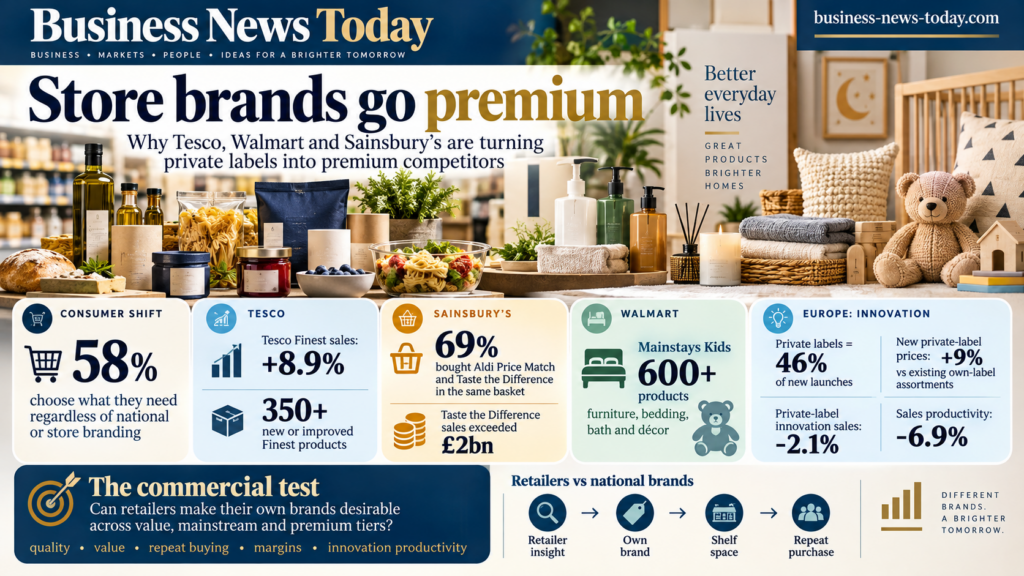
Tesco PLC (LSE: TSCO), Walmart Inc. (NASDAQ: WMT) and J Sainsbury plc (LSE: SBRY) are expanding retailer-owned brands beyond traditional budget products as consumers increasingly judge merchandise by quality, design and value rather than the name on its packaging. Tesco reported 8.9% growth in its premium Finest range during the first half of fiscal 2026/27, while Sainsbury’s disclosed that 69% of customers purchased products from both its Aldi Price Match and premium Taste the Difference ranges in the same shopping basket during its latest financial year. Walmart has extended its private-brand strategy into home furnishings through Mainstays Kids, introducing more than 600 products across furniture, bedding, bath and décor. The developments coincide with NielsenIQ findings that retailer-owned products now account for 46% of new product launches across five major Western European markets, although sales generated by private-label innovation have declined. The central commercial opportunity is for retailers to make their own brands desirable across multiple price tiers, but sustainable growth depends on whether product differentiation generates repeat purchasing, stronger customer loyalty and attractive margins rather than simply increasing assortment complexity.
The shift represents a competitive challenge for national consumer goods manufacturers that have historically relied on brand recognition, advertising and product development to justify price premiums. Retailers increasingly have the ability to offer value, mainstream and premium alternatives within their own product portfolios while controlling merchandising, pricing and much of the customer relationship. This potentially changes how consumers make purchasing decisions, particularly when a retailer-owned product offers features or quality comparable with a familiar national brand. However, the expansion also transfers greater responsibility for product development, inventory performance and brand management to retailers, creating financial risks that can be obscured by impressive launch numbers.
Why are consumers becoming more willing to choose private labels over national brands?
The changing perception of private labels is supported by consumer research extending beyond individual supermarket announcements. NielsenIQ reported in August 2026 that 58% of consumers considered whether a product was a national brand or private label largely irrelevant, preferring to purchase what best met their needs. The finding was drawn from its existing consumer research and highlighted in a broader analysis developed with World Data Lab examining how purchasing decisions vary according to household finances and perceived value. NielsenIQ also reported that 67% of Generation Z consumers considered private-label products comparable in quality with national brands, indicating that traditional brand ownership may carry less weight among some younger shoppers.
These findings suggest that the distinction between trading down and trading up is becoming less useful when analysing consumer behaviour. A household may seek the lowest available price for routine grocery essentials while paying more for a premium ready meal, specialist cleaning product or attractive home accessory. Such decisions can occur within the same shopping trip because consumers place different values on quality, convenience and product differentiation across categories. Retailers able to satisfy these contrasting requirements may capture a larger share of household spending without forcing customers to choose between discount and premium shopping destinations.
The commercial significance is reinforced by American retail sales data. The Private Label Manufacturers Association reported that US store-brand sales reached $282.8 billion in 2025, an increase of 3.3%, compared with 1.2% growth for national brands in its measured retail channels. Store brands represented 21.3% of sales value and 23.5% of product units during the year, demonstrating that they already occupy a substantial position in everyday purchasing. During the first half of 2026, their unit share reached 23.8% in the association’s Circana-based measurement, providing additional evidence of continued participation.
The growth does not mean consumers have abandoned national brands or that premium private labels are responsible for every increase. Affordable alternatives remain important in a period of pressure on household budgets, while established branded products continue to compete effectively where shoppers perceive meaningful differences in performance. Nevertheless, the combination of stronger private-label sales and changing consumer attitudes gives retailers greater confidence to develop products beyond basic low-price substitutes. That creates opportunities across food, personal care, household cleaning and home furnishings.
How is Tesco turning Finest into a premium retail growth engine?
Tesco provides one of the clearest examples of premium private-label products becoming commercially significant within an established supermarket business. In its October 8, 2026, interim results, the company reported that Finest sales increased 8.9% across its UK business during the 26 weeks ended August 29. The retailer introduced more than 350 new or improved Finest products, including innovations across bakery, fish, barbecue and delicatessen categories. The activity followed fiscal 2025/26 results showing 15% annual growth in Finest sales, which reached approximately £3 billion.
The figures indicate that Finest has developed into a substantial premium product franchise rather than an experimental supermarket assortment. Tesco can use the range to serve customers seeking higher-quality meals, distinctive ingredients or products associated with special occasions while continuing to compete aggressively on everyday essentials. Its strategy includes Aldi Price Match items, Clubcard Prices and broader value initiatives alongside premium innovation. This combination allows the retailer to compete for different purchasing occasions without requiring customers to visit another supermarket when they want to spend more.
The opportunity is particularly relevant in fresh and prepared foods, where consumers may compare supermarket products with restaurant meals or specialist retailers. Premium ready meals, bakery products and deli items can offer convenience alongside perceived quality, potentially encouraging customers to substitute some spending previously directed towards foodservice. Tesco’s own-label development also allows it to respond directly to demand for healthier products, including fibre-enriched bakery, high-protein meals and other nutrition-oriented formats. These categories offer opportunities for differentiation beyond simply replicating existing national-brand products.
Tesco’s broader financial performance provides context for the strategy. Group adjusted operating profit increased 6.5% at actual exchange rates to £1.78 billion in the first half of fiscal 2026/27, while sales excluding value-added tax and fuel increased 2% to £33.78 billion. The company attributed its performance to several factors, including operational efficiencies, sales mix and additional income streams, rather than solely to Finest. Its results therefore establish that premium innovation is occurring within a profitable and growing retail operation, although Tesco does not separately disclose the contribution margin of the Finest range.
The next question is whether Tesco can maintain the range’s momentum as premium products become more widely available from competitors. Sustained growth would require customers to continue choosing Finest products after initial launches, while new items must deliver sufficient sales to justify shelf space and product-development spending. Tesco’s challenge is not simply to expand the brand but to ensure that each new assortment strengthens its overall customer proposition. That becomes harder when competing retailers are pursuing similar premiumisation strategies.
What does Sainsbury’s reveal about consumers buying value and premium products together?
Sainsbury’s offers unusually direct evidence that price-conscious shopping and premium purchasing can coexist within individual customer relationships. In its results for the 52 weeks ended February 28, 2026, the company reported that 69% of customers purchased items from both its Aldi Price Match and Taste the Difference ranges in the same shopping basket during the financial year. Taste the Difference sales exceeded the retailer’s £2 billion target, while fresh-food sales within the premium range grew 16%. The company also reported that customers were purchasing larger premium baskets more frequently, supporting its emphasis on differentiated food quality alongside competitive pricing.
The behavioural significance lies in how customers allocate spending rather than whether they identify as budget or premium shoppers. A household might purchase lower-priced milk, vegetables and other staples while selecting a Taste the Difference main course or dessert for a weekend meal. That combination allows Sainsbury’s to address affordability concerns without surrendering the opportunity to sell higher-value products. It also offers a mechanism for increasing customer loyalty because shoppers may find both their routine essentials and occasional premium preferences within the same retailer.
Product innovation has been central to this approach. Sainsbury’s launched more than 1,200 own-brand products during fiscal 2025/26, with approximately half belonging to Taste the Difference. The retailer also expanded premium offerings through its Discovery collection, which emphasises restaurant-quality meals and specialist ingredients. These initiatives reflect an attempt to compete through quality, convenience and product experience rather than depending exclusively on discounts.
However, the financial evidence illustrates why stronger premium sales should not automatically be interpreted as higher profitability. Sainsbury’s retail underlying operating profit declined 1.1% to £1.025 billion during fiscal 2025/26, despite grocery sales growth of 5.2%. The company attributed pressure on profitability to investment in its competitive position and unusually high operating cost inflation, partly offset by structural savings. Premium private-label growth may strengthen the overall business, but those benefits operate alongside pricing investment, labour expenses, supply-chain costs and other demands on retail margins.
For investors, Sainsbury’s provides a useful test of whether product differentiation can support sustained operating performance. Taste the Difference can contribute to customer attraction and basket value, while Aldi Price Match and Nectar promotions protect competitiveness against discount retailers. The combination is commercially attractive if it increases total customer spending and retention without requiring excessive price investment. Ultimately, the retailer must convert stronger brand appeal into profitability across its overall business rather than relying on premium sales growth in isolation.
Why is Walmart expanding private-label innovation beyond groceries?
Walmart is pursuing a related opportunity in household merchandise, where consumers increasingly evaluate retailer-owned products on design, functionality and affordability. On May 27, 2026, the company introduced Mainstays Kids, its first new home brand launch in five years. The assortment includes more than 600 products spanning furniture, bedding, bath accessories and décor, organised around coordinated collections intended to simplify children’s room decoration. The launch demonstrates how retailer-owned brands can compete through product design and merchandising rather than functioning only as inexpensive alternatives to specialist home retailers.
The strategy reflects Walmart’s ability to combine scale with detailed knowledge of consumer purchasing patterns across multiple categories. Families shopping for household essentials may also purchase bedroom furniture, decorative accessories or seasonal products, creating opportunities to increase spending within the same retail ecosystem. By developing a coordinated assortment, Walmart can make it easier for customers to purchase several related products without assembling items from different manufacturers. That approach potentially supports larger baskets while helping the retailer establish a recognisable product identity.
Walmart also refreshed its hardware assortment during 2026, expanding Hyper Tough products and introducing additional exclusive power-tool offerings. The company launched Greenworks Pro exclusively through Walmart, although that arrangement should be distinguished from retailer-owned private labels because Greenworks is a separate brand. Together, the initiatives illustrate a broader strategy involving both owned brands and exclusive merchandise to differentiate Walmart’s assortment from competing retailers. The distinction matters commercially because ownership, sourcing arrangements and profit-sharing can vary significantly between private-label and exclusive third-party products.
The home category creates opportunities and risks that differ from grocery private labels. Consumers may buy certain household products less frequently, making product durability, visual appeal and customer satisfaction especially important. Furniture and décor can also involve higher inventory costs, seasonal preferences and greater exposure to changing design trends. Walmart’s distribution scale and sourcing capabilities provide potential advantages, but the company has not disclosed sufficient product-specific information to establish the profitability or repeat-purchase performance of Mainstays Kids.
Why is Aldi making its own brand identity more visible?
Aldi provides another example of retailers attempting to turn store ownership into a positive consumer-brand attribute. In September 2025, Aldi US announced its largest packaging refresh, introducing more prominent Aldi branding across its private-label portfolio. Products were scheduled to carry either the Aldi name or an Aldi Original endorsement, making the retailer’s identity more visible on packaging that previously featured several individual product brands. The company said more than 90% of its products were private label, giving the initiative substantial reach across its assortment.
The change reflects a different strategic priority from premium product launches. Aldi is strengthening the connection between the products consumers purchase and the retailer they associate with value and quality. When shoppers recognise a retailer’s identity across multiple categories, positive experiences with one product may influence their willingness to try others. This creates an opportunity to build trust at the retailer level rather than relying entirely on separate identities for individual products.
Aldi’s expansion plans also demonstrate the scale of the strategy. In January 2026, the company announced plans to open more than 180 additional US stores during the year, alongside broader investment in distribution infrastructure and digital shopping. The announcement reflects confidence in its retail proposition, although store expansion should not be confused with evidence of rising demand for premium private labels specifically. Aldi’s position remains strongly associated with value, illustrating that retailer-brand development can support different consumer strategies rather than a single movement towards higher prices.
The wider implication is that successful private labels may increasingly function like conventional consumer brands. Retailers must manage consistent product quality, packaging identity, assortment decisions and customer expectations across multiple categories. Stronger retailer recognition could make it easier to introduce new products, but it also means quality failures in one category may affect perceptions of the broader store brand. Brand ownership therefore creates both commercial opportunities and reputational responsibilities.
Are retailers launching too many private-label products without generating enough sales?
The strongest warning against an overly optimistic interpretation comes from NielsenIQ’s September 21, 2026, analysis of product innovation across France, Germany, Italy, Spain and the United Kingdom. Private labels accounted for 46% of new product launches during the latest measured year, compared with 42% previously, with more than 83,000 new retailer-owned products entering the market. Retailer-owned assortments expanded faster than the overall fast-moving consumer goods shelf, indicating that retailers were allocating additional space to their own products. Yet private-label innovation sales declined 2.1% in value, compared with 1.8% growth for branded innovation.
This creates an important distinction between investment activity and commercial performance. Retailers are introducing more products and broadening their assortments, but their new products are not collectively generating stronger sales. NielsenIQ reported that private-label innovation sales productivity declined 6.9%, compared with a 1.6% decline for the overall measured market. The findings suggest that expanding the number of launches may be diluting average product performance, particularly where several similar products compete for limited consumer attention.
The data also reveals that private labels retain an innovation advantage in certain measures. Newly introduced products accounted for 11.7% of private-label sales value, compared with 8.1% for national brands. However, the private-label contribution had declined from 12.2% a year earlier, while the branded figure remained unchanged. This suggests that retailer-owned brands are becoming more sophisticated competitors while simultaneously facing challenges in converting extensive innovation activity into efficient sales growth.
For retailers, the commercial lesson is that product selection may become more important than product-launch volume. Developing fewer successful products could produce stronger financial returns than continuously introducing new assortments that require additional inventory, promotional support and shelf allocation. The challenge is particularly relevant for premium private labels, where product-development costs and customer expectations may be higher. The retailers that combine consumer insight with disciplined assortment decisions could outperform competitors pursuing innovation primarily through volume.
Can premium private labels maintain higher prices without losing their value advantage?
NielsenIQ’s European findings indicate that retailers are increasingly introducing private-label products above the price level of their existing own-brand assortments. Newly launched private-label products carried average prices approximately 9% higher than the typical private-label product already on the shelf. The figure is a comparison within retailer-owned assortments, not a claim that store brands are generally more expensive than national brands. It nevertheless demonstrates that retailers are developing products intended to compete beyond the lowest price tier.
Home care provides a particularly interesting example. NielsenIQ found that new private-label products in the category carried a 21% premium to existing retailer-owned offerings, down from 38% a year earlier. At the same time, prices for new home-care private labels declined 12.3% year on year, indicating that retailers were making innovative products more accessible. The findings suggest a market adjusting its premium positioning rather than abandoning higher-value product development.
Other categories show different patterns. Private-label innovation prices increased 5.7% in personal care and 5.1% in confectionery and snacks, while innovation sales value grew 11.5% and 23.9%, respectively. These category-level increases indicate that selected premiumisation strategies are finding commercial traction even as aggregate private-label innovation performance weakens. The differences also demonstrate why broad claims about the success or failure of retailer-owned products can be misleading when categories are developing at different speeds.
Pricing power ultimately depends on whether consumers recognise sufficient differentiation to justify the cost. A premium supermarket meal may compete against restaurant takeaway, while a household cleaning product is more likely to be evaluated against familiar branded alternatives. In each case, consumers may accept higher prices when they perceive improvements in quality, convenience or performance. Retailers must balance those opportunities against the risk that their premium products become expensive enough to undermine the value reputation that originally attracted customers.
What does the growth of retailer-owned brands mean for national manufacturers?
The expansion of premium private labels creates a more complicated competitive environment for companies such as The Procter & Gamble Company (NYSE: PG), Unilever and other major consumer goods manufacturers. Traditionally, national brands have relied on advertising, product research, scale and established consumer trust to support their market positions. Retailers introducing differentiated own-brand products can compete more directly with those advantages while retaining control over shelf placement and promotional activity. This creates pressure on manufacturers to demonstrate why their products deserve a premium over retailer-owned alternatives.
However, the evidence does not support a uniform retreat from national brands. In its fiscal 2026 results commentary, Procter & Gamble stated that it was not observing a significant consumer shift towards private labels within its business and argued that shoppers continued to prioritise product performance and effectiveness. The company reported fiscal 2026 net sales of $87 billion, up 3%, while organic sales increased approximately 1%. Its comments provide an important company-specific counterpoint to broader market research and suggest that strong differentiation can continue supporting national brands.
Procter & Gamble’s financial results also highlight the wider challenge of maintaining profitability. Its reported gross margin declined from 51.2% in fiscal 2025 to 50.2% in fiscal 2026, while operating margin decreased from 24.3% to 22.7%. These movements reflect multiple operating factors and should not be attributed primarily to private-label competition. Nevertheless, they demonstrate why product innovation, pricing discipline and cost efficiency remain central to the economics of established consumer goods businesses.
The competitive consequences will vary across categories. National brands may retain stronger advantages where product performance, specialised formulations or customer trust are difficult to replicate. Retailer-owned brands may be more competitive when consumers perceive limited differences between alternatives and price becomes the deciding factor. The broader shift is therefore likely to produce selective pressure on branded manufacturers rather than a uniform transfer of market share.
Which manufacturers and suppliers could benefit from premium private-label growth?
The expansion of retailer-owned products also creates opportunities for businesses operating behind the brands. Private-label manufacturers, ingredient suppliers, packaging companies and product-development specialists can participate in retailer innovation without building consumer-facing brands themselves. Retailers seeking differentiated formulations, improved packaging and faster product launches may increasingly rely on specialised manufacturing partners. The commercial opportunity involves supplying capabilities that help retailers achieve quality and consistency while remaining competitive on price.
Premiumisation can increase the complexity of those relationships. Manufacturers may need to develop distinctive ingredients, packaging formats or product specifications rather than simply produce lower-cost equivalents of existing branded merchandise. Food products may require specialist sourcing and quality assurance, while home and personal-care products involve different formulation, safety and manufacturing requirements. These capabilities can create opportunities for suppliers with technical expertise, but the economics depend on contract terms, production volumes and the retailer’s pricing demands.
Retailers also hold significant negotiating power because they control purchasing decisions and shelf access. Suppliers may benefit from larger private-label programmes while facing pressure to deliver lower costs, shorter development cycles and consistently high quality. Winning a major retailer contract can support production scale, but dependence on a small number of customers can create concentration risk. Manufacturers must therefore evaluate whether the expected volumes and margins justify investments in capacity, product development and inventory.
For established consumer goods companies, another strategic option is to strengthen innovation rather than compete primarily through discounts. Products offering meaningful performance improvements, convenience or distinctive consumer experiences may be better positioned to maintain branded premiums. Retailers and manufacturers could consequently increase investment in genuine product differentiation, even as some categories become more price competitive. The outcome may be a more demanding innovation environment across the consumer goods value chain.
How should investors assess Tesco, Walmart and Sainsbury’s exposure to the trend?
For listed retailers, premium private-label innovation is relevant because it can influence sales mix, customer retention, competitive positioning and operating profitability. Tesco’s Finest performance provides measurable evidence of demand within an established premium range, while its broader financial results show that the business continues generating substantial operating profit. However, the absence of separate Finest profitability disclosures limits conclusions about the range’s direct financial contribution. Investors should assess premium growth alongside the overall sales mix, cost savings and competitive pricing commitments.
Sainsbury’s offers a different combination of evidence. Its Taste the Difference range has reached meaningful scale, and the coexistence of premium and value products within shopping baskets provides a distinctive customer-behaviour signal. Yet the decline in retail underlying operating profit during fiscal 2025/26 shows that stronger grocery sales and premium-brand activity do not automatically produce higher operating earnings. Margin recovery and sustained customer spending will be important measures of execution.
Walmart’s Mainstays Kids launch demonstrates strategic expansion across household categories, but the company has not disclosed financial performance for the new range. The initiative is better understood as part of its wider assortment and merchandising strategy than as an individually measurable earnings catalyst. Its significance lies in whether owned-brand products improve customer engagement, merchandising differentiation and category economics. Future disclosures about private-brand penetration and product performance would provide stronger evidence of financial impact.
The broader investor question is not whether private labels are gaining visibility, but whether their expansion improves returns on retail investment. Higher sales value, stronger basket composition and sustained product demand could support the business case, while assortment complexity and weak launch productivity could undermine it. Daily share-price movements are not necessary to evaluate these longer-term consumer and commercial developments. Operating performance and the economics of product innovation provide more durable measures.
What will prove that premium private labels are becoming a lasting retail advantage?
The next 6 to 24 months should reveal whether retailers can translate premium product development into sustained consumer behaviour and stronger commercial performance. Tesco’s Finest sales growth and Sainsbury’s Taste the Difference performance provide established benchmarks, particularly if both ranges continue attracting repeat purchases without excessive promotional support. Walmart’s progress in household categories will offer another test of whether retailer-owned brands can compete through design and functionality beyond food. Continued private-label unit-share gains in the United States and improving product performance across Western Europe would strengthen the broader consumer signal.
The most revealing evidence may come from innovation productivity rather than the number of new products introduced. NielsenIQ’s findings show that retailers are expanding their product pipelines even as average new-product performance weakens, creating a measurable challenge for future reporting periods. A recovery in private-label innovation sales and sales productivity, accompanied by sustainable pricing premiums, would suggest that retailers are improving their ability to develop products consumers genuinely value. Continued declines in productivity, increasing promotional dependence or widespread product discontinuations would point towards excessive assortment expansion.
Margin performance will be equally important. Retailers demonstrating stronger sales mix and customer loyalty alongside improving operating profitability would provide more persuasive evidence than premium product launches alone. Supplier investment and manufacturing growth could support the thesis when accompanied by recurring orders and attractive contract economics. National-brand performance will offer another useful comparison, particularly where established manufacturers maintain market share through superior products rather than relying mainly on discounts.
The emerging consumer shift is not simply that shoppers are purchasing more inexpensive supermarket alternatives. It is that retailer-owned brands are increasingly being considered alongside national brands across value, mainstream and premium purchasing decisions, giving retailers greater influence over how consumers define quality and value. Tesco, Walmart and Sainsbury’s are pursuing different versions of that opportunity, while independent retail data reveals both genuine market momentum and the risk of overexpansion. If retailers can sustain premium demand while improving product productivity and profitability, their own brands could become a more powerful competitive advantage; if innovation continues growing faster than consumer purchasing, the financial benefits may prove narrower than the current expansion suggests.
Discover more from Business-News-Today.com
Subscribe to get the latest posts sent to your email.