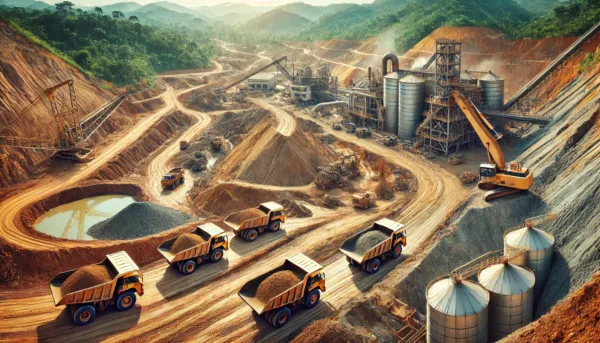

Rio Tinto Group (ASX: RIO), the diversified miner spanning iron ore, aluminium, copper and lithium, reported a strong September quarter across several of the projects intended to reshape its portfolio through 2030. Oyu Tolgoi copper production increased 27% year on year in Q3 and 29% over the first nine months, while the operation ran at an annualised rate of approximately 450,000 tonnes during the quarter. Global iron ore sales increased 3% to 90.8 million tonnes, and Simandou reached an annualised production rate of around 10 million tonnes on a 100% basis as its ramp-up continued.
RIO nevertheless closed at AUD 146.27 on October 23, approximately 5.6% below its October 16 level and 12.7% below the September 23 close of AUD 167.61. The divergence does not prove that the operational update caused the decline, particularly because commodity prices and broader mining sentiment also influence the shares. It does make the investment question more interesting: whether Rio Tinto’s copper, iron ore and lithium expansion can create enough incremental cash flow to overcome commodity-cycle uncertainty and the capital intensity of a large project pipeline.
Why does Oyu Tolgoi’s 27% Q3 copper growth matter for Rio Tinto’s portfolio transition?
Oyu Tolgoi production increased 27% year on year during the third quarter and 29% across the first nine months. The Mongolian operation achieved an annualised production rate of approximately 450,000 tonnes during Q3 as underground production continued ramping. That makes Oyu Tolgoi one of the most important contributors to Rio Tinto’s strategy of increasing copper exposure.
Group consolidated copper production was 205,000 tonnes during the quarter, broadly unchanged year on year and down 4% sequentially. Nine-month production increased 1% to 646,000 tonnes, and full-year guidance remains 800,000 to 870,000 tonnes. Oyu Tolgoi’s strong growth therefore needs to be understood alongside more mixed performance elsewhere in the copper portfolio.
Kennecott completed its flash-converting-furnace rebuild ahead of plan during August, improving the operational setup for subsequent periods. The stronger investment case would involve Oyu Tolgoi maintaining higher underground production while Kennecott and other assets provide more consistent group-level volumes. That would allow copper to become a larger earnings contributor rather than relying on one standout asset.
How important is Simandou after reaching a 10-million-tonne annualised production rate?
The Simandou iron ore project in Guinea reached an annualised production run rate of approximately 10 million tonnes on a 100% basis during Q3. Rio Tinto continues to target a 60-million-tonne annual production rate during the second half of 2028. The project is strategically significant because it adds a large new source of high-grade iron ore outside the Pilbara.
Ramp-up remains in its early stages. An annualised 10-million-tonne rate does not mean Simandou has already produced 10 million tonnes during a quarter or that the 60-million-tonne target has been achieved. It simply indicates the operating rate reached at a point during the ramp.
The opportunity is substantial because higher-grade ore can become increasingly valuable if steelmakers face pressure to reduce emissions and improve blast-furnace efficiency. The risk is that large integrated mining, rail and port systems can encounter commissioning constraints as throughput increases. Progress toward the 2028 target should therefore be evaluated incrementally rather than assuming a straight-line ramp.
Can Rio Tinto’s iron ore business keep funding growth while new commodities expand?
Global iron ore sales reached 90.8 million tonnes in Q3, up 3% year on year, while nine-month sales increased 3% to 255.3 million tonnes. Pilbara sales increased 2% in Q3 and 4% over nine months. Full-year global iron ore sales guidance remains 343 million to 366 million tonnes, including 323 million to 338 million tonnes from the Pilbara.
Iron ore remains the group’s most important cash-generating business even as Rio Tinto invests heavily in copper and lithium. Its ability to generate cash through the commodity cycle therefore affects how comfortably the company can finance major growth projects while maintaining dividends and balance-sheet flexibility.
First-half 2026 results illustrated the scale of that financial foundation. Rio Tinto reported approximately US$14.8 billion of underlying EBITDA, US$9.2 billion of operating cash flow and US$3.8 billion of free cash flow. Net debt was approximately US$14.1 billion at June 30, leaving the group with substantial capacity but also a meaningful requirement for disciplined capital allocation.
What does 33% year-to-date lithium growth add to Rio Tinto’s diversification strategy?
Lithium production increased 33% year on year during the first nine months despite weather disruption during Q3. Third-quarter output was approximately 13,000 tonnes of lithium carbonate equivalent, while nine-month production reached about 40,300 tonnes. Full-year guidance remains 61,000 to 64,000 tonnes, although Rio Tinto has indicated that production is likely to land toward the lower end.
The company is ramping Fenix 1B and advancing Sal de Vida and Rincon, with a broader ambition to create a material lithium business. This adds exposure to battery demand alongside Rio Tinto’s established iron ore, aluminium and copper portfolio. The commercial value, however, remains sensitive to lithium prices after the severe commodity downturn that followed earlier market shortages.
Lithium therefore offers diversification without eliminating cyclicality. Higher volumes create more operating leverage when prices improve but can also expand exposure during weaker pricing periods. Investors need to assess project costs and long-term competitiveness rather than assuming that volume growth automatically produces higher returns.
What does Rio Tinto’s capital-release programme actually mean for shareholders?
Rio Tinto said it had announced more than US$2 billion of capital-release initiatives year to date as part of a broader US$5 billion to US$10 billion programme. The company remains on track to announce initiatives representing approximately US$5 billion by the end of 2026. Importantly, announced capital release should not be treated as cash already received because individual transactions can remain subject to binding agreements, completion conditions and timing.
Management is also targeting approximately US$1.8 billion of annualised productivity benefits by the end of 2026. At the first-half stage, the company had reached an annualised run rate of around US$1.3 billion and had banked approximately US$870 million of benefits. Productivity gains can help offset cost inflation and create additional capacity to fund growth.
The combination of portfolio simplification and operating productivity is strategically important because Rio Tinto’s project pipeline is large. Growth becomes more attractive when new investment is partly funded by selling or restructuring lower-priority assets and extracting more cash from existing operations rather than simply increasing gross capital expenditure.
How much caution is reflected in RIO after a 12.7% one-month share-price decline?
RIO closed at AUD 146.27 on October 23, down approximately 5.6% from AUD 154.93 on October 16. Compared with its September 23 close of AUD 167.61, the stock has declined approximately 12.7%. The current 52-week range is approximately AUD 125.50 to AUD 195.84.
Market data estimate Rio Tinto’s group equity value at approximately AUD 203 billion. The shares now sit much closer to their annual low than to the 52-week high despite progress at Oyu Tolgoi, Simandou and several lithium projects. That creates a different valuation setup from one in which investors are already pricing flawless execution.
The decline should not automatically be interpreted as evidence that the market rejects the growth strategy. Rio Tinto remains highly sensitive to iron ore, copper and broader Chinese industrial expectations, which can dominate short-term price movements. What the lower share price does is increase the importance of determining whether operational progress translates into higher cash generation as projects mature.
What evidence would show that Rio Tinto’s growth pipeline is creating shareholder value?
Oyu Tolgoi needs to maintain its stronger production rate and continue translating underground development into group-level copper growth. Simandou needs to move progressively from its current ramp toward the targeted 60-million-tonne annual rate without material schedule or capital deterioration. Lithium projects need to increase volumes while demonstrating competitive economics through weaker commodity-price environments.
Cash flow provides the common measure across all three. Rio Tinto can report excellent project milestones without creating equivalent shareholder value if growth consumes excessive capital or requires permanently optimistic commodity assumptions. Higher operating cash flow and free cash flow as projects ramp would provide more convincing evidence.
The existing iron ore business remains central to that transition. If Pilbara operations continue delivering reliable volumes while new copper and lithium businesses expand, Rio Tinto can diversify without sacrificing the cash engine funding the transformation. A combination of operating delivery, capital release and productivity progress would provide the strongest evidence that the portfolio is becoming broader and economically stronger rather than simply larger.
Rio Tinto stock outlook: Key takeaways after the Q3 2026 production update
- Oyu Tolgoi copper production increased 27% year on year in Q3 and 29% across the first nine months.
- The operation reached an annualised copper-production rate of approximately 450,000 tonnes during Q3.
- Simandou reached an annualised iron ore production rate near 10 million tonnes on a 100% basis and continues targeting 60 million tonnes during the second half of 2028.
- Global Q3 iron ore sales increased 3% to 90.8 million tonnes, while full-year guidance remains unchanged.
- Lithium production increased 33% year to date, although full-year output is expected toward the lower end of guidance.
- RIO closed at AUD 146.27 on October 23, approximately 12.7% below its September 23 close.
- The strongest evidence for the investment case would be project ramp-ups translating into higher free cash flow while iron ore maintains the financial capacity to fund growth.
Discover more from Business-News-Today.com
Subscribe to get the latest posts sent to your email.