
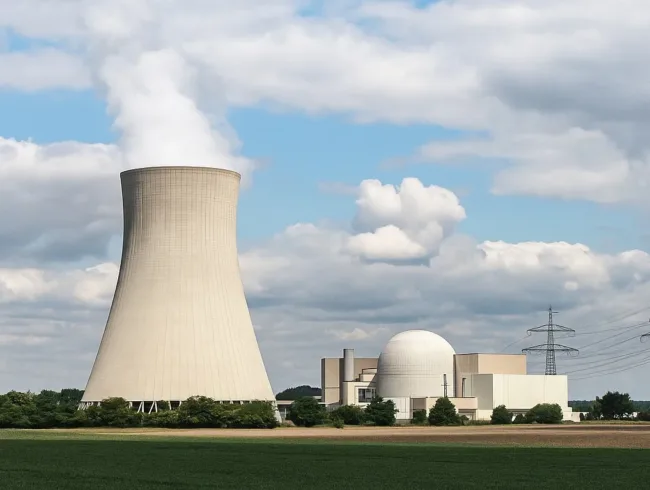


Constellation Energy Corporation (NASDAQ: CEG) has secured a conditional loan commitment of up to $5 billion from the United States Department of Energy to support potential nuclear power capacity expansions across selected existing generating facilities. Announced on October 27, 2026, the proposed financing would help fund nuclear uprates, which increase electricity output from operating reactors through equipment upgrades and technical improvements rather than construction of entirely new nuclear plants. The initiative builds on long-term electricity agreements with Google and Amazon that Constellation says support more than $7 billion in private investment and approximately 1,080 MW of additional nuclear capacity. However, the federal commitment remains conditional and does not constitute completed loan financing or a final investment decision for every identified project.
The development highlights growing interest in extracting additional electricity from established nuclear infrastructure as data centres, industrial facilities and other large consumers seek dependable power. Constellation identified eight existing nuclear generating facilities across Illinois, Maryland and Pennsylvania as potential recipients of investment, although the final scope and timing remain subject to engineering, regulatory and financial requirements. The central commercial question is whether the combination of long-term customer commitments and lower-cost federal financing can accelerate nuclear output growth while maintaining acceptable investment returns.
Why is Constellation targeting nuclear uprates instead of relying exclusively on new reactor construction?
Nuclear uprates can increase the output of existing generating facilities by modifying equipment, improving plant performance or obtaining approval to operate at higher authorised power levels. The scale of the increase depends on the design, operating condition and technical requirements of each reactor. Compared with developing an entirely new nuclear power station, uprates can potentially use established sites, workforce capabilities and transmission connections.
This approach can reduce certain development challenges, although it does not eliminate the need for investment or regulatory approval. Uprates may require modifications to turbines, electrical systems, cooling infrastructure and other equipment. Nuclear safety assessments must also establish that proposed operating changes comply with applicable requirements.
The commercial attraction lies in adding dependable power capacity from assets that already possess much of the necessary infrastructure. Where technically feasible, this can offer a different construction risk profile from developing a new reactor at an undeveloped site. However, the cost per megawatt and implementation timetable must be assessed individually rather than assuming that every uprate will be equally economical.
For electricity markets experiencing rapid demand growth, additional nuclear output can contribute generation that is not dependent on prevailing sunlight or wind conditions. This may be particularly valuable for large industrial and computing customers requiring electricity throughout the day. Nevertheless, nuclear generation remains subject to scheduled maintenance, unexpected outages and plant-specific operating constraints.
How do Google, Amazon and Meta agreements support Constellation’s nuclear expansion strategy?
Constellation has linked its uprate ambitions to long-term electricity arrangements with major technology companies. Recent 20-year agreements involving Google and Amazon are intended to support more than $7 billion in investment associated with approximately 1,080 MW of additional nuclear capacity. A separate agreement with Meta supports a planned 30 MW expansion at the Clinton Clean Energy Center in Illinois.
These arrangements demonstrate how large electricity buyers may help support investment in generating infrastructure. Long-term contracts can improve revenue visibility for power producers, potentially strengthening the financial case for capital expenditure. However, the commercial contribution depends on contractual pricing, operating obligations and the ability to complete the relevant generating capacity upgrades.
The technology-sector connection is significant because artificial intelligence and cloud computing infrastructure can require substantial and relatively continuous electricity supply. Such demand may create opportunities for operators of established nuclear plants capable of increasing output without undertaking entirely new reactor projects. Nevertheless, the existence of a long-term customer agreement does not eliminate the need for engineering work or regulatory authorisation.
Constellation’s proposed use of federal financing could complement these private commercial commitments by reducing borrowing costs. Combining customer demand with access to potentially favourable capital may improve the economics of selected projects, although the final financial benefit will depend on executed loan terms and project-level returns.
The investment approach also illustrates a broader shift in the relationship between power producers and large corporate electricity consumers. Rather than simply purchasing electricity from existing supply, some customers are entering agreements that may support additional generating capacity. The economic significance lies in whether these commitments enable infrastructure investment that otherwise might not proceed under comparable conditions.
Which nuclear plants could benefit from the proposed $5 billion financing programme?
Constellation identified Braidwood, Byron, Clinton, Dresden, LaSalle and Quad Cities in Illinois, together with Calvert Cliffs in Maryland and Limerick in Pennsylvania, as potential facilities that could benefit from the financing. These locations represent a portfolio of existing nuclear generating stations rather than a final list of approved uprate construction projects. Each site would require its own assessment of technical feasibility, implementation cost and regulatory requirements.
The geographic spread provides Constellation with several opportunities to evaluate capacity additions across established facilities. However, the company has not disclosed a definitive allocation of the $5 billion commitment among the individual locations. Nor has it provided a final megawatt capacity increase attributable to every named plant.
The distinction matters because a conditional financing facility covering multiple possible projects is not equivalent to an order for a specific amount of generating capacity. Constellation must complete the relevant studies and obtain necessary approvals before construction or equipment installation can proceed. The ultimate investment programme may differ from the preliminary list of eligible opportunities.
Regulatory oversight will remain a central consideration. Nuclear uprates can require review by the United States Nuclear Regulatory Commission and compliance with applicable safety requirements. The technical work must demonstrate that equipment, plant systems and operating procedures remain suitable for the proposed increase in output.
For investors, the most useful forthcoming disclosures will be the identification of individual uprate projects, their expected capacity additions and the estimated capital required. These details would provide a clearer basis for assessing investment economics than the headline federal financing commitment alone.
How is the $5 billion conditional commitment different from completed project financing?
The Department of Energy’s commitment remains subject to due diligence, negotiation of definitive financing documents and satisfaction of applicable conditions. Constellation has explicitly stated that the announcement does not represent a final decision to proceed with every potential uprate. Consequently, the headline figure should not be treated as money already borrowed or invested in completed projects.
This distinguishes the announcement from financing arrangements that have reached formal financial close. A conditional commitment can provide a potential financing pathway, but the borrower must still satisfy requirements before accessing funds. Individual project approvals and construction decisions remain separate milestones.
The financing could reduce the cost of capital if completed on favourable terms. Nuclear generating assets typically operate over extended periods, making financing costs important to the economics of capacity upgrades. However, any potential benefit must be measured against capital expenditure, operating costs and the additional revenue generated by the uprated facilities.
The arrangement also involves public financial support for private energy infrastructure investment. The economic justification will depend on whether the supported projects deliver dependable capacity and acceptable returns while complying with their financing and regulatory obligations. The government announcement does not independently establish the final cost per megawatt or total customer savings from the proposed uprates.
What does the nuclear financing development mean for Constellation shares and future earnings?
Constellation shares closed October 30 at $262.38, declining approximately 0.83% from the previous session. The stock had advanced about 2.57% on October 27, when the financing announcement was made, but subsequently experienced mixed trading. These movements suggest that the announcement occurred within a broader period of valuation volatility rather than producing an uninterrupted positive market response.
The long-term investment opportunity is tied to the potential expansion of generating capacity from established nuclear assets. Additional output under long-term electricity contracts could support earnings and cash flow if projects are completed at economically attractive costs. However, the financing commitment itself does not create immediate operating revenue.
Execution remains important because nuclear infrastructure projects require specialised equipment, engineering and regulatory compliance. Delays or cost increases could weaken projected investment returns even where customer demand is strong. The company must therefore balance the advantages of additional generation against the financial and operational requirements of implementing each uprate.
The agreement also reflects a broader competitive environment in which utilities and independent power producers are seeking ways to meet growing electricity demand. Existing nuclear facilities may offer opportunities to add capacity faster than some new-build alternatives, but their potential is constrained by plant-specific technical limits and approval requirements.
Constellation’s conditional $5 billion financing commitment represents an important step towards increasing US nuclear electricity output through upgrades at existing facilities. The support from major technology customers provides commercial demand visibility, while prospective federal financing could improve project economics.
The decisive milestones will be completion of the financing arrangements, approval of individual projects and successful implementation of the capacity increases. Until those stages are reached, the announced programme remains an important development opportunity rather than completed generation capacity.
Discover more from Business-News-Today.com
Subscribe to get the latest posts sent to your email.