

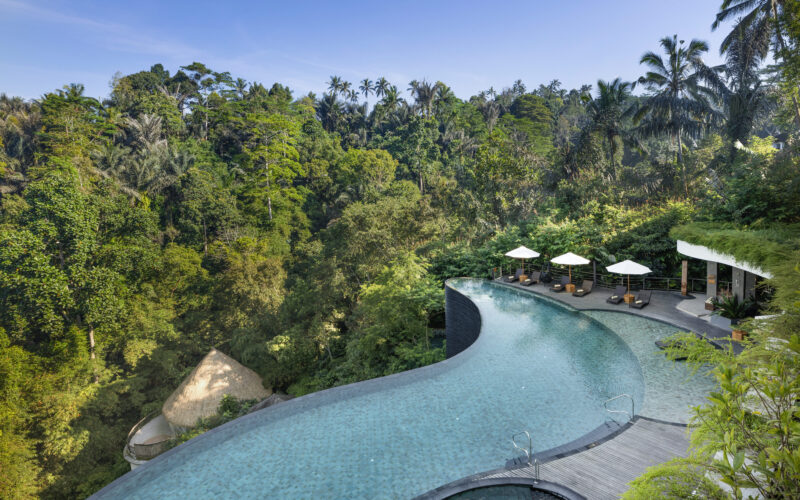
Cicada Resort Bali Ubud, Autograph Collection, a property within Marriott International’s (NASDAQ: MAR) Autograph Collection portfolio, is strengthening its positioning around spiritual and experiential wellness as it prepares to open Pravi Spa in September 2026 and expand its existing accommodation footprint. The Sebatu Valley resort currently comprises 20 suites and 10 heated-pool villas, with six additional villas planned, while its hospitality proposition increasingly centres on Balinese purification traditions, locally rooted experiences and a smaller-scale luxury format rather than conventional resort amenities alone. The strategy arrives as international arrivals into Bali continue to rise and the global wellness-tourism economy moves toward the trillion-dollar mark, giving destination hotels a potentially lucrative reason to compete for travellers who attach greater value to privacy, culture and restorative experiences. The commercial question is whether Cicada Resort Bali Ubud can translate cultural depth into sustained pricing power and guest loyalty without reducing the traditions it draws upon to another interchangeable luxury-hotel wellness package.
The resort’s August 20 announcement places its Melukat purification experience at the centre of that differentiation. Sacred water flows from Pura Bintang into a purification spring at the property, while a Pemangku from the Sebatu Village community leads the ritual after a traditional Mewacak spiritual reading. Cicada Resort Bali Ubud says the reading determines whether the timing is considered spiritually appropriate for the purification ceremony, meaning the experience is presented as a ritual governed by local practice rather than simply an activity that every guest automatically receives on demand.
That distinction matters commercially because the luxury-wellness segment is becoming increasingly crowded. A swimming pool, spa menu, yoga programme and healthy dining concept are now close to baseline expectations at many higher-end resorts. Cicada Resort Bali Ubud is instead attempting to make place, cultural participation and ritual part of the product itself, creating a proposition that may be more difficult for a generic resort elsewhere to reproduce convincingly.
Why is Cicada Resort Bali Ubud putting spiritual wellness at the centre of its luxury hospitality strategy?
Wellness tourism is no longer a niche adjacent to the broader travel market. The Global Wellness Institute estimated global wellness-tourism expenditure at US$893.9 billion in 2024, up 13.8% from 2023, and projects the market to reach about US$1.08 trillion in 2026 and US$1.38 trillion by 2029. Asia-Pacific wellness-tourism spending reached an estimated US$215 billion in 2024 after expanding 31.2% from the previous year, although that unusually strong rate partly reflects the region’s later post-pandemic tourism recovery.
For Cicada Resort Bali Ubud, the implication is that wellness can function as more than an ancillary spa revenue stream. If travellers increasingly select destinations because of restorative, cultural or personal-development experiences, the resort can potentially use wellness to influence the original booking decision, length of stay, food and beverage spending, treatment revenue and willingness to pay for higher-category accommodation.
Its small inventory is important in that equation. Marriott currently describes the resort as having 20 suites and 10 private heated-pool villas overlooking Sebatu Valley, a configuration that allows Cicada Resort Bali Ubud to emphasise privacy rather than volume. Marriott’s development listings separately show six additional guestrooms for Cicada Resort Bali Ubud in the third quarter of 2026, broadly aligning with the resort’s announcement that six more villas are planned.
Adding six villas to an existing 30-unit resort would represent a 20% increase in accommodation count if all six become operational as described. That is meaningful for an individual boutique property, but it remains controlled enough to preserve the scarcity underpinning the resort’s intimate positioning. The stronger commercial opportunity therefore appears to lie in combining modest capacity expansion with higher-value experiences rather than pursuing conventional room-volume growth.

How could Pravi Spa change the economics of Cicada Resort Bali Ubud beyond simply adding treatments?
Pravi Spa is scheduled to open in September 2026 along the Oos River at the end of what the property calls its Path of Dharma. The resort says the spa will combine traditional healing practices with contemporary therapeutic techniques and use locally sourced natural ingredients and holy water within its treatment concepts. Marriott’s existing property information also identifies Pravi Spa as an on-site facility and describes two treatment rooms, indicating that the spa is designed as an intimate operation rather than a large-volume wellness centre.
From a hospitality economics perspective, the spa matters because premium hotels increasingly compete on revenue generated beyond the room itself. A guest who books accommodation because of a wellness proposition can subsequently generate spending through treatments, food and beverage, guided experiences and longer stays, improving total guest value without requiring the operator to continually add inventory.
Cicada Resort Bali Ubud is already packaging that broader experience. Marriott booking offers for the property have combined accommodation with Balinese massage, a water-blessing ceremony, village craft experiences, afternoon tea, dining and other resort activities. Another package includes the Melukat water-blessing experience alongside daily resort programming and food and beverage inclusions.
Pravi Spa therefore appears less like a standalone amenity and more like another piece of an integrated stay proposition. The operational test will be whether guests engage with multiple elements rather than treating the spiritual and wellness components as optional extras. Higher treatment utilisation, longer average stays, repeat visits and demand for villas would provide stronger evidence that the concept is influencing economics rather than simply adding another layer of marketing language.
Does Bali’s 2026 tourism recovery give Cicada Resort Bali Ubud enough demand to support a more specialised offering?
The demand backdrop is supportive. Statistics of Bali Province recorded 605,013 international visitor arrivals directly into Bali in June 2026, an increase of 4.63% from 578,251 in May. Australian passport holders accounted for 25.90% of June international arrivals, making Australia the largest individual source market reported in the release.
Hotel utilisation has also been comparatively firm. Bali’s star-rated hotel occupancy reached 61.16% in May 2026, up 3.22 percentage points from April and 3.06 percentage points from May 2025. Those figures do not reveal how individual Ubud luxury properties are performing, but they indicate that Cicada Resort Bali Ubud is developing its wellness proposition against a tourism market with improving visitor volumes rather than attempting to stimulate demand during a broad destination downturn.
That creates opportunity but also raises the competitive hurdle. Strong Bali tourism encourages additional hotel development, renovations and brand entries, meaning operators cannot rely on destination growth indefinitely to conceal weak differentiation. Marriott’s own future-opening portfolio shows multiple Indonesian projects across Bali, Jakarta, Manado, Medan and other destinations, including additional Autograph Collection, Luxury Collection and JW Marriott properties planned for Bali.
Ubud also competes differently from Bali’s major beach destinations. Its appeal is heavily associated with landscape, culture, temples, crafts, food and wellness, making experiential authenticity particularly important. In that environment, Cicada Resort Bali Ubud’s location in Sebatu, away from the most heavily trafficked centre of Ubud, can support its privacy proposition, but it also means the resort must convince guests that relative seclusion is an advantage worth travelling for rather than an inconvenience.
What makes the Balinese cultural component commercially valuable but operationally difficult to scale?
Cicada Resort Bali Ubud’s strongest potential differentiator may also be the part that requires the most careful execution. The Melukat ceremony is connected to sacred water from Pura Bintang and involves a Pemangku from the local community, while the resort’s broader positioning draws on Sebatu’s craft traditions, local natural materials and Balinese spirituality.
From a brand perspective, locally specific experiences can generate a form of differentiation that physical luxury alone cannot easily create. Competitors can build another infinity pool, purchase similar spa equipment or offer comparable room sizes, but genuinely place-specific cultural relationships are harder to replicate. That can become particularly valuable as luxury travellers encounter increasingly standardised design and wellness concepts across international destinations.
The difficulty is that authenticity does not scale as easily as conventional amenities. Increasing guest volumes, adding villas or packaging rituals more aggressively could create tension between commercial accessibility and the cultural framework that gives the experience its meaning. Maintaining community participation, appropriate interpretation and credible boundaries around sacred practices is therefore not separate from the business strategy; it is central to protecting the differentiation on which that strategy depends.
The resort’s decision to retain a Mewacak reading before Melukat is commercially interesting for precisely this reason. It potentially limits the predictability expected of a hotel activity because the ritual may not proceed when the timing is considered inappropriate. Yet preserving that constraint may strengthen the credibility of the experience far more than turning it into a guaranteed item on a resort itinerary.
What does Cicada Resort Bali Ubud reveal about Marriott International’s wider Asia-Pacific growth strategy?
For Marriott International, Cicada Resort Bali Ubud is far too small to represent a material earnings catalyst by itself. Its strategic relevance is instead as another example of how Marriott can expand an asset-light global network through distinctive properties that retain strong individual identities while participating in Autograph Collection and Marriott Bonvoy.
Marriott entered the second half of 2026 with more than 10,000 properties and nearly 1.814 million rooms globally. Its development pipeline stood at approximately 629,000 rooms across 4,186 properties at the end of the second quarter, with more than half of pipeline rooms located outside the United States and Canada. Asia-Pacific excluding China delivered RevPAR growth of more than 5% during the quarter, supported by leisure demand and intra-regional travel, providing a favourable regional backdrop for properties such as Cicada Resort Bali Ubud.
Marriott International shares closed at US$359.22 on August 19, gaining 0.73% in the session. The stock was up 1.90% over five trading days and 15.79% year to date, although it remained below its 52-week high of US$410.98 and had declined 1.44% over the preceding month. There is no basis to attribute that market performance to the Cicada announcement, which is immaterial relative to Marriott International’s global scale, but the broader stock strength indicates that investor sentiment has remained comparatively constructive despite mixed international RevPAR trends.
For Marriott International, the more significant long-term question is whether specialised properties can help sustain network growth without weakening brand distinctiveness. Autograph Collection effectively allows Marriott International to capture loyalty, distribution and fee economics from hotels whose appeal depends partly on not resembling a conventional global chain property. Cicada Resort Bali Ubud fits that model particularly clearly because the commercial proposition is built around a highly localised identity rather than Marriott-standard architecture or a globally uniform resort experience.
Can Cicada Resort Bali Ubud turn spiritual wellness into durable pricing power rather than a hospitality trend?
The next measurable milestone is Pravi Spa’s planned September opening, followed by the addition of the six proposed villas and evidence that the expanded wellness offering converts into guest demand. Cicada Resort Bali Ubud already has the ingredients for a differentiated boutique proposition: limited inventory, private villas, a valley setting, local cultural participation, ritual-led experiences, spa services and access to Marriott Bonvoy’s international distribution ecosystem.
What remains unproven is the commercial durability of that combination. Global demand for wellness travel is expanding quickly, but that growth is also attracting more hotels into the category, making the word “wellness” increasingly easy to claim and increasingly difficult to defend as a meaningful competitive advantage.
Cicada Resort Bali Ubud’s opportunity is consequently narrower and more interesting than simply participating in a growing wellness market. The resort must demonstrate that guests perceive enough value in its Sebatu setting, cultural relationships and spiritual framework to choose it over an expanding field of Bali luxury resorts and potentially pay a premium for the difference.
If Pravi Spa increases experiential spending while the additional villas expand capacity without weakening the intimacy of the property, the strategy could strengthen both revenue potential and competitive positioning. If the cultural layer becomes indistinguishable from the wellness programming offered elsewhere, however, Cicada Resort Bali Ubud would be competing much more heavily on conventional luxury-hotel variables such as price, room quality, service and loyalty benefits. The clearest proof point will therefore not be the spa opening itself, but whether the combination of culture, wellness and limited inventory produces sustained guest demand after the initial launch period.
Key takeaways from Cicada Resort Bali Ubud’s spiritual wellness expansion
- Cicada Resort Bali Ubud is strengthening its spiritual-wellness positioning ahead of the planned September 2026 opening of Pravi Spa.
- The resort currently has 20 suites and 10 heated-pool villas, with six additional villas planned.
- Six new villas would increase the property’s accommodation count by 20% if completed as announced.
- The resort differentiates its wellness proposition through Melukat purification using sacred water associated with Pura Bintang and participation from the Sebatu community.
- Global wellness-tourism expenditure is projected by the Global Wellness Institute to reach roughly US$1.08 trillion in 2026.
- Bali recorded 605,013 direct international visitor arrivals in June 2026, up 4.63% from May.
- Marriott International reported more than 5% second-quarter RevPAR growth in Asia-Pacific excluding China, providing a supportive regional demand backdrop.
- Marriott International shares ended August 19 at US$359.22, but the Cicada Resort Bali Ubud announcement is too small to infer any direct market impact.
- The principal opportunity is to combine limited room inventory with higher-value spa, cultural, dining and experiential spending.
- The key test after Pravi Spa opens will be whether cultural and wellness differentiation translates into durable demand, pricing power and guest spending rather than simply broader marketing reach.
Discover more from Business-News-Today.com
Subscribe to get the latest posts sent to your email.