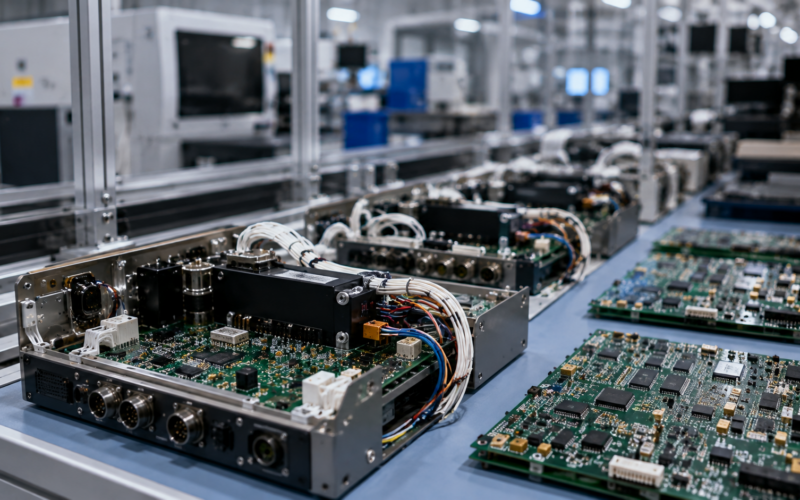
Centum Electronics Limited (NSE: CENTUM) ended Q1 FY27 with a standalone order book of approximately ₹1,800 crore, up 31% year on year, giving the Bengaluru-based electronics manufacturer substantially stronger revenue visibility as it refocuses on its Indian defence, aerospace, space and high-reliability manufacturing businesses. Standalone quarterly order inflow reached around ₹360 crore, rising roughly 70%, while revenue from operations increased 11% to about ₹205 crore.
The headline consolidated profit figure requires more caution. Centum reported consolidated profit after tax of about ₹106 crore, but approximately ₹94 crore arose from a one-time gain linked to the deconsolidation of overseas subsidiaries following restructuring in France. Profit from continuing operations after tax was around ₹11 crore, making the order book, underlying Indian operations and future margin trajectory more useful indicators than the unusually large reported PAT.
How much revenue visibility does Centum Electronics’ ₹1,800 crore order book provide?
The ₹1,800 crore standalone order book is almost nine times the ₹205 crore of standalone revenue generated during Q1 FY27. Comparing a multi-year backlog with one quarter is not a forecast of the time required to execute it, but the ratio illustrates how far contracted and committed programme visibility now extends beyond the latest quarterly revenue base.
The order book has also grown faster than current revenue. Standalone revenue increased about 11% year on year, while backlog expanded 31%, suggesting new order intake and long-duration programmes are replenishing the pipeline faster than recognised sales. Management said quarterly order inflow itself rose around 70% to ₹360 crore.
The underlying mix is important because Centum operates two materially different models. Its build-to-specification business handles higher-complexity programmes across defence, radar, space and electronic warfare, while Electronics Manufacturing Services supports customers in industrial, energy and semiconductor equipment. Build-to-specification orders tend to have longer development and execution cycles, creating quarterly revenue volatility even when the backlog is growing.
Management consequently continues to encourage investors to assess performance over a full-year period rather than extrapolating individual quarters. It has maintained a medium-term India-business revenue growth ambition of around 25%, supported by current order trends and programmes under execution.
Where is Centum seeing the strongest new electronics demand?
Defence and aerospace remain important growth engines. Centum is involved in radar, electronic-warfare and airborne programmes, while management expects continued order intake across space, air-navigation and strategic electronics. Development work includes programmes associated with Virupaksha radar and other platforms where successful prototype qualification could lead to serial-production opportunities later.
The Electronics Manufacturing Services business is simultaneously benefiting from semiconductor-equipment demand. Centum said a semiconductor-equipment customer that contributed virtually no revenue in FY25 had already crossed ₹100 crore in FY26, with management expecting the business to more than double as qualified products move deeper into serial production.
That is strategically significant because semiconductor equipment broadens Centum beyond defence-linked spending cycles. Semiconductor-manufacturing equipment demands stringent process control, reliability and customer qualification, allowing suppliers that clear the initial qualification barrier to potentially participate in longer-duration production relationships.
Centum is also working on new products for industrial electrification and grid automation as global customers localise more of their supply chains in India. Management expects several of those programmes to begin contributing meaningfully over the next two years, which could create a third growth leg alongside strategic electronics and semiconductor equipment.

Why did Centum Electronics exit its overseas subsidiaries?
The overseas restructuring is intended to remove a persistent source of losses and management distraction. During Q1, a French court approved the transfer of substantially all operating businesses and employees of Centum T&S Group and certain subsidiaries to successful bidders, including MBDA and SII, after which those operations were deconsolidated from Centum’s financial statements from June 4.
The remaining entities subsequently entered liquidation proceedings, and management has said it does not expect further liabilities relating to the transferred overseas operations. That assertion remains subject to the normal uncertainties of legal wind-down processes, but it marks a major strategic simplification compared with maintaining loss-making international engineering subsidiaries.
The accounting impact explains the unusually high consolidated PAT. The deconsolidation produced a one-time gain of about ₹94 crore, lifting reported consolidated profit to ₹106 crore despite profit from continuing operations after tax being only around ₹11 crore. Investors comparing Q1 FY27 PAT with previous quarters therefore need to strip out the restructuring gain before assessing recurring profitability.
More importantly, the restructuring redirects management attention and capital toward India. Centum is effectively becoming a cleaner domestic electronics-system-design-and-manufacturing story, with export exposure increasingly coming through products manufactured from India rather than through ownership of overseas engineering operations.
What does the order mix imply for Centum Electronics’ margins?
Standalone EBITDA reached approximately ₹23 crore in Q1 FY27, producing an EBITDA margin of 11.28%. Management said margins were affected by a lower contribution from the build-to-specification business during the quarter and expects the mix to improve as execution on key programmes accelerates.
The company reported an EBITDA margin of about 12.5% in the previous year and is targeting more than 13% as its mix evolves. Higher-value design-led manufacturing, strategic defence electronics and integrated engineering-plus-manufacturing work could support that improvement, while conventional contract manufacturing generally carries lower margins.
Centum is attempting to move customers from engineering into manufacturing rather than treating the two services as separate activities. That design-led manufacturing strategy can deepen customer relationships and increase the amount of value captured per programme, particularly when Centum owns more of the engineering content.
The main constraint is execution timing. Development programmes can consume engineering resources well before serial-production revenue arrives, while defence procurement schedules can shift between quarters. A rising order book is therefore positive, but conversion speed and programme mix ultimately determine margins and cash generation.
How is Centum Electronics stock performing after the restructuring?
Centum Electronics shares closed at ₹3,439 on August 21, down 0.20% for the session after trading between ₹3,400.10 and ₹3,550. The stock had reached a 52-week and all-time high around ₹3,960 earlier in August and remained substantially above its 52-week low of ₹2,051.55.
The shares have consequently pulled back by roughly 13% from the recent high even as the order book and strategic outlook remain strong. That moderation may reflect investors digesting the difference between the large reported Q1 profit and much smaller recurring profit from continuing operations, alongside normal volatility in a relatively smaller-cap electronics company.
The investment case now becomes cleaner but also easier to measure. Centum no longer needs investors to look through a large overseas restructuring story; instead, performance can increasingly be judged against the ₹1,800 crore order book, order conversion, 25% growth ambition and progress toward a 13%-plus margin profile.
If the semiconductor-equipment business continues scaling while defence and aerospace development orders move into production, the current backlog could support a meaningful expansion of the India platform. The critical question is whether Centum can translate that visibility into recurring earnings without the one-time accounting gains that made Q1’s headline PAT look dramatically stronger than the underlying business.
Discover more from Business-News-Today.com
Subscribe to get the latest posts sent to your email.