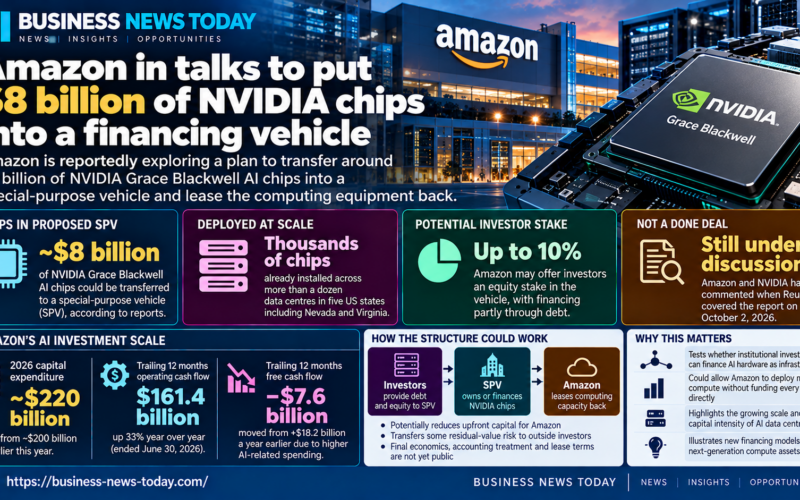
Amazon.com, Inc. (NASDAQ: AMZN) is reportedly exploring a plan to transfer roughly $8 billion of NVIDIA Corporation (NASDAQ: NVDA) Grace Blackwell artificial intelligence chips into a special-purpose vehicle and lease the computing equipment back, potentially creating one of the most significant tests yet of whether institutional investors can finance hyperscale AI hardware as infrastructure.
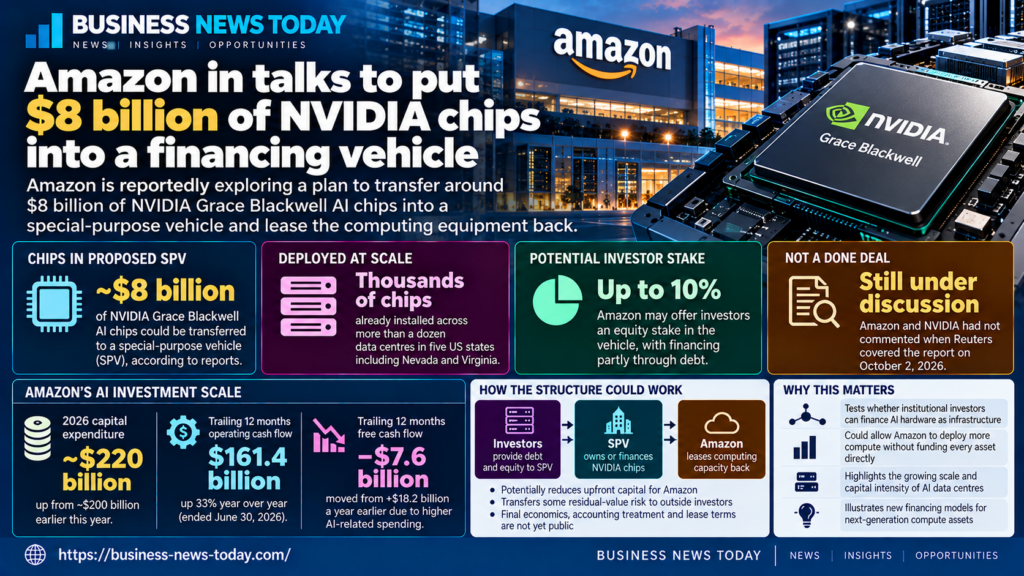
The Financial Times reported, citing people familiar with the discussions, that Amazon has held talks with investors about the proposed structure. According to the report, thousands of Grace Blackwell chips that have already been installed across more than a dozen data centres in five US states, including Nevada and Virginia, could be transferred to the special-purpose vehicle, or SPV, which would finance the assets partly through debt. Amazon may also offer investors an equity stake of up to 10% in the vehicle, although the final ownership, financing and lease terms have not been publicly disclosed.
The proposal remains under discussion rather than a completed Amazon transaction. Amazon and NVIDIA had not provided immediate comment on the report when Reuters covered the development on October 2. That distinction matters because the eventual economics, accounting treatment, allocation of residual-value risk and financing benefits would depend heavily on contractual terms that are not yet public.
Even with those uncertainties, the reported plan arrives at an important moment for the AI industry. Amazon has increased its expected 2026 capital expenditure to approximately $220 billion while Amazon Web Services continues to accelerate, creating a striking combination of powerful demand and extraordinary capital intensity. The emerging question is therefore not whether Amazon intends to keep investing heavily in AI infrastructure, but whether increasingly sophisticated financing structures could allow it to deploy more compute without funding every asset through direct ownership.
Why would Amazon move $8 billion of NVIDIA chips into a special-purpose vehicle?
The most important feature of the reported structure is the potential separation between ownership of the physical processors and Amazon’s continued use of their computing capacity. Under such a model, an SPV could own or finance the chips while Amazon makes contractual payments for access to the hardware, although the precise economic substance would depend on the final lease and financing arrangements.
That could potentially reduce the amount of upfront capital Amazon needs to commit directly to ownership of a particular pool of processors. It could also transfer some residual-value exposure to outside investors, depending on whether Amazon provides guarantees, repurchase obligations, minimum lease payments or other forms of credit support. Without the final contracts, however, it would be premature to conclude that $8 billion simply disappears from Amazon’s balance sheet or that the company eliminates the associated economic obligations.
This distinction is especially important because lease accounting can leave substantial liabilities on a user’s balance sheet even when it does not legally own the underlying asset. The strategic significance of the reported Amazon structure therefore lies less in a simplistic assumption of accounting removal and more in the possibility of broadening the sources of capital available for AI infrastructure.
Asset-backed and lease-based financing are already common in capital-intensive sectors such as aviation, telecommunications and transportation. What makes artificial intelligence processors considerably harder to finance is the uncertainty surrounding their economic life. An aircraft can remain productive for decades, whereas the economic value of a high-end accelerator can be affected rapidly by improvements in performance, power efficiency, networking and software support.
How does Amazon’s $220 billion capital spending plan change the financing equation?
Amazon initially said in February that it expected to invest approximately $200 billion in capital expenditure during 2026, with Chief Executive Officer Andy Jassy linking the spending to opportunities in artificial intelligence, chips and other areas. After Amazon’s second-quarter results in July, the company increased that expectation by about 10% to approximately $220 billion.
The scale becomes clearer when compared with Amazon’s cash-flow numbers. For the trailing 12 months ended June 30, 2026, Amazon reported $161.4 billion of operating cash flow, up 33% year over year. Purchases of property and equipment, net of sales and incentives, reached approximately $169.0 billion over the same period, up 64% from approximately $103.0 billion a year earlier.
As a result, Amazon’s trailing-12-month free cash flow moved from an inflow of approximately $18.2 billion at the end of June 2025 to an outflow of approximately $7.6 billion at the end of June 2026. Amazon said the deterioration was driven primarily by a $66.1 billion year-over-year increase in purchases of property and equipment, net of proceeds and incentives, with the increase primarily reflecting artificial intelligence investments.
Those figures do not indicate that Amazon’s underlying operations are deteriorating. Second-quarter 2026 net sales rose 20% year over year to $200.6 billion, while operating income increased 43% to $27.5 billion. Instead, they illustrate how rapidly the capital requirements of AI infrastructure can absorb cash even while revenue and operating income continue growing strongly.
That makes financing architecture increasingly relevant. If Amazon can combine internally funded infrastructure with corporate debt, equipment financing, leases and externally owned computing assets, it could potentially diversify how it funds the enormous physical buildout required by AI.
Why is Amazon Web Services growth central to the $8 billion chip proposal?
Amazon Web Services provides the commercial backdrop that makes an $8 billion chip-financing proposal plausible in the first place. AWS generated $42.2 billion of revenue during the second quarter of 2026, up 37% year over year and representing its fastest growth in 18 quarters. Amazon described the business as operating at an annualised revenue run rate of approximately $169 billion.
AWS operating income reached $16.6 billion during the quarter, compared with $10.2 billion a year earlier. Amazon also said its AWS AI business had exceeded a $25 billion annual revenue run rate and was growing at triple-digit percentages year over year, while its chips business had separately surpassed a $25 billion annual run rate.
Those disclosures provide evidence that Amazon is not merely building speculative capacity without corresponding commercial activity. The strategic tension is that continuing to serve rapidly growing AI demand requires further data centres, processors, networking equipment, power infrastructure and supporting systems, creating a cycle in which strong demand can itself produce enormous capital requirements.
The reported SPV therefore appears more consistent with an effort to broaden financing options than with a retreat from AI spending. Amazon actually increased its 2026 capital-spending expectation after reporting accelerating AWS growth.
For outside investors, Amazon’s scale could also make the financing proposition different from lending primarily against GPUs operated by a smaller artificial intelligence infrastructure provider. Amazon Web Services generates substantial revenue and operating income, potentially giving financiers contractual cash flows backed by a large investment-grade corporate customer rather than forcing them to rely solely on the resale value of the chips themselves.
Why does NVIDIA chip depreciation matter so much to investors?
The difficult question is what an advanced NVIDIA processor will be worth several years after it is installed. NVIDIA has been arguing that its computing platforms can remain economically useful for long periods, while financial institutions evaluating GPU-backed transactions have adopted considerably more conservative assumptions.
Reuters reported that banks commonly underwrite GPUs using depreciation periods of approximately three to four years. That approach contrasts with NVIDIA’s argument that leading processors can continue generating revenue for much longer, highlighting a fundamental disagreement about how AI hardware should be valued for financing purposes.
The distinction between useful life and economic competitiveness is important. A Grace Blackwell processor could remain technically capable of running AI workloads years after installation while nevertheless becoming less valuable for premium applications if future generations deliver materially better performance, memory capacity or energy efficiency.
Financiers therefore have to assess more than whether the hardware still functions. They need to estimate utilisation, contractual revenue, electricity costs, customer demand and residual value throughout the financing period.
That makes an Amazon-backed transaction particularly interesting. Investors may be more comfortable financing rapidly depreciating technology when the lease payments come from Amazon than when repayment depends mainly on selling used GPUs several years later. The credit quality of the customer could consequently become as important as the collateral value of the chips.
Is NVIDIA trying to turn AI compute into a new institutional asset class?
NVIDIA has made its ambitions unusually explicit. In August 2026, NVIDIA announced partnerships with Apollo Global Management, BlackRock, Blackstone, Brookfield, Goldman Sachs and KKR intended to establish independent AI compute financing platforms capable of mobilising more than $500 billion of third-party capital over time.
NVIDIA described the initiative as an attempt to turn AI compute and full-stack infrastructure into an investable asset class. The company said the planned platforms would create dedicated pools of independently underwritten capital that customers could use to build and access AI infrastructure.
The company has also acknowledged that these arrangements remain subject to execution risk. NVIDIA’s subsequent regulatory filing said the memorandums of understanding and other preliminary arrangements may not lead to definitive agreements. NVIDIA also disclosed that it may, at its option, provide limited residual-value support for portions of specific projects, subject to project-by-project evaluation and risk management.
That disclosure reinforces why residual value is central to the emerging financing market. Outside investors are willing to examine AI hardware as infrastructure, but they may demand additional customer commitments, guarantees or other forms of protection before accepting large amounts of technology-obsolescence risk.
Amazon’s reported SPV would therefore sit inside a much broader industry experiment. Semiconductor suppliers, hyperscalers, private-credit managers, banks and infrastructure investors are effectively trying to determine whether computing capacity can be financed in a repeatable way similar to other productive infrastructure assets.
Why is Amazon also borrowing heavily while exploring alternative AI financing?
The reported chip vehicle would not be Amazon’s only source of external capital. In July, Amazon moved to sell approximately $25 billion of US dollar-denominated bonds across multiple maturities, attracting peak investor demand of approximately $62 billion. The company said proceeds could be used for general corporate purposes, including capital expenditure and repayment of upcoming debt.
That offering followed a roughly $37 billion bond transaction earlier in 2026, illustrating how rapidly major technology companies have been increasing their use of debt markets alongside the AI investment boom.
Amazon is not alone. Alphabet, Microsoft, Meta Platforms, Oracle and other hyperscalers have also been committing enormous amounts of capital to processors, data centres, networking and power capacity. As issuance increases, credit investors have begun scrutinising whether the scale of borrowing could eventually increase funding costs or reduce demand for additional technology-sector debt.
An SPV could therefore provide another financing channel rather than simply replacing conventional debt. Amazon could theoretically use different capital structures for different portions of its infrastructure, although the company has not publicly detailed how the reported $8 billion vehicle would fit within its broader financing strategy.
The important analytical point is that the AI infrastructure race is beginning to become a financing problem as well as a technology problem. Companies still need processors, land, power and networking equipment, but they increasingly also need structures capable of matching enormous upfront investment with revenue expected to arrive over several years.
What does Amazon’s recent share-price reaction say about investor sentiment toward AI spending?
Amazon’s second-quarter results provided one recent indication that investors are willing to support large AI spending when accompanied by accelerating commercial performance. Amazon shares rose nearly 9% in after-hours trading immediately following the July 30 results, when the company reported 37% AWS growth and increased its 2026 capital-spending forecast to approximately $220 billion.
During the following regular trading session on July 31, Amazon shares finished more than 15% higher as investors responded to the company’s results and stronger cloud growth. Those two movements describe different trading periods and should not be combined into a single percentage.
The reaction suggested that the market was focusing heavily on whether higher infrastructure spending was producing visible revenue growth. Amazon’s results offered investors evidence that AWS demand was accelerating at the same time the company was dramatically expanding investment.
That earlier market response should not be interpreted as investor approval of the subsequently reported $8 billion SPV proposal. The financing discussions emerged separately in October, and the final terms remain unknown. However, the July reaction illustrates the broader framework through which investors are evaluating Amazon: substantial capital spending is likely to receive greater tolerance when Amazon Web Services growth and operating performance demonstrate corresponding commercial momentum.
Could GPU leasing become a standard way to finance the AI infrastructure boom?
The potential implications extend beyond Amazon. If investors become comfortable owning or financing GPU pools against long-term commitments from financially strong customers, a larger institutional market for compute infrastructure could begin developing.
Such a market could attract infrastructure funds, private-credit managers, insurers, pension capital and other investors seeking contracted cash flows. Hyperscalers could retain operational control of computing capacity while a larger share of the underlying hardware is financed outside traditional corporate capital budgets.
There are still major obstacles. Unlike many conventional infrastructure assets, advanced processors face unusually rapid technological change. Financing structures may therefore need shorter durations, stronger customer guarantees, conservative residual-value assumptions or contractual mechanisms that protect investors if the hardware becomes economically obsolete faster than expected.
That could make the identity of the user crucial. A pool of GPUs supported by long-term payments from Amazon could be considered very differently from the same hardware supporting a young AI company with concentrated customers and uncertain cash flow.
The reported Amazon structure could therefore help answer one of the most consequential financial questions surrounding the AI boom: whether investors can reliably separate ownership of the computing asset from operation of the computing service.
What should investors watch next in Amazon’s reported NVIDIA chip SPV plan?
The next meaningful milestone would be evidence that Amazon’s discussions with investors have progressed into a definitive transaction. Until that happens, the reported $8 billion value should be treated as the scale of a proposed financing rather than a completed transfer.
The most important terms would include how much debt the vehicle uses, who provides the equity, what equity interest Amazon ultimately retains or offers, how long Amazon commits to leasing the processors, whether Amazon guarantees minimum payments, who absorbs losses if chip values fall rapidly, and whether NVIDIA provides any residual-value support.
Those details would determine the real economic significance of the transaction. A vehicle heavily guaranteed by Amazon could transfer legal ownership without transferring much economic risk, while a structure in which outside investors genuinely assume residual-value exposure would represent a more significant development in AI infrastructure finance.
Accounting treatment will also depend on the final contractual structure. Without definitive agreements, it would be inappropriate to describe the proposal simply as removing $8 billion of assets or obligations from Amazon’s balance sheet.
The larger significance is already visible, however. Amazon is planning approximately $220 billion of capital expenditure this year while AWS is growing at its fastest rate in 18 quarters, NVIDIA is attempting to mobilise more than $500 billion of third-party infrastructure capital, and lenders are simultaneously debating how quickly GPUs should depreciate.
That convergence suggests the next phase of the AI boom will depend not only on who can design the fastest processors or build the largest data centres, but also on who can finance those assets efficiently.
If Amazon ultimately completes an approximately $8 billion Grace Blackwell financing vehicle on terms attractive to both the company and outside investors, the transaction could provide an influential precedent for how hyperscale AI computing infrastructure is funded. Until the structure is finalised, however, it remains a reported proposal and its ultimate balance-sheet, cash-flow and risk-transfer effects cannot yet be determined.
Discover more from Business-News-Today.com
Subscribe to get the latest posts sent to your email.