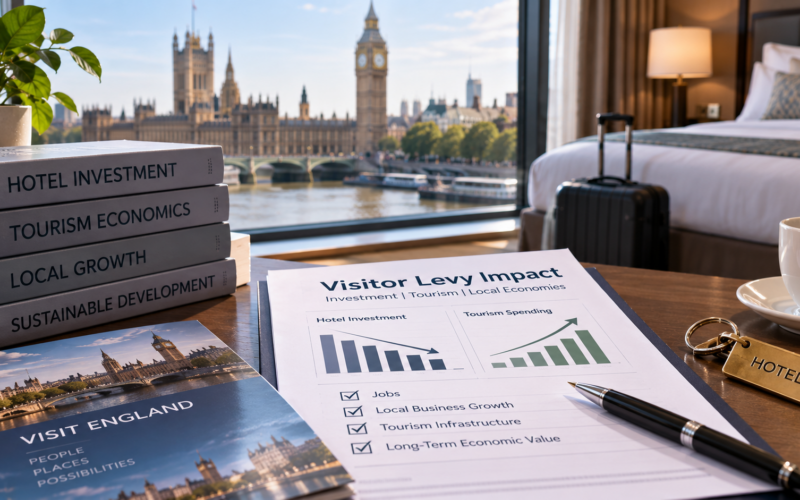
Whitbread plc (LSE: WTB), the owner of Premier Inn, has warned that England’s proposed Overnight Visitor Levy could contribute to a reduction of as much as £500 million in its UK investment over the next five years when combined with rising business rates and other employment costs. Chief executive Dominic Paul argues that additional taxation could make planned hotel developments harder to justify, particularly in regional and coastal locations where project returns are already more sensitive to construction costs and achievable room rates. The UK government says the levy will be optional for eligible mayors and strategic authorities, charged as a percentage of accommodation cost rather than a flat fee, with locally retained proceeds available for transport, public spaces, culture and other tourism-supporting infrastructure. The policy therefore creates a direct debate between the potential value of reinvesting visitor revenue in destinations and the possibility that higher total accommodation costs reduce private hotel investment or consumer demand. WTB closed around 2,347 pence on September 11, approximately 1.4% below September 4 and nearly 5% lower over one month, while remaining around 29% below its 52-week high.
Why could an overnight visitor levy change the economics of a Premier Inn development?
Premier Inn operates predominantly in the value and midscale hotel market, where customers are more sensitive to the total price of a night’s accommodation than travellers using luxury properties. A levy charged as a percentage is designed to protect cheaper stays from the disproportionate effect of a fixed nightly fee, but it still raises the total cost paid by the guest.
Hotels do not necessarily bear the tax directly in accounting terms, yet demand can force them to absorb part of the economic burden. If a £100 room becomes more expensive after the levy, Premier Inn may need to moderate its underlying rate to preserve the customer’s total price point, particularly in markets where several budget operators compete aggressively.
That effectively reduces the room revenue available to cover wages, rent, construction financing and operating costs. The impact becomes more important in regional markets where average daily rates are lower and project returns may already sit closer to the investment hurdle.
Whitbread’s concern is therefore not simply that existing hotels pay another tax. It is that expected future room economics determine whether a new property gets built at all. Small reductions in stabilised cash flow can materially lower the present value of a hotel project when applied over decades of operation.
The policy could consequently affect investment geography. London and other high-demand markets may continue supporting new hotels even with greater taxation, while marginal regional projects are delayed or cancelled because their economics become less resilient.
What is the government trying to achieve with the Overnight Visitor Levy?
The government argues that destinations hosting millions of visitors need sustainable funding for infrastructure and public services used by tourists as well as residents. Allowing local leaders to levy overnight stays creates a revenue stream linked directly to tourism activity, bringing English cities closer to systems already used in many international destinations.
The percentage-based structure is intended to make the policy progressive within accommodation. A budget hotel guest would pay less than a traveller booking an expensive luxury suite, avoiding a flat fee that could represent a disproportionately high percentage of a cheap room.
Local authorities would decide whether to implement the levy and would be expected to consult residents and businesses before proceeding. They would also determine how revenue is invested, with potential uses including public transport, high streets, visitor attractions, events and public spaces.
Supporters argue these investments can strengthen the tourism economy itself. Better transport, cleaner public areas and stronger cultural events can attract additional visitors and improve destination quality, potentially creating benefits for hotels that help offset the tax.
The economic result therefore depends heavily on implementation. A modest levy visibly reinvested in tourism-supporting infrastructure can produce a different commercial outcome from a high charge whose benefits are difficult for visitors or accommodation businesses to identify.
Why is Whitbread’s £500 million warning particularly important given its existing five-year strategy?
Whitbread is already restructuring its capital allocation through a five-year plan that aims to create a more focused Premier Inn business. The company is reducing exposure to standalone branded restaurants, converting selected restaurant space into hotel rooms and recycling property capital while targeting substantial free-cash-flow generation.
Management has said the plan can reduce net capital investment by more than £1 billion and generate around £2 billion of capacity for shareholder returns by fiscal 2031. This means new hotel development already competes against other uses of capital inside a more disciplined investment framework.
A further £500 million reduction in UK investment would therefore not occur in isolation. It could accelerate an existing process in which Whitbread becomes more selective about which projects deserve capital and which assets can be monetised or reconfigured.
The company also has growth opportunities in Germany, giving management another destination for investment if UK development economics deteriorate. Capital can move between countries when one market provides better risk-adjusted returns, especially for a hotel operator large enough to maintain several pipelines simultaneously.
That possibility strengthens Whitbread’s negotiating position but also makes the warning economically plausible. A company does not need to abandon the United Kingdom completely for taxation to alter investment. It only needs the next pound of capital to earn a better expected return somewhere else.
Could the visitor levy actually help Premier Inn by improving destinations and local infrastructure?
The positive case should not be dismissed. Hotels benefit when cities and tourism areas have reliable transport, attractive public spaces, events and cultural amenities that encourage visitors to stay longer. A local levy could finance improvements that individual hotel companies cannot provide themselves.
Premier Inn could benefit particularly from transport investment because its customer base includes families and domestic leisure travellers who may be sensitive to the ease and total cost of moving around a destination. Better buses, rail connections or late-night services can increase the practical attractiveness of a city break.
Events can also improve room demand. Publicly supported festivals, exhibitions and cultural programming can create compression nights when occupancy rises and hotels achieve stronger average rates. Revenue raised from visitors can therefore theoretically support activities that generate more visitors.
The dispute concerns whether those benefits exceed the immediate cost and whether local authorities set rates appropriately. A percentage levy with no carefully considered ceiling could become materially more burdensome over time as room prices rise.
Whitbread is therefore not arguing that destination investment has no value. Its position is that the hospitality sector already carries substantial taxation and operating-cost pressure, so another charge could reduce private investment before public reinvestment has time to produce compensating demand.
Why are regional and coastal towns potentially more exposed than London?
London combines international demand, business travel, leisure tourism and events, giving hotels several customer segments and generally stronger room rates. Regional and coastal locations can depend more heavily on domestic leisure spending, seasonality and lower average prices, making the economics less forgiving.
A percentage levy is gentler on cheaper rooms than a flat charge but still raises total holiday spending. Families choosing between a domestic coastal break and an overseas package may respond to even relatively small price differences when transport, food and attractions are added together.
Seasonal hotels also have fewer high-demand months in which to recover fixed annual costs. A policy that reduces occupancy or pricing power during peak periods can therefore have a disproportionate effect on profitability.
These locations are precisely where new hotel investment can create jobs and modernise tourism infrastructure. Whitbread argues that weakening project returns could slow development in communities where policymakers would otherwise like to encourage economic activity.
Local discretion is therefore important. A levy suitable for central London may not make sense at the same percentage in every coastal or rural market, which is why consultation and regional economic assessment will matter before implementation.
How could the levy affect Premier Inn’s competitive position against Airbnb and other accommodation?
The government intends the levy to cover overnight accommodation broadly rather than targeting hotels alone, reducing the risk that traditional operators are uniquely disadvantaged against short-term rental platforms. Consistent treatment would be important because hotels already face regulatory, staffing and property costs that differ from many private accommodation providers.
Administration still matters. Large operators such as Whitbread can build tax collection into central reservation and accounting systems, while smaller accommodation businesses may face a greater relative compliance burden. A complicated local patchwork could create different rates and exemptions across England.
Premier Inn may actually possess an administrative advantage because its scale allows system changes to be spread across hundreds of properties. The economic demand effect, however, remains regardless of whether collection is technically easy.
The brand’s value positioning could offer some protection. A percentage levy produces a lower absolute charge on a £90 room than on a £300 hotel room, meaning Premier Inn remains comparatively affordable. The problem arises if price-sensitive guests respond by travelling less often or reducing length of stay.
The competitive outcome will therefore depend on elasticity rather than the tax mechanism alone. A low-cost operator can gain share while the overall market still loses demand.
Why is WTB trading almost 30% below its 52-week high despite the Premier Inn brand’s strength?
Whitbread shares around 2,347 pence remain substantially below the 52-week high near 3,302 pence. The stock is approximately 12% above its annual low, leaving investors cautious even though Premier Inn remains one of Britain’s strongest hotel brands.
The discount reflects several pressures including labour costs, business rates, consumer sensitivity, capital expenditure and uncertainty around the pace of German profitability. The visitor levy adds another potential variable rather than creating the entire valuation problem.
Whitbread’s property assets and brand scale provide significant strategic flexibility. Management can sell property, reconfigure restaurants, add rooms at existing sites and direct more capital toward markets producing stronger returns.
Investors nevertheless want evidence that the five-year plan translates into higher free cash flow rather than simply a sequence of restructuring actions. A reduction in UK investment could improve near-term cash preservation while reducing longer-term room growth, creating a trade-off rather than an automatic benefit.
The overnight levy debate therefore matters because it goes directly to capital allocation. If policy changes alter enough project returns, they can reshape the future footprint of Britain’s largest hotel operator.
What are the key takeaways from Whitbread’s warning over England’s Overnight Visitor Levy?
- Whitbread says combined tax and cost pressures could reduce planned UK investment by as much as £500 million over five years.
- The government plans to give eligible mayors and strategic authorities the option to introduce an Overnight Visitor Levy.
- The levy would be charged as a percentage of accommodation cost rather than a flat nightly fee.
- Local leaders could reinvest proceeds in transport, public spaces, culture, events and other destination infrastructure.
- Whitbread argues additional costs could make new Premier Inn developments less attractive, particularly in regional and coastal markets.
- Premier Inn’s value positioning makes total guest price particularly important to demand.
- Whitbread already has a five-year strategy focused on capital discipline, restaurant restructuring and property recycling.
- Growth opportunities in Germany give management alternatives if UK project returns become less competitive.
- WTB remains almost 30% below its 52-week high amid wider cost and growth concerns.
- The policy’s ultimate economic effect will depend on local levy rates, exemptions, how revenue is reinvested and how sensitive travellers are to higher total accommodation prices.
Discover more from Business-News-Today.com
Subscribe to get the latest posts sent to your email.