




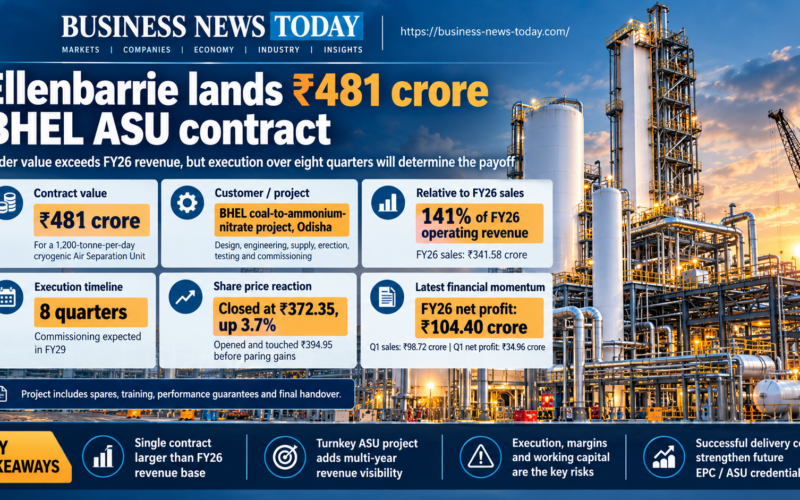
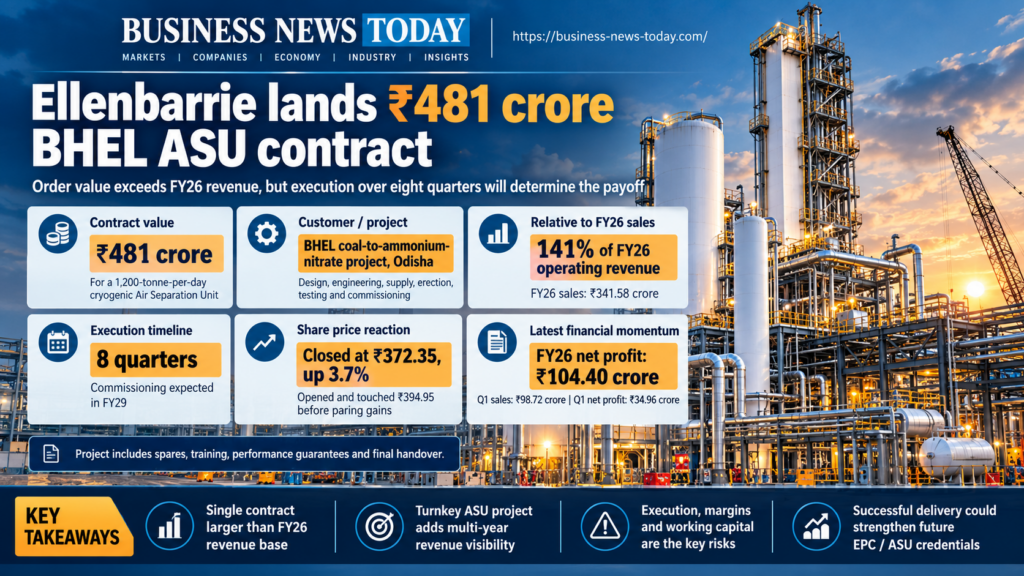
Ellenbarrie Industrial Gases Limited (NSE: ELLEN) closed September 29 at ₹372.35, up 3.7%, after opening at ₹394.95 following disclosure of a ₹481 crore contract from Bharat Heavy Electricals Limited. The intraday reversal is worth paying attention to. Investors initially pushed the newly listed industrial-gases company sharply higher, but by the close the market had retained only part of the enthusiasm despite an order whose value exceeds Ellenbarrie Industrial Gases’ entire FY26 operating revenue.
The contract covers the design, engineering, supply, erection, testing and commissioning of a 1,200-tonne-per-day cryogenic Air Separation Unit for Bharat Heavy Electricals’ 2,000-tonne-per-day Coal to Ammonium Nitrate project in Odisha. The project also includes spares, training, performance guarantees and final handover, with execution spread across eight quarters and commissioning expected in FY29.
How large is the ₹481 crore BHEL contract relative to Ellenbarrie Industrial Gases?
FY26 sales were ₹341.58 crore. The ₹481 crore contract therefore represents approximately 141% of an entire year’s historical operating revenue.
That is an unusually large comparison for a single contract, but investors should immediately add an important qualification: the order will not be recognised in one quarter or even one financial year.
Execution extends across eight quarters. If revenue were recognised perfectly evenly, which real EPC accounting rarely permits, the contract would average roughly ₹60 crore per quarter or about ₹240 crore annually during a two-year execution period.
Even on that simplified basis, the order could become a major contributor to Ellenbarrie Industrial Gases’ revenue base.
The contract also takes the company beyond routine supply of industrial gases. Ellenbarrie Industrial Gases is effectively delivering a large cryogenic production asset on a turnkey build-and-transfer basis, including engineering, construction, commissioning and performance demonstration.
That creates potentially stronger revenue visibility but also introduces execution, working-capital and project-management risks.
Why did Ellenbarrie shares give back much of their initial order-driven gain?
The September 29 price action provides a useful clue. Ellenbarrie Industrial Gases opened and touched ₹394.95 but closed at ₹372.35, only 3.7% above the previous session.
The market clearly recognised the scale of the order, but the intraday pullback suggests investors were unwilling to capitalise the full ₹481 crore headline immediately.
One reason is the long execution period. Revenue and profit arrive gradually and depend on project milestones rather than the date the order is announced.
Another reason is margin uncertainty. Ellenbarrie Industrial Gases has not disclosed the expected profit margin attached to the contract. Large EPC orders can produce excellent returns when pricing, procurement and execution are disciplined, but the same headline revenue can create disappointing economics if costs rise.
The market may also be absorbing an already strong share-price run. Ellenbarrie Industrial Gases listed relatively recently and has traded across a wide 52-week range, making the stock sensitive to both order momentum and valuation.
Are Ellenbarrie Industrial Gases’ existing margins strong enough to support the expansion?
FY26 provides a strong starting point. Sales increased 9.3% to ₹341.58 crore while net profit rose 25.4% to ₹104.40 crore. Operating profit was approximately ₹116.22 crore, giving the company an unusually healthy operating-margin profile for an industrial business.
The latest June quarter strengthened that picture. Sales increased 18% year over year to approximately ₹98.72 crore, while net profit climbed about 87% to ₹34.96 crore.
That indicates Ellenbarrie Industrial Gases entered the BHEL project from a period of improving profitability rather than weak operating performance.
However, existing gas-manufacturing economics should not automatically be applied to a ₹481 crore turnkey construction project. Project revenue can have a different margin profile from gases produced and sold from owned facilities.
Investors therefore need segment and project-level execution data before assuming the BHEL contract will preserve the company’s historical profitability ratios.
Why is a 1,200 TPD air-separation unit strategically important?
Air Separation Units separate atmospheric air into industrial gases including oxygen and nitrogen using cryogenic processes. At 1,200 tonnes per day, the BHEL project is a large industrial installation rather than a modest captive plant.
The unit supports a coal-to-ammonium-nitrate project, giving Ellenbarrie Industrial Gases exposure to India’s developing coal-gasification and downstream chemicals infrastructure.
Successfully executing a project of this scale can become an important qualification reference for future industrial-gas plant opportunities.
This may therefore be more significant than the revenue contribution alone. A company that demonstrates engineering and commissioning capability at this scale can compete for larger turnkey opportunities from energy, chemicals, metals and government-linked customers.
The flip side is that performance guarantees matter. Large cryogenic plants must meet technical output, purity, energy-consumption and reliability requirements before final handover.
What does the order mean for Ellenbarrie Industrial Gases’ growth profile through FY29?
The eight-quarter schedule gives Ellenbarrie Industrial Gases a layer of multi-year revenue visibility while its existing gas operations continue growing.
If the company maintains Q1’s organic momentum and adds meaningful project revenue, FY27 through FY29 could look substantially larger than FY26.
Working capital becomes the issue to watch. Large turnkey contracts can require spending on equipment, subcontracting and construction before customers release milestone payments. Rapid accounting revenue growth can therefore coexist with weaker operating cash flow.
Balance-sheet discipline will matter especially for a company moving from a ₹342 crore annual sales base into a single ₹481 crore contract.
Investors should also watch whether the BHEL win is followed by additional large ASU orders. One project proves capability; multiple awards begin to establish a scalable new business line.
What should Ellenbarrie Industrial Gases investors watch from here?
The first checkpoints are project milestones and revenue recognition. Investors need clarity on how much of the BHEL contract is expected to contribute during FY27, FY28 and FY29.
Margins and cash conversion are equally important. Strong revenue growth will matter considerably less if receivables and project costs absorb cash faster than earnings accumulate.
Additional industrial-gas and turnkey orders would help determine whether the BHEL award is exceptional or the beginning of a structurally larger order pipeline.
The September 29 market reaction was therefore sensible. A ₹481 crore contract against ₹341.58 crore of FY26 sales is unquestionably material, but the stock’s retreat from ₹394.95 to ₹372.35 reminds investors that enormous order value and immediate shareholder value are not the same thing. Execution will determine the difference.
Discover more from Business-News-Today.com
Subscribe to get the latest posts sent to your email.

