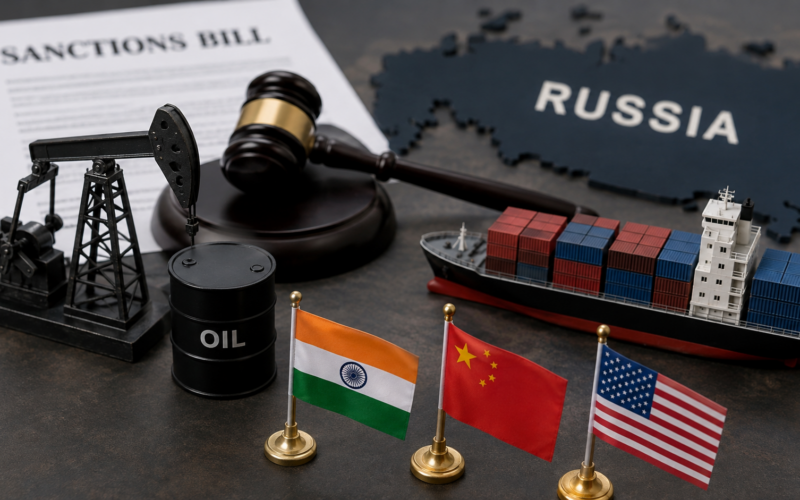
The United States Senate overwhelmingly approved sweeping new Russia sanctions legislation late on Friday, August 7, 2026, giving President Donald Trump potential authority to impose tariffs of up to 100% on goods from major countries that continue buying Russian oil and gas.
Senators passed the Lindsey O. Graham Sanctioning Russia and Iran Act of 2026 by 86 votes to 11, delivering one of Congress’s most significant attempts during Trump’s second term to squeeze the revenues financing Russia’s war in Ukraine. The legislation now moves to the House of Representatives, where its unusually broad tariff provisions are expected to generate a considerably more difficult political fight.
India and China are central to the bill’s potential global impact because both remain major purchasers of Russian energy. The legislation does not automatically impose a blanket 100% tariff on all countries buying Russian oil. Instead, it authorises the president to apply targeted tariffs of up to 100% against countries among the five largest purchasers of Russian crude oil or natural gas, as well as leading jurisdictions enabling Russian energy sanctions evasion.
Japan and some European Union countries could also potentially fall within its reach depending on how the statutory criteria are applied. That makes the measure more than another financial-sanctions package against Russian officials and banks. If implemented aggressively, it could force some of Washington’s important trading partners to choose between continued access to discounted Russian energy and avoiding potentially severe additional barriers in the United States market.
The Senate vote also carries considerable political symbolism because the legislation was championed for more than a year by Republican Senator Lindsey Graham, one of Ukraine’s strongest congressional supporters, before his sudden death on July 11. His sister, Senator Darline Graham, who was appointed to fill his South Carolina seat, announced the final tally as senators applauded.
What exactly did the United States Senate approve in the new Russia sanctions legislation?
The legislation creates several layers of economic pressure rather than relying exclusively on tariffs. It targets Russian officials, senior political and military figures, oligarchs, financial institutions and energy projects while also expanding restrictions aimed at vessels used to circumvent existing sanctions on Russian oil exports.
Russia has increasingly depended on an extensive network of older tankers, frequently described as a shadow fleet, to move crude around restrictions imposed after its invasion of Ukraine. Ships can change ownership structures, flags, insurers or operating arrangements in ways that complicate enforcement. The legislation is designed to broaden Washington’s ability to target that infrastructure rather than focusing solely on Russian producers themselves.
The most consequential provision for the global economy, however, is the authority covering countries that continue purchasing Russian energy. The amended legislation limits potential tariffs to the five largest importers of Russian crude oil or gas and the five leading countries considered to facilitate Russian energy sanctions evasion. That is substantially narrower than earlier proposals that had generated fears of sweeping penalties against almost any country maintaining significant Russian trade.
The legislation also includes exemptions for countries importing less than 15% of their natural gas from Russia while taking steps to reduce those purchases. The White House would additionally retain waiver authority when the president certifies to Congress that suspending or modifying restrictions is in the United States national interest.
Another part of the package concerns Iran. Lawmakers added provisions intended to prevent the expiration of sanctions authorities restricting funds flowing into Iranian energy and weapons networks, helping secure Trump administration support for legislation that had previously remained stalled.

Could India really face tariffs of up to 100% because it continues buying Russian oil?
India is one of the countries most exposed to the headline risk surrounding the legislation because it has become a major destination for Russian crude since Moscow’s 2022 invasion of Ukraine altered global energy trade.
Indian refiners sharply increased purchases when Russian barrels began trading at discounts as traditional European buyers reduced imports. India eventually became the largest buyer of Russian seaborne crude, using those supplies to meet the requirements of an economy that imports most of the oil it consumes.
The new Senate bill does not mean Indian exports to the United States will suddenly face a 100% tariff. The legislation first needs House approval and Trump’s signature, after which the president would receive substantial discretion over whether, when and at what level to impose tariffs within the permitted ceiling.
That distinction will be crucial for New Delhi. A maximum tariff authority can function primarily as negotiating leverage, allowing Washington to demand reductions in Russian oil purchases without necessarily imposing the highest available rate. India could also seek exemptions, transition periods or recognition for steps taken to diversify supplies.
Even the possibility of steep tariffs could have important consequences, however. The United States is one of India’s largest trading partners, meaning Indian policymakers would have to weigh savings achieved through discounted Russian crude against the much larger commercial relationship involving technology, pharmaceuticals, engineering goods, textiles, services and other sectors.
New Delhi has consistently defended its energy purchases as necessary for national economic security and has argued that affordable Russian crude contributed to stability in international oil markets. India has also maintained longstanding ties with Moscow while simultaneously deepening strategic relations with Washington.
The sanctions legislation would test whether that balancing strategy can survive a more coercive phase of American economic policy.
Why are China and other major Russian energy buyers also exposed to the Senate bill?
China represents an even larger strategic target because it remains one of Russia’s most important economic partners and purchases substantial quantities of Russian oil and gas.
Washington has long argued that Moscow’s ability to redirect energy exports towards Asian customers reduced the effectiveness of Western sanctions. While restrictions have complicated financing, insurance and transportation, Russian hydrocarbons continue generating enormous revenues that can support government spending and military operations.
The Senate legislation attempts to attack that problem indirectly. Rather than relying solely on sanctions against Russian sellers, it creates economic consequences for foreign buyers whose purchases sustain those revenues.
That approach resembles secondary sanctions, which seek to influence parties outside the jurisdiction imposing the original restriction. The difference is that tariffs on ordinary imported goods could produce effects far beyond energy companies, potentially reaching manufacturers and consumers across multiple sectors.
For China, the implications would intersect with an already complicated trade relationship with Washington. Trump has repeatedly used tariffs as an instrument of economic and geopolitical pressure, meaning Russia-related tariff powers could become another element of broader United States-China negotiations.
Japan and some European countries are also mentioned among potentially affected Russian energy customers. Their circumstances are different because several are close United States allies that have already worked to reduce dependence on Moscow, potentially creating arguments for exemptions or differentiated treatment.
The legislation therefore gives Washington a powerful instrument but also creates diplomatic complexity. Applying similar penalties to strategic rivals, allies and partners could generate resistance unless implementation clearly distinguishes between governments deliberately expanding Russian energy purchases and those attempting to reduce legacy dependence.
Why did Donald Trump finally support sanctions legislation that had remained stalled for more than a year?
The bill’s journey through Congress has been unusually long because Trump had previously preferred to control Russia sanctions policy from the White House rather than allow Congress to dictate when economic measures should be imposed.
Senate Republican leaders consequently declined to advance the legislation for much of Trump’s second term despite substantial bipartisan sponsorship. Graham and Democratic Senator Richard Blumenthal continued negotiating the measure while attempting to preserve enough presidential flexibility to secure administration support.
That breakthrough came shortly before Graham’s death. Graham announced on July 10 that he and Trump had reached agreement allowing the legislation to move forward. He died unexpectedly the following day, adding considerable emotional and political momentum to the bill among colleagues who had worked with him on Ukraine policy.
The revised version gives Trump greater discretion than some earlier proposals. Instead of forcing uniformly enormous secondary tariffs, it limits the countries that can be targeted and allows presidential decisions regarding tariff levels and waivers.
Trump also secured the addition of Iran-related sanctions provisions, making the package relevant to two of the administration’s most important foreign-policy confrontations.
The result is legislation that strengthens presidential economic power at the same time that Congress is attempting to increase pressure on Moscow. That compromise explains both its overwhelming Senate support and the emerging objections in the House.
Why could the tariff powers become the biggest obstacle when the bill reaches the House?
The 86-11 Senate vote creates considerable momentum, but it does not guarantee the House will approve identical language.
Representative Gregory Meeks, the leading Democrat on the House Foreign Affairs Committee, and Representative Don Beyer have warned that the measure grants Trump excessively broad tariff authority. They argue that the president could use Russia-related provisions to pursue wider trade disputes while American importers and consumers ultimately bear part of the cost.
Those concerns are not confined entirely to Democrats. Republican Senator Rand Paul opposed the legislation and argued that tariffs function as taxes ultimately paid by Americans. Paul joined Democratic Senator Ron Wyden in an unsuccessful attempt to strip the new tariff authority from the bill.
That amendment failed, but the Senate dispute revealed the tension at the centre of the legislation. Lawmakers broadly support imposing stronger pressure on Russia, yet they disagree on whether giving Trump additional unilateral control over tariffs is the appropriate mechanism.
Democratic Senator Raphael Warnock eventually supported the package after receiving a written commitment from United States Trade Representative Jamieson Greer regarding safeguards around the tariff powers. According to the Senate debate, tariffs should be removed once affected countries no longer satisfy the Russian-energy purchasing or sanctions-evasion criteria.
The House is not expected to return from its summer recess until August 31. That gives supporters and opponents several weeks to negotiate changes that could determine whether the bill reaches Trump in its current form or returns to the Senate after amendment.
Would new sanctions actually reduce Vladimir Putin’s ability to finance Russia’s war in Ukraine?
The economic theory behind the legislation is straightforward. Russia depends heavily on hydrocarbon exports for government revenue, so reducing the number of willing buyers or forcing Moscow to accept larger discounts should weaken the financial resources available to sustain the war.
The practical outcome is more complicated.
Previous sanctions have substantially changed how Russian energy is transported and financed but have not eliminated exports. Moscow redirected oil towards Asian customers, expanded use of alternative payment mechanisms and relied increasingly on tankers operating outside traditional Western insurance and maritime systems.
The proposed legislation attempts to close that gap by making continued purchases more costly for major importers. If India, China or other large customers reduce Russian purchases to protect access to the United States market, Russia could face fewer buyers and weaker pricing power.
However, excessive pressure could also disrupt global oil flows and lift international crude prices. Higher prices could partly compensate Russia for selling fewer barrels while increasing fuel costs for consumers elsewhere.
That is one reason implementation would matter as much as the legislation itself. A gradual approach designed to reduce Russian revenues without abruptly removing large quantities of oil from the market could produce different economic consequences from immediate maximum tariffs.
The White House would therefore need to coordinate sanctions policy with energy diplomacy if the bill becomes law.
Why has Ukraine welcomed the Senate vote as more than a symbolic political gesture?
Ukraine has strongly supported the legislation because Kyiv believes Russia’s ability to continue financing its military remains closely connected to energy revenues.
The Ukrainian embassy in Washington described Senate passage as a timely and significant step that increases pressure on Russia. Ukrainian Foreign Minister Andrii Sybiha also welcomed the legislation and linked stronger United States support to efforts to achieve a durable peace.
President Volodymyr Zelenskyy personally reinforced the lobbying campaign during a recent visit to Washington. He met senators from both parties after Graham’s funeral and watched as the Senate held procedural votes advancing the legislation.
For Kyiv, sanctions provide an additional form of pressure at a moment when debates over military assistance remain politically difficult in Washington. Economic restrictions can target Moscow without requiring the same immediate congressional appropriations associated with weapons packages.
Supporters also hope the prospect of further revenue losses could change Russia’s calculations regarding negotiations. Whether that occurs depends on how strongly the legislation is implemented and whether other major economies cooperate.
Moscow has historically argued that Western sanctions have failed to achieve their objectives and has sought to deepen economic links with countries outside the traditional United States-European alliance system. The new bill is specifically designed to make those alternative relationships more expensive.
What are the key takeaways from the United States Senate’s new Russia sanctions bill?
- The United States Senate passed the Lindsey O. Graham Sanctioning Russia and Iran Act of 2026 by an overwhelming 86-11 vote on August 7, sending the legislation to the House of Representatives.
- The legislation authorises President Donald Trump to impose tariffs of up to 100% on goods from major countries purchasing Russian oil or natural gas, potentially affecting India, China, Japan and some European countries.
- The tariff authority has been narrowed to the five largest importers of Russian crude oil or gas and the five leading countries enabling Russian energy sanctions evasion, rather than applying automatically to every Russian trading partner.
- India faces particular scrutiny because it became the largest purchaser of Russian seaborne crude after the Ukraine invasion, although Senate passage does not mean a 100% tariff on Indian goods has automatically taken effect.
- The package also targets senior Russian officials, banks, energy projects and Russia’s shadow fleet of tankers used to move oil around existing sanctions.
- The legislation contains additional measures preserving sanctions authority over Iranian energy and weapons funding, an element that helped secure Trump administration support.
- House lawmakers remain divided over giving Trump broad tariff powers, creating uncertainty over whether the chamber will approve the Senate version when it returns from recess after August 31.
- If the legislation becomes law and is aggressively enforced, its most important effect may be forcing major Russian energy customers to weigh discounted oil purchases against access to the far larger United States trading relationship.
Could the Russia sanctions bill force India and other countries to make a strategic choice?
The Senate vote is important because Washington is attempting to move beyond sanctioning Russia itself and instead change the behaviour of the countries that keep Russian export revenues flowing.
That strategy could significantly increase economic pressure on Moscow, but it also transfers part of the confrontation to governments such as India that have resisted choosing exclusively between Russia and the West.
For New Delhi, the issue is particularly sensitive. India has built a strategic partnership with the United States while preserving decades-old defence and energy links with Russia. Russian crude has also provided Indian refiners with commercially attractive supplies during a period of volatile global energy prices.
A tariff threat approaching 100% would radically alter that calculation if it were actually applied. Yet Trump would possess considerable discretion, making negotiations, exemptions and phased reductions in Russian purchases more plausible than an immediate maximum penalty.
The House battle will therefore be the next major checkpoint. The overwhelming Senate majority demonstrates that congressional pressure on Russia remains unusually bipartisan, but concerns over Trump’s tariff authority could force revisions before the measure reaches the White House.
For Russia, the danger lies less in another list of sanctioned officials than in whether Washington can persuade or pressure the largest remaining buyers of Russian energy to reduce their purchases simultaneously. If that happens without causing a major increase in global oil prices, Moscow’s ability to replace lost revenue could narrow substantially.
For India, China and other buyers, meanwhile, the legislation turns Russia’s war in Ukraine into a potentially direct trade-policy issue. The question is no longer simply whether countries will join Western sanctions. It is whether access to the United States market can be used to make remaining outside those sanctions significantly more expensive.
Discover more from Business-News-Today.com
Subscribe to get the latest posts sent to your email.