


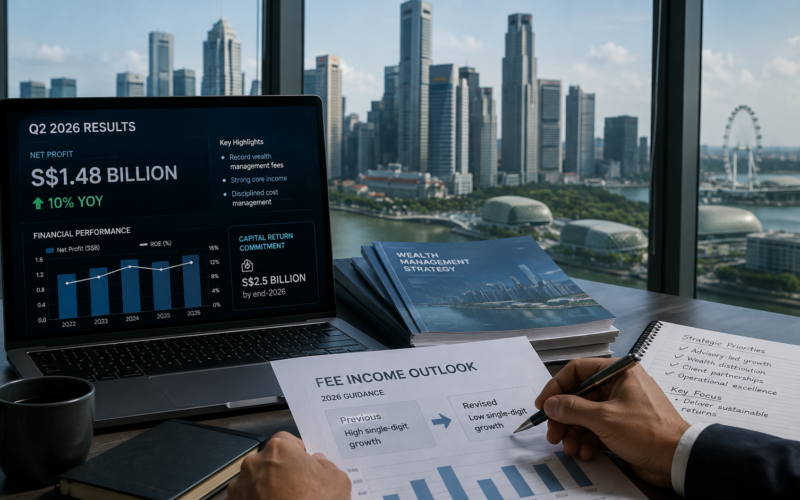
United Overseas Bank Limited (SGX: U11), Southeast Asia’s third-largest bank by assets, on 7 August 2026 reported a 10 percent year-on-year rise in second-quarter net profit to S$1.48 billion, comfortably ahead of the S$1.4 billion mean estimate from three analysts polled by LSEG and a Bloomberg-poll consensus of S$1.45 billion. The beat was driven by record wealth management fees and it lands just two business days after United Overseas Bank agreed to sell its wholly owned asset management arm, UOB Asset Management Ltd., to Allianz Global Investors for S$555 million alongside a ten-year strategic distribution partnership. The board declared an interim dividend of 88 Singapore cents per share, keeping the 50 percent ordinary payout ratio intact and reaffirming a commitment to complete the S$2.5 billion capital return package by the end of 2026. But the headline growth number sits inside a first-half net profit rise of only 3 percent, and management used the same release to trim its 2026 fee income guidance from high single-digit growth to low single-digit growth. The central question for shareholders is whether the strategic pivot from fund manufacturing toward advisory-led wealth distribution can compound quickly enough to justify a share price already trading above the average analyst target.
What did United Overseas Bank actually deliver in the second quarter of 2026 to justify a 10 percent profit rise
The 10 percent April-June profit rise to S$1.48 billion is a clean beat against expectations, and it is a sharper acceleration than the first quarter, when United Overseas Bank posted S$1.44 billion in net profit, down 4 percent year-on-year and up 2 percent sequentially. The recovery leans decisively on fee income rather than net interest income. The first quarter had already shown net fee income at S$637 million with wealth and card fees carrying the load, and the second quarter takes that trajectory to a record on the wealth line specifically. Net interest income remains under pressure from a lower rate environment, with the first-quarter net interest margin at 1.82 percent, down 18 basis points year-on-year and 2 basis points sequentially. Management is still guiding to a full-year net interest margin of 1.75 to 1.80 percent, which means the second-quarter margin is likely to have compressed further from the first quarter, absorbed by growth in customer-related treasury income, cards, and wealth advisory fees.
Loan growth is doing its part but not carrying the story. Gross customer loans stood at S$353.8 billion at the end of the first quarter, up 4 percent year-on-year, and management continues to guide to low single-digit loan growth for the year. Credit costs are running within the 25 to 30 basis points annual guidance range, with the first-quarter figure at 26 basis points on a stable non-performing loan ratio of 1.5 percent. The Common Equity Tier 1 ratio at 15.3 percent gives the bank room to fund the S$2.5 billion capital return without stretching its buffer. What the second quarter clarifies is that the fee engine, and specifically the wealth fee engine, is the swing factor in United Overseas Bank’s 2026 earnings story. The rest of the profit and loss account is behaving broadly as guided.

Why does the record wealth fee number matter more than the headline profit against a cut in fee income guidance
The most instructive line in the release is not the headline. It is the guidance revision. When management moves 2026 fee income guidance from high single-digit growth to low single-digit growth in the same statement that unveils a record wealth fee quarter, the message is that the second half is expected to be materially softer than the first half implies. Loan-related fees have been softening on flatter credit demand, credit card fees are running into consumer-spending caution across ASEAN, and treasury customer sales, while strong in the first half, are not a linear compounder. The wealth line was the standout, and management is effectively saying it does not expect the second-half wealth run rate to lift the full year into the previous higher band.
That distinction matters for how the market should read the beat. A 10 percent year-on-year print with a fee guidance cut is a very different signal from a 10 percent print with an unchanged guidance envelope. Investors focused on the through-cycle earnings power of United Overseas Bank will note that the S$2.4 billion in net fee income the group delivered in 2024, led by double-digit wealth fee growth then, is not an easy base to grow against without a step-change in wealth flows. The record wealth fee quarter is genuine progress on the mix shift the group has been signalling since 2024, but it is progress against a full-year fee target that has now been lowered. The second-half comparables become the real proof point.
How does the S$555 million UOBAM sale to Allianz Global Investors fit into United Overseas Bank’s wealth strategy
Two days before the earnings print, United Overseas Bank confirmed it had agreed to sell its wholly owned asset management subsidiary, UOB Asset Management Ltd., to Allianz Global Investors for S$555 million in cash, including excess cash held by the unit and a ten-year strategic distribution agreement. UOB Asset Management had approximately S$42 billion in assets under management at end-2025 and operates across eight Asian markets, Singapore, Brunei, Indonesia, Japan, Malaysia, Taiwan, Thailand, and Vietnam. The group said it expects to book a pre-tax gain of around S$330 million on completion, with a roughly 14 basis point uplift to the Common Equity Tier 1 ratio. The transaction, subject to regulatory approvals, is expected to close in 2027, and around 500 UOB Asset Management employees would transfer to Allianz Global Investors on completion.
The commercial logic is a deliberate separation of manufacturing from distribution. United Overseas Bank is exiting fund manufacturing, where scale and cost economics increasingly favour global asset managers such as Allianz Global Investors, which had close to EUR 600 billion in assets under management at the end of March 2026. In its place, the bank keeps a decade-long product supply relationship on the shelf while it doubles down on advisory, private banking, and cross-border wealth flows across an 8.5 million ASEAN retail customer base built out through the Citigroup consumer banking integration in Indonesia, Malaysia, Thailand, and Vietnam. Management has explicitly stated that the group is targeting a doubling of wealth income by 2030. The Allianz deal converts a capital-heavy manufacturing arm into cash and a distribution economics engine, which fits neatly with an open-architecture wealth model. It also confirms that the group is prepared to concede product economics to a specialist partner if that trade releases capital for the parts of the wealth business where it has a genuine local edge.
That said, the pivot introduces new dependencies. The record wealth fees reported in the second quarter still include some UOB Asset Management contribution, and the group will lose a portion of that fee stream once completion happens in 2027. The ten-year distribution partnership is meant to offset that loss, but the economics of distribution fees on Allianz Global Investors products will not perfectly replicate the manufacturing margin. Investors should treat the S$330 million pre-tax gain as one-off value crystallisation, not a recurring earnings uplift, and watch how quickly advisory-led revenue can fill the gap on completion.
What does the 88 cent interim dividend say about UOB’s S$2.5 billion capital return commitment
The 88 cent interim dividend keeps the 50 percent ordinary payout ratio intact and is consistent with the S$2.5 billion capital return package that management has said it plans to complete by the end of 2026. That package sits within a broader S$3 billion surplus capital distribution plan announced with the FY2024 results, which combined special dividends and share buybacks over three years, alongside a S$2 billion share buyback programme running to 2027. The completion of the UOB Asset Management sale in 2027, together with the 14 basis point Common Equity Tier 1 uplift, gives management additional headroom to sustain that distribution cadence into the next capital return cycle without stretching the balance sheet.
For income investors, the practical message is that the 88 cent interim dividend, together with the still-outstanding tail of the S$0.50 per share special dividend declared in 2025, means the bank is preserving its dividend arithmetic even as the earnings mix shifts. The reported first-quarter Common Equity Tier 1 ratio of 15.3 percent, robust liquidity coverage of 144 percent, and a net stable funding ratio of 115 percent give the board comfortable room to run the capital return through 2026. What the Allianz deal really does is buy insurance against the payout ratio slipping in the event the fee slowdown deepens more than management expects.
How does UOB’s second quarter compare with DBS Group and OCBC in this Singapore banking earnings cycle
The context around the print matters. DBS Group reported a 9 percent year-on-year rise in second-quarter net profit to a record S$3.08 billion, taking first-half profit to a record S$6.01 billion, and lifted its 2026 guidance, with the shares scaling a record high on the release. Oversea-Chinese Banking Corp posted a 22 percent year-on-year jump in second-quarter net profit to a record S$2.22 billion, comfortably beating a S$1.93 billion consensus, and raised its 2026 loan growth outlook, declaring an interim dividend of 47 cents per share, up 15 percent year-on-year. Both peers reported net interest margin compression, with the Oversea-Chinese Banking Corp margin narrowing to 1.70 percent from 1.92 percent, but both also reported strong fee, trading, and, in the OCBC case, insurance income that more than offset the margin drag.
Against those two, United Overseas Bank’s 10 percent profit rise and unchanged 50 percent payout ratio look creditable but not sector-leading. DBS Group and Oversea-Chinese Banking Corp were both able to raise guidance for 2026, while United Overseas Bank had to lower its fee guidance in the same release that celebrated a record wealth fee quarter. That relative positioning is one reason United Overseas Bank shares closed 6 August at S$43.58 with a five-day loss of 0.68 percent, while DBS Group traded to a record high on the same session and lifted the broader Straits Times Index. On a longer horizon the picture is more even, with United Overseas Bank shares up around 24 percent year-to-date, but the read across the Singapore banking cycle in the current quarter is that the sector’s fee tailwind is playing out more decisively at the two larger peers.
Where do the execution risks sit for UOB as it tries to double wealth income by 2030
The 2030 target of doubling wealth income is the analytical anchor investors need to keep in view over the next several years. The Allianz Global Investors deal removes fund manufacturing from the calculation and leaves the target dependent on the pace of asset gathering into United Overseas Bank’s advisory and private banking platforms, on cross-border wealth flows from ASEAN into Singapore and vice versa, and on the successful conversion of the enlarged retail customer base from the Citigroup integration into wealth clients. Assets under management at the group level stood at approximately S$198 billion at the end of the first quarter, up 5 percent year-on-year but down 1 percent sequentially, which underlines that the target requires a materially faster growth path from here.
Three execution risks stand out. First, the transition period between announcement and 2027 completion of the UOB Asset Management sale carries client attrition risk, particularly among institutional mandates where a change of ownership triggers investment committee reviews. Second, the distribution partnership with Allianz Global Investors is a partial substitute for owning the manufacturer, and the fee split economics will need to prove durable across market cycles. Third, competition for high-net-worth wealth in Singapore is intensifying, with DBS Group and Oversea-Chinese Banking Corp both extending advisory capacity, and Allianz itself expanding its Singapore footprint through its separate S$2.7 billion agreement to acquire the HSBC Holdings plc Singapore insurance business announced on 24 July. The record wealth fee quarter is a useful data point, but it is one data point on a multi-year trajectory that faces a more crowded competitive field.
Macro exposures add to the near-term uncertainty. Chief Executive Officer Wee Ee Cheong flagged the evolving Middle East conflict, energy market developments, and what he described as K-shaped growth across major economies as sources of uncertainty. He indicated that United Overseas Bank’s strong capital, funding, and liquidity position would support growth while providing a buffer against these risks. That framing is consistent with the group’s decision to hold the net interest margin, credit cost, and loan growth guidance ranges unchanged, and it puts the burden of the 2026 earnings variance squarely on the fee line.
How has the market read the second-quarter numbers and the Allianz deal with UOB shares trading above analyst targets
United Overseas Bank shares closed 6 August at S$43.58 in Singapore, up 1.21 percent for the session and up around 24 percent year-to-date. The 15-analyst mean consensus target is S$42.67 per share, which implies the shares are trading around 2 percent above the average target and consensus sits at a hold rating rather than a buy. Trading above the average target price does not automatically imply that the shares are overvalued, but it does mean that further upside from here is likely to require either an upgrade cycle from covering analysts or a fresh strategic catalyst. The Allianz Global Investors deal has arguably provided one such catalyst by clarifying the wealth strategy, and the second-quarter beat with a record wealth fee number provides another, but the guidance cut on fees pulls in the other direction.
The 24 percent year-to-date share performance suggests the market has already priced in a positive read on the wealth pivot and the capital return trajectory. The MSCI ESG rating of AA also puts United Overseas Bank in the leader band of the sector, which supports index and quality-tilt flows. What the market will now be looking for is confirmation from Wee Ee Cheong and Group Chief Financial Officer Leong Yung Chee on the analyst call about the shape of the second-half fee mix, the pace of Common Equity Tier 1 accretion after the Allianz sale closes, and how quickly advisory income can scale to fill the manufacturing revenue gap after 2027. Without that confirmation, the fee guidance cut will become the story that sits above the record wealth quarter.
What should investors track as United Overseas Bank moves toward the 2027 close of the Allianz UOBAM sale and its 2030 wealth income target
- Second-quarter 2026 net profit rose 10 percent year-on-year to S$1.48 billion, ahead of the S$1.4 billion LSEG mean estimate and a Bloomberg-poll consensus of S$1.45 billion, driven by record wealth management fees against a still-compressed net interest margin
- First-half net profit rose only 3 percent year-on-year, meaning the second-quarter beat is offsetting the first-quarter 4 percent year-on-year decline rather than compounding on it
- Management cut 2026 fee income guidance to low single-digit growth from high single-digit growth previously, while keeping net interest margin guidance of 1.75 to 1.80 percent, loan growth guidance of low single-digit, and credit cost guidance of 25 to 30 basis points unchanged
- The board declared an 88 Singapore cent interim dividend, preserving the 50 percent ordinary payout ratio, and reaffirmed the S$2.5 billion capital return plan for completion by the end of 2026 inside a broader S$3 billion surplus capital distribution package
- Two business days before the print, United Overseas Bank agreed to sell UOB Asset Management to Allianz Global Investors for S$555 million with a ten-year distribution partnership, targeting a 2027 close, a pre-tax gain of around S$330 million, and a 14 basis point Common Equity Tier 1 uplift
- UOB Asset Management managed approximately S$42 billion of assets at end-2025 across Singapore, Brunei, Indonesia, Japan, Malaysia, Taiwan, Thailand, and Vietnam, and around 500 employees would transfer to Allianz Global Investors on completion
- The strategic pivot from fund manufacturing to advisory-led wealth distribution supports the group’s stated 2030 target of doubling wealth income, but exposes the earnings mix to client attrition risk during the transition and to distribution fee economics after 2027
- Second-quarter peer comparison is unfavourable in relative terms, with DBS Group reporting a record S$3.08 billion net profit and lifting 2026 guidance, and Oversea-Chinese Banking Corp posting a 22 percent net profit rise to S$2.22 billion and raising its loan growth outlook, while United Overseas Bank had to cut its fee guidance in the same release that reported a record wealth quarter
- United Overseas Bank shares closed 6 August at S$43.58, up around 24 percent year-to-date, trading approximately 2 percent above the S$42.67 15-analyst mean consensus target with a hold rating, meaning further upside now depends on estimate upgrades or fresh strategic catalysts rather than a rerating on trailing earnings
- The next measurable proof points are the shape of the second-half 2026 fee mix, the pace of assets under management growth at the group level from the current S$198 billion base, the analyst-day articulation of a bridge from record wealth quarter to durable advisory-led income, regulatory approval for the Allianz Global Investors transaction, and the actual completion economics in 2027 that will determine whether the pivot compounds toward the 2030 target or merely swaps a manufacturing fee stream for a thinner distribution one
Discover more from Business-News-Today.com
Subscribe to get the latest posts sent to your email.


