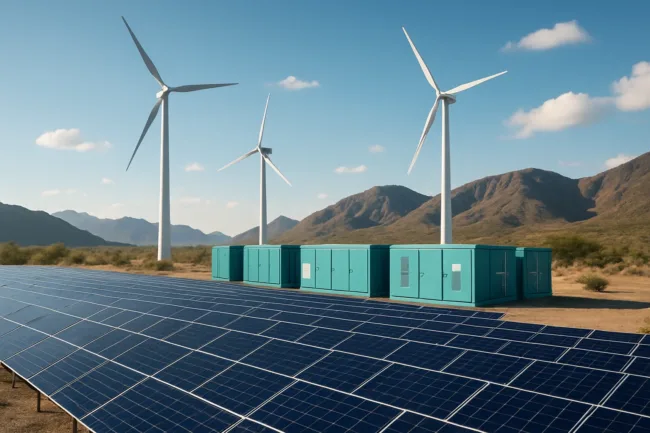



The United Kingdom Government has proposed the Seventh Carbon Budget, setting a science-led target for an 87% emissions reduction during the 2038 to 2042 period as part of its long-term climate and energy security strategy. The Department for Energy Security and Net Zero said the target is intended to protect family finances, strengthen energy security, attract investment and support economic growth while reducing the United Kingdom’s exposure to fossil fuel price shocks. The announcement comes as the government links recent global energy volatility, including Russia’s invasion of Ukraine and the war in Iran, with the need to accelerate clean homegrown power. For businesses, investors and households, the policy question is whether the United Kingdom can turn climate targets into cheaper energy, industrial jobs and a more resilient economy before the next fossil fuel shock lands.
The proposed Seventh Carbon Budget covers the five-year period from 2038 to 2042 and sets an emissions limit of 535 MtCO2e, equivalent to an 87% reduction on 1990 levels. The government said the target has been endorsed by the Environmental Audit Committee and the Climate Change Committee and is consistent with the Paris Agreement goal of keeping global warming to 1.5 degrees. The announcement was also supported by new analysis from the Energy and Climate Intelligence Unit, backed by Confederation of British Industry Economics, which found that the United Kingdom’s net zero economy supported more than one million jobs and added £105 billion in gross value added in 2025 alone.
Why is the United Kingdom setting the Seventh Carbon Budget during renewed fossil fuel price shocks?
The United Kingdom is setting the Seventh Carbon Budget at a time when energy security has moved back to the centre of economic policy. The government’s argument is that households and businesses remain exposed to international fossil fuel markets, where geopolitical crises can move prices quickly and unpredictably. Russia’s invasion of Ukraine and the war in Iran are being used by ministers as recent examples of how external shocks can feed directly into domestic costs.
This framing matters because climate policy is no longer being presented only as a long-term environmental obligation. The Department for Energy Security and Net Zero is positioning clean power as a cost-stability policy, an industrial strategy and a national resilience tool. The government says half of the United Kingdom’s recessions since 1970 have been caused by fossil fuel shocks, which gives the carbon budget an economic security argument rather than a purely climate-centred justification.
The Seventh Carbon Budget therefore becomes a signal to investors and industries that the United Kingdom intends to keep moving toward electrification, renewable energy, nuclear power and low-carbon infrastructure. The risk is that targets can be easier to announce than deliver. The strategic test will be whether the United Kingdom can build the grid, supply chains, planning capacity, skills base and investment certainty needed to make the target credible.
How could the Seventh Carbon Budget affect clean energy investment and industrial strategy?
The Seventh Carbon Budget could affect clean energy investment by giving companies a long-term policy signal for the period from 2038 to 2042. Investors in clean energy, grid infrastructure, nuclear, carbon capture, electric vehicles, batteries, heat pumps, hydrogen and industrial decarbonisation need confidence that demand and regulation will persist beyond one parliamentary cycle. A carbon budget helps provide that visibility by setting a legally anchored emissions pathway.
The government says the Climate Change Act 2008 has already created a framework that has attracted billions of pounds in private investment and helped the United Kingdom build clean energy industries. Since July 2024, the government says more than £90 billion of private investment has been announced in clean energy, including carbon capture projects in Teesside and nuclear at Sizewell C off the Suffolk coast. These examples show how the government is using the carbon budget to argue that climate policy can drive private capital formation, not only public spending commitments.
For industry, the issue is not only the target but the delivery environment around the target. Clean energy projects need grid connections, planning approvals, skilled workers, financing structures, procurement certainty and supply-chain capacity. If those parts move too slowly, the carbon budget could create ambition without enough build-out. If those parts move at the required pace, the carbon budget could strengthen the United Kingdom’s pitch as a stable market for low-carbon investment.
Why is the net zero economy becoming a jobs story for the United Kingdom?
The net zero economy is becoming a jobs story because the government is using employment data to argue that climate action is already generating measurable economic value. The Energy and Climate Intelligence Unit analysis, supported by Confederation of British Industry Economics, found that the United Kingdom net zero economy supported more than one million jobs in 2025 and added £105 billion in gross value added. The government also says it is supporting more than 400,000 additional clean energy jobs by 2030.
The productivity figures are politically important. Jobs supported by net zero businesses were reported to be 48% more productive than the United Kingdom average, generating £119,300 in economic value per full-time job. These roles also generated an average of £43,142 for a full-time worker, above average wage levels. That allows ministers to argue that clean energy employment is not simply about replacing older industries with lower-value work. It is being presented as a higher-productivity segment of the economy.
The regional impact could be significant if investment reaches areas tied to energy production, industrial transition and manufacturing. Teesside, Suffolk, coastal regions, former industrial clusters and areas with grid or renewable energy projects could all become part of the clean growth map. However, the jobs promise depends on whether training, local supply chains and project delivery keep pace with headline investment announcements. A million jobs is a strong figure. The tougher question is whether those jobs are distributed widely enough to change local economies.
How does the clean energy transition connect to lower bills and consumer choice?
The government is presenting the Seventh Carbon Budget as a consumer choice-led pathway, built around technologies such as solar, batteries and electric vehicles that can reduce household costs over time. The argument is that electrification can cut exposure to imported fossil fuel prices and give households more control through home generation, storage and cleaner transport options. In the government’s telling, clean power is not only a climate policy but a household finance strategy.
This is an important political shift because energy transition debates often become stuck around upfront costs. Solar panels, batteries, electric vehicles, heat pumps and efficiency upgrades can require capital, even if running costs improve later. The government’s choice-led language is designed to avoid the impression that households will be forced into technology adoption before they are ready. That matters because public consent will influence the speed and durability of the transition.
The risk is that consumer choice only works well when markets are accessible. Households need affordable finance, clear information, trusted installers, reliable products, fair charging networks, responsive grid infrastructure and stable incentives. If clean technologies remain easier for higher-income households to adopt, the transition could widen inequality. If costs fall and access improves, the benefits could spread across a wider share of the country.
Why does the Climate Change Act 2008 still matter for investment certainty?
The Climate Change Act 2008 still matters because it created the legal framework for carbon budgets and gave the United Kingdom a long-term emissions reduction architecture. The government is using the Seventh Carbon Budget to reinforce the argument that the Climate Change Act 2008 has combined economic growth with climate action and attracted private-sector investment. The framework has also influenced climate legislation globally, with the government noting that 60 other countries have adopted their own climate laws since the United Kingdom introduced its Act.
For investors, legal continuity matters. Capital-intensive projects such as offshore wind, nuclear energy, carbon capture and grid upgrades require long payback periods. Investors need to believe that policy direction will survive political noise and remain credible over decades. Carbon budgets help by translating broad climate goals into staged, measurable limits.
The Seventh Carbon Budget also builds on the Carbon Budget and Growth Delivery Plan published in October 2025, which brought together actions across government to meet carbon budgets 4 to 6 from 2023 to 2037. That sequencing matters because the government is trying to show continuity from near-term delivery to long-term emissions reduction. The credibility test is whether the delivery plan, planning reform, grid expansion and private investment pipeline can carry the same weight as the target itself.
What does the proposed 87% emissions reduction mean for energy security and the Paris Agreement?
The proposed 87% emissions reduction for 2038 to 2042 is being framed around three linked goals: reducing exposure to fossil fuel shocks, maximising economic and health benefits, and staying consistent with the Paris Agreement goal of limiting global warming to 1.5 degrees. That combination gives the target both domestic and international significance. Domestically, it links emissions policy to bills, jobs and energy independence. Internationally, it keeps the United Kingdom aligned with global climate commitments.
Energy security is central to the government’s case. The United Kingdom imports and trades in energy markets that are influenced by conflict, supply decisions and global demand. More renewable and nuclear generation can reduce exposure to imported fossil fuels and volatile commodity markets, although the system still needs storage, flexibility, interconnectors and firm capacity. Clean energy does not remove every risk. It changes the risk profile.
The Paris Agreement connection also matters for the United Kingdom’s diplomatic positioning. A country that sets long-term carbon budgets can claim credibility in international climate negotiations and clean investment diplomacy. However, credibility depends on domestic delivery. If emissions targets are missed or diluted, the international signal weakens. The Seventh Carbon Budget therefore functions as both a domestic policy instrument and a global climate credibility marker.
How could the carbon budget affect businesses exposed to energy costs and climate regulation?
Businesses exposed to energy costs could benefit if the transition reduces price volatility over time. Manufacturers, data centres, logistics operators, retailers, hospitality firms and public services all face cost pressure when energy prices rise. Clean homegrown power can help reduce exposure to international fossil fuel markets, although electricity system costs will still depend on infrastructure investment, market design and network charges.
Businesses exposed to climate regulation will also need to plan for a more demanding long-term emissions trajectory. The proposed carbon budget signals that industrial processes, buildings, transport fleets and supply chains will need to continue decarbonising through the late 2030s and early 2040s. Companies that move early may gain from lower operating costs, better investor access and stronger customer positioning. Companies that delay may face higher transition costs later.
For financial institutions, the carbon budget offers another reference point for assessing transition risk. Banks, insurers, pension funds and asset managers increasingly need to evaluate whether portfolio companies are aligned with policy direction. The Seventh Carbon Budget could influence capital allocation by reinforcing expectations around clean energy, low-carbon industrial products, electrification and infrastructure resilience.
What are the delivery risks if clean energy targets move faster than infrastructure readiness?
The main delivery risk is that emissions targets move faster than infrastructure readiness. Clean energy deployment depends heavily on grid connections, planning approval, skilled labour, supply chains and local consent. If renewable projects are delayed, nuclear timelines slip, carbon capture projects stall or network upgrades lag demand, the United Kingdom could face a gap between ambition and delivery.
Another risk is consumer affordability. The government argues that the clean energy transition can lower bills for good, but the pathway requires upfront investment across the energy system. If system costs are poorly allocated or households feel pressured into expensive upgrades without adequate support, public confidence could weaken. The politics of net zero will be shaped less by abstract emissions numbers and more by whether families see lower bills, warmer homes and better transport options.
There is also a skills challenge. Supporting more than 400,000 additional clean energy jobs by 2030 requires training pipelines in engineering, construction, electrical work, project management, data, manufacturing and maintenance. The United Kingdom cannot install its way to net zero without workers. The clean energy transition may be powered by electrons, but it will be delivered by people with vans, tools, permits and patience.
What are the key takeaways from the United Kingdom’s Seventh Carbon Budget and clean energy strategy?
- The United Kingdom Government has proposed the Seventh Carbon Budget for the 2038 to 2042 period, setting an emissions limit of 535 MtCO2e. That level is equivalent to an 87% reduction on 1990 emissions and has been presented as a science-led target.
- The Department for Energy Security and Net Zero is linking the Seventh Carbon Budget to energy security, lower bills, jobs and private investment. The government says moving away from volatile fossil fuel markets can reduce exposure to shocks such as Russia’s invasion of Ukraine and the war in Iran.
- New analysis from the Energy and Climate Intelligence Unit, supported by Confederation of British Industry Economics, found that the United Kingdom net zero economy supported more than one million jobs in 2025. The same analysis put the sector’s gross value added contribution at £105 billion.
- The government says net zero jobs are 48% more productive than the United Kingdom average and generate £119,300 in economic value per full-time job. These jobs also generated average full-time worker earnings of £43,142, supporting the government’s case that clean growth can improve wages.
- The proposed carbon budget builds on the Climate Change Act 2008, which created the United Kingdom’s legally anchored carbon budget framework. The government says that framework has helped attract billions of pounds in private investment and has been copied by 60 other countries.
- Since July 2024, the United Kingdom has seen more than £90 billion of private investment announced in clean energy, including carbon capture projects in Teesside and nuclear at Sizewell C. The government is using those announcements to frame climate policy as an investment strategy.
- The government says it is supporting more than 400,000 additional clean energy jobs by 2030 across the United Kingdom. That target will depend on project delivery, workforce training, supply-chain capacity and whether clean energy investment reaches regions outside established growth centres.
- The delivery risk is that emissions targets could outpace grid upgrades, planning reform, skilled labour supply and consumer affordability. The Seventh Carbon Budget will be judged by whether it produces visible energy security, lower household bills and durable private investment.
Discover more from Business-News-Today.com
Subscribe to get the latest posts sent to your email.