




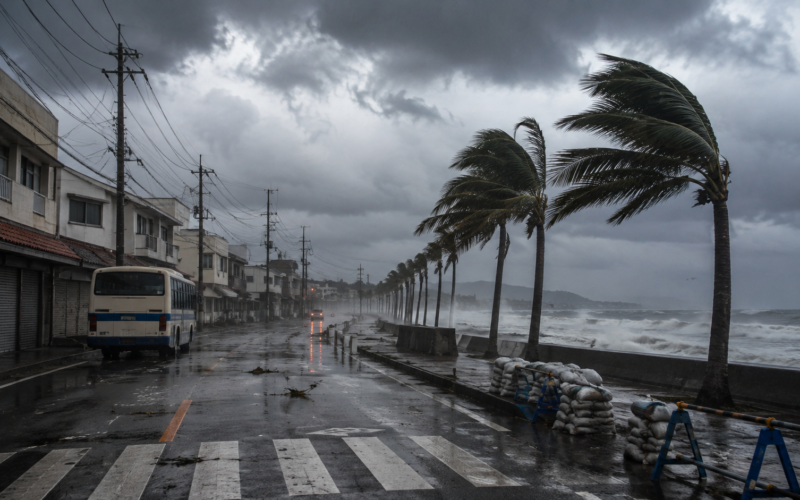
Japan ordered nearly 260,000 residents to evacuate and airlines cancelled more than 500 flights on Friday, August 7, 2026, as Typhoon Dolphin approached southwestern parts of the country with destructive winds, intense rainfall and potentially dangerous coastal waves.
The storm was carrying maximum sustained winds of around 144 kilometres per hour, with gusts reaching 198 kilometres per hour, as it approached the island chain stretching between Japan’s southern Kyushu region and Okinawa Prefecture. Japan’s weather authorities warned that Dolphin was expected to retain considerable strength while moving towards Okinawa, creating conditions capable of damaging or even collapsing vulnerable structures.
The disruption has already extended deep into Japan’s transport and manufacturing networks. More than 500 flights were cancelled as airlines adjusted schedules around the storm, while Toyota Motor Corporation suspended operations at nine factories on Friday. The combination of evacuation orders, airport disruption and factory shutdowns underlines the economic consequences of a typhoon affecting one of Japan’s most important industrial regions.
The most immediate humanitarian concern is Kumamoto Prefecture, where communities are still struggling with the consequences of the magnitude-7.1 earthquake that struck southern Japan on July 28. Around 6,700 people remained in evacuation centres as Dolphin approached, leaving residents displaced by one natural disaster exposed to another before recovery operations have been completed.
The Japan Meteorological Agency has also warned that a linear rain band could form as Dolphin moves through the region. These narrow but extremely intense bands of thunderstorms can repeatedly dump rainfall over the same locations, significantly increasing the danger of flash flooding and landslides.
Where is Typhoon Dolphin heading and which parts of Japan face the greatest danger?
Typhoon Dolphin was approaching the islands situated between Kyushu and Okinawa on Friday morning, bringing strong winds across an increasingly wide area of southwestern Japan.
Evacuation orders covering nearly 260,000 people were issued across Kagoshima and Okinawa prefectures. Authorities urged residents in vulnerable communities to move before conditions deteriorated sufficiently to make evacuation dangerous.
The storm’s relatively slow movement increases the potential threat because affected areas may experience severe weather for longer periods. Even without a direct passage over major population centres, prolonged winds and repeated heavy rainfall can cause substantial disruption.
Okinawa is particularly exposed because many communities are distributed across islands where transport connections depend heavily on aircraft and ferries. Once winds and waves exceed operational safety limits, communities can become temporarily isolated and emergency movement becomes substantially more difficult.
Kagoshima faces a combination of coastal, rainfall and landslide threats. Mountainous terrain across southern Kyushu means intense rainfall can rapidly destabilise slopes, particularly when the soil becomes saturated.
The Japan Meteorological Agency warned that Dolphin could maintain its strength during its approach to Okinawa. Authorities were particularly concerned about winds powerful enough to damage buildings, while high waves posed additional dangers around exposed coastlines.
The storm does not necessarily need to make a conventional direct landfall to cause extensive damage. Large typhoons can generate damaging weather hundreds of kilometres from their centre, particularly through outer rain bands and strong pressure gradients.

Why are linear rain bands making Typhoon Dolphin particularly dangerous for Japan?
One of the most important warnings surrounding Dolphin concerns the possible formation of a linear precipitation band.
These systems develop when powerful thunderstorms repeatedly form and travel over approximately the same area. Instead of a short period of heavy rain followed by relief, communities can receive intense precipitation continuously for several hours.
That dramatically increases the danger of rivers rising rapidly, drainage systems overflowing and hillsides collapsing.
Japan’s mountainous geography makes the country especially vulnerable. Many towns sit between steep slopes and rivers, leaving relatively little space for floodwater or debris to spread without affecting buildings and infrastructure.
Linear rain bands have consequently become a major element of Japan’s disaster-warning system. Forecasting exactly where they will develop remains difficult because relatively small changes in atmospheric conditions can determine whether the heaviest rainfall strikes one watershed or another.
Dolphin’s slow movement compounds the risk. If moist air continues flowing into the same portion of Kagoshima, Okinawa or Kyushu, rainfall totals can accumulate even when the typhoon’s centre remains offshore.
Authorities have therefore warned residents against judging the danger solely by the location of the storm’s eye. In many typhoons, flooding and landslides produce greater casualties than the strongest winds around the centre.
Why is Typhoon Dolphin especially dangerous for communities recovering from the Kumamoto earthquake?
Kumamoto entered the typhoon emergency with thousands of people already displaced.
A magnitude-7.1 earthquake struck the region on July 28, damaging buildings, roads, electricity infrastructure and water systems across southwestern Japan. The death toll had reached at least 36 by early August as emergency teams continued recovery operations.
Around 6,700 residents remained in evacuation centres as Dolphin approached. Many damaged homes cannot yet be safely occupied, while some communities have continued dealing with disrupted infrastructure and repeated aftershocks.
The storm creates several overlapping risks.
Earthquake-damaged buildings may be less capable of withstanding powerful typhoon winds. Roofs, exterior walls and foundations weakened by shaking can become more vulnerable when subjected to gusts approaching 200 kilometres per hour.
Landslide risk may also be elevated around slopes destabilised by the earthquake. Intense rainfall can infiltrate fractured ground and trigger failures that might not have occurred before the seismic event.
Emergency shelters create another challenge. Authorities must protect thousands of displaced residents while maintaining adequate food, water, sanitation and medical care during extreme weather.
Temperatures in parts of the affected region are also expected to reach around 36 degrees Celsius. Japan’s weather authorities have therefore warned about heatstroke at the same time as residents prepare for floods and destructive winds.
This unusual combination complicates disaster management. Residents may be told to remain indoors because of the typhoon while still facing heat risks inside damaged buildings or crowded shelters.
Why has Toyota Motor Corporation stopped production at nine Japanese factories?
Toyota Motor Corporation suspended operations at nine factories on Friday as Dolphin approached southwestern Japan.
The shutdown is primarily a safety measure, protecting workers from dangerous commuting conditions and limiting the possibility that employees become stranded as rail, road and public transport services are disrupted.
Japanese manufacturers frequently adjust production when severe typhoons approach because industrial plants depend on complex supply chains extending well beyond individual factory gates.
A factory can technically remain operational while still becoming unable to obtain components because suppliers, trucking companies, ports or warehouses have suspended activity.
The precautionary shutdown therefore illustrates how a major weather event can propagate through a manufacturing system even before physical damage occurs.
Japan’s automotive industry operates tightly coordinated production networks in which components often arrive according to carefully timed schedules. Temporary interruptions can create knock-on effects when suppliers or assembly plants reopen at different speeds.
At this stage, there is no indication that the nine Toyota facilities have sustained typhoon damage. The suspensions should be treated as preventive operational measures unless the company subsequently reports physical disruption.
The duration will depend on Dolphin’s path, local transport conditions and whether electricity or supplier networks are affected.
How badly has Typhoon Dolphin disrupted flights and travel across Japan?
More than 500 flights were cancelled on August 7 as airlines responded to deteriorating conditions around southwestern Japan.
Okinawa depends particularly heavily on aviation because of its island geography. Flight cancellations can affect residents, tourists, military personnel and cargo movements simultaneously.
High winds present obvious problems for aircraft during take-off and landing, while heavy rainfall reduces visibility and can disrupt airport ground operations. Conditions that are manageable for an aircraft at cruising altitude can make safe operations impossible at airports exposed to crosswinds or severe thunderstorms.
Typhoons also disrupt ferry services, leaving island residents with fewer alternative transportation options.
The timing in early August adds another dimension because Japan is entering a significant domestic travel period ahead of the Obon holiday season. Disruption can therefore affect large numbers of passengers even when airports themselves remain undamaged.
Travellers whose flights are not yet cancelled may still face schedule changes as airlines reposition aircraft and crews. A typhoon affecting several airports can continue distorting flight schedules after weather conditions improve.
The greatest challenge will come if Dolphin moves slowly enough to produce more than one day of widespread disruption. Rebooking thousands of passengers becomes increasingly difficult as cancelled flights accumulate.
What does the evacuation of nearly 260,000 people reveal about Japan’s disaster strategy?
Japan’s evacuation approach reflects decades of experience with typhoons, earthquakes, tsunamis, floods and landslides.
Authorities generally seek to move vulnerable residents before conditions become extreme rather than waiting until homes are already flooding or roads are blocked.
That principle is particularly important for elderly residents and people requiring assistance. Strong winds can make outdoor movement dangerous, while heavy rainfall can quickly cut access to evacuation centres.
The scale of the Dolphin orders demonstrates the difficulty of translating forecasts into public action. An evacuation instruction affecting hundreds of thousands does not mean every resident will necessarily leave home. People assess their own buildings, local terrain, family circumstances and previous storm experience before deciding how to respond.
Repeated warnings can also produce complacency when earlier storms pass without major damage.
Dolphin presents a stronger case for precaution because authorities are warning simultaneously about destructive winds, high waves, flooding and landslides.
Kumamoto adds another layer because some residents are already living in temporary accommodation following the July earthquake.
Japan therefore faces a complex multi-disaster operation rather than a standard typhoon evacuation.
Could Typhoon Dolphin cause prolonged power, communications and infrastructure disruption?
The severity of infrastructure damage will depend heavily on Dolphin’s precise track and how long its strongest winds remain over populated areas.
Gusts approaching 198 kilometres per hour can bring down trees, damage roofs and affect power distribution infrastructure. Even areas that escape direct structural damage can experience electricity outages if transmission equipment or local distribution lines are affected.
Okinawa has previous experience with prolonged typhoon-related power disruption, particularly when damaged infrastructure is located on smaller islands where repair crews and equipment must be transported by sea or air.
Telecommunications networks also depend on commercial power and physical infrastructure. Backup generators can maintain mobile services temporarily, but prolonged outages or damaged fibre connections may affect communications.
Road networks face threats from fallen trees, flooding and landslides. Blocked routes can prevent emergency services from reaching isolated communities and slow the delivery of food, fuel and medical supplies.
Ports could also become important once the storm passes. If airports remain closed, maritime logistics may provide alternative routes, but damaged harbour facilities or continued high waves could delay that recovery.
Japan’s immediate priority will therefore be to preserve access rather than simply prevent building damage.
What are the key takeaways from Typhoon Dolphin’s approach to southwestern Japan?
- Nearly 260,000 people in Kagoshima and Okinawa prefectures were ordered to evacuate on August 7 as Typhoon Dolphin approached southwestern Japan with dangerous winds, heavy rainfall and high waves.
- Dolphin was carrying maximum sustained winds of around 144 kilometres per hour, with gusts reaching approximately 198 kilometres per hour as it approached islands between Kyushu and Okinawa.
- More than 500 flights were cancelled as airlines reduced operations around affected airports, creating significant disruption for residents and travellers.
- Toyota Motor Corporation suspended operations at nine Japanese factories on Friday as a precaution against dangerous weather and transportation disruption.
- The Japan Meteorological Agency warned that a linear rain band could form, creating the potential for concentrated rainfall, flash flooding and landslides.
- Kumamoto Prefecture remains particularly vulnerable after the July 28 magnitude-7.1 earthquake, with around 6,700 people still staying in evacuation centres as the typhoon approaches.
- Earthquake-damaged buildings and slopes could face additional stress from Dolphin’s powerful winds and heavy rainfall, complicating recovery operations across southern Kyushu.
- Japan is simultaneously warning residents about heatstroke, with temperatures expected to reach around 36 degrees Celsius in some areas even as communities prepare for the approaching typhoon.
Why the next 24 hours will determine whether Typhoon Dolphin becomes a wider Japanese disaster
Typhoon Dolphin is already a major disruption before its full effects have been felt. Hundreds of flights have been cancelled, factories have halted production and hundreds of thousands of people have received evacuation instructions.
The decisive factor will now be the storm’s combination of speed and track.
A faster passage could limit rainfall accumulation even if winds remain severe. A slower movement near Kyushu or Okinawa would increase the possibility that the same communities experience hours of intense rain, raising the probability of floods and landslides.
Kumamoto deserves particularly close attention. The prefecture is dealing with damaged buildings, disrupted infrastructure and thousands of people who have not yet returned home after the July 28 earthquake. A significant typhoon impact could turn an ongoing earthquake recovery into a compound disaster.
The industrial implications will become clearer once Toyota Motor Corporation and other manufacturers assess whether facilities and suppliers can restart normally. Short precautionary shutdowns are manageable, but power outages, damaged roads or supplier disruptions could extend production losses.
Japan’s emergency-management system is designed for precisely these conditions, and the large evacuation orders show authorities are acting before the storm reaches its most dangerous phase. The effectiveness of that preparation will depend on whether residents can reach secure shelter and whether critical infrastructure withstands Dolphin’s winds and rainfall.
For now, the most important development is that the threat has moved from forecast to real-world disruption. The number of cancelled flights, evacuated residents and factory closures could increase rapidly if Dolphin retains its strength and its rain bands remain over southwestern Japan.
Discover more from Business-News-Today.com
Subscribe to get the latest posts sent to your email.

