Microsoft Corporation (NASDAQ: MSFT) is entering a particularly revealing phase of its artificial intelligence investment cycle. The technology company is generating strong revenue growth, expanding its cloud business and committing unprecedented resources to infrastructure, yet it has simultaneously opened a voluntary exit programme to approximately 60,000 eligible employees. The apparent contradiction is central to understanding how Microsoft intends to balance expansion with organisational efficiency.
The voluntary exit offer, introduced on 26 October 2026, should not be confused with an announcement of 60,000 job losses. That figure represents the approximate number of eligible employees, rather than confirmed departures or a workforce-reduction target. The actual number leaving will depend on participation, eligibility conditions and decisions within the participating organisations, making the programme’s eventual effect on headcount materially uncertain.
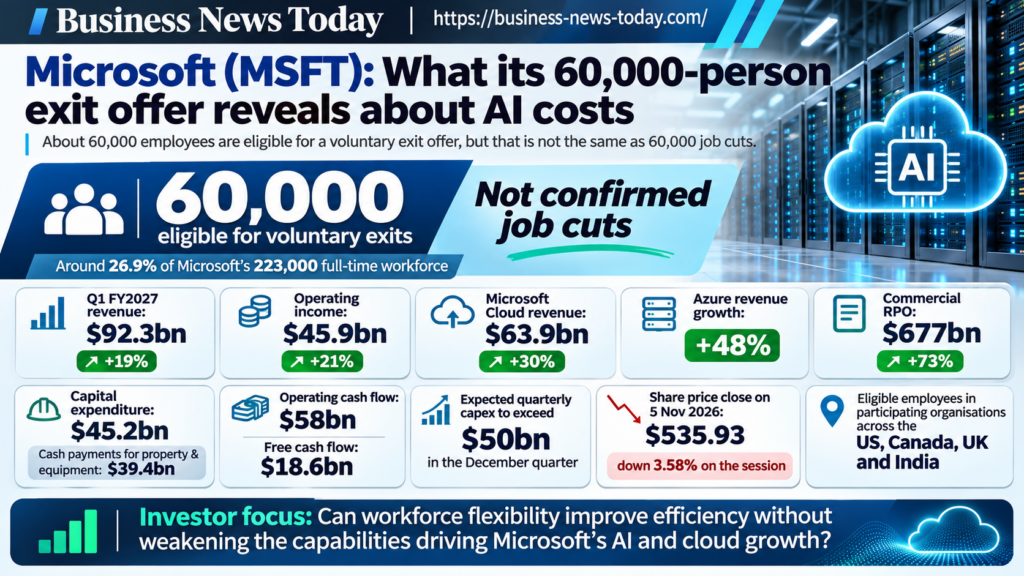
Microsoft’s subsequent quarterly earnings provide a stronger reason to examine the decision now than the original announcement alone. For the three months ended 30 September 2026, revenue increased 19% to $92.3 billion, while operating income rose 21% to $45.9 billion. Those results demonstrate that the voluntary exit programme is not being undertaken against a backdrop of collapsing group revenue, but during a period of substantial business expansion and major changes in the resources required to support it.
Why is Microsoft offering voluntary exits when revenue and profit are growing?
Microsoft’s financial performance suggests that conventional financial distress is not the principal explanation for its latest workforce initiative. The company’s Microsoft Cloud revenue increased 30% to $63.9 billion in the September quarter, while Azure revenue grew 48%. Commercial remaining performance obligations climbed 73% to $677 billion, providing evidence of substantial contracted future business, although the timing and profitability of recognising that revenue will depend on contract terms and delivery.
However, growing revenue does not mean every existing organisational structure remains economically appropriate. Cloud infrastructure, enterprise software, cybersecurity and artificial intelligence require different combinations of technical expertise, customer engagement and operational support. As those priorities shift, a company can simultaneously need additional specialists in certain areas and fewer employees in roles that have become duplicated, less strategically relevant or suitable for redesign.
Microsoft’s approach is therefore better understood as workforce reallocation than as evidence of a uniform retreat from hiring. The company has not disclosed a comprehensive breakdown showing which functions will ultimately lose the most employees or how many vacancies could be recreated elsewhere. Without that information, claims that artificial intelligence is directly replacing a particular number of Microsoft employees would go beyond the available evidence.
The distinction matters commercially because voluntary exits create a different operating challenge from conventional layoffs. Management gains flexibility to reduce positions through employee choice, but it also has less direct control over which eligible employees decide to leave. An unexpectedly high concentration of departures in critical functions could require recruitment, internal transfers or additional retention measures, reducing some of the anticipated efficiency gains.
What does the 60,000-employee eligibility figure actually tell us?
Microsoft’s programme applies to eligible employees at level 70 and below within participating organisations in the United States, Canada, the United Kingdom and India. Chief People Officer Amy Coleman explained in the company’s original announcement that participation would vary according to business priorities, customer commitments and workforce requirements. Employees in participating groups were to receive individual offer details, with financial and career-planning support available to those choosing to leave.
The approximately 60,000 eligible employees represent about 26.9% of Microsoft’s reported 223,000 full-time workforce at 30 June 2026. This makes the programme unusually broad in eligibility, but breadth should not be mistaken for the number of positions management expects to eliminate. Eligibility establishes the maximum pool invited to consider the option, not the number of accepted applications, approved exits or permanent reductions.
The design also introduces an important difference between global coverage and company-wide availability. Not every Microsoft employee in the four countries qualifies, and the offer is not available across every division. The use of selected organisations provides management with a mechanism to tailor voluntary departures to different operating requirements rather than imposing the same workforce policy across the entire business.
Earlier in 2026, Microsoft introduced a voluntary retirement programme that attracted participation from more than 30% of those eligible. That experience helps explain the company’s decision to experiment with another employee-choice mechanism, but the earlier acceptance rate cannot reliably predict the outcome of the broader offer. The two programmes involve different employee populations, personal circumstances and potentially different motivations for leaving.
The decisive missing number is therefore not the eligibility count but the eventual departures. It is also important to establish how many eliminated positions remain vacant, how many are replaced with new capabilities and whether employee-related savings exceed the programme’s transition and severance costs.
How does Microsoft’s AI capital spending change the workforce equation?
The financial context makes the workforce decision particularly significant. Microsoft reported $45.2 billion in capital expenditure during its fiscal first quarter of 2027, including finance-lease commitments and spending on infrastructure required to support expanding cloud and artificial intelligence demand. Cash payments for property and equipment totalled approximately $39.4 billion, demonstrating the scale of the cash investment taking place alongside the company’s accounting-based capital expenditure commitments.
During the same quarter, Microsoft generated $58 billion in operating cash flow and $18.6 billion in free cash flow. These figures show that the company continues to generate substantial cash despite its infrastructure investment programme. Nevertheless, management’s expectation that quarterly capital expenditure will exceed $50 billion in the December quarter illustrates how aggressively resources are being committed to computing capacity.
This is where the workforce discussion becomes more economically consequential. Microsoft is operating in an environment where demand for cloud services can require enormous upfront spending on data centres, processing equipment, networking and supporting infrastructure. Reducing organisational complexity may protect operating margins and free resources for investment, but labour savings alone cannot be assumed to offset the depreciation, energy requirements and financing commitments associated with infrastructure expansion.
The company’s earnings-call guidance also indicates that estimates for the voluntary exit offer have been incorporated into its cost outlook. This is an important distinction because the programme is not entirely separate from Microsoft’s financial planning, even though management has not provided a definitive public estimate of the number of employees who will accept or the resulting recurring savings.
There is another strategic dimension. Artificial intelligence can improve productivity inside software development, support and commercial operations, potentially allowing existing teams to handle more work. However, higher productivity is not automatically equivalent to lower total employment because expanding customer demand can generate new engineering, deployment, risk management and customer-success requirements.
For Microsoft, the economic opportunity lies in achieving greater output from a workforce whose skills and responsibilities are increasingly aligned with its largest growth areas. The corresponding risk is that aggressive organisational simplification could remove institutional knowledge or customer-facing capabilities that remain commercially valuable.
What does the latest Microsoft share price suggest about investor expectations?
Microsoft shares closed at $535.93 on 5 November 2026, declining 3.58% during the session. That compares with $532.60 at the close on 26 October, the day the voluntary exit programme was introduced. The relatively small net difference across those dates contrasts with substantial fluctuations during the intervening sessions, reinforcing the need to avoid treating workforce announcements as the sole explanation for share-price movements.
The company’s stock performance must instead be viewed alongside its earnings, Azure growth, capital expenditure outlook and changing expectations for the economics of artificial intelligence infrastructure. Investors have received evidence of strong operating demand, but they are also evaluating whether the scale and timing of investment will translate into durable future returns. Microsoft has enough financial strength to pursue both infrastructure expansion and organisational restructuring, yet financial capacity does not eliminate the requirement to demonstrate capital discipline.
The labour initiative may eventually support margins if departures reduce costs that would otherwise persist. However, voluntary exits can produce upfront severance expenses, and the recurring benefit depends on which roles disappear, whether replacements are hired and how productivity develops after restructuring. Until those variables are disclosed, it would be premature to assign a specific earnings-per-share benefit to the programme.
A useful investment distinction is between accounting profitability and cash generation. Microsoft’s September-quarter operating income expanded strongly, while free cash flow remained positive despite substantial infrastructure spending. Future results will show whether those characteristics can be sustained as capital commitments continue rising and the new workforce model begins to take shape.
Why could Microsoft’s voluntary exit model matter beyond the technology sector?
Large employers have traditionally relied on targeted redundancies, hiring restrictions, retraining and reorganisations when business requirements change. Microsoft’s programme demonstrates another approach: offering selected employees a supported opportunity to leave while management redesigns the organisation around future priorities. It is not entirely new as a corporate practice, but its application to a workforce pool of approximately 60,000 makes the scale noteworthy.
Other organisations may examine whether voluntary exits offer a more adaptable transition mechanism when technological change affects roles unevenly. Such programmes could reduce some of the confrontation associated with compulsory redundancies, although they can also create uncertainty about future staffing levels and which capabilities will remain. Their effectiveness depends heavily on programme design, the attractiveness of the package and the strength of internal workforce planning.
India’s inclusion is particularly relevant because Microsoft maintains substantial engineering, research, cloud and business operations in the country. However, the company has not publicly disclosed how many India-based employees are eligible or how many might ultimately leave. Any attempt to translate the global eligibility figure into a specific Indian job-loss estimate would therefore be speculative.
There is also a wider implication for talent markets. Employees leaving an established technology company may move into startups, competitors, consulting firms or entirely different industries. Yet potential talent redistribution should not be treated as a guaranteed positive outcome because individual employees face different employment prospects, financial obligations and career preferences.
What will reveal whether Microsoft’s workforce strategy has succeeded?
The next meaningful evidence will come from the programme’s participation results and subsequent workforce disclosures, rather than from another announcement repeating the original eligibility figure. Investors and employees need to understand how many departures were accepted, whether headcount falls on a net basis and how much Microsoft spends on supporting the transition. Further detail on organisational distribution would help distinguish genuine structural simplification from broad workforce attrition.
The operational test is equally important. Azure growth, commercial contract fulfilment, product delivery and customer service must remain strong while Microsoft manages the changes. A reduction in headcount would have limited strategic value if it introduced delays, damaged customer relationships or required costly replacement recruitment.
Microsoft’s 60,000-person offer ultimately highlights a broader shift in corporate management. The company is not choosing between growth and efficiency in a simple sense; it is attempting to fund an extraordinarily capital-intensive expansion while changing the composition of the organisation supporting that expansion. The strongest evidence of success will be sustained revenue growth, disciplined operating costs and continued positive free cash flow after the voluntary exits have translated into actual workforce changes.
What should investors and employees understand about Microsoft’s 60,000-person voluntary exit programme?
The most important distinction is that approximately 60,000 employees are eligible to consider an exit, not that Microsoft has announced 60,000 redundancies. The programme spans participating organisations in four countries and follows an earlier voluntary retirement initiative, while the company continues generating substantial revenue and cash flow. Its ultimate financial significance depends on actual participation, replacement hiring, severance costs and whether the resulting organisation can sustain growth across cloud and artificial intelligence services. Microsoft’s next workforce disclosures and operating results will provide a more reliable assessment than the original eligibility figure alone.
Discover more from Business-News-Today.com
Subscribe to get the latest posts sent to your email.