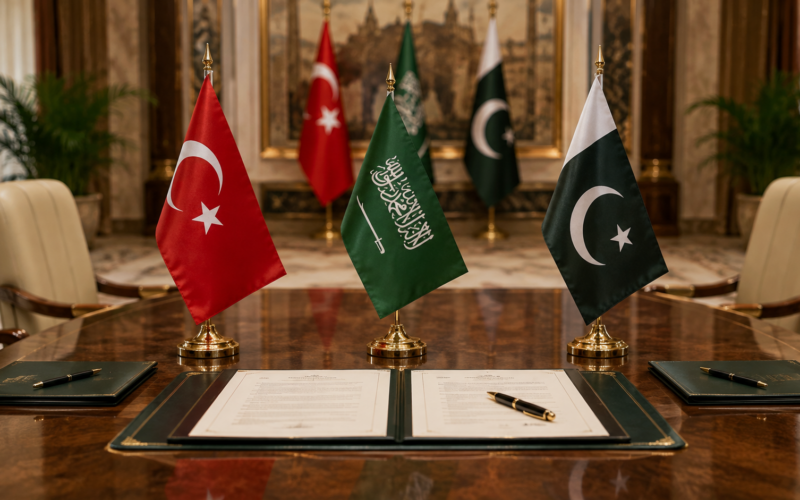
Turkey, Saudi Arabia and Pakistan are expected to sign a joint defence agreement in Saudi Arabia on Friday, August 7, 2026, creating a potentially important new security framework at a moment when the kingdom is warning of imminent attacks from Iran-aligned groups operating to its north and south.
Two regional sources with direct knowledge of the matter told Reuters that the three countries would sign the agreement on Friday. The precise scope, legal obligations and military mechanisms contained in the pact had not been publicly disclosed as of early August 7, making it essential to distinguish the scheduled signing from assumptions about an automatic collective-defence guarantee.
Pakistan Prime Minister Muhammad Shehbaz Sharif arrived in Saudi Arabia for an official visit running from August 6 to August 8. His delegation includes Pakistan’s deputy prime minister and foreign minister, the chief of army staff and chief of defence forces, along with other senior ministers. Turkish President Recep Tayyip Erdoğan was also expected to arrive in the kingdom on Friday.
The agreement comes as Saudi Arabia faces simultaneous pressure from the Houthis in Yemen, Iran-backed armed groups in Iraq and Tehran’s warning that renewed United States strikes on Iran could trigger attacks on oil facilities, power grids, water infrastructure and transport networks across the Gulf. Saudi intelligence assessments reportedly indicate that coordinated attacks against civilian sites, ports, airports and energy assets may be imminent.
The timing gives the pact significance beyond routine military cooperation. Saudi Arabia is attempting to reinforce deterrence without abandoning diplomacy, Pakistan is positioning itself as both a security partner and regional mediator, while Turkey is seeking a larger role in the emerging security order connecting the Gulf, the Red Sea and South Asia.
What is known about the Turkey, Saudi Arabia and Pakistan defence agreement?
The confirmed public information remains limited. Reuters reported that Turkey, Saudi Arabia and Pakistan would sign a joint defence agreement in the kingdom on August 7, citing two regional sources familiar with the plans. No complete text, joint declaration or official explanation of the pact’s obligations had been released before the expected signing.
It is therefore unclear whether the agreement will establish a binding mutual-defence commitment, create a consultation mechanism or concentrate on practical cooperation such as intelligence sharing, training, exercises, air defence, maritime security and defence-industrial collaboration.
Another unresolved question is whether the new arrangement expands the Strategic Mutual Defence Agreement signed by Saudi Arabia and Pakistan in September 2025 or creates a separate trilateral structure. The Saudi-Pakistan pact declared that aggression against either country would be treated as aggression against both, but there has been no confirmation that the same formulation will automatically apply to Turkey.
That distinction matters. A cooperation agreement can improve military coordination without obligating every signatory to enter a conflict. A genuine collective-defence clause would carry much larger implications because an attack on Saudi Arabia, Pakistan or Turkey could require formal consultations or a coordinated response from the others.
The presence of senior political and military leaders suggests that the agreement is more substantial than a symbolic memorandum. However, its true importance will depend on the wording covering activation conditions, command arrangements, territorial scope and the types of support each country is expected to provide.

Why is Saudi Arabia seeking stronger defence ties during the Iran war?
Saudi Arabia’s immediate security environment has deteriorated sharply. A Houthi attack in southern Najran Province wounded 11 civilians, including Saudi, Yemeni, Egyptian and Pakistani nationals. A four-year-old child was among those injured and reportedly suffered second-degree burns.
Saudi officials have also warned that intelligence gathered by the kingdom, the United States and other regional countries points towards possible coordinated attacks by the Houthis and Iran-backed Iraqi militias. Potential targets are said to include energy installations, ports, airports and civilian infrastructure.
The kingdom has confronted the Houthis for more than a decade, but the Yemen conflict has now become intertwined with the wider United States-Israel war against Iran. The Houthis have attacked Saudi military positions, vessels and infrastructure, while Iran-backed Iraqi groups have threatened or targeted Saudi interests from the north.
Tehran has separately warned Gulf governments that renewed United States attacks on Iranian infrastructure would bring retaliation against their strategic assets. Iranian officials reportedly identified refineries, oilfields, electricity networks, water systems and transport infrastructure as potential targets unless Gulf capitals persuade Washington to return to diplomacy.
Saudi Crown Prince Mohammed bin Salman has urged United States President Donald Trump to delay further military action and pursue negotiations. At the same time, Riyadh has indicated that it would respond militarily if its territory were attacked, demonstrating an attempt to combine diplomatic restraint with credible deterrence.
The trilateral pact can therefore be read as part of a wider Saudi strategy. Riyadh does not appear to be replacing its relationship with the United States, which Saudi officials say remains operationally strong. Instead, it is adding regional partners capable of contributing military personnel, intelligence, weapons, maritime assets and diplomatic influence.
What military capabilities could Pakistan contribute to the new security framework?
Pakistan brings one of the Muslim world’s largest and most experienced armed forces to the prospective arrangement. Its military has decades of operational experience, established relationships with Gulf states and considerable capabilities across land warfare, aviation, missile systems, maritime security and counterterrorism.
Saudi Arabia and Pakistan already have a long defence relationship. Pakistani troops have previously served in the kingdom, while Pakistani personnel have trained Saudi forces and participated in joint exercises. Their September 2025 pact formalised the principle that an attack against either state would be treated as aggression against both.
Pakistan’s status as a nuclear-armed state inevitably creates questions about whether its strategic deterrent is connected to Saudi security. Neither government publicly confirmed that nuclear weapons were included in the 2025 agreement, and no evidence currently establishes that a new trilateral arrangement would extend nuclear guarantees to Saudi Arabia or Turkey.
Islamabad may be more willing to offer conventional forces, intelligence, training, air defence and maritime assistance than to accept open-ended commitments involving its nuclear arsenal. Pakistan’s military leadership has traditionally retained strict national control over nuclear command decisions.
Pakistan also faces a diplomatic balancing act. It maintains relations with Iran and has supported efforts to resolve the confrontation around the Strait of Hormuz. Its foreign ministry said Islamabad remained engaged in attempts to achieve de-escalation and a lasting regional settlement.
This means Pakistan will want the pact to strengthen Saudi security without appearing to join an explicitly anti-Iran alliance. The exact language will reveal whether the agreement is framed around defence against any aggression, maritime security and terrorism, or threats specifically associated with Iran and allied armed groups.
Why is Turkey joining Saudi Arabia and Pakistan in a trilateral defence arrangement?
Turkey contributes a large military, an expanding defence industry and geographic reach across the Middle East, the Black Sea, the eastern Mediterranean and Europe. It is also a member of the North Atlantic Treaty Organization, giving the prospective trilateral framework an indirect connection to Western defence structures without making the agreement a NATO initiative.
Ankara has developed an increasingly influential defence-export sector built around drones, missiles, armoured vehicles, naval platforms, electronic warfare and ammunition. Cooperation with Saudi Arabia and Pakistan could support joint production, technology transfer and procurement programmes alongside conventional security coordination.
Turkey and Pakistan already maintain close military and political relations. Their armed forces conduct exercises and training, while Turkish defence companies have pursued partnerships and export opportunities in Pakistan.
Relations between Turkey and Saudi Arabia have also improved after periods of political tension. The two governments have expanded cooperation in trade, investment, energy and defence, including Saudi interest in Turkish unmanned aircraft and other military technologies.
For Ankara, joining a security arrangement with Riyadh and Islamabad offers strategic access to the Gulf at a time when regional states are reconsidering their reliance on external security guarantees. It also allows Turkey to position itself as a major Muslim military power capable of shaping regional deterrence.
However, Turkey will be cautious about commitments that could automatically involve it in Saudi confrontations with Iran, the Houthis or Iraqi militias. The agreement may therefore emphasise coordination and consultation rather than an unconditional obligation to participate in every conflict.
Could the agreement become the foundation of an “Islamic NATO”?
The concept of an “Islamic NATO” has repeatedly appeared in political commentary whenever Muslim-majority countries discuss collective security. The Turkey-Saudi Arabia-Pakistan agreement will inevitably revive that description, but the available evidence does not yet support treating the pact as a direct equivalent of NATO.
NATO has a permanent institutional structure, integrated military planning, established commands and a treaty article under which an armed attack on one member is considered an attack on all. No comparable structure has been announced for the trilateral agreement.
The three countries nevertheless possess capabilities that could form the core of a more influential regional grouping. Saudi Arabia brings financial resources, strategic geography and substantial defence procurement. Pakistan contributes military manpower, nuclear deterrence and links to South Asia. Turkey provides advanced defence manufacturing, operational experience and access to NATO systems.
A functioning trilateral framework could later attract other states concerned about missile attacks, drone warfare and maritime disruption. Qatar, Egypt, Kuwait and other regional governments may study whether the arrangement offers practical security benefits.
Expansion would be politically complicated. Gulf governments have different relationships with Iran, Israel, the United States and one another. Some may support intelligence or maritime cooperation while resisting a binding defence alliance that reduces their diplomatic flexibility.
The more realistic near-term outcome is a compact security partnership focused on specific threats rather than a formal multinational alliance. Counter-drone defence, early-warning systems, maritime escorts and joint exercises are easier to organise than a sweeping promise of collective war.
How could the pact affect Iran and the armed groups aligned with Tehran?
Iran is likely to examine the agreement for signs that Saudi Arabia is building a coordinated military front. Tehran has attempted to pressure Gulf governments while simultaneously encouraging them to restrain Washington, creating a strategy that mixes threats with diplomatic engagement.
A pact involving Turkey and Pakistan complicates that calculation. Both countries maintain channels with Iran and are not natural participants in a simple anti-Tehran bloc. Their involvement may allow Saudi Arabia to strengthen deterrence while keeping open relationships that could be used for mediation.
The agreement could also reduce the effectiveness of pressure from Iran-aligned groups if it produces better intelligence sharing, coordinated air defence and faster responses to missile and drone attacks. Saudi Arabia’s vulnerability has historically resulted less from a lack of expensive weapons than from the difficulty of detecting and intercepting varied threats arriving from multiple directions.
Iran may respond by warning Turkey and Pakistan against allowing the agreement to be used for attacks on Iranian territory. It could also seek assurances that neither country will provide operational support for United States or Israeli strikes.
The Houthis and Iraqi militias will similarly watch for changes in Saudi defensive posture. Deployments of Pakistani personnel, Turkish air-defence systems or shared maritime patrols would demonstrate that the pact is moving beyond political symbolism.
What could the defence agreement mean for India and South Asian security?
India will monitor any arrangement that increases Pakistan’s strategic influence, particularly when it involves Saudi Arabia, an important energy supplier and investment partner for New Delhi.
The 2025 Saudi-Pakistan mutual-defence pact already prompted India to study the implications for its national security and regional stability. Saudi Arabia has simultaneously worked to maintain strong political, economic and security relations with India, limiting the likelihood that Riyadh would want the new framework portrayed as directed against New Delhi.
The key issue for India will be whether the trilateral pact is geographically restricted to threats against Saudi Arabia and Gulf security or whether it contains broader commitments that Pakistan might attempt to invoke during a South Asian crisis.
Turkey’s participation could increase Indian concern because Ankara and Islamabad have close political relations, while Turkey has periodically supported Pakistan’s diplomatic positions on Kashmir. Yet commercial and diplomatic considerations may discourage Saudi Arabia from accepting provisions that entangle it in India-Pakistan disputes.
The released text, if published, will therefore be crucial. A narrowly designed agreement covering Gulf infrastructure, maritime routes and regional missile threats would have different implications from a treaty declaring that aggression against any of the three countries requires a joint military response anywhere.
What will determine whether the agreement changes the Middle East security balance?
The signing ceremony will attract immediate attention, but the agreement’s practical value will be determined by what follows. Many defence memorandums promise cooperation without creating the command systems, funding and deployment mechanisms needed to respond during a crisis.
The first test will be whether the three governments release the text or clarify the circumstances in which the pact can be activated. Ambiguity may provide strategic flexibility, but excessive uncertainty could also weaken deterrence because adversaries will not know whether an attack would trigger a coordinated response.
The second test will involve military implementation. Joint air-defence exercises, intelligence centres, naval patrols, weapons procurement and personnel deployments would indicate that the arrangement is becoming operational.
The third will be diplomatic balance. Pakistan and Turkey will need to reassure Iran that defensive cooperation with Saudi Arabia does not automatically make them participants in a United States-led campaign against Tehran. Saudi Arabia, meanwhile, will want to show Iran-aligned groups that attacks on its territory can no longer be calculated as a bilateral confrontation.
The pact reflects a broader regional trend. Gulf states are no longer relying on a single external protector and are instead building overlapping relationships with the United States, European powers and major Muslim militaries.
Should the agreement produce genuine coordination, it could become one of the most consequential security developments of the Iran war. Should it remain largely declaratory, its importance will be political rather than military. The first answers are likely to emerge from the wording released after the August 7 signing and the deployments that follow.
What are the key takeaways from the planned Turkey-Saudi Arabia-Pakistan defence pact?
- Turkey, Saudi Arabia and Pakistan are expected to sign a joint defence agreement in Saudi Arabia on August 7, 2026, according to two regional sources with direct knowledge of the plans.
- The agreement’s text and operational obligations had not been released before the expected signing, meaning it is not yet clear whether it includes a binding collective-defence clause.
- Pakistan Prime Minister Muhammad Shehbaz Sharif is visiting Saudi Arabia with senior ministers and military leaders, while Turkish President Recep Tayyip Erdoğan is expected in the kingdom.
- The pact comes as a Houthi attack wounded 11 civilians in southern Saudi Arabia and Riyadh warned that coordinated attacks from Yemen and Iraq could target energy facilities, ports and airports.
- Iran has warned that further United States strikes could trigger attacks on oilfields, refineries, electricity grids, water systems and transport infrastructure across the Gulf.
- Saudi Arabia already has a mutual-defence agreement with Pakistan under which aggression against one country is considered aggression against both, but Turkey’s status under the new arrangement remains unknown.
- Pakistan could contribute military manpower, training and strategic deterrence, while Turkey brings advanced defence technology, drones, naval capacity and links to NATO systems.
- The pact could become the foundation for deeper regional security cooperation, but describing it as an “Islamic NATO” would be premature without a published treaty, permanent institutions or integrated command structure.
Discover more from Business-News-Today.com
Subscribe to get the latest posts sent to your email.