
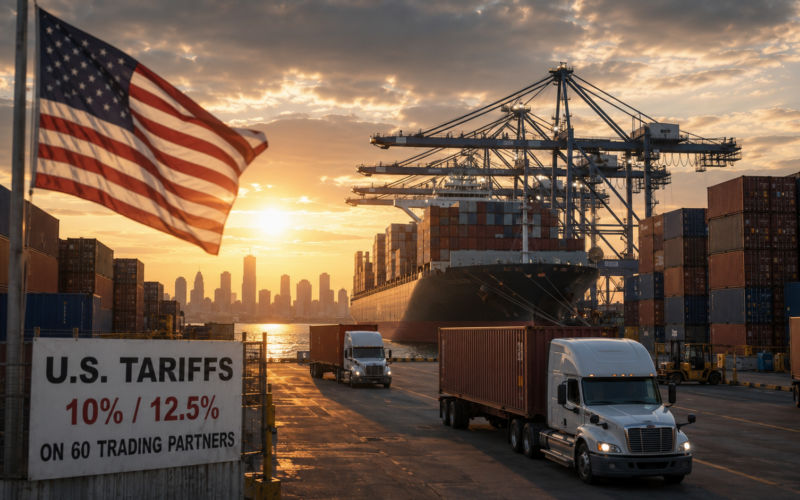
The United States imposed new tariffs of 10% and 12.5% on imports from 60 trading partners on July 24, 2026, replacing an expiring temporary global duty with a broader trade measure linked to allegations that foreign governments have failed to prevent goods made with forced labour from entering their markets.
The tariffs took effect at 12:01 a.m. Eastern Time, the same moment that a temporary 10% global tariff expired after 150 days. The action covers economies including India, China, the European Union, the United Kingdom, Canada, Japan, South Korea, Australia, Brazil, Vietnam and Switzerland.
The Office of the United States Trade Representative imposed the duties under Section 301 of the Trade Act of 1974 following investigations into the forced-labour import policies of 60 economies. The Donald Trump administration said those economies had either failed to introduce adequate bans on products made with forced labour or had failed to enforce existing restrictions effectively.
India, the United Kingdom, Canada, Mexico and several Southeast Asian and Latin American countries face a 10% tariff on most non-exempt goods. China, Australia, Brazil, Vietnam and most of the remaining investigated economies face a 12.5% tariff, while special calculations apply to the European Union, Taiwan, Japan, South Korea and Switzerland.
The measure preserves a near-universal tariff floor across United States imports after the United States Supreme Court invalidated earlier duties imposed under emergency economic powers. Although the new tariffs cover goods representing 99.4% of United States imports, exemptions for energy, food, fertiliser, aircraft, critical minerals and products already facing national-security duties significantly narrow the immediate economic impact.
What tariffs did the United States impose on 60 trading partners on July 24, 2026?
The new tariff structure separates the 60 investigated economies into several groups based on the United States government’s assessment of their forced-labour import policies and commitments.
An additional 10% tariff applies to goods from Argentina, Bangladesh, Cambodia, Canada, Ecuador, El Salvador, Guatemala, Honduras, India, Indonesia, Jordan, Malaysia, Mexico, Pakistan, Sri Lanka, Trinidad and Tobago and the United Kingdom. The Office of the United States Trade Representative concluded that these economies had introduced relevant prohibitions, made commitments through trade agreements or established partial systems, but had not yet met the United States enforcement standard.
Goods from the European Union and Taiwan are subject to a combined tariff level of 10%, including the normal most-favoured-nation duty. Where an existing tariff is already 10% or higher, no additional Section 301 duty is imposed. Where the existing duty is lower, the new tariff raises the total to 10%.
A similar structure applies to Japan, South Korea and Switzerland, but the combined tariff ceiling is 12.5%. Products already carrying most-favoured-nation duties of at least 12.5% receive no additional Section 301 tariff.
Most goods from the remaining investigated economies face a direct 12.5% additional tariff. That category includes China and Vietnam, two major suppliers of manufactured products, consumer goods, electronics, machinery, textiles and industrial components to the United States.
Products loaded onto vessels before the duties took effect receive limited transitional protection. Those goods must enter United States commerce or be withdrawn from a bonded warehouse before 12:01 a.m. Eastern Time on July 28, 2026, to avoid the additional tariff.
Why did Donald Trump use Section 301 after the Supreme Court rejected earlier tariffs?
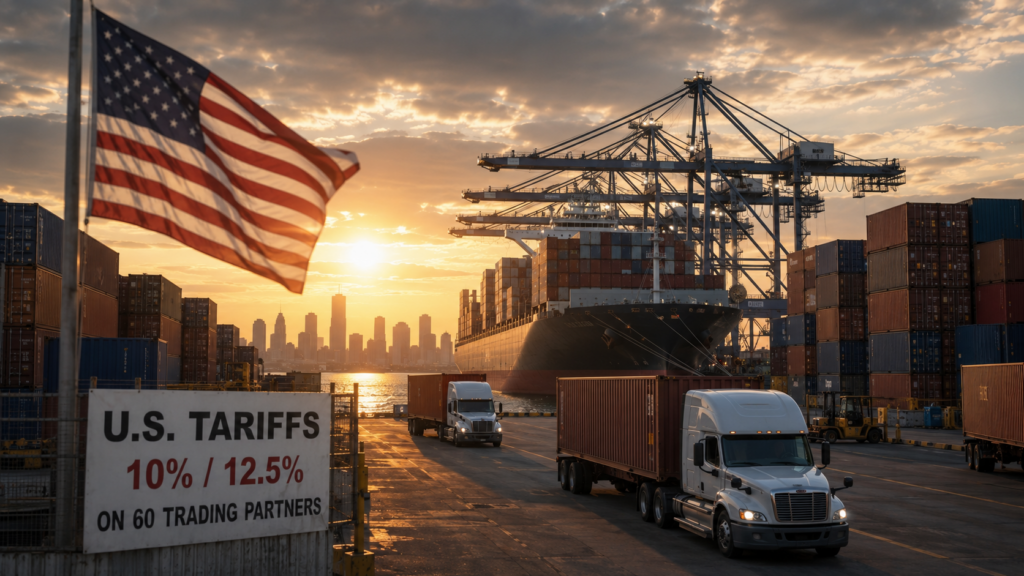
The July 24 action is the Donald Trump administration’s most significant attempt to reconstruct its global tariff programme after the United States Supreme Court invalidated earlier duties imposed under the International Emergency Economic Powers Act.
The earlier tariff system had relied on presidential emergency powers to impose broad duties of between 10% and 50% on trading partners. The Supreme Court ruling removed that legal foundation, forcing the administration to identify alternative statutory authorities capable of supporting a large and durable import-tax structure.
Section 301 of the Trade Act of 1974 gives the Office of the United States Trade Representative authority to investigate foreign policies considered unreasonable, discriminatory or burdensome to United States commerce. It also allows tariffs or other trade restrictions to be imposed after investigations, consultations and public participation procedures.
The Office of the United States Trade Representative opened 60 separate forced-labour investigations on March 12, 2026. The agency received more than 1,600 written submissions and held a three-day public hearing from July 7 to July 9, during which more than 100 witnesses representing governments, industries and non-governmental organisations gave evidence.
Using Section 301 may provide the administration with a stronger legal foundation than the emergency-powers route because the statute explicitly authorises trade retaliation following an investigative process. However, affected governments, importers and industry groups could still challenge whether the investigation, findings and breadth of the remedy satisfy statutory and administrative-law requirements.
The shift also transforms forced-labour policy into a central pillar of United States tariff strategy. The administration is no longer relying primarily on trade deficits or reciprocal tariff differences to justify near-universal duties. Instead, it is linking market access to the enforcement of labour standards throughout international supply chains.
Why are India, China and the European Union treated differently under the new tariffs?
India received the 10% rate after introducing a forced-labour import prohibition during consultations with the United States. The Office of the United States Trade Representative nevertheless concluded that further enforcement was required before Indian goods could avoid the Section 301 measure.
The tariff affects most non-exempt Indian exports entering the United States, although several strategically important sectors remain outside the measure. Aircraft, critical minerals and goods already subject to separate national-security tariffs do not face the additional duty, while exemptions also protect selected food, energy and industrial inputs.
China received the higher 12.5% rate because the United States government concluded that China had not established an acceptable forced-labour import prohibition. The United States has also accused China of using coercive labour practices involving Uyghur and other Muslim minority populations in Xinjiang, allegations rejected by the Chinese government.
The new tariff sits alongside duties retained from Donald Trump’s first presidential term, including 25% tariffs on several categories of Chinese industrial products. The administration has indicated that its objective is to rebuild the broader tariff level on Chinese goods towards the terms of an earlier United States-China trade understanding without immediately exceeding those agreed limits.
The European Union faces a different calculation because the United States and European Union have already established tariff commitments through a bilateral trade framework. The Section 301 duty will therefore raise applicable tariffs to a combined level of 10% rather than automatically adding 10 percentage points to every product.
The European Commission disputed the suggestion that European Union controls were inadequate but noted that the tariff outcome remained within previously negotiated United States commitments. That approach reduces the risk of an immediate transatlantic tariff confrontation while allowing negotiations over additional exemptions to continue.
How do exemptions limit the effects of tariffs covering 99.4% of US imports?
The Office of the United States Trade Representative said the measures apply to goods representing 99.4% of United States imports, but that figure reflects the economies covered rather than the share of trade that will ultimately pay the new duty.
The exemption schedule protects oil and natural gas, fertiliser and certain food products. Those exclusions reduce the danger that the tariffs will deepen energy and food inflation at a time when the conflict involving the United States and Iran has already placed pressure on fuel prices and international shipping.
Aircraft and aircraft parts are exempt, as are critical minerals needed by United States manufacturers. Excluding critical inputs reduces the possibility that the tariffs will interrupt aerospace production, technology manufacturing, defence supply chains or industrial investment.
Goods already subject to Section 232 national-security tariffs are also excluded. These categories include automobiles, steel, aluminium and copper, which remain governed by separate tariff arrangements and country-specific agreements.
The administration added hundreds of products to the exemption list following public comments and industry testimony. The Office of the United States Trade Representative concluded that tariffs on some inputs could create domestic shortages, cause economy-wide disruption or prove ineffective in changing foreign policy.
The result is a tariff regime designed to preserve political and legal breadth while limiting some of the most immediate economic costs. Consumer goods, manufactured products and non-exempt industrial inputs remain exposed, but sectors with the greatest potential to generate supply shocks receive substantial protection.
Importers must nevertheless review product classifications, countries of origin, existing most-favoured-nation rates and separate trade remedies to determine the final duty. The complexity creates a significant compliance burden even for businesses whose goods may ultimately qualify for an exemption.
How will the forced-labour tariffs affect textiles and Southeast Asian supply chains?
Textiles and apparel are among the sectors most directly connected to the administration’s forced-labour justification. Bangladesh, Cambodia, Indonesia and Malaysia received the 10% rate, but the United States plans to create tariff-rate quotas linked to their purchases of United States cotton and textile inputs.
Under the proposed mechanism, specified volumes of textiles and apparel could eventually enter the United States without the additional Section 301 duty. Eligibility would depend partly on each economy increasing its use of United States-produced cotton and other textile materials.
The policy is intended to reduce reliance on inputs originating from supply chains considered more vulnerable to forced labour. It also creates a commercial incentive for Asian garment-producing economies to source more raw materials from United States suppliers.
Until the tariff-rate quotas are operational, covered textile and apparel imports remain subject to the applicable 10% duty. The Office of the United States Trade Representative has not yet completed the detailed quota volumes, product coverage or administrative procedures.
The measure could reshape sourcing decisions across global garment production. Manufacturers may compare the cost of paying the tariff with the cost of changing suppliers, improving traceability systems or increasing purchases of United States cotton.
Bangladesh, Cambodia and Vietnam are major exporters of garments and consumer products to the United States. Differences between the 10% rate for Bangladesh and Cambodia and the 12.5% rate for Vietnam could influence future orders, although labour costs, factory capacity, delivery times and existing relationships remain equally important.
Why are trading partners challenging the United States forced-labour justification?
Several affected governments rejected the United States conclusion that their policies were inadequate. China opposed the use of unilateral tariffs and maintained that trade restrictions would not resolve disagreements over labour standards or supply-chain governance.
Australia and Brazil described the duties as unjustified, while Norway said there was no basis for imposing them. Switzerland also disputed the investigation’s findings even while acknowledging that the tariff calculation remained within previously negotiated limits.
The objections focus partly on the unusual connection between the alleged policy failure and the remedy. The United States is not only blocking individual shipments suspected of containing forced-labour inputs. It is imposing broad tariffs across nearly all non-exempt goods from each investigated economy.
Affected governments may argue that such economy-wide measures are disproportionate because many exporters and products have no demonstrated connection to forced labour. They may also question whether the United States has applied consistent standards across economies with different legal systems and enforcement capacities.
The Donald Trump administration’s position is that weak import controls allow goods made with forced labour to circulate through international supply chains before reaching the United States. From that perspective, foreign governments benefit commercially when they do not impose restrictions comparable to the United States prohibition.
The dispute therefore concerns both human rights and the distribution of compliance costs. Washington wants trading partners to police forced-labour risks before goods enter global commerce, while foreign governments resist a system in which the United States unilaterally determines whether their enforcement is sufficient.
Why did the United Kingdom emerge as a partial winner from the tariff changes?
The United Kingdom faces a 10% tariff on most covered goods, but several exemptions improved its position in strategically important export sectors.
Scotch whisky exports to the United States now receive zero-tariff treatment under the wider United States-United Kingdom Economic Prosperity Deal. Medical technology products also benefit from zero tariffs, providing relief for two significant British export categories.
The United Kingdom government said its bilateral agreement remained in force despite the new global action. The result gives British whisky and medical-technology exporters more favourable treatment than they faced under the expiring temporary tariff.
British producers still confront a mixed competitive picture. The general 10% rate reduces differences between the United Kingdom and some trading partners, while separate treatment for steel and other products can alter relative advantages across individual industries.
The United Kingdom outcome illustrates how bilateral agreements and product exemptions can matter more than the headline tariff rate. Two countries may both appear to face 10%, yet the real commercial effect can differ significantly depending on the goods excluded and the tariffs already in place.
Could another US Section 301 investigation bring additional tariffs later in 2026?
The forced-labour tariffs may not represent the final stage of the Donald Trump administration’s effort to rebuild its trade barriers. A separate Section 301 investigation is examining foreign industrial overcapacity and could produce additional measures against 16 trading partners.
That investigation includes major economies such as China, the European Union, India, Japan, South Korea and Switzerland. The administration is assessing whether foreign subsidies, excess production and other industrial policies burden United States manufacturers and commerce.
Any new tariffs would interact with the forced-labour duties, existing most-favoured-nation rates, Section 232 national-security measures and earlier Section 301 tariffs. The cumulative burden could therefore become substantially higher for selected goods even where the new forced-labour tariff appears moderate.
Businesses face uncertainty because the latest tariff structure provides only part of the future cost picture. Importers may delay sourcing commitments, renegotiate contracts or diversify suppliers while waiting for the excess-capacity investigation to conclude.
Financial markets showed a limited immediate reaction to the July 24 announcement, partly because the tariffs had been widely anticipated and included extensive exemptions. However, additional tariffs targeting industrial capacity could have a greater effect on manufacturing investment, inflation expectations and trade relations.
The strategic significance of the July 24 action is therefore not only the 10% and 12.5% rates. It establishes the legal and administrative framework through which the United States may continue rebuilding a broad tariff system after losing its earlier emergency-powers case.
What are the key takeaways from the new US tariffs on 60 trading partners?
- The United States imposed new tariffs of 10% and 12.5% on imports from 60 trading partners at 12:01 a.m. Eastern Time on July 24, 2026, replacing a temporary 10% global tariff that expired simultaneously.
- The Office of the United States Trade Representative used Section 301 of the Trade Act of 1974 after completing investigations into whether foreign economies had prohibited and effectively enforced restrictions on imports produced with forced labour.
- India, the United Kingdom, Canada, Mexico, Bangladesh, Indonesia, Malaysia and several other economies received a 10% rate, while China, Vietnam, Australia, Brazil and most remaining investigated economies face 12.5%.
- The European Union and Taiwan face combined most-favoured-nation and Section 301 rates capped at 10%, while the equivalent combined ceiling for Japan, South Korea and Switzerland is 12.5%.
- Oil, natural gas, fertiliser, selected food products, aircraft, aircraft parts, critical minerals and products already subject to Section 232 tariffs are exempt, limiting some inflation and supply-chain risks.
- Bangladesh, Cambodia, Indonesia and Malaysia may later receive tariff-free textile and apparel quotas linked to purchases of United States cotton and textile inputs, although those mechanisms have not yet been implemented.
- China, Australia, Brazil, Norway and other trading partners disputed the United States justification, while the European Union said the tariff calculation remained within earlier transatlantic trade commitments.
- A separate United States investigation into foreign industrial overcapacity could produce additional tariffs on 16 economies, including China, India, the European Union, Japan, South Korea and Switzerland.
Discover more from Business-News-Today.com
Subscribe to get the latest posts sent to your email.