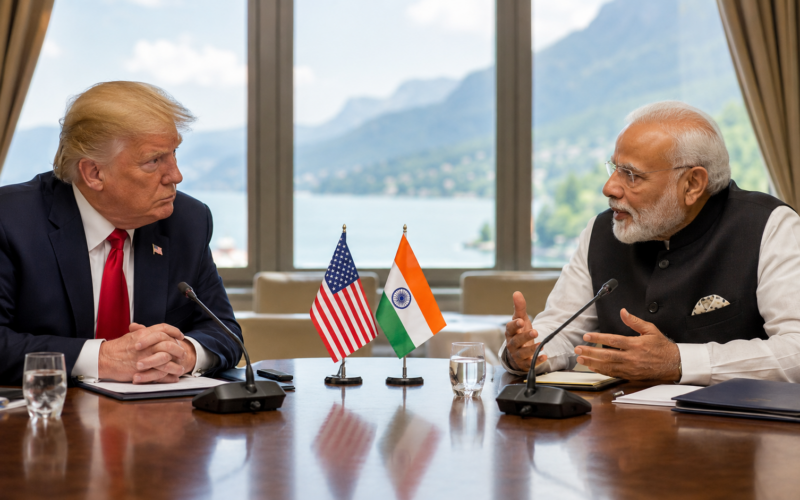
United States President Donald Trump and Indian Prime Minister Narendra Modi are expected to discuss a possible trade deal during the G7 leaders summit in Évian-les-Bains, France, from June 15 to June 17, 2026, but United States officials do not expect an agreement to be finalised at the summit.
The meeting will place trade, tariffs, energy security and maritime tensions at the centre of the United States India relationship. United States Trade Representative Jamieson Greer is expected to visit India the week after the summit for further discussions, signalling that the G7 conversation is likely to act as a political checkpoint rather than a final negotiating stage.
The timing is important for India because Narendra Modi has said India will voice the aspirations of the Global South at the G7 summit while also engaging leaders from France, the United States, Canada and other major economies. India is attending the G7 as a partner country, reflecting New Delhi’s growing role in global economic, energy and diplomatic debates.
The diplomatic backdrop is unusually complex. Trade talks between Washington and New Delhi are moving forward, but the relationship has been strained by United States tariffs on Indian goods and by recent tensions over United States military actions near the Strait of Hormuz. Three Indian sailors were killed in attacks on Indian crewed tankers linked to United States action against Iran related shipping, and India has called for an end to such strikes.
The G7 summit will therefore test whether the United States and India can separate the trade negotiation from the wider strategic friction created by energy routes, maritime security and West Asia instability.
Why will the Trump Modi meeting at the G7 summit matter for United States India trade talks?
The Trump Modi meeting at the G7 summit will matter because it gives the United States and India a high-level political forum to assess whether their trade negotiations can move toward an interim agreement. The summit itself is not expected to produce a completed deal, but it can help define the political boundaries for the next round of technical talks.
United States officials have said trade will be discussed during Donald Trump’s meeting with Narendra Modi. They have also indicated that Jamieson Greer will travel to India after the G7 summit for follow-up discussions. That sequencing suggests the two sides are using leader-level diplomacy to maintain momentum while leaving detailed bargaining to trade negotiators.
India has been seeking preferential tariff treatment as part of an interim trade deal. Indian Commerce and Industry Minister Piyush Goyal has indicated that the first phase of a bilateral trade agreement could be concluded by mid-July. That timeline gives the G7 meeting added relevance because the summit comes just weeks before the expected window for a possible first tranche.
For Washington, the negotiation is likely to focus on market access, tariffs, supply chains and strategic economic alignment. For New Delhi, the priority is to prevent tariffs from limiting exports while preserving policy space for domestic manufacturing, agriculture, technology and industrial development.

How does India’s Global South message shape Narendra Modi’s G7 outreach in France?
India’s Global South message shapes Narendra Modi’s G7 outreach by turning the summit into more than a bilateral trade platform. Narendra Modi has framed India’s presence at the G7 as a moment to speak not only for India but also for developing countries facing debt stress, energy volatility, climate finance gaps and uneven access to technology.
The G7 remains a forum of advanced economies, but India’s repeated invitations show that major powers increasingly see New Delhi as a bridge to wider developing world concerns. India has now become a recurring outreach partner in G7 discussions, which gives New Delhi space to present itself as both a large emerging economy and a diplomatic voice for countries outside the formal G7 structure.
This is strategically useful for India because it allows Narendra Modi to place trade demands within a broader development argument. Preferential tariff treatment, energy security, resilient supply chains and technology access can all be presented as issues that affect the Global South rather than as narrow national asks.
The broader consequence is that India is using the G7 platform to strengthen its position across multiple diplomatic tracks. New Delhi can engage Washington on trade, Paris on strategic cooperation, Ottawa on bilateral ties and other G7 leaders on development priorities while still projecting itself as a representative of emerging economies.
Why are Strait of Hormuz tensions now affecting United States India diplomacy?
Strait of Hormuz tensions are affecting United States India diplomacy because the waterway is central to global energy security and to India’s maritime interests. India depends heavily on imported energy, and any disruption in Gulf shipping routes can affect fuel prices, supply chains and inflation pressures.
The immediate diplomatic strain comes from United States military action against Iran linked shipping and the deaths of three Indian sailors in attacks on Indian crewed tankers. India has objected to lethal action against commercial shipping and has called for such strikes to end. United States officials have defended their actions as part of efforts to uphold security and enforce measures against Iran related oil transport.
That disagreement matters because it places India in a difficult diplomatic position. New Delhi wants strong ties with Washington, but it also needs to protect Indian seafarers, maintain energy flows and avoid being drawn too deeply into a conflict around Iran. The Strait of Hormuz is not a distant crisis for India. It is a direct economic and human security concern.
The G7 setting could make the issue more urgent. Narendra Modi is expected to raise concerns linked to West Asia and energy security, while Donald Trump is expected to engage several Middle East leaders on Iran and regional stability. The overlap means trade talks cannot be fully separated from maritime and energy diplomacy.
What role does France play in India’s G7 diplomacy and European outreach?
France plays a central role because the 2026 G7 summit is being hosted in Évian-les-Bains, and Narendra Modi’s visit includes bilateral engagement with French President Emmanuel Macron. The France leg of the visit also comes within a wider European outreach plan that includes Slovakia.
India and France have built a deep strategic partnership across defence, space, civil nuclear cooperation, technology, maritime security and Indo-Pacific coordination. Narendra Modi’s meeting with Emmanuel Macron gives both leaders a chance to review progress and define next steps after earlier moves to elevate the relationship.
The French dimension matters especially because India’s G7 priorities include the Global South, West Asia, energy security and technology cooperation. France has positioned itself as a European partner willing to engage India on strategic autonomy, defence industrial cooperation and global governance reform.
For India, the visit to France and Slovakia also signals that New Delhi wants a wider European presence beyond its major traditional partners. Slovakia matters because the visit is described as the first by an Indian prime minister since the country became independent in 1993. That gives the trip a Central European angle alongside the G7 and France components.
Why is the United States India trade negotiation politically sensitive before the July target?
The United States India trade negotiation is politically sensitive because both sides want progress but neither side wants to appear to concede too much before domestic constituencies. Donald Trump has repeatedly emphasised tough trade bargaining, while Narendra Modi has to protect India’s domestic industrial and agricultural interests.
The tariff dispute is central to the challenge. United States tariffs on Indian goods have strained the relationship, while India is pushing for preferential tariff treatment as part of an interim agreement. Any deal must therefore balance market access with political acceptability in both countries.
The negotiations also sit inside a larger strategic relationship. The United States sees India as an important Indo-Pacific partner, a market, a supply chain alternative and a counterweight in a changing Asian balance. India sees the United States as a key technology, defence, trade and investment partner, but New Delhi also wants strategic autonomy in energy, Russia policy, Iran policy and global forums.
That is why a quick announcement at the G7 summit is unlikely. A trade framework may be politically useful, but the hard details still need technical negotiation. The expected visit by Jamieson Greer to India after the summit suggests that both governments know the real bargaining will continue beyond the leader-level meeting.
How could the G7 summit reshape India’s position between trade, energy and geopolitics?
The G7 summit could reshape India’s position by forcing several policy tracks to converge at once. Trade with the United States, energy security through the Strait of Hormuz, diplomatic positioning on Iran, and India’s Global South message are all expected to surface during the same summit window.
This convergence gives India an opportunity, but it also increases risk. If trade talks advance, New Delhi can show that its engagement with Washington remains productive despite geopolitical friction. If the talks stall or maritime tensions worsen, the summit could highlight the limits of strategic convergence between the two democracies.
For the Global South, India’s role will be watched closely because many developing economies face the same pressures India is raising: fuel price volatility, debt, climate finance gaps, food security and uncertainty in global trade rules. India’s argument is that these issues cannot be handled only by advanced economies.
For the G7, India’s presence is useful because it adds legitimacy to conversations about global governance beyond the traditional advanced economy circle. But for India, the real test is whether repeated G7 invitations translate into outcomes on tariffs, energy security, maritime stability and development finance.
What are the key takeaways from Narendra Modi’s G7 agenda and United States India trade talks?
- United States President Donald Trump and Indian Prime Minister Narendra Modi are expected to discuss a possible trade deal during the G7 leaders summit in Évian-les-Bains, France, from June 15 to June 17, 2026.
- United States officials do not expect a trade agreement to be finalised at the G7 summit, making the meeting a political checkpoint rather than the closing stage of the bilateral negotiation.
- United States Trade Representative Jamieson Greer is expected to visit India the week after the G7 summit, which indicates that technical discussions will continue after the leader-level talks in France.
- India is seeking preferential tariff treatment as part of an interim trade deal, while Indian Commerce and Industry Minister Piyush Goyal has indicated that a first phase could be concluded by mid-July.
- Narendra Modi has said India will use its G7 presence to voice the aspirations of the Global South, placing development concerns alongside India’s own trade, energy and diplomatic priorities.
- Strait of Hormuz tensions have added strain to United States India diplomacy after three Indian sailors were killed in attacks on Indian crewed tankers linked to United States action against Iran related shipping.
- Narendra Modi is also expected to engage French President Emmanuel Macron and other world leaders, making the France visit a wider diplomatic exercise beyond the United States India trade track.
- The G7 summit will test whether Washington and New Delhi can preserve trade momentum while managing differences over tariffs, energy routes, West Asia instability and maritime security.
Discover more from Business-News-Today.com
Subscribe to get the latest posts sent to your email.