



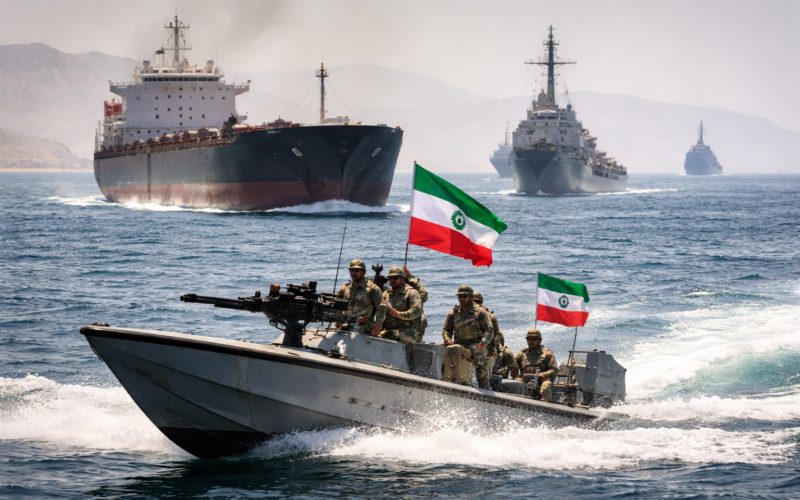
Iran’s joint military command declared on 18 April 2026 that control of the Strait of Hormuz had returned to its previous state of strict management and control by Iran’s armed forces, reversing a declaration made less than 24 hours earlier by Iranian Foreign Minister Abbas Araghchi that the critical waterway was completely open for commercial vessel transit. Iran’s military command cited what it described as repeated breaches of trust by the United States and the continuation of the United States naval blockade of Iranian ports as the reasons for reimposing restrictions on the Strait of Hormuz.
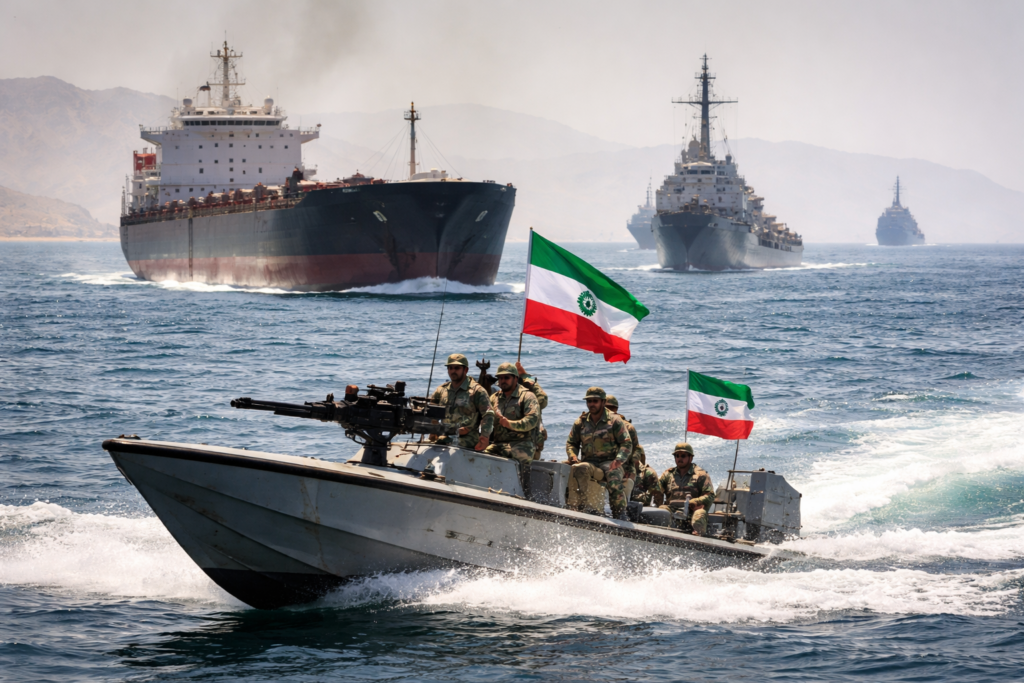
Islamic Revolutionary Guard Corps gunboats opened fire on a tanker transiting the Strait of Hormuz on 18 April 2026, according to the British military’s United Kingdom Maritime Trade Operations centre. The United Kingdom Maritime Trade Operations centre reported the tanker and crew as safe but did not identify the vessel or its destination. A second commercial vessel, a container ship, was struck by an unknown projectile during the same period, sustaining damage to some containers with no reported injuries.
TankerTrackers.com reported that at least two Indian-flagged vessels, including a supertanker carrying Iraqi oil, were forced to turn around after being fired upon by Iranian forces in the strait. A United States defence official confirmed at least three attacks on commercial ships on 18 April 2026, while the United Kingdom Maritime Trade Operations centre confirmed two separate incidents. Audio recordings from the attacks indicated that at least one vessel had been given clearance to enter the strait before Iranian forces opened fire, prompting the vessel’s dispatcher to announce it was turning around.
Ebrahim Azizi, head of the Iranian parliament’s National Security Commission, described the situation as a return to the status quo, characterising the requirement for ships to obtain Iranian naval authorisation and pay a toll before transiting the Strait of Hormuz as the standard operating position. Iran’s Fars semi-official state news agency cited an Iranian military official accusing the United States of banditry and maritime piracy, and warning that the Strait of Hormuz would remain tightly controlled as long as the United States blockade of Iranian ports continued.
Why did Iran reverse its Strait of Hormuz opening declaration within hours of the announcement on 17 April 2026?
The reversal exposed deep internal divisions within Iran’s political and military establishment over the terms under which the Strait of Hormuz could be opened. When Iranian Foreign Minister Abbas Araghchi announced on 17 April 2026 that the strait was completely open for all commercial vessels in line with the Israel-Lebanon ceasefire, United States President Donald Trump responded by welcoming the move on Truth Social but simultaneously confirming that the United States naval blockade of Iranian ports would remain in full force until a comprehensive peace agreement was concluded. Iranian state media subsequently said Araghchi had misspoken, insisting that only Islamic Revolutionary Guard Corps-authorised civilian vessels were permitted to pass through shipping lanes designated by Tehran. The Islamic Revolutionary Guard Corps effectively overrode the foreign ministry’s public announcement within hours, reimposing the authorisation and toll payment regime.
Iran’s use of the Strait of Hormuz as a reciprocal pressure instrument has been consistent throughout the 2026 conflict. Tehran has repeatedly conditioned transit access on American concessions, including the lifting of the United States naval blockade of Iranian ports, a halt to Israeli military operations in Lebanon, and international recognition of Iranian sovereign rights over the waterway. The international community, including the United States, the United Kingdom, the European Union, and most major shipping nations, has rejected Iran’s claim to sovereign management authority over the Strait of Hormuz, which the United Nations Convention on the Law of the Sea treats as an international transit passage open to vessels of all nations. Iran is not a signatory to the United Nations Convention on the Law of the Sea and has historically asserted a broader interpretation of its coastal state rights in the Persian Gulf.
How does Iran’s reimposition of Strait of Hormuz restrictions affect United States-Iran peace negotiations ahead of the 22 April 2026 ceasefire expiry?
The reimposition of restrictions on the Strait of Hormuz added acute pressure to an already fragile diplomatic environment. Iranian sources told CNN that a second round of direct United States-Iran peace negotiations was expected to take place on Monday, 20 April 2026, in Islamabad under Pakistani mediation. The United States had not publicly confirmed those talks as of 18 April 2026. The two-week ceasefire between the United States and Iran, agreed on 8 April 2026 and brokered by Pakistan with the involvement of Pakistani Army Chief Field Marshal Asim Munir, United States Vice President JD Vance, United States Special Envoy Steve Witkoff, and Iranian Foreign Minister Abbas Araghchi, was set to expire on 22 April 2026.
Bloomberg reported that both sides were considering extending the ceasefire by a further two weeks to allow time for substantive negotiations, though no public confirmation of an extension had been made. Trump said he may not extend the ceasefire if negotiations fail. Pakistani mediators had been working to use the 16 April 2026 Israel-Lebanon ceasefire as diplomatic leverage to persuade Tehran to make concessions on permanent Hormuz access and Iran’s nuclear enrichment programme. Those efforts appeared to produce momentum on 17 April 2026 when Araghchi announced the strait’s opening, only for Iran’s military establishment to reverse the decision within hours of Trump confirming the United States blockade would remain.
The two thorniest outstanding issues between the United States and Iran remain Iran’s nuclear programme and unconditional commercial access through the Strait of Hormuz. The United States and Israel are pushing for complete restrictions on Iranian uranium enrichment. Iran insists its enrichment programme serves civilian purposes only. Trump claimed Tehran had agreed to hand over what he described as enriched uranium stockpiles, which he referred to as nuclear dust, but the precise terms of any arrangement over Iran’s nuclear material remained unconfirmed and disputed as of 18 April 2026.
What is the current United States military posture in the Strait of Hormuz and the broader Middle East as ceasefire talks continue?
The United States military posture in the region remained extensive and ready for resumed combat operations. Chairman of the Joint Chiefs of Staff Air Force General Dan Caine stated on 16 April 2026 that more than 10,000 sailors, marines, and airmen, together with over a dozen ships and dozens of aircraft, were enforcing the United States military blockade of Iranian ports. United States Central Command said 23 ships complied with United States instructions to turn around since the blockade commenced, with enforcement occurring inside Iran’s territorial seas and in international waters. The USS George H.W. Bush aircraft carrier was reported en route to the Middle East, joining the USS Abraham Lincoln already operating in the region, along with the USS Gerald R. Ford, USS Mahan, and USS Winston S. Churchill operating in the Red Sea.
Iran-backed Shiite militias conducted hundreds of attacks on United States forces since the 2026 conflict began, according to Lieutenant General James Adams, head of the United States Defense Intelligence Agency, who told a House Armed Services subcommittee that the United States and Israeli bombing campaign had caused significant degradation of Iranian military capabilities. Intelligence assessments cited by CNN indicated that roughly half of Iran’s missile launchers remained intact and that Iran retained thousands of one-way attack drones and a large number of missiles despite the United States-Israeli bombing campaign since 28 February 2026.
The death toll from the conflict remained severe. Iran’s forensics chief reported more than 3,300 people killed in Iran since United States-Israeli strikes began. The death toll in Lebanon reached 2,196 by 16 April 2026, according to Lebanon’s National News Agency. Thirty-two people were killed in Gulf states, 23 in Israel, and 13 United States service members were killed in combat. The renewed closure of the Strait of Hormuz on 18 April 2026, combined with the persistence of the United States naval blockade of Iranian ports and uncleared sea mines in the waterway, left the global energy trade facing continued and acute disruption with no confirmed resolution in sight before the 22 April 2026 ceasefire expiry date.
What Iran’s reimposition of Strait of Hormuz restrictions on 18 April 2026 means for global shipping and the United States-Iran ceasefire
- Iran’s Islamic Revolutionary Guard Corps reimposed restrictions on the Strait of Hormuz on 18 April 2026, reversing Iranian Foreign Minister Abbas Araghchi’s announcement of 17 April 2026 that the waterway was completely open, with Iran’s joint military command citing the continuation of the United States naval blockade of Iranian ports as the reason.
- Islamic Revolutionary Guard Corps gunboats fired on at least one tanker and a container ship sustained projectile damage in the Strait of Hormuz on 18 April 2026, with at least two Indian-flagged vessels, including a supertanker carrying Iraqi oil, forced to turn around.
- Iran’s parliament security commission head Ebrahim Azizi stated the strait has returned to a status quo requiring Iranian naval authorisation and toll payment before any vessel may transit, a position rejected by the United States, the United Kingdom, the European Union, and international maritime law under the United Nations Convention on the Law of the Sea.
- A second round of direct United States-Iran peace negotiations is expected on 20 April 2026 in Islamabad under Pakistani mediation, though the United States had not publicly confirmed the talks as of 18 April 2026; the existing ceasefire is set to expire on 22 April 2026.
- The thorniest outstanding issues between the United States and Iran remain Iran’s nuclear enrichment programme and unconditional commercial access through the Strait of Hormuz, with both sides maintaining maximalist opening positions and no confirmed framework for resolution before the ceasefire expiry.
Discover more from Business-News-Today.com
Subscribe to get the latest posts sent to your email.