





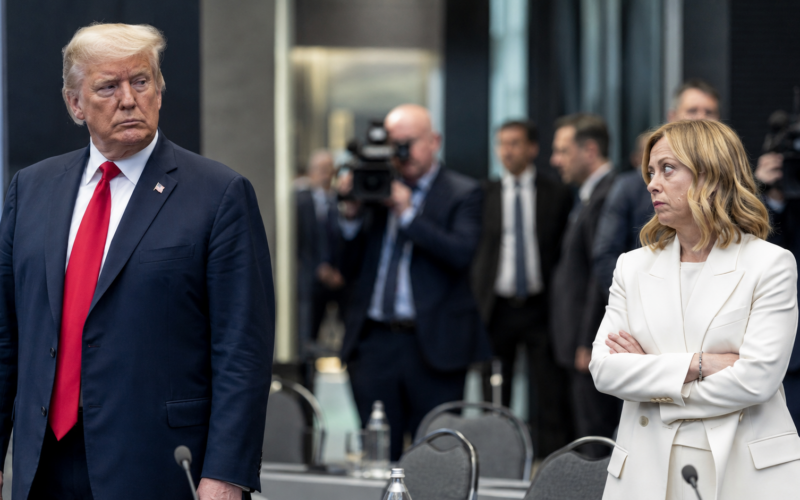
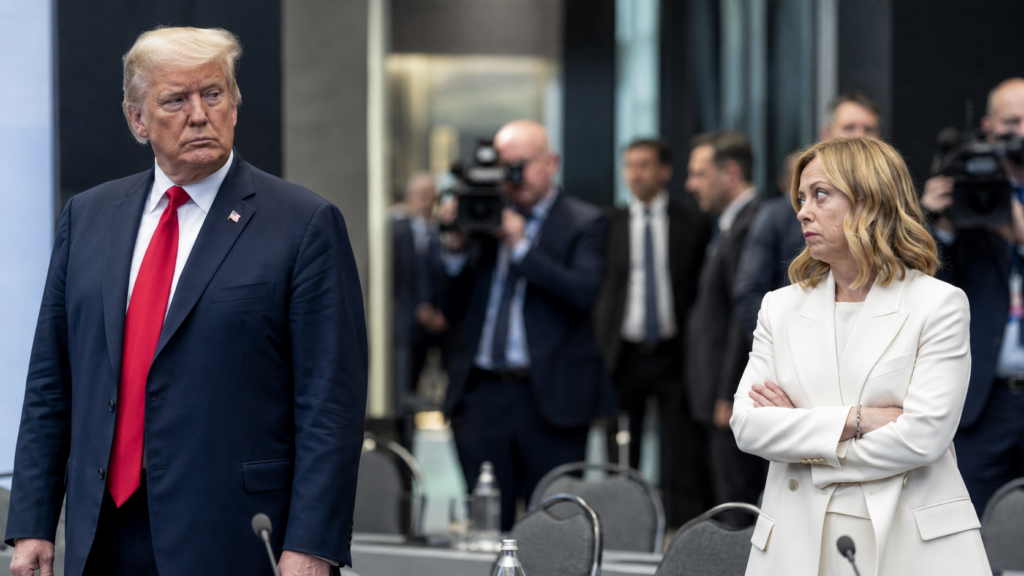
Relations between the United States and Italy have entered an unusually public dispute after President Donald Trump renewed his criticism of Prime Minister Giorgia Meloni on June 20, 2026, claiming she repeatedly sought a photograph with him during the Group of Seven summit in France. Meloni rejected the account, described Trump’s attacks as unprovoked and senseless, and told the United States president to concentrate on his own popularity rather than hers.
The confrontation has already produced a diplomatic consequence. Italian Foreign Minister Antonio Tajani cancelled a planned visit to the United States that was expected to include a business forum in Miami and a meeting with Secretary of State Marco Rubio. The cancellation transformed what began as a dispute over a photograph into a broader test of government-level relations between two longstanding NATO allies.
The disagreement is rooted in more serious policy divisions, particularly Italy’s refusal to allow United States military aircraft connected to operations against Iran to use Naval Air Station Sigonella in Sicily without the required Italian authorisation. Meloni maintains that cooperation with Washington cannot override Italy’s sovereignty, legal procedures or control over military activity conducted from its territory.
Neither government has withdrawn from defence agreements, recalled an ambassador or announced a suspension of military cooperation. However, the public exchange comes less than three weeks before NATO leaders gather in Ankara on July 7 and July 8, increasing the political cost of a dispute involving alliance obligations, military bases and the treatment of European partners.
What did Donald Trump and Giorgia Meloni say as their public dispute escalated?
The confrontation began after Trump told Italian television channel La7 that Meloni had repeatedly sought a photograph with him at the Group of Seven summit. He portrayed the interaction as an attempt by the Italian prime minister to repair their relationship and improve her domestic political standing after Italy declined to support parts of the United States campaign against Iran.
Meloni said the account was entirely fabricated and rejected the suggestion that she or Italy had pleaded for access to the United States president. She also accused Trump of showing greater aggression towards Western allies than towards governments that challenge the West, turning the disagreement into a criticism of his wider diplomatic conduct.
Trump responded on June 20 through Truth Social, repeating the photograph claim and initially misspelling Meloni’s first name before correcting it. He argued that her refusal to support the United States during the Iran war had weakened her popularity and suggested that she was trying to restore their earlier relationship.
Meloni answered that her political support did not depend on Trump’s approval and that defending Italy’s national interest remained her responsibility. Her response was unusually direct for a leader previously regarded as one of Trump’s closest ideological partners in Europe, indicating that the disagreement had moved beyond a misunderstanding that could be resolved through a routine clarification.
Why did Antonio Tajani cancel his planned visit to the United States?
Antonio Tajani had been expected to travel to the United States for commercial and diplomatic engagements, including a business forum in Miami and discussions with Marco Rubio. The programme was intended to promote investment, trade and cooperation between two countries with extensive economic, military and cultural ties.
Tajani cancelled the visit after Trump’s initial comments about Meloni, describing the remarks as offensive not only to the prime minister but to Italy. The decision created an institutional consequence without escalating to the more serious diplomatic step of recalling Italy’s ambassador or formally downgrading relations.
Cancelling the visit allowed Rome to demonstrate that public criticism of the prime minister would carry a cost while preserving space for later de-escalation. Business events and ministerial meetings can be rescheduled more easily than defence agreements, diplomatic representation or alliance commitments.
The decision nevertheless interrupts an important channel at a sensitive moment. Italy and the United States need regular coordination on NATO preparations, the Iran conflict, Ukraine, Mediterranean security, trade and the operation of United States forces based on Italian territory.
A rescheduled Tajani visit or a direct conversation with Rubio would be one of the clearest signs that both governments intend to contain the dispute. Continued cancellation without replacement would suggest that the disagreement is affecting practical diplomacy rather than remaining primarily a confrontation between two leaders.
How did Italy’s refusal to provide base access during the Iran war deepen tensions?
Italy denied United States military aircraft permission to use Sigonella in late March for operations connected to the Middle East conflict. Reports indicated that the aircraft were expected to land in Sicily before continuing towards the region, but Italian authorities concluded that the mission fell outside routine access arrangements.
Defence Minister Guido Crosetto said the decision did not represent a general closure of United States facilities in Italy. Washington could continue using bases for purposes covered by existing agreements, while missions involving combat or support for offensive operations required additional authorisation.
The distinction is important because Italy did not reject its entire security partnership with the United States. It rejected a specific use of Italian territory after concluding that the necessary consultation and permission had not been obtained.
Trump interpreted the refusal as a failure to support the United States during a major conflict. Meloni presented the same decision as an exercise of Italian sovereignty and compliance with domestic legal obligations.
The dispute therefore reflects incompatible expectations about alliance cooperation. Washington expected a close partner to facilitate an urgent military operation, while Rome insisted that ideological friendship and NATO membership did not remove Italy’s authority over how its territory could be used.
What legal and political limits govern United States military operations from Italy?
Italy hosts a large and strategically important United States military presence, but the bases remain located on Italian sovereign territory. Their operation is governed by NATO commitments, bilateral arrangements and procedures defining which activities are already authorised and which require further approval.
Routine logistics, training, surveillance and collective defence activities can operate under established agreements. A mission directly supporting military strikes outside those arrangements may require consultation with the Italian government and, depending on its character, parliamentary involvement.
Sigonella is an Italian military facility that hosts a United States naval air station and supports operations across the Mediterranean, Europe, Africa and the Middle East. Its strategic location makes it valuable for surveillance, transport, refuelling and logistical missions, but that importance does not create an unrestricted right for Washington to use the facility for any operation.
The Italian government’s position is that the United States did not complete the required procedures before seeking access for the Iran-related flights. Trump’s criticism effectively challenges whether close allies should be able to delay or refuse such support during a conflict Washington considers important.
That question extends beyond Italy. France and Spain also restricted aspects of United States or Israeli military activity connected to the Iran war, demonstrating broader European concern over automatic participation in operations outside NATO’s collective defence framework.
Why does the Trump-Meloni fallout matter before NATO leaders meet in Ankara?
NATO’s next summit will take place in Ankara on July 7 and July 8 under the chairmanship of Secretary General Mark Rutte. Alliance leaders are expected to discuss defence spending, force readiness, military capabilities and security threats affecting Europe and the wider transatlantic area.
NATO operates through institutions, military commands and negotiated decisions rather than the personal relationship between any two leaders. The United States and Italy can therefore continue routine cooperation even while Trump and Meloni exchange public criticism.
Personal disputes can still affect the atmosphere in which consensus must be reached. Leaders who believe they have been publicly humiliated may become less willing to provide political concessions, defend unpopular compromises or serve as intermediaries between competing governments.
Meloni had previously positioned herself as a bridge between Trump and European leaders who were more openly critical of his tariffs, approach to Ukraine and demands for higher defence spending. The deterioration of that relationship weakens one of the informal channels through which European concerns could reach the White House.
The summit will provide an immediate test. A bilateral meeting, coordinated statement or visibly professional interaction in Ankara could stabilise relations, while another confrontation would risk distracting from NATO’s wider security agenda.
Could the dispute reshape Giorgia Meloni’s political position inside Italy and Europe?
Meloni has built her political identity around nationalism, conservative values and a commitment to defending Italy’s interests within Western alliances. Her earlier relationship with Trump supported her claim that Italy could maintain influence in Washington without abandoning European institutions.
The dispute places that strategy under pressure because Trump is no longer presenting Meloni as a favoured partner. His criticism suggests that personal alignment offers limited protection when an ally refuses a policy request considered important by the White House.
Standing up to Trump could strengthen Meloni among Italian voters who oppose the Iran war or object to foreign pressure over military bases. However, any domestic benefit must be balanced against the risk that Italy loses diplomatic access or influence within the United States administration.
Italian political figures from within the government rallied around the prime minister after Trump’s remarks. Defence Minister Guido Crosetto and Antonio Tajani framed the issue as one involving respect for Italy rather than an internal disagreement about Meloni’s leadership.
The European implications are equally significant. Meloni had been one of the few major European leaders able to combine a cooperative relationship with Trump and participation in European Union decision-making. If that bridge collapses, European capitals may rely more heavily on collective negotiation rather than attempts to influence Washington through individual ideological relationships.
How important is Italy to United States military strategy in Europe and the Mediterranean?
Italy hosts approximately 12,662 permanently assigned United States military personnel, according to data covering the end of 2025. These forces operate from locations including Aviano, Vicenza, Naples and Sicily, making Italy the second-largest host of permanently stationed United States troops in Europe after Germany.
The facilities support air operations, naval command, ground forces, logistics and coordination across NATO’s southern region. Italy’s geographic position provides access to the Mediterranean, the Balkans, North Africa and the Middle East, giving the partnership strategic importance beyond the bilateral relationship.
Sigonella is particularly valuable for surveillance, maritime operations, transport and support for the United States Sixth Fleet. Aviano Air Base supports United States Air Force operations, while Naples hosts important naval and NATO command functions.
A prolonged political dispute would not necessarily close these facilities because they operate under longstanding agreements and serve both Italian and allied security interests. However, disagreement over mission authorisation can affect the speed and flexibility with which Washington responds to crises.
The Sigonella episode demonstrates that access and operational freedom are not the same. United States forces may be present in Italy while still requiring Italian consent for missions falling outside the arrangements under which the facilities normally operate.
What does the clash reveal about Donald Trump’s approach to European allies?
Trump frequently evaluates alliances through burden sharing, military support and whether partners respond positively to United States requests. Governments that decline cooperation can become targets of public criticism even when they maintain broader defence commitments.
His approach can create negotiating pressure by making the political cost of refusal visible. It can also complicate diplomacy when disagreements over policy become personalised through attacks on another leader’s popularity, motives or public image.
The Meloni dispute is notable because she had made significant efforts to maintain a constructive relationship with Trump. She attended his January 2025 inauguration and was widely viewed as one of the European leaders most ideologically compatible with his administration.
Their falling-out demonstrates that political similarity does not eliminate disputes over sovereignty, military action or domestic legal requirements. European leaders may conclude that maintaining influence in Washington requires institutional leverage rather than relying heavily on personal rapport.
Trump’s supporters may view his criticism as evidence that he places United States interests above diplomatic convention. Critics will argue that public attacks on allied leaders make cooperation more difficult and provide strategic opportunities for governments seeking divisions within NATO.
What developments will show whether United States-Italy relations can recover?
The first indicator will be whether Antonio Tajani reschedules his United States visit and restores direct engagement with Marco Rubio. Ministerial contact could lower the temperature without requiring either Trump or Meloni to retract every public statement.
The second will be whether the White House and Palazzo Chigi establish a shared explanation of the Sigonella rules. Clear procedures for future military requests could prevent another operational disagreement from turning into a public confrontation.
The third will be the NATO summit in Ankara. A bilateral meeting between Trump and Meloni would demonstrate that both governments remain capable of separating personal disputes from alliance responsibilities.
The fourth will involve military cooperation on Italian territory. Routine operations are continuing, but another denied request could reinforce Washington’s argument that Italy is becoming a less dependable operational partner.
The final indicator will be the tone of the leaders’ public statements. A pause in personal criticism would allow diplomats to repair the relationship, while renewed accusations could turn a temporary dispute into a lasting feature of transatlantic politics.
What are the key takeaways from the Donald Trump and Giorgia Meloni dispute?
- Donald Trump renewed his criticism of Giorgia Meloni on June 20, 2026, claiming that the Italian prime minister repeatedly sought a photograph with him during the Group of Seven summit in France to improve her political standing.
- Giorgia Meloni rejected Trump’s account as fabricated, described his repeated attacks as senseless and argued that her responsibility was to defend Italy’s national interest rather than secure favourable treatment from the United States president.
- Italian Foreign Minister Antonio Tajani cancelled a planned United States visit involving a business forum in Miami and expected discussions with Secretary of State Marco Rubio, giving the political dispute an immediate diplomatic consequence.
- The deeper disagreement concerns Italy’s refusal to allow United States aircraft connected to operations against Iran to use Naval Air Station Sigonella without prior consultation and the authorisation required under Italian procedures.
- Italy continues to host a substantial United States military presence and has not suspended defence cooperation, withdrawn from NATO agreements or announced restrictions covering all American activities at Italian facilities.
- The clash comes before NATO leaders meet in Ankara on July 7 and July 8, where defence spending, military capabilities and transatlantic coordination will require cooperation between Washington, Rome and other allied governments.
- Meloni’s earlier effort to serve as a political bridge between Trump and Europe has been weakened, although publicly defending Italian sovereignty could strengthen her standing among voters opposed to the Iran war or foreign pressure.
- Relations could begin recovering through a rescheduled Tajani visit, clearer military base procedures and a bilateral meeting at the NATO summit, while further personal attacks or operational disputes would deepen the rupture.
Discover more from Business-News-Today.com
Subscribe to get the latest posts sent to your email.

