





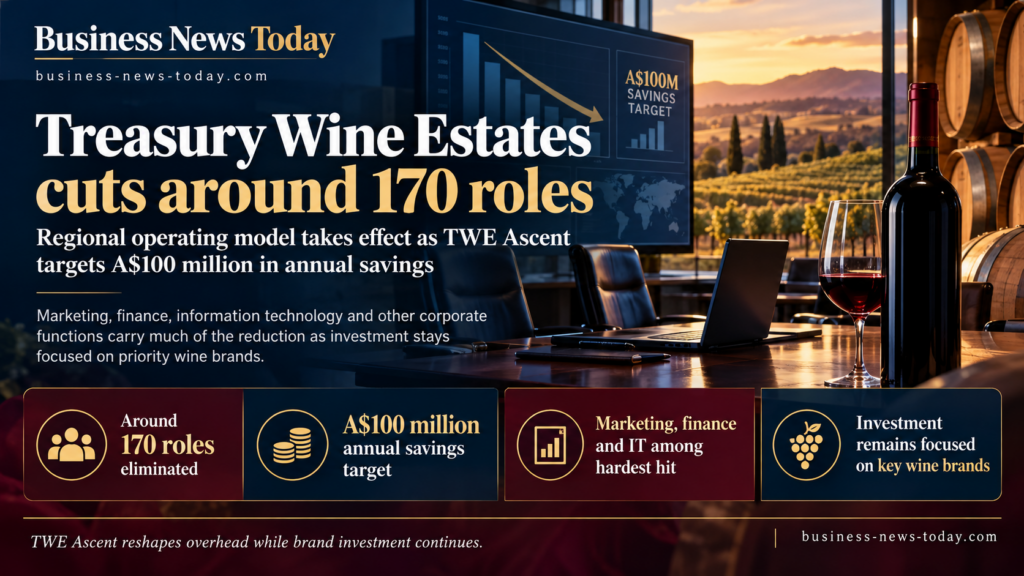
Treasury Wine Estates Limited (ASX: TWE) has made approximately 170 positions redundant as the Australian wine producer accelerates a restructuring designed to reduce duplication, simplify decision-making and generate A$100 million in annual savings by fiscal 2029. Most of the affected positions are concentrated in corporate functions including marketing, information technology, finance and support operations, with the Melbourne headquarters carrying a significant portion of the impact.
The reduction is sizeable relative to Treasury Wine Estates’ approximately 2,700 employees at the end of fiscal 2026, representing roughly 6% of that workforce base. The company is nevertheless recruiting in selected commercial roles across Australia, New Zealand, China and emerging markets, demonstrating that the programme is a redistribution of labour as well as an overall reduction.
The restructuring follows a difficult financial year in which Treasury Wine Estates reported a statutory loss of approximately A$1.08 billion after absorbing substantial impairment charges and taking aggressive steps to reset its United States supply position. Management is now attempting to create a smaller brand portfolio, more regionally accountable structure and lower corporate cost base without weakening the premium wine franchises expected to drive future growth.
Why is Treasury Wine Estates cutting jobs after changing its entire operating model?
The redundancies are the workforce consequence of a structural change that became effective on October 1. Treasury Wine Estates previously operated through three major divisions centred on Penfolds, Treasury Americas and Treasury Collective. That model has been replaced with geographic regions covering the Americas, Australia and New Zealand with Europe, Greater China and emerging markets.
The rationale is to put sales, marketing and commercial strategy closer to customers while retaining selected global functions for areas where scale still matters. Management believes the model should reduce duplicated activities that developed when major brand and geographic organisations operated more independently.
That naturally affects corporate staffing. When responsibilities move from separate divisions into shared regional or global functions, management positions, marketing teams and support structures can overlap. Eliminating those overlaps is one of the main ways Treasury Wine Estates expects to convert organisational simplification into measurable savings.
The company has said approximately 170 roles have been made redundant, predominantly across corporate functions. Reports have also indicated that some vineyard positions may have been affected, although the bulk of the reductions appear concentrated around office and support activities.
How does the workforce reduction fit the TWE Ascent savings plan?
TWE Ascent is broader than a headcount exercise. The programme combines portfolio simplification, operating-model changes and direct cost optimisation, with management targeting approximately A$100 million in annual savings by fiscal 2029. Around A$40 million of those savings are expected to be captured earlier in the programme.
Employment reductions can contribute quickly because salaries and related overheads disappear faster than many other structural costs. However, Treasury Wine Estates also wants to simplify processes, use technology more efficiently and reduce the complexity created by a large portfolio of brands and regional structures.
The group has already been reducing that portfolio through asset sales and brand transactions. Businesses and labels that no longer fit the strategy are being exited while capital and commercial attention are concentrated behind brands with stronger growth or luxury positioning.
Penfolds remains central to that logic. Its high brand recognition and exposure to wealthy consumers, particularly in Asia, make it strategically different from lower-priority labels whose economics can be harder to justify when distribution and marketing costs are included.
The emerging Treasury Wine Estates therefore appears designed around fewer brands, clearer geographic accountability and lower corporate overhead. That model could generate stronger returns if priority brands grow, but it also makes the business more dependent on successfully executing behind a narrower group of assets.
Why did Treasury Wine Estates report such a large fiscal 2026 loss?
The A$1.08 billion statutory loss was heavily influenced by major writedowns rather than simply weak day-to-day trading. Treasury Wine Estates took approximately A$1.3 billion of impairment charges associated largely with its United States assets and changing supply assumptions.
The United States has been a particularly difficult part of the portfolio. Wine demand has softened in parts of the market, inventories have required adjustment and the company has had to reconsider the economics of production and distribution. Those problems have been serious enough to alter both valuation assumptions and the organisation’s operating priorities.
The impairment itself does not create a recurring cash expense equal to the accounting charge, but it sends an important strategic signal. Management is acknowledging that assets acquired or developed under earlier assumptions are worth less than previously expected.
That helps explain why the company is now moving so aggressively on costs. A business facing lower asset values, excess inventory and uneven consumer demand has less room to tolerate duplicated functions or brands that cannot earn attractive returns.
Is Treasury Wine Estates still hiring despite the 170 redundancies?
Yes, and that is one of the most important details for understanding the restructuring. Treasury Wine Estates has indicated that it continues recruiting in commercial roles across priority markets, particularly where the company sees opportunities for brands such as Penfolds, DAOU and Matua.
That means the workforce story is not simply one of contraction. The organisation is removing positions from functions it believes can be consolidated while adding employees closer to revenue-generating markets.
China is particularly important following the removal of punitive tariffs on Australian wine. Penfolds has rebuilt distribution and carefully managed supply into the market, where high-end Australian wines historically enjoyed substantial demand.
The company therefore needs commercial talent in precisely the regions where growth opportunities are strongest. The tension is that adding sales capabilities while cutting marketing, finance and support roles requires the new structure to absorb more work with fewer central employees.
Automation and standardisation are likely to become increasingly important in making that model sustainable. If those productivity gains fail to materialise, employees remaining in corporate functions could face heavier workloads even if reported costs decline.
What does Treasury Wine Estates stock say about restructuring sentiment?
Treasury Wine Estates shares closed around A$5.62 on October 9, up modestly during the session and above the A$3.34 lower end of their 52-week trading range. The stock has recovered from some of its earlier weakness but remains well below levels seen before the scale of the United States problems became apparent.
The relatively muted reaction to the 170 redundancies suggests investors had already expected meaningful cost action following the company’s previously announced Ascent programme. Workforce reductions therefore confirm the implementation of an existing strategy rather than representing a completely unexpected shift.
The more important valuation question is whether A$100 million in annual savings eventually translates into stronger cash generation rather than being absorbed by weaker volumes or continued pricing pressure. Cost programmes create the most value when they accompany a stabilising business rather than merely offsetting continuing deterioration.
Investors will consequently watch depletion trends, margins, United States inventory levels, China demand and the performance of Penfolds and DAOU more closely than the absolute number of employees removed.
Treasury Wine Estates has now moved from announcing simplification to implementing it directly across the workforce. The next phase will determine whether fewer jobs, fewer brands and clearer geographic accountability can actually produce the consistent growth and profitability management is targeting.
Discover more from Business-News-Today.com
Subscribe to get the latest posts sent to your email.


