




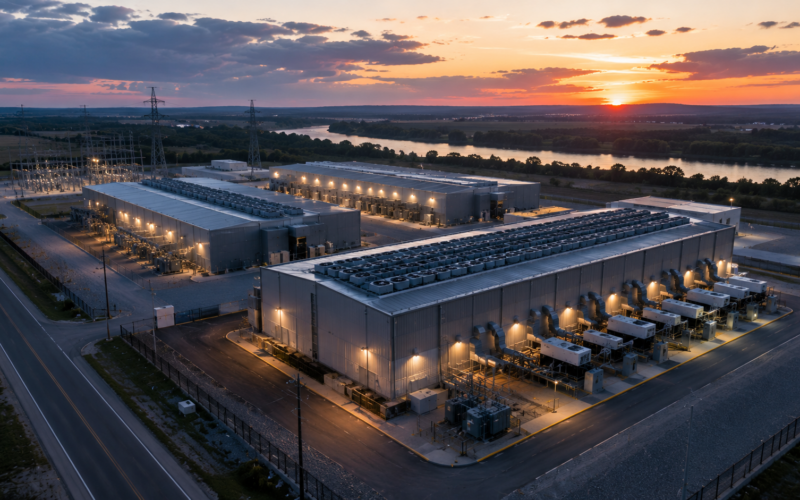
TeraWulf Inc. (NASDAQ: WULF) has moved from cryptocurrency-linked volatility into one of the most closely watched corners of the artificial intelligence infrastructure market after signing a 20-year lease with Anthropic for its Justified Data campus in Hawesville, Kentucky. The agreement is expected to generate approximately $19 billion of contracted lease revenue and support about 401 megawatts of critical information technology load, with initial capacity targeted for the second half of 2027 and full ramp expected by early 2028. TeraWulf has also agreed to sell its 50.1% stake in the 168-megawatt Abernathy joint venture to a Fluidstack-led investor group, recycling capital from a jointly controlled Texas project into wholly owned AI infrastructure. TeraWulf shares closed at $21.97 on July 10, leaving the stock up roughly 3.7% across the five trading sessions since July 2 but down about 5.3% from the June 10 close, a sign that investors remain excited by the Anthropic lease while still questioning execution, financing and valuation. The feature-level question is no longer whether AI demand exists, but whether TeraWulf can convert power access, customer commitments and ambitious construction schedules into long-term returns per share.
Why has TeraWulf’s Anthropic lease become a bigger AI infrastructure story by July 11?
The significance of the TeraWulf and Anthropic agreement has grown since the initial July 6 announcement because the market has had time to move beyond the headline number. A $19 billion lease sounds enormous, and it is, but that revenue is expected over a 20-year initial term and must be earned through delivery of operational data centre capacity. The agreement therefore does not turn TeraWulf into a cash-flow giant overnight. It gives TeraWulf a contracted path towards becoming one if the company can finance and build the infrastructure on time.
That distinction matters because TeraWulf’s public identity has changed faster than its financial statements. The company’s roots are in Bitcoin mining, where earnings were exposed to cryptocurrency prices, mining difficulty, power costs and block-reward cycles. The Anthropic lease shifts the centre of gravity towards high-performance computing infrastructure, a market where long-term tenant commitments and power-secured campuses now command investor attention.
The deal also reflects a wider industry pattern. AI developers and model companies are racing to secure reliable compute capacity before power, land, transformers and cooling systems become even tighter constraints. In that environment, a company with ready power and a plausible construction plan can attract customers that might once have preferred traditional hyperscale data centre operators.
TeraWulf’s advantage is not a mysterious AI algorithm or a proprietary model. Its advantage is control of large power-connected sites. That is less glamorous than model benchmarks, but in the current AI cycle, electricity has become the new scarce input. The least flashy asset on the spreadsheet may now be the one deciding who actually gets to build.

How does the Justified Data campus change TeraWulf’s transition from Bitcoin mining to AI infrastructure?
The Justified Data campus in Hawesville gives TeraWulf a platform that is fundamentally different from its legacy mining footprint. Bitcoin mining facilities are designed around power availability and computing density, but AI data centres require higher standards for uptime, cooling, networking, security, customer service and long-term operational reliability. Converting from one model to the other is therefore not simply a matter of swapping mining rigs for graphics processing units.
The campus is expected to support approximately 401 megawatts of critical IT load for Anthropic. That is a scale normally associated with major hyperscale infrastructure planning rather than speculative small-cap technology projects. It positions TeraWulf among a relatively small group of power-rich operators that can discuss hundreds of megawatts with serious AI customers.
The economics are also different. Bitcoin mining monetises computing power through exposure to a digital asset whose price can move sharply. A long-term lease monetises infrastructure through contracted payments from a customer. That can improve revenue visibility, but it introduces construction obligations, service-level commitments and counterparty requirements that mining operations did not carry in the same way.
The transformation is already visible in TeraWulf’s first-quarter numbers. The company reported high-performance computing lease revenue of $21 million in the March quarter after beginning HPC leasing operations in 2025, while bitcoin output fell as mining activity was curtailed and infrastructure was repurposed. The business is still mid-transition, with legacy mining exposure, new HPC leases, construction spend and financing obligations all visible at the same time.
That makes the Anthropic lease a strategic validation, not a completed transformation. The contract confirms demand for TeraWulf’s infrastructure. The next two years will determine whether the company can deliver AI-grade capacity at the cost, schedule and reliability required to make the pivot financially durable.
Why does the $19 billion lease headline still leave TeraWulf with a major financing question?
The headline lease value provides revenue visibility, but it does not answer the capital question. TeraWulf must fund data halls, electrical infrastructure, cooling systems, networking, site preparation, backup systems and fit-out requirements before it can earn the full benefit of the Anthropic contract. AI campuses require capital before cash flow, and the gap between signing and service commencement is where financing risk lives.
A rough average of the $19 billion over 20 years implies approximately $950 million of annual contracted lease revenue once the project is fully operating, although actual revenue timing will depend on the ramp schedule and lease structure. On a simple per-megawatt basis, that equates to about $2.37 million of annual revenue for each critical IT megawatt. That calculation helps size the opportunity, but it does not reveal the margin because power costs, pass-through arrangements, operating expenses, financing costs and depreciation remain essential.
TeraWulf’s latest quarterly filing shows why the balance-sheet discussion is central. The company had substantial cash at the end of March, but it also carried major debt, reported a large net loss and recorded sharply higher interest expense compared with the prior year. The company has been raising and deploying capital aggressively to build its AI infrastructure platform, and the Anthropic lease adds a much larger project to that funding agenda.
Investment-grade credit support attached to the Anthropic lease should make project financing more attractive. Lenders generally prefer long-duration contracted cash flows backed by strong credit support. However, investors still need to know the details, including who provides the support, how long it lasts, which obligations it covers and how much construction equity TeraWulf must contribute before debt financing becomes available.
The key financial risk is not that demand disappears tomorrow. It is that construction, debt costs and equity dilution absorb too much of the value created by the contract. A major AI tenant solves one problem. It does not pour concrete, install switchgear or refinance convertible obligations on its own.
What does the Abernathy sale to Fluidstack reveal about TeraWulf’s capital discipline?
The decision to sell TeraWulf’s entire 50.1% interest in the Abernathy joint venture is an important companion to the Anthropic lease. Abernathy was a 168-megawatt AI data centre joint venture in Texas with Fluidstack, and TeraWulf had invested approximately $450 million into the project. By selling the majority stake to a Fluidstack-led investor group at a premium to invested capital, TeraWulf is signalling that it wants to recycle capital towards sites where it has direct ownership, customer relationships and operating control.
That matters because the AI infrastructure land grab could easily tempt companies into collecting projects faster than they can finance them. Joint ventures can reduce capital burden but divide economics and complicate decision-making. Wholly owned campuses can offer stronger returns, but they also concentrate risk on the operator’s balance sheet.
The Abernathy sale suggests that TeraWulf is not simply hoarding megawatts for the sake of announcing a bigger pipeline. It is choosing which projects to own directly and which to monetise. That is a useful signal of capital discipline, provided the proceeds are clearly disclosed and redeployed into higher-return opportunities.
The company has not yet provided enough detail for investors to calculate the exact return on the Abernathy investment. Disclosure of sale proceeds, closing timetable and use of funds will be important because the transaction could become a meaningful source of funding for the Justified Data buildout or other wholly owned developments.
The strategic logic is coherent. TeraWulf is trying to move from being a project participant to being a long-term infrastructure owner. The risk is that direct ownership gives shareholders more upside only if the company can also manage the larger financing and delivery burden.
Can Kentucky’s power footprint make Hawesville an AI infrastructure hub without creating local strain?
The Hawesville site is strategically attractive because it offers large-scale power access at a time when power is the primary bottleneck for AI infrastructure. Many proposed data centre projects are slowed not by lack of customer interest, but by multi-year grid queues, transformer shortages, transmission delays and local resistance. A site with immediate or near-term power availability has become a rare asset.
The Justified Data campus is located at a former industrial site, which is important because heavy industrial locations often already have grid connections, substations, land and transmission infrastructure. Redeveloping such sites can be faster than building from scratch in a crowded data centre market. It also gives communities a route to convert legacy industrial infrastructure into participation in the AI economy.
For Kentucky, the project could bring construction work, skilled technical jobs, tax revenue and wider recognition as an AI infrastructure location. However, the economic effect should not be exaggerated. Large data centres are capital-intensive but do not usually employ as many people as traditional manufacturing plants of comparable footprint. The real local value depends on construction spend, supplier participation, tax arrangements, workforce training and power-system investments.
The strain question is equally important. A 401-megawatt campus is an enormous electricity user. Local and state authorities will need to consider how electricity costs, grid upgrades, water demand and emergency services are allocated. A data centre can be a valuable anchor customer for utilities, but only if the cost of serving it does not quietly migrate to households or smaller businesses.
This is where AI infrastructure becomes a policy story as much as a corporate story. The United States wants domestic AI capacity, but the industry’s growth increasingly depends on whether communities accept large power users. TeraWulf’s success in Hawesville will therefore depend not only on Anthropic and financing, but also on maintaining local trust.
How should investors read TeraWulf stock after the rally faded by July 10?
TeraWulf shares closed at $21.97 on July 10, below the immediate post-announcement intraday enthusiasm but still above the July 2 close of $21.18. The stock gained about 3.7% across the five trading sessions from July 2 to July 10, yet it remained approximately 5.3% below the June 10 close of $23.19. That mix captures the investor mood neatly: the Anthropic lease is a major validation, but not enough to erase concerns about valuation and execution.
The stock remains highly volatile. It traded as low as $4.52 over the past 52 weeks and reached a high of $29.84 on June 22, meaning the July 10 close was still nearly five times the annual low but roughly 26% below the annual high. That is not the price action of a settled infrastructure utility. It is the price action of a company being revalued from one business model into another.
The market capitalisation near $9.3 billion also frames the debate. TeraWulf’s equity value is far below the $19 billion headline lease revenue, but that comparison can mislead if used too casually. The lease revenue is spread over two decades and requires significant capital spending before it becomes operating income.
Investors are effectively pricing a probability-weighted version of the future. The bullish case assumes TeraWulf becomes a repeatable AI infrastructure developer with long-duration tenants and power-secured campuses. The cautious case assumes that construction cost inflation, financing needs, customer concentration and dilution reduce the value retained by shareholders.
The July 10 close suggests the market is not ignoring the deal, but it is refusing to treat the contract as finished value. That is a rational stance. In AI infrastructure, signed demand is the beginning of the test, not the graduation ceremony.
What could go wrong before Anthropic’s 401 MW campus reaches full operation in 2028?
The first major risk is construction execution. TeraWulf must bring initial capacity online in the second half of 2027 and ramp the full 401 megawatts by early 2028. That timeline is ambitious in an industry dealing with shortages of transformers, switchgear, cooling equipment, electrical labour and experienced data centre contractors.
The second risk is cost inflation. Data centre construction costs have risen because AI workloads require denser power delivery, stronger cooling, more complex electrical design and higher reliability standards. If TeraWulf’s construction budget expands faster than lease economics, shareholder returns could compress even while contracted revenue remains impressive.
The third risk is customer concentration. Anthropic will become one of the defining customers in TeraWulf’s AI infrastructure strategy. That creates strong visibility, but also exposes the company to one tenant’s deployment schedule, technical requirements and long-term strategic direction. The investment-grade credit support helps, but the exact structure remains critical.
The fourth risk is technology evolution. AI hardware requirements are changing quickly. Future systems may require different rack densities, liquid cooling specifications, networking layouts or power profiles. A 20-year lease must be flexible enough to accommodate upgrades without creating unplanned landlord costs.
The fifth risk is capital allocation. TeraWulf is pursuing a multi-site AI infrastructure strategy while still carrying legacy financial complexity from its transformation. Management must avoid chasing every attractive opportunity before the existing projects are funded and delivered.
The sixth risk is market sentiment. AI infrastructure companies have benefited from enormous investor enthusiasm, but sentiment can reverse quickly if customers slow capital expenditure, if data centre power politics intensify or if financing markets tighten. TeraWulf is no longer valued like a small miner. It is being tested like an infrastructure growth company.
The company’s opportunity is real because demand is real. The risk is also real because infrastructure is unforgiving. Servers can be upgraded; a poorly sequenced campus buildout is harder to patch.
What does TeraWulf’s pivot signal for Bitcoin miners and AI infrastructure peers?
TeraWulf’s pivot reflects a broader reclassification of power-rich cryptocurrency miners. During the mining boom, access to low-cost electricity was valuable because it supported Bitcoin production. In the AI era, the same power access can be more valuable if converted into contracted data centre capacity for model developers, cloud providers and high-performance computing customers.
This has implications for peers such as IREN Limited, Hut 8 Corp., Applied Digital Corporation and other operators with large energy footprints. Investors are increasingly asking which companies have genuine data centre sites and which merely have mining facilities with AI vocabulary attached. The distinction matters because AI customers require reliability, compliance, cooling, networking and construction expertise that many mining operations did not originally need.
TeraWulf’s Anthropic lease raises the bar for the group. It provides evidence that AI companies will lease from former mining operators if the power, site and execution plan are credible. It also makes weaker announcements less persuasive. After a $19 billion lease with a named AI customer, the market will be less impressed by vague pipeline slides.
The competitive landscape is shifting from hashrate to megawatts, and then from megawatts to financeable megawatts. The best-positioned companies will not be those with the biggest theoretical power pipeline, but those with signed customers, grid certainty, project financing and the ability to deliver capacity on schedule.
TeraWulf has moved into that conversation more forcefully than most. Whether it leads the group will depend on converting the Justified Data lease into an operating campus before competitors secure their own anchor tenants.
What are the key takeaways from TeraWulf’s $19 billion Anthropic lease and AI infrastructure pivot?
- TeraWulf’s 20-year Anthropic lease gives the company approximately $19 billion of contracted revenue visibility, but the value will be earned over two decades rather than immediately.
- The Justified Data campus in Kentucky is expected to support about 401 megawatts of critical IT load, with initial service targeted for late 2027 and full ramp expected by early 2028.
- The agreement validates TeraWulf’s transition from Bitcoin mining into AI infrastructure, although the company remains in the middle of that financial and operational transformation.
- Investment-grade credit support should improve financing options, but investors still need clarity on the provider, scope and duration of that support.
- The Abernathy sale to a Fluidstack-led investor group signals a move away from joint-venture economics towards directly owned AI infrastructure opportunities.
- TeraWulf’s July 10 close of $21.97 shows that the stock retained part of the post-deal validation but remained well below its June 52-week high.
- The company’s market value cannot be compared directly with the $19 billion lease headline because revenue will require substantial construction and operating expenditure.
- Kentucky’s power-connected industrial footprint gives TeraWulf a strategic advantage, but electricity use, grid costs and local economic benefits will remain public-policy issues.
- Construction timing, cost inflation, customer concentration and potential shareholder dilution remain the main risks before the project reaches full operation.
- TeraWulf’s deal raises the standard for former Bitcoin miners trying to reposition as AI infrastructure companies because signed customers now matter more than speculative megawatt pipelines.
Discover more from Business-News-Today.com
Subscribe to get the latest posts sent to your email.