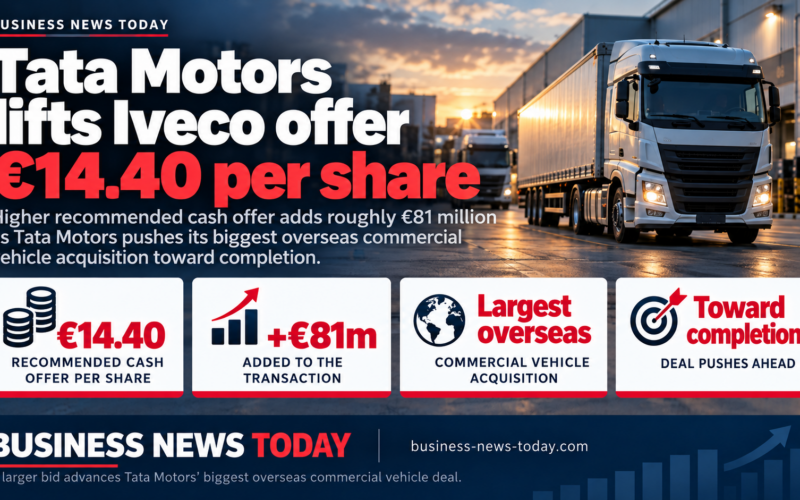
Tata Motors Limited (NSE: TMCV) has increased its recommended cash takeover offer for Iveco Group N.V. (EXM: IVG) from €14.10 to €14.40 per share, lifting the potential equity consideration for the Italian commercial vehicle manufacturer to approximately €3.91 billion. The revised price, announced on October 9, 2026, represents Tata Motors’ best and final offer and comes as the transaction approaches a critical October 16 shareholder meeting and the October 26 end of the current tender period. Iveco Group’s board has welcomed the higher consideration and continues to recommend the transaction, while approximately 28.4% of the shares targeted by the offer had already been tendered by October 9. The additional €0.30 per share is financially modest relative to the size of the acquisition, but strategically important because it reduces the incentive for remaining Iveco shareholders to wait for another price increase while Tata Motors attempts to complete a combination that would create a commercial vehicle group generating roughly €21 billion of annual revenue.
The offer applies to Iveco Group after the separation of its defence business, which is outside the Tata Motors transaction perimeter. The acquisition combines Tata Motors’ strength in India and other emerging markets with Iveco Group’s substantial positions in Europe and South America, while adding buses, powertrain activities and financial services to the enlarged commercial vehicle platform. The companies estimate that the combined business would sell more than 590,000 vehicles annually, with revenue distributed across Europe, India, South America and other international markets.
Why did Tata Motors raise the Iveco Group takeover price when its original €14.10 offer already had board support?
The revised price appears designed primarily to improve execution certainty rather than change the strategic economics of the acquisition. Tata Motors has maintained that the original €14.10-per-share consideration represented a full valuation of Iveco Group, but the authorisation and transaction process has taken longer than initially expected in some jurisdictions. Raising the offer by €0.30 gives shareholders additional compensation for the extended timetable while signalling that Tata Motors remains committed to closing the transaction.
The increase lifts the maximum consideration by roughly €81 million, based on Iveco Group’s approximately 271 million common shares. In percentage terms, Tata Motors is adding just over 2% to the previous offer price, a comparatively limited concession for a transaction intended to reshape the geographic and industrial profile of its commercial vehicle business.
Calling €14.40 the best and final price is equally important. It removes some of the optionality that might otherwise encourage shareholders to delay tendering in anticipation of another increase. Tata Motors is effectively telling the market that the negotiation over price has reached its endpoint and that the remaining decision should focus on whether the revised cash consideration is preferable to retaining exposure to Iveco Group as an independent listed manufacturer.
That approach becomes particularly relevant because the offer period ends on October 26. With the shareholder meeting scheduled for October 16, the next two weeks could determine whether the acquisition proceeds smoothly toward settlement or requires additional transaction mechanics to reach the ownership thresholds necessary to take Iveco Group private.
Does the €14.40 Tata Motors offer now provide enough incentive for Iveco shareholders to tender?
The new offer represents a 6.77% premium to Iveco Group’s July 29, 2025 closing price, the final unaffected trading day before the original transaction was announced. That premium may appear modest compared with many public-company takeovers, but Iveco shareholders have already received significant value through the separation and sale of the defence business.
The defence transaction resulted in an extraordinary interim dividend of approximately €1.55 billion paid to shareholders in April 2026. Tata Motors is therefore acquiring the remaining commercial vehicle, bus, powertrain and financial services businesses rather than paying for the former Iveco Group in its entirety.
That distinction is essential when assessing the takeover price. Looking only at the €14.40 cash offer without considering the defence separation understates the total value shareholders have extracted from the restructuring surrounding the transaction. Conversely, shareholders must still decide whether the remaining Iveco businesses possess enough independent upside to justify rejecting cash that is now essentially reflected in the public market price.
Iveco shares closed at €14.40 on October 9, exactly matching the revised tender price after touching €14.53 during the session, which was also the upper end of their latest 52-week trading range. The stock has risen about 1.6% from its October 5 close and roughly 2.5% from its September 10 level, but the convergence with the offer price indicates that the market is now valuing Iveco largely as a merger-arbitrage security rather than on standalone operating expectations.
Why does acquiring Iveco Group fundamentally change Tata Motors’ global commercial vehicle position?
The most compelling industrial rationale is geographic complementarity. Tata Motors has a powerful domestic position in India and exposure to emerging markets, while Iveco Group derives a substantial portion of its business from Europe and maintains established operations across South America. The companies have relatively limited direct overlap in their most important markets, reducing the immediate need for large-scale plant closures or brand rationalisation.
On a combined basis, Europe would account for approximately 46% of revenue, India around 32%, South America about 8% and other markets approximately 14%. This creates a significantly more balanced geographic mix than Tata Motors’ commercial vehicle operation has today and reduces dependence on the Indian truck cycle.
Scale is equally important because commercial vehicle manufacturers face escalating development costs. Electrification, emissions regulation, connected vehicle technology, autonomous systems, safety requirements and alternative fuels all demand research and capital expenditure that can be difficult to absorb across smaller production volumes. Selling more than 590,000 vehicles annually could allow engineering and technology investment to be spread across a substantially larger revenue base.
Tata Motors would also gain access to Iveco Group’s FPT Industrial powertrain business. Engines, transmissions and propulsion technology represent strategically important intellectual property as commercial vehicles transition across diesel, natural gas, electric and potentially hydrogen architectures. A successful integration could therefore create value beyond simply combining two truck sales organisations.
How strong is Iveco Group’s underlying business before Tata Motors takes control?
Iveco Group entered the takeover process with a mixed financial profile. Continuing operations excluding defence generated €13.4 billion of consolidated net revenue during 2025, down 7% from the previous year, while adjusted EBIT fell to €645 million from €892 million. Adjusted net income declined to €312 million and industrial free cash flow turned negative at €109 million.
Performance improved at the revenue level during the second quarter of 2026. Consolidated revenue rose 7.3% year on year to €3.76 billion, supported by stronger European volumes, while Industrial Activities revenue increased 7.9% to approximately €3.70 billion. Profitability remained under pressure, however, with Industrial Activities adjusted EBIT falling to €104 million from €143 million as the company invested in product quality and dealt with operational costs.
That earnings profile helps explain why strategic ownership could be attractive. Iveco Group possesses meaningful industrial assets, brands, technology and market positions, but profitability has been volatile. A larger owner capable of spreading development and procurement costs across greater volumes could potentially extract benefits that are harder to realise within the existing standalone structure.
The risk is that scale alone does not create those benefits. Tata Motors will need to integrate procurement, engineering, technology platforms and capital allocation without undermining Iveco Group’s established brands or European customer relationships. A geographically complementary acquisition can reduce antitrust complexity, but it can also limit obvious plant-level cost synergies because the operations are not heavily overlapping.
What does Tata Motors’ latest financial position say about its ability to absorb a €3.91 billion acquisition?
Tata Motors Limited’s commercial vehicle operation entered the transaction from a comparatively strong financial position. For the quarter ended June 30, 2026, standalone revenue increased 23% to ₹19,300 crore, while EBITDA rose 17% to ₹2,300 crore. Profit before exceptional items increased 26% to ₹2,100 crore and profit after tax reached ₹1,500 crore.
Free cash flow for the quarter was approximately ₹1,100 crore, and the domestic business held net cash of about ₹7,100 crore at June 30 after paying a ₹1,473 crore dividend. On a consolidated basis, Tata Motors Limited reported net cash of approximately ₹13,500 crore, giving the company a stronger starting balance sheet than would normally be associated with a leveraged cross-border industrial acquisition of this size.
The original transaction financing included a committed bridge facility from Morgan Stanley and MUFG, with Tata Motors expecting to term out the financing using a combination of equity and long-term debt after completion. Increasing the offer price by roughly €81 million does not materially change that financing equation, although the acquisition will still represent a major call on capital.
What matters more is post-closing cash generation. The enlarged company will need to fund product development, electrification and manufacturing investment across multiple regions while also managing acquisition debt. The strategic case therefore depends partly on converting greater scale into stronger operating cash flow rather than allowing the larger organisation simply to carry a larger fixed-cost base.
Why has Tata Motors stock weakened even as the Iveco acquisition moves closer to completion?
Tata Motors Limited closed at ₹410.30 on October 9, down 0.7% for the session and approximately 3.9% from its October 5 close of ₹426.80. The stock has declined about 7.8% over one month and remains roughly 19% below its 52-week high of ₹509, although it is still comfortably above the 52-week low of ₹306.30.
The recent weakness does not mean investors are necessarily rejecting the Iveco strategy. Tata Motors is simultaneously navigating commodity-cost pressures, normal volatility in commercial vehicle demand and the capital requirements associated with a large international integration. The company also raised commercial vehicle prices in India from October to offset input-cost inflation, reinforcing that near-term margin protection remains an operating priority.
The market appears to be assigning limited immediate value to the acquisition until the financing and integration path becomes clearer. That is understandable because the transaction promises benefits primarily over several years through geographic diversification, procurement, technology and operating leverage, while the debt and execution costs begin much sooner.
A successful closing could shift attention from transaction probability to synergy delivery. At that point, quarterly performance at Iveco Group, debt reduction and evidence of shared engineering or procurement benefits are likely to become more important to the Tata Motors valuation than incremental developments in the tender process.
What competitive pressure could the Tata Motors and Iveco combination create for global truck manufacturers?
A combined Tata Motors and Iveco Group would create another large multinational commercial vehicle manufacturer competing with companies such as Daimler Truck Holding AG, Volvo Group and Traton SE. The competitive significance is not simply the number of vehicles sold, but the enlarged company’s ability to operate across both mature and emerging markets.
European truck manufacturers are under pressure to fund battery-electric trucks, charging ecosystems, hydrogen programmes and increasingly sophisticated software while maintaining conventional powertrain portfolios. Tata Motors can add lower-cost engineering and sourcing capabilities from India, while Iveco Group contributes European technology, distribution and powertrain expertise.
Emerging markets create a second opportunity. Tata Motors already has extensive experience producing commercial vehicles designed for cost-sensitive customers, while Iveco Group provides additional products and dealer networks that could support expansion across Africa, Asia and Latin America.
The challenge will be resisting the temptation to force excessive product harmonisation. Commercial vehicle requirements differ substantially between India, Europe and South America because of regulation, road infrastructure, payload requirements and customer economics. The strongest integration model may therefore involve shared technology and procurement beneath regionally distinct products rather than an aggressive attempt to create identical global platforms.
Why is the October 16 Iveco shareholder meeting now the critical milestone for the transaction?
The October 16 extraordinary general meeting will consider resolutions required for the post-offer structure. The tender originally requires acceptance of at least 95% of Iveco Group common shares, but that threshold falls automatically to 80% if shareholders approve the relevant back-end resolution.
That difference could be decisive. Achieving 95% acceptance in a public tender can be difficult even when a board recommends the offer because passive funds, arbitrage investors and smaller shareholders may not all tender promptly. Reducing the practical threshold to 80% provides Tata Motors with substantially greater execution flexibility.
If Tata Motors reaches 95% ownership, it can pursue a Dutch legal squeeze-out to acquire the remaining shares. If ownership ends between 80% and 95% and the required resolutions are approved, the company intends to use a post-offer demerger and liquidation structure to complete the acquisition.
Exor N.V. materially reduces uncertainty because Iveco Group’s largest shareholder has irrevocably committed its approximately 27.06% equity interest to the offer. That stake represents an even larger proportion of voting rights, giving the recommended transaction substantial support before considering other tendered shares.
With around 28.4% of targeted shares already tendered by October 9, attention will increasingly focus on whether acceptance accelerates following the price increase and shareholder meeting. Tender offers often see large volumes submitted close to the deadline, so current acceptance should not be treated as a final indication of whether Tata Motors will achieve the necessary threshold.
What happens if Tata Motors successfully completes the Iveco acquisition after October 26?
The first priority will be protecting business continuity. Tata Motors has committed to preserving Iveco Group’s industrial footprint and employee communities, an important consideration given the political sensitivity surrounding large European manufacturing assets. Avoiding disruptive restructuring can help regulatory and employee relations, but it also means early value creation is likely to depend more heavily on procurement, technology and capital allocation.
The second priority will be financing. Tata Motors will need to move from bridge financing toward a longer-duration mix of equity and debt while demonstrating that cash generation across India and Iveco Group can support the enlarged balance sheet.
The third challenge will be technology investment. Commercial vehicle manufacturers are simultaneously funding internal-combustion efficiency, electric platforms, connected fleets, alternative fuels and autonomous technology. The acquisition makes strategic sense only if the enlarged scale allows Tata Motors and Iveco Group to pursue those investments more efficiently than they could separately.
The €0.30 increase therefore should not dominate the long-term assessment of the transaction. It adds around €81 million to a deal approaching €3.91 billion, a manageable concession if it materially increases closing certainty. The much larger question is whether Tata Motors can turn a geographically complementary acquisition into a genuinely integrated global commercial vehicle platform without allowing complexity, debt and regional differences to consume the benefits of scale.
What are the key takeaways from Tata Motors’ €14.40 Iveco Group takeover offer?
- Tata Motors has raised its Iveco Group offer from €14.10 to €14.40 per share, taking the potential equity consideration to approximately €3.91 billion.
- The €14.40 price is Tata Motors’ best and final offer, reducing expectations that shareholders can secure another increase by delaying acceptance.
- Iveco Group’s board continues to support the transaction, while Exor has irrevocably committed its approximately 27.06% equity holding.
- Around 28.4% of the shares targeted by the tender had been submitted by October 9, with the offer period currently scheduled to end on October 26.
- Iveco Group shares closed exactly at the €14.40 offer price, indicating that the market is now pricing the stock largely around successful deal completion.
- Tata Motors shares remain under pressure, closing at ₹410.30 on October 9 and falling about 7.8% over the previous month as investors balance domestic operating momentum against acquisition and financing risks.
- The combined commercial vehicle business would generate roughly €21 billion in revenue and sell more than 590,000 vehicles annually, materially increasing Tata Motors’ international scale.
- Geographic complementarity is the central strategic advantage, with Iveco strengthening Tata Motors in Europe and South America while Tata Motors contributes greater exposure to India and other emerging markets.
- Integration risk remains substantial despite limited geographic overlap, particularly across technology investment, procurement, financing and the management of different regional product requirements.
- The October 16 shareholder meeting is the next decisive milestone, because approval of the back-end resolutions can reduce the effective minimum acceptance threshold from 95% to 80%.
Discover more from Business-News-Today.com
Subscribe to get the latest posts sent to your email.