
Targa Resources Corp. (NYSE: TRGP) has secured 20 years of additional volume visibility from Exxon Mobil Corporation across the Permian Basin, pairing new fee-based gathering, processing and downstream agreements with a fresh wave of infrastructure spending. The agreements run through 2046 and cover new acreage dedications in both the Delaware and Midland basins, along with long-term natural gas liquids transportation and fractionation commitments. Targa is responding by adding three new Delaware Basin processing plants with combined capacity of about 825 million cubic feet per day and by increasing its 2026 net growth-capital estimate to about $5 billion. The immediate attraction is unusually long commercial visibility from one of the Permian Basin’s largest producers, but the central question is whether that certainty is valuable enough to justify billions of dollars of capital being deployed before all of the future volumes arrive.
The market’s first response was emphatically positive. Targa Resources shares closed August 18 at $297.77, up 7.16% for the session after reaching an intraday high above $303, while Exxon Mobil Corporation also gained more than 2%. Targa’s rally pushed the stock beyond its previous 52-week high, turning a commercial agreement into one of the company’s most significant market catalysts of the year.
The reaction is understandable because this is not simply a three-plant announcement. ExxonMobil is extending Targa’s commercial visibility across almost the entire integrated chain from Permian wellhead gas through processing, natural gas liquids transportation and fractionation. That gives Targa more confidence that infrastructure built today can remain economically relevant across multiple drilling cycles rather than relying only on shorter-duration volume growth.
How much infrastructure is Targa Resources committing to the ExxonMobil Permian expansion through 2046?
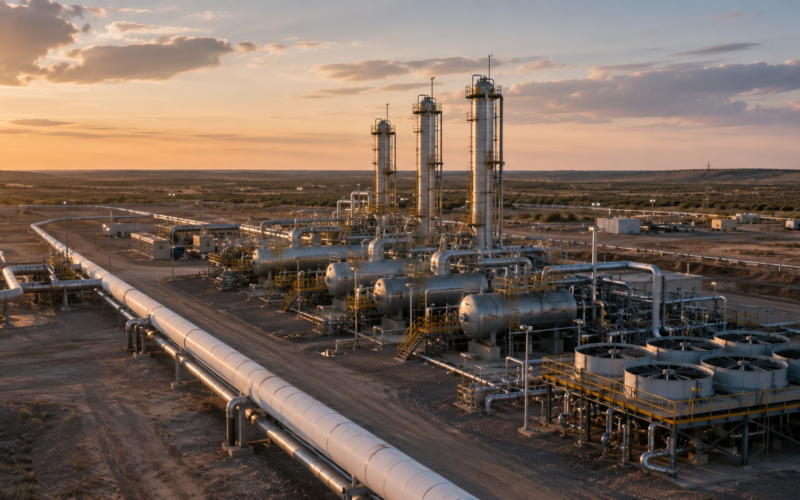
The most visible part of the expansion is the addition of the Wrangler, Ranger and Ranger II natural gas processing plants in the Permian Delaware. Each plant will have capacity of about 275 million cubic feet per day, taking the combined announced addition to roughly 825 million cubic feet per day.
Targa expects the three plants to begin operating during the first half of 2028. The timing means the company is committing capital well ahead of the full development of future ExxonMobil volumes, which makes the durability of the agreements particularly important.
Targa is also evaluating as many as five additional processing plants in the Permian Delaware. If all five were eventually built at the same 275 million-cubic-feet-per-day scale, they would represent another approximately 1.375 billion cubic feet per day of potential processing capacity.
That future layer is not yet a firm construction commitment, so it should not be treated as inevitable capacity. However, its inclusion in Targa’s planning signals that management sees the ExxonMobil agreements as the foundation for a much longer infrastructure buildout rather than a one-off expansion.
The scale becomes clearer when compared with Targa’s existing Permian system. At the end of 2025, Targa reported about 4.119 billion cubic feet per day of processing capacity in Permian Midland and 3.835 billion cubic feet per day in Permian Delaware, giving a combined base of roughly 7.954 billion cubic feet per day.
The newly announced 825 million cubic feet per day therefore represents an increase of about 10.4% relative to that year-end 2025 Permian processing base. If all five additional 275 million-cubic-feet-per-day plants were eventually approved and built, the total incremental capacity represented by the three announced plants plus the five possible plants would reach approximately 2.2 billion cubic feet per day.
That would equal more than one-quarter of Targa’s year-end 2025 Permian processing capacity. The comparison shows why the ExxonMobil agreements matter beyond their 20-year duration. They could influence the physical scale of Targa’s Permian system for years.

Why does Bull Run II matter as much as the three new Targa Resources processing plants?
Processing capacity creates little value if residue gas cannot leave the basin efficiently. Targa is therefore planning Bull Run II, an approximately 70-mile natural gas pipeline that will connect production from the new Delaware Basin plants with the Waha Hub.
The pipeline is expected to begin operating during the first half of 2028, broadly aligning its timetable with Wrangler, Ranger and Ranger II. Targa said Bull Run II will be supported by take-or-pay commitments, giving the project a degree of contractual revenue protection.
The need for takeaway capacity is not theoretical. Targa said Permian inlet volumes increased by more than 450 million cubic feet per day sequentially during the second quarter even as some producers temporarily curtailed output in response to negative Waha natural gas prices.
That combination is important. Strong processing growth can coexist with poor local gas pricing when pipeline capacity becomes constrained. Targa is therefore not just building plants to process more associated gas. It is simultaneously trying to ensure that the residue gas leaving those plants has a reliable path toward downstream markets.
The company already has several residue-gas connectivity projects under development across the Permian Basin, including Bull Run, Buffalo Run and Forza. Bull Run II extends that infrastructure strategy and suggests Targa increasingly views gas takeaway as an integral part of winning gathering and processing business.
For ExxonMobil, the commercial logic is also straightforward. The producer has been expanding Permian output rapidly and reported record production of more than 1.8 million oil-equivalent barrels per day in the basin during the second quarter of 2026. ExxonMobil has also outlined plans for Permian production to continue growing through 2030.
More production means more associated natural gas and natural gas liquids that must be gathered, treated, processed and transported. Targa is positioning itself to capture a larger share of that infrastructure chain.
What does Targa Resources’ jump to $5 billion of 2026 growth capital say about capital discipline?
The ExxonMobil agreements arrive only days after Targa Resources reported record second-quarter financial performance and reiterated a 2026 net growth-capital estimate of about $4.5 billion. The August 17 announcement increased that figure to approximately $5 billion.
That is an increase of roughly $500 million, or about 11.1%, in less than two weeks.
The revised estimate incorporates expected spending on the three new Delaware Basin processing plants, associated field infrastructure and Bull Run II. The increase demonstrates how quickly commercial success in the Permian can translate into additional capital requirements for a midstream operator.
Targa has the financial scale to undertake the programme. Second-quarter adjusted EBITDA reached a record $1.603 billion, up 38% from the prior-year period, while net income attributable to Targa Resources increased to $765 million from $629 million.
The balance sheet is substantial, however. Targa reported approximately $19.6 billion of consolidated debt at June 30, alongside about $3.2 billion of liquidity. That makes returns on incremental infrastructure spending a central issue even when the underlying contracts are long-term.
The attraction of the ExxonMobil agreements is that the commercial terms should reduce some volume uncertainty. Fee-based structures, acreage dedications and take-or-pay support can improve visibility compared with infrastructure built primarily on speculative basin growth.
They do not eliminate execution risk. Construction costs, project timing, field infrastructure requirements and the pace at which production fills new capacity will still influence returns. The economic question is therefore not whether Targa can spend $5 billion. It is whether the company can convert that spending into long-duration cash flow at returns that justify the capital intensity.
Why does ExxonMobil’s Permian production strategy make the 20-year Targa agreement unusually significant?
ExxonMobil’s Permian position has become a much larger part of its upstream strategy following its acquisition of Pioneer Natural Resources and continued development of the combined acreage base.
ExxonMobil has said it expects Permian production to grow at roughly a 9% compound annual rate through 2030, with output expected to reach around 2.5 million oil-equivalent barrels per day by the end of the decade. Second-quarter 2026 Permian production already exceeded 1.8 million oil-equivalent barrels per day.
Those targets help explain why Targa is willing to commit capital so far in advance. A 20-year agreement linked to acreage controlled by one of the basin’s largest producers provides more planning visibility than a typical short-duration processing contract.
The importance extends beyond gas processing. The agreements also include natural gas liquids dedications into Targa’s logistics and transportation system, creating the potential for incremental volumes to move through multiple pieces of infrastructure owned by Targa.
That integrated model can increase the economic value of each unit of producer volume. Gas can generate gathering and processing fees, while extracted natural gas liquids can support pipeline transportation, fractionation and potentially export-related activity further downstream.
That is why the agreement is strategically more valuable than an isolated plant dedication. It gives Targa the opportunity to earn revenue across several stages of the hydrocarbon value chain from the same production base.
Does the 7% TRGP share-price jump already price in too much of the ExxonMobil opportunity?
Targa Resources closed August 18 at $297.77 after gaining 7.16% in a single session, with trading volume rising well above typical levels. The stock had already been performing strongly before the announcement, and the rally pushed it to a fresh 52-week high.
Over roughly one month, the shares were up about 5% before accounting for the latest move, while the 52-week gain had become substantial. The reaction suggests investors viewed the ExxonMobil agreements as more than routine customer additions.
The enthusiasm likely reflects three factors.
First, a 20-year contract duration is unusually long and gives Targa stronger visibility into future utilisation. Second, ExxonMobil’s Permian growth profile gives credibility to the underlying volume opportunity. Third, the agreements reinforce Targa’s existing integrated midstream model rather than forcing the company into an unfamiliar business.
At the same time, the market is capitalising future earnings before most of the newly announced assets begin operations. Wrangler, Ranger, Ranger II and Bull Run II are not expected to start service until the first half of 2028.
The share-price move therefore brings forward some of the value investors expect Targa to create over a much longer period. Whether that expectation proves justified will depend on execution, cost control and how quickly new contracted volumes translate into EBITDA and free cash flow.
What will determine whether Targa Resources converts 20 years of ExxonMobil visibility into durable cash flow?
The next phase is primarily about execution.
Targa needs to deliver the three announced plants and Bull Run II on schedule while continuing to complete a wider list of projects already under construction. That includes processing expansions, additional residue-gas pipelines, fractionation trains and natural gas liquids transportation infrastructure.
Management must also decide whether and when the five additional Delaware Basin plants move from evaluation into formal development. Those decisions will provide an important indicator of how quickly ExxonMobil and other producer volumes are materialising.
Another test will be the trajectory of Permian inlet volumes. Targa reported record Permian volumes during the second quarter, and the system is already absorbing rapid growth. Continued increases would strengthen the case for additional processing capacity.
Capital discipline will matter equally. Targa’s growth spending has risen from approximately $4.5 billion to $5 billion for 2026, so investors will increasingly look for evidence that higher capital requirements are producing proportionate gains in adjusted EBITDA and adjusted free cash flow.
The ExxonMobil agreements improve Targa’s strategic position because they reduce one of the biggest uncertainties facing large midstream projects: whether enough long-term production will exist to support the assets.
What remains unresolved is the return profile of the buildout itself. Targa now has stronger visibility into who may provide the volumes. The next measurable proof point is whether management can turn that visibility into infrastructure delivered on time, filled quickly and operated at returns that justify a $5 billion annual growth-capital programme.
Key takeaways from Targa Resources’ 20-year ExxonMobil Permian agreements and $5 billion expansion
- Targa Resources has signed new 20-year fee-based agreements with ExxonMobil covering Permian gathering, processing and downstream services through 2046.
- The agreements include significant acreage dedications in the Delaware and Midland basins and 20-year natural gas liquids dedications into Targa’s downstream system.
- Targa will build the Wrangler, Ranger and Ranger II processing plants, adding about 825 million cubic feet per day of Delaware Basin capacity by the first half of 2028.
- The new plants represent approximately 10.4% of Targa’s 7.954 billion-cubic-feet-per-day Permian processing capacity reported at the end of 2025.
- Targa is evaluating up to five additional 275 million-cubic-feet-per-day plants, creating potential for another 1.375 billion cubic feet per day of future capacity.
- Bull Run II will add approximately 70 miles of residue-gas takeaway infrastructure to the Waha Hub and will be supported by take-or-pay commitments.
- Targa increased its 2026 net growth-capital estimate to approximately $5 billion from $4.5 billion, an increase of about 11.1%.
- Targa reported record second-quarter adjusted EBITDA of $1.603 billion, providing a stronger earnings base from which to fund expansion.
- ExxonMobil’s Permian production exceeded 1.8 million oil-equivalent barrels per day in the second quarter and remains central to its long-term upstream growth strategy.
- The main test is whether Targa can convert unusually long commercial visibility into timely project delivery, rising utilisation and durable free cash flow.
Discover more from Business-News-Today.com
Subscribe to get the latest posts sent to your email.