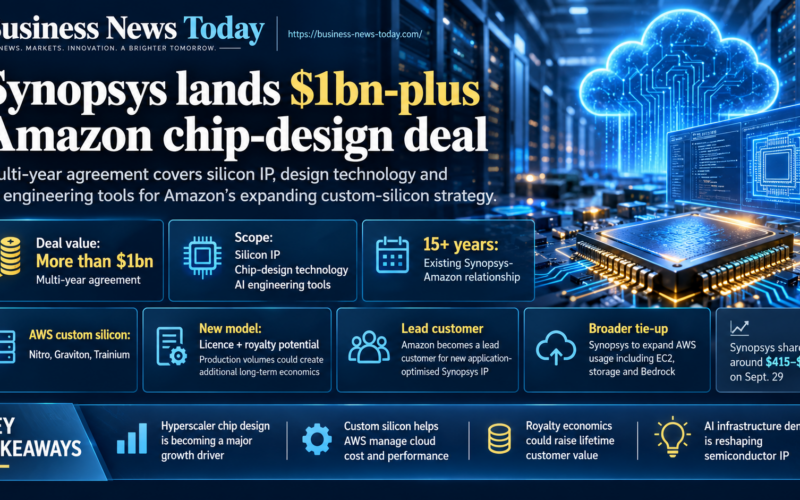
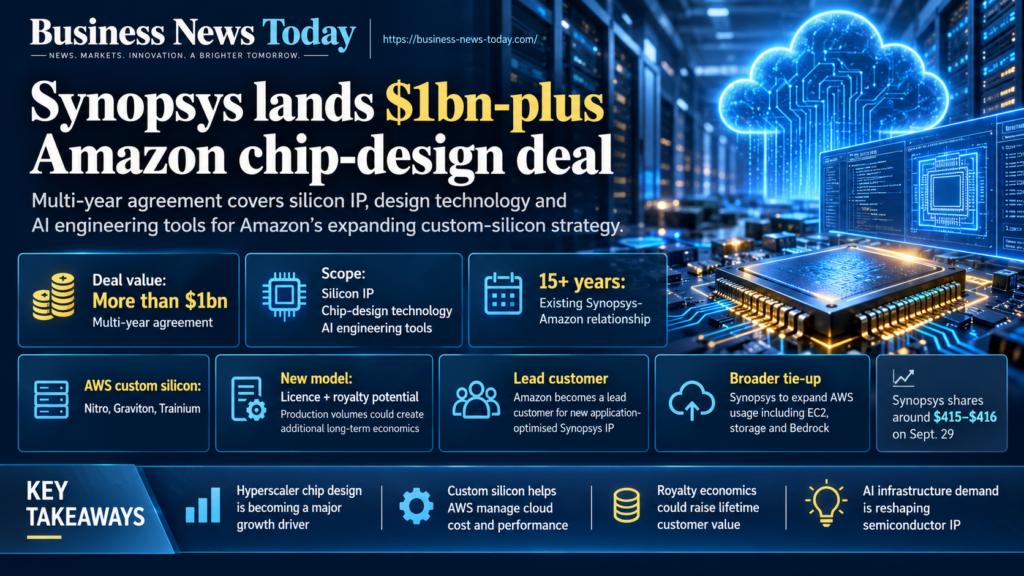
Synopsys, Inc. (Nasdaq: SNPS), the California-based electronic design automation and semiconductor intellectual-property company, has signed a multi-year agreement worth more than $1bn with Amazon.com, Inc. (Nasdaq: AMZN) covering silicon IP, chip-design technology and artificial-intelligence engineering tools. The transaction makes Amazon a lead customer for a new generation of application-optimised Synopsys intellectual property while deepening a relationship that already spans more than 15 years.
The agreement is commercially important because Amazon Web Services increasingly designs the processors sitting inside its own data centres rather than relying exclusively on merchant chips from Intel Corporation, Advanced Micro Devices, Inc. and NVIDIA Corporation. AWS has built Nitro infrastructure chips, Graviton central processors and Trainium accelerators for artificial-intelligence workloads, turning semiconductor design into part of Amazon’s cloud cost and differentiation strategy.
For Synopsys, the contract is more than a large customer win. The company is evolving parts of its semiconductor-IP business from conventional upfront licensing toward a licence-plus-royalty structure under which production volumes can generate additional economics over time. That could make successful customer programmes more valuable if Amazon deploys custom processors across an expanding global AWS footprint.
Why is Amazon spending more than $1bn on Synopsys chip-design intellectual property?
Designing a modern processor requires far more than creating the main computing core. A chip incorporates memory interfaces, high-speed connectivity, security, data movement, controllers and numerous reusable building blocks that need to work together at extremely high speeds while remaining within power and thermal limits.
Customers can design every component internally, but doing so consumes engineering time and increases verification risk. Licensing proven intellectual property from Synopsys allows Amazon’s semiconductor teams to concentrate internal resources on areas where customisation provides the greatest performance or cost advantage.
The new agreement specifically expands Synopsys into application-optimised silicon IP. That moves the relationship beyond relatively standard component blocks toward technology designed around particular workload requirements. The companies have not identified which future AWS processors will incorporate the new IP, so it would be premature to assume that a particular generation of Graviton or Trainium is covered.
The strategic direction is nevertheless clear. Amazon wants greater control over the economics of computing infrastructure, while Synopsys wants to earn more revenue as hyperscalers design increasingly specialised silicon. Both trends become stronger as artificial-intelligence infrastructure grows more expensive.
How does custom silicon help Amazon Web Services compete with Microsoft Azure and Google Cloud?
Cloud providers historically differentiated themselves through software, geographic coverage, developer services and pricing while purchasing much of their underlying computing hardware from common suppliers. Artificial intelligence has made hardware architecture far more important because accelerator cost and power efficiency can materially influence the price of running a model.
AWS developed Trainium partly to provide customers with another option alongside NVIDIA GPUs. Graviton performs a similar strategic role in general-purpose computing, allowing Amazon to optimise performance and energy efficiency around its own cloud workloads.
Custom chips can also reduce dependency on suppliers whose products are in exceptionally high demand. Amazon still buys large volumes of third-party processors, but internal silicon gives AWS negotiating leverage and the ability to optimise infrastructure around its own software stack.
The economic objective is straightforward even if execution is technically difficult. If an internally designed processor delivers the required performance at a lower lifetime cost, AWS can either retain more margin, reduce prices or use the difference to fund additional infrastructure.
Synopsys benefits whichever competitive response Amazon chooses because every new custom chip requires design, verification, simulation and reusable IP.
Why does the licence-plus-royalty model matter to Synopsys investors?
Synopsys generated approximately $1.75bn of revenue from its silicon-IP business in its latest fiscal year, making intellectual property a substantial business alongside electronic design automation software. Moving selected contracts toward royalties changes how revenue may develop after a design enters production.
A traditional licence generates significant economics around access to the technology. A royalty can add another stream linked to customer production volumes, meaning the supplier participates more directly when a chip architecture scales successfully.
The arrangement can therefore increase the lifetime value of a customer relationship, although it can also make revenue timing more dependent on product launches and manufacturing volumes. A design programme that never reaches large-scale production would generate less royalty upside than one deployed across millions of servers.
Amazon is particularly attractive under that model because AWS operates one of the world’s largest computing infrastructures. A successful processor architecture can be deployed internally across multiple regions rather than relying on retail semiconductor sales to external buyers.
The deal also arrives as Synopsys integrates Ansys, expanding its position from semiconductor design into broader multiphysics simulation. Amazon will use a wider range of Synopsys EDA, simulation and analysis tools, creating opportunities for the relationship to spread beyond individual IP blocks.
Why is Synopsys also moving more of its own engineering onto AWS?
The transaction runs in both directions. Synopsys plans to increase its use of Amazon Elastic Compute Cloud and AWS storage while using Amazon Bedrock to build artificial-intelligence applications and engineering agents.
Synopsys will also work to optimise some of its engineering software for Amazon Trainium and Graviton. That creates a strategically interesting loop: Amazon licenses Synopsys technology to develop chips, while Synopsys increasingly uses Amazon’s processors and cloud to develop the tools that help engineers design complex systems.
Electronic design automation is highly compute intensive. Semiconductor teams run large simulations and verification workloads repeatedly before committing a design to manufacturing, making cloud infrastructure potentially attractive when demand varies sharply across projects.
Artificial intelligence could reduce some engineering time by assisting with optimisation, verification and design-space exploration. Synopsys has already been embedding AI into its tools, and access to Amazon Bedrock provides another route for building agentic workflows around those products.
The commercial opportunity extends beyond Amazon. If Synopsys can demonstrate that its engineering software performs efficiently on AWS custom processors, other Amazon cloud customers designing chips or complex systems may also use that configuration.
What does the Amazon agreement mean for Synopsys stock sentiment?
Synopsys shares finished September 29 around $415 to $416 after declining during the previous two sessions. The stock remained below levels reached earlier in 2026 and had fallen by roughly a low-double-digit percentage year to date before the Amazon agreement became public on September 30.
That backdrop makes the $1bn-plus contract particularly useful for the company’s investor narrative. Synopsys has been trying to convince shareholders that semiconductor IP, AI-enabled engineering and its expanded Ansys portfolio can generate faster earnings growth after a period of concern around execution and valuation.
The deal does not solve every issue immediately. Revenue will be recognised over multiple years, the exact royalty economics are undisclosed and Amazon represents a sophisticated customer likely to negotiate aggressively.
What changes is the proof point. Application-optimised IP has moved from a strategic concept into a billion-dollar-scale customer relationship with one of the world’s largest designers and users of custom silicon.
For Synopsys, the durable search and investment question is therefore no longer whether hyperscalers will design more chips themselves. Amazon already is. The question is how much of the value created by that shift Synopsys can capture each time those chips move from design files into millions of operating servers.
Discover more from Business-News-Today.com
Subscribe to get the latest posts sent to your email.