

Iran has hardened its position over the Strait of Hormuz, declaring that passage through the strategic waterway will remain under Tehran’s control as tanker traffic falls to a fraction of normal levels and the economic consequences of the US-Israel war with Iran increasingly reach motorists and energy markets around the world.
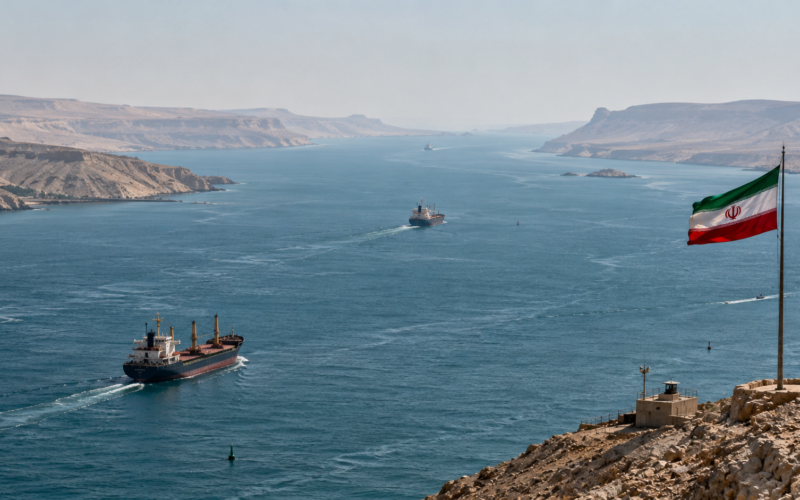
Only two vessels were recorded crossing the strait on Friday, August 14, according to Kpler data cited by Reuters. One was a grain ship entering Iranian waters and the other an empty dry-bulk vessel travelling in the opposite direction. A separate empty liquefied petroleum products tanker was approaching the Gulf, but no crude-oil shipment was visible through a waterway that routinely handled more than 130 vessels per day before the war.
Iranian Deputy Foreign Minister Kazem Gharibabadi said early on August 15 that Iran alone would determine when the strait opens or closes and urged Washington to accept what Tehran describes as its defeat. His comments indicated that Iran sees control of Hormuz not merely as wartime disruption but as strategic leverage in its confrontation with the United States. Iran calls its restrictions a blockade, while Washington has also used blockade terminology for its restrictions on Iranian vessels leaving Iranian ports.
US President Donald Trump, meanwhile, told Americans to tolerate higher gasoline prices while the conflict continues. The average price of regular gasoline reached $4.0776 per gallon on August 14, according to AAA, up from $3.1601 a year earlier, an increase of about 29%. Trump said the additional cost was justified by his objective of preventing Iran from acquiring a nuclear weapon.
The confrontation is becoming increasingly important because Hormuz was the world’s most significant oil transit chokepoint before the war. US Energy Information Administration data show that about 20 million barrels per day of oil moved through the strait in 2024, equivalent to around 20% of global petroleum liquids consumption, while roughly one-fifth of global liquefied natural gas trade also depended on the passage.
How close is the Strait of Hormuz to being completely closed to commercial oil shipping?
Commercial traffic has not technically fallen to zero, but the latest vessel movements show how close the strait has come to becoming unusable for normal energy trade.
Kpler identified only two completed vessel transits on August 14, compared with more than 130 ship movements per day before the February 28 outbreak of war between the United States and Israel on one side and Iran on the other. Neither completed transit involved a crude-oil cargo, although ships operating with their automatic identification systems switched off may not appear in conventional tracking data.
The scale of the disruption is even clearer from broader EIA data. The agency estimates that crude oil and other petroleum liquids moving through Hormuz averaged just 4.9 million barrels per day during the second quarter of 2026, compared with 21.6 million barrels per day during the fourth quarter of 2025 before the conflict began. That represents a decline of roughly 77% between those two periods.
Conditions have deteriorated further during the renewed fighting in recent weeks. The EIA said in its August outlook that shipping through Hormuz was expected to remain severely constrained through August and estimated that about 5.5 million barrels per day of Middle Eastern oil production had been shut in during July because producers could not move normal volumes through the strait and energy infrastructure had been damaged.
The latest Kpler figures therefore suggest the immediate situation is even more restrictive than the quarterly average implies. Hormuz remains physically navigable, but the combination of Iranian restrictions, missile and drone risks, insurance concerns and military activity has made ordinary tanker operations exceptionally difficult.

Why is Iran insisting that only Tehran can decide when the Strait of Hormuz reopens?
Iran increasingly treats control over Hormuz as one of its most powerful remaining forms of leverage against the United States and its allies.
Gharibabadi’s August 15 statement was deliberately uncompromising. He said Iran would continue enforcing the blockade until Washington accepted what Tehran considers the reality of the conflict, rejecting suggestions that American military deployments or political declarations could determine the status of the strait.
That position is consistent with previous Iranian statements. In late June, Gharibabadi said any demining of Hormuz would be carried out solely by Iran, rejecting suggestions that European governments could participate independently. In early August, he also said Iran and Oman were finalising arrangements concerning the strait, indicating that Tehran is prepared to discuss navigation but wants those negotiations conducted on terms that recognise an Iranian role.
For Tehran, the strategic logic is straightforward. The United States possesses overwhelming conventional military power and has imposed extensive sanctions on Iranian oil exports and financial institutions. Iran cannot replicate those capabilities symmetrically, but its geography gives it influence over a narrow maritime passage used by several of the world’s largest energy exporters.
The problem is that exercising that leverage imposes costs far beyond the United States. Saudi Arabia, Iraq, Kuwait, Qatar, Bahrain and the United Arab Emirates all depend to varying degrees on Gulf export routes, while major consumers in Asia and Europe face higher prices when those supplies cannot move normally.
Why did Trump tell Americans to accept gasoline above $4 despite promising lower energy prices?
The political tension between Trump’s energy agenda and the Iran war is becoming increasingly visible.
Speaking in Garden City, New York, on August 14, Trump argued that Americans should accept paying somewhat more for gasoline because the military campaign against Iran was preventing what he described as a dangerous country from obtaining nuclear weapons. He also indicated that the United States was prepared for a prolonged military commitment, saying the 260-day deployment of an American aircraft carrier supporting the campaign had not been excessively long.
AAA placed the national average for regular gasoline at $4.0776 per gallon on August 14. That compares with $4.0422 a week earlier, $3.8587 a month earlier and $3.1601 one year earlier. Diesel averaged $5.4265 per gallon, substantially above the $3.7154 level recorded a year earlier.
The increase creates a difficult domestic political argument because reducing energy costs was one of Trump’s major economic themes. Higher fuel prices affect households directly at petrol stations but also feed into transportation, food, manufacturing and delivery costs throughout the economy.
Democrats are consequently trying to make the economic consequences of the Iran conflict an issue ahead of November’s US midterm elections. Reuters reported that the combination of higher fuel costs and inflation has already disappointed some voters, creating pressure on the administration to demonstrate that its military strategy can eventually produce a result that justifies the financial burden.
How important was the Strait of Hormuz to global oil and LNG markets before the Iran war?
Hormuz is difficult to replace because its importance extends across several different forms of energy.
EIA data show that approximately 20 million barrels per day of oil passed through the strait in 2024. The agency described that volume as equivalent to around one-fifth of global petroleum liquids consumption, making Hormuz the world’s most important oil transit chokepoint.
The natural-gas exposure is also substantial. About 20% of worldwide LNG trade passed through Hormuz in 2024, overwhelmingly consisting of exports from Qatar, alongside smaller volumes from the UAE. Qatar alone shipped approximately 9.3 billion cubic feet per day of LNG through the passage.
Alternative routes exist for some oil producers, including Saudi pipelines connecting production areas with Red Sea terminals and UAE infrastructure capable of bypassing Hormuz through Fujairah. Those systems provide valuable emergency flexibility but cannot replace the entire volume that historically moved by tanker through the strait.
The result is that disruption creates two simultaneous problems. Tankers cannot carry normal volumes away from Gulf exporters, while producers eventually have to reduce output because storage facilities begin filling. The EIA estimated earlier this year that Gulf producers collectively shut in millions of barrels per day as constrained Hormuz traffic reduced their ability to export production.
Why are tanker companies unwilling to test Iran’s blockade even though the strait remains open water?
The threat to commercial shipping is no longer hypothetical.
Reuters reported that vessels attempting to transit without Iranian permission face the risk of missile or drone attack. The UAE’s Abu Dhabi National Oil Company said two of its vessels were attacked while transiting the strait on Thursday evening, followed by another reported attack on a vessel on Friday.
These incidents radically alter the commercial calculation for shipowners. Even if a naval escort makes physical transit possible, operators must consider whether a tanker carrying hundreds of millions of dollars of cargo could be hit, disabled or set on fire inside one of the world’s busiest energy corridors.
Insurance becomes another constraint. War-risk premiums can rise sharply when commercial vessels are attacked repeatedly, and some underwriters may impose conditions that make a voyage commercially unattractive even when it remains legally possible.
Crew safety also matters. Tanker owners cannot treat sailors as interchangeable assets, particularly when an identifiable route has recently experienced missile or drone attacks. A sustained pattern of violence can therefore reduce shipping without Iran physically preventing every vessel from entering the waterway.
That helps explain why vessel traffic has collapsed far more dramatically than a conventional map of the strait might suggest. The passage may be geographically open, but commercial risk can produce an effective closure without a permanent physical barrier.
Are peace negotiations between Washington and Tehran still capable of reopening Hormuz?
There was little indication early on August 15 that negotiations were about to restart.
Iranian Foreign Minister Abbas Araghchi said no decision had been made to resume negotiations with the United States. Qatar and Pakistan were exchanging messages with Iran as intermediaries, but Tehran said those contacts did not amount to formal negotiations.
The current stalemate follows the collapse of a tentative June arrangement intended to move the conflict towards de-escalation. Reuters reported that the deal had effectively broken down, leaving neither Washington nor Tehran publicly preparing for another immediate round of peace talks.
This matters because reopening Hormuz is now directly connected to the wider political conflict. Earlier in the year, it appeared possible that maritime arrangements could proceed somewhat separately from the nuclear and military disputes. Iran’s latest language instead suggests that Tehran views continued restriction of the strait as part of its leverage in securing an acceptable overall settlement.
Washington faces the opposite incentive. Allowing Iran to establish an accepted right to determine which commercial vessels can transit Hormuz would create a precedent the United States and many Gulf governments would find strategically unacceptable.
A compromise would therefore probably need to restore predictable commercial access without requiring either side publicly to concede the larger argument over who controls the waterway.
How badly is the prolonged Hormuz crisis damaging Iran’s own economy?
Iran is also absorbing substantial economic damage from a confrontation it says gives it strategic leverage.
President Masoud Pezeshkian has acknowledged severe inflationary pressure and blamed the situation on the US blockade of Iranian ports together with sanctions restricting Iran’s oil exports. Tehran therefore faces the paradox of imposing disruption on Gulf trade while simultaneously struggling with restrictions on its own access to external markets.
The longer the conflict continues, the more difficult that trade-off becomes. Oil and petroleum exports are central sources of foreign currency for Iran, while restrictions on imports can increase domestic prices and make industrial inputs harder to obtain.
Washington is attempting to intensify that pressure. Trump and Treasury Secretary Scott Bessent have both signalled further financial measures against Iran, with Bessent saying additional announcements were expected in the coming week.
Tehran’s strategy therefore depends on whether the cost imposed on its opponents rises faster politically than the cost Iran itself can absorb economically. Hormuz is particularly useful for that purpose because a relatively concentrated Iranian military effort can create market consequences across numerous countries.
The danger is that prolonged economic pressure can become destabilising without necessarily producing compromise. Both governments may conclude that backing down first would weaken their negotiating position, leaving global energy markets trapped inside a conflict neither side feels able to end unilaterally.
Why are the Houthis creating an additional risk of a wider Middle East shipping crisis?
The maritime pressure is no longer confined to the Persian Gulf.
Yemen’s internationally recognised government said Iran-backed Houthi forces fired six ballistic missiles at the Red Sea port of Mocha on August 14, killing four civilians. The Houthi-run SABA news agency separately cited a military source saying the group targeted an Aramco facility in Najran, Saudi Arabia, using a drone.
Those developments matter because the Red Sea and Strait of Hormuz are two separate maritime gateways connecting Middle Eastern energy and trade with international markets. Simultaneous instability around both routes gives shipowners fewer safe alternatives.
A tanker or container ship attempting to avoid one danger can face another depending on its origin and destination. The Red Sea route connects the Indian Ocean with the Suez Canal, while Hormuz controls access to the Persian Gulf’s major energy-exporting states.
The expansion of Houthi operations therefore increases the possibility that the Iran conflict produces a wider regional shipping emergency even without direct escalation between the United States and Iran.
What are the key takeaways from Iran’s continued Strait of Hormuz blockade and rising US gasoline prices?
- Only two vessels were recorded completing transits through the Strait of Hormuz on August 14, compared with more than 130 daily ship movements before the Iran war. Kpler data cited by Reuters showed no visible crude-oil shipment among those transits.
- Iranian Deputy Foreign Minister Kazem Gharibabadi said early on August 15 that Iran would determine when the Strait of Hormuz opens or closes and indicated that Tehran intends to maintain its blockade while the conflict with Washington continues.
- President Donald Trump told Americans that somewhat higher gasoline prices were a price worth paying for preventing Iran from obtaining a nuclear weapon, as the conflict showed no immediate sign of moving back towards peace negotiations.
- AAA placed the US average price for regular gasoline at $4.0776 per gallon on August 14, up roughly 29% from $3.1601 a year earlier. Diesel averaged $5.4265, compared with $3.7154 a year earlier.
- EIA estimates show petroleum flows through Hormuz averaged 4.9 million barrels per day in the second quarter of 2026, down about 77% from the 21.6 million barrels per day recorded in the fourth quarter of 2025 before the war.
- Before the conflict, Hormuz carried roughly one-fifth of global petroleum liquids consumption and around 20% of worldwide LNG trade, making prolonged disruption a direct risk to oil, fuel and natural-gas markets far beyond the Gulf.
- Commercial shipping faces direct physical danger in addition to political restrictions. ADNOC said two of its vessels were attacked while passing through the strait on August 13, while another vessel was reported attacked on August 14.
- No renewed US-Iran peace talks had been agreed by early August 15. Qatar and Pakistan were communicating with Tehran as intermediaries, but Iranian Foreign Minister Abbas Araghchi said those contacts did not constitute negotiations.
Why two ships crossing Hormuz in one day could matter more than another round of US-Iran rhetoric
The most important number in the latest confrontation may not be a missile count, an oil price or even the American gasoline average. It is two.
A maritime route that handled more than 130 vessel movements on an ordinary prewar day recorded only two completed transits on Friday, with no crude shipment visible in the tracking data. That transforms Iran’s threat to restrict Hormuz from a geopolitical scenario into a measurable disruption of one of the central arteries of the global energy system.
The economic transmission mechanism is already visible. Petroleum movements through the strait collapsed by roughly three-quarters between the fourth quarter of 2025 and second quarter of 2026, Middle Eastern producers have shut in millions of barrels of production, oil prices remain under upward pressure and US gasoline has climbed about 29% from a year ago.
What makes the August 15 situation more dangerous is the apparent absence of an immediate diplomatic exit. Iran is not signalling urgency about restoring normal trade. Instead, senior officials are presenting continued control of the strait as evidence that American military power has failed to compel Tehran. Washington is responding by promising additional financial pressure while Trump argues that higher energy costs are justified by the strategic objective of preventing a nuclear-armed Iran.
Both positions can be maintained for some time, but neither is economically neutral. Gulf producers lose export capacity, Iran suffers under sanctions and blocked trade, consumers pay more for fuel, insurers charge more for maritime risk and governments dependent on imported energy face another source of inflation.
The shipping industry may ultimately become the clearest measure of whether the confrontation is improving. Political statements can remain maximalist even while negotiations quietly progress, but commercial tanker traffic responds rapidly to real changes in risk. A sustained return towards dozens of daily transits would indicate that some form of practical understanding was developing even before a formal peace agreement.
For now, the movement is in the opposite direction. Hormuz has not been sealed completely, but normal crude traffic has almost disappeared, vessels have been attacked and Iran is explicitly saying that it sees no reason to surrender the leverage created by the disruption.
That leaves the United States facing a strategic calculation with increasingly visible domestic consequences. Trump argues that preventing Iran from acquiring a nuclear weapon is worth higher gasoline prices. The longer Hormuz remains nearly empty, the more American voters, Gulf exporters and energy-importing economies will have to decide how much economic pain that objective is worth.
Discover more from Business-News-Today.com
Subscribe to get the latest posts sent to your email.