



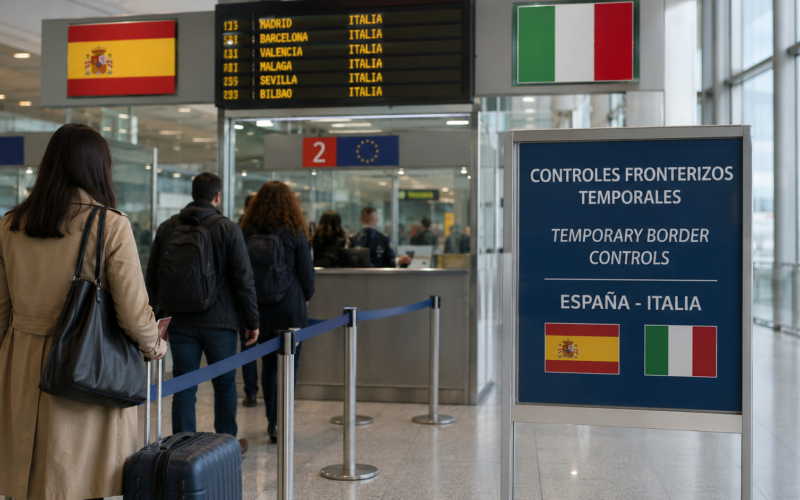
Spain is imposing temporary border controls on travellers arriving from Italy from midnight on Saturday, August 8, escalating an increasingly acrimonious migration dispute that has spilled from the North African enclave of Ceuta into the European Union’s normally border-free Schengen system.
The Spanish government said passengers arriving on flights and ships from Italy would face checks covering passports, nationality and visa status. The measures are scheduled to remain in force until September 7 and were announced only hours after the government of Italian Prime Minister Giorgia Meloni rejected Spanish demands that it remove comparable restrictions on travellers arriving from Spain.
Italy introduced its controls after approximately 72,000 people crossed from Morocco into Ceuta beginning on July 30, an extraordinary influx that overwhelmed the Spanish enclave and resulted in dozens of deaths. Rome argued that temporary checks were necessary to prevent irregular migrants from moving onwards towards Italy and to guard against potential security or terrorism threats. Spain countered that most of those who entered Ceuta had already returned to Morocco and that special controls apply to movement from Ceuta towards mainland Spain and the wider Schengen area.
The confrontation now risks becoming more significant than the migration event that triggered it. Spain and Italy are two of the European Union’s largest Mediterranean countries and have frequently demanded greater solidarity from northern European states over irregular migration. Instead, they are now imposing checks on one another while publicly disputing whether the other government is exaggerating migration risks for political purposes.
The immediate effect is not a closure of travel between Spain and Italy. Flights and ferries can continue operating, European Union citizens retain freedom-of-movement rights, and valid Schengen visas have not been cancelled. However, travellers should expect document inspections and potentially longer processing times as both governments temporarily restore border procedures normally absent from journeys within the Schengen area.
Why has Spain imposed border controls on flights and ships arriving from Italy after the Ceuta crisis?
Madrid’s decision followed a week of escalating diplomatic exchanges with Rome over Italy’s initial reaction to the Ceuta migrant influx.
Italy temporarily reintroduced controls on non-European Union nationals arriving from Spain after tens of thousands of migrants crossed into Ceuta from neighbouring Morocco. Because Spain and Italy have no shared land border, the practical impact falls principally on passengers travelling by air and sea between the countries.
Spain initially demanded that Italy withdraw the restrictions, describing them as unjustified, discriminatory and contrary to the interests of the European Union. Madrid argued that Rome had failed to demonstrate that migrants who entered Ceuta were actually moving towards Italy or even had the ability to do so.
The dispute intensified on August 7 when Spain threatened reciprocal measures unless Italy removed its controls. Meloni’s government responded that it would not accept what it characterised as ultimatums or external pressure and would maintain its restrictions until at least August 15.
Hours later, Spain announced that it would begin its own checks rather than wait for the previously discussed deadline. The Spanish measures are broader in duration, currently extending until September 7, although Madrid linked them directly to Italy maintaining its own restrictions.
Spanish authorities said the checks would cover Italian nationals and passengers of other nationalities travelling from Italy. Border personnel can therefore request passports or identity documents and verify whether non-European Union travellers possess valid visas or residence documentation.
The reciprocal measures turn what began as a dispute over migration risk into an operational interruption of normal Schengen travel between two major member states.

Does Spain’s decision mean the Schengen border-free travel system has been suspended between Spain and Italy?
No. The temporary border controls do not amount to Spain or Italy leaving Schengen, nor do they eliminate the underlying right of eligible travellers to move between the countries.
The Schengen Borders Code allows participating governments to temporarily restore controls at internal borders when they identify a serious threat to public policy or internal security. European Union rules describe such measures as exceptional and require them to be necessary, proportionate and limited to the minimum period needed to address the identified threat.
Several European countries already operate temporary internal border controls for reasons involving migration, terrorism, organised crime or security threats. Germany, France, Austria, Sweden, the Netherlands, Poland and Italy are among countries with various controls currently registered under the system.
What makes the Spain-Italy dispute politically unusual is its explicitly reciprocal character. Spain is not merely citing a general domestic security concern. Its government has linked the new checks directly to Italy’s treatment of travellers arriving from Spain.
For ordinary travellers, the most visible difference will be the return of identity and immigration checks that normally do not occur when travelling between Schengen countries. Passengers should therefore carry valid travel documents even if they would ordinarily expect a largely seamless internal European journey.
A valid Schengen visa is not automatically invalidated because border controls have returned. Instead, immigration officials can inspect the document and determine whether its holder continues to meet normal entry and stay requirements.
The distinction is important because describing the move as a complete suspension of Schengen could wrongly suggest that international travellers are prohibited from moving between Spain and Italy. The present measures restore checks. They do not automatically prohibit lawful travel.
Why does Italy argue that migrants entering Ceuta could create a security risk for other European countries?
Meloni’s government has defended the controls by pointing to both the unprecedented scale of the July 30 influx and warnings that another mass crossing attempt could occur on August 15.
Spain’s Civil Guard has said authorities are aware of online calls encouraging another attempt to cross into Ceuta on that date, although there is currently no reliable estimate of how many people could respond. Italy has argued that it should not withdraw precautions until it is satisfied that there is no renewed migration wave, security or terrorism threat, or movement of irregular migrants towards mainland European territory.
The Italian argument reflects a broader position associated with Meloni’s government: once irregular migration reaches one European Union member state, secondary movement can eventually affect others because of the bloc’s extensive internal transport networks.
Rome has therefore insisted that migration pressure at Spain’s external frontier cannot be considered exclusively a Spanish matter.
However, Madrid says the particular geography and legal arrangements surrounding Ceuta substantially weaken that argument.
Ceuta is Spanish territory on the North African coast, and movement from the enclave to mainland Spain or other Schengen destinations remains subject to identity and document checks under special Schengen arrangements. The European Commission has previously confirmed that specific checks apply to people departing Ceuta or Melilla for Peninsular Spain and other Schengen countries.
Spanish authorities also say there has been no evidence that the migrants remaining in Ceuta are organising mass travel towards Italy. Reuters reported that there was no indication that they intended to travel there or possessed the resources needed to purchase airline tickets.
That factual disagreement lies at the centre of the dispute. Italy argues that precaution is justified before secondary migration emerges. Spain argues that Rome is imposing restrictions in response to a threat for which there is currently little evidence.
How has the Ceuta migrant rush transformed relations between Giorgia Meloni and Pedro Sánchez?
The border dispute exposes a wider political divide between Giorgia Meloni and Spanish Prime Minister Pedro Sánchez over how Europe should manage irregular migration.
Meloni has built much of her political identity around tougher border enforcement, stronger action against migrant-smuggling routes and agreements designed to prevent irregular migrants from reaching European territory.
Sánchez has taken a different approach, combining border enforcement with regularisation, integration programmes and legal migration channels. His government recently pursued a large-scale regularisation process for migrants already living in Spain and launched an Integration and Citizenship Plan intended to expand legal pathways while bringing undocumented residents into the formal system.
Those philosophical differences were manageable while the two governments were dealing primarily with their own migration routes. Ceuta changed the dynamic because Italy treated a crisis on Spanish territory as a potential threat to Italian internal security.
Madrid viewed that decision as an implicit accusation that Spain could not control onward movement from its own borders.
Spanish officials have also accused Italy of applying a double standard. Madrid noted that Italy itself has recorded high levels of irregular migration and argued that Rome has experienced more irregular crossings than Spain in recent years.
The language has become increasingly confrontational. Italy has rejected Spanish pressure as an attempt to impose conditions on another sovereign government, while Spanish officials have characterised the Italian position as politically motivated and disconnected from the actual migration situation in Ceuta.
That makes a quick compromise harder because both governments now have domestic political credibility invested in refusing to retreat.
Could the Spain-Italy dispute trigger a wider wave of internal European border controls?
The risk is not that every European Union country will immediately copy Spain and Italy, but the dispute adds to a broader erosion of unrestricted internal movement across parts of the Schengen area.
Temporary border controls have become increasingly common as governments respond to irregular migration, security threats, terrorism concerns and cross-border crime.
Germany currently maintains controls along several land borders because of migration and security concerns. France operates controls across internal air, sea and land borders, while Austria, Poland, Sweden, the Netherlands and others have also notified temporary measures.
The European Commission has repeatedly stressed that restoring internal border controls should remain a last resort. It has also assessed whether longer-running national measures are necessary and proportionate, while urging governments to minimise disruption to legitimate cross-border travel.
The Spain-Italy episode creates an additional concern because internal controls could become retaliatory rather than purely security-driven.
If one government responds to another country’s border restrictions by imposing reciprocal checks, Schengen risks becoming vulnerable to bilateral political disputes. That would create a very different problem from temporary security measures introduced independently in response to specific threats.
The economic consequences could also become meaningful if reciprocal controls spread. European aviation, tourism, freight and business travel depend heavily on predictable movement between member states.
Spain and Italy are particularly important tourism markets. Millions of travellers move between the countries each year, and even modest processing delays at airports during the peak summer period can create operational complications.
For now, there is no indication of large-scale flight cancellations or severe disruption. The principal effect is additional documentation and border processing.
Why does the possibility of another Ceuta crossing on August 15 matter for the border dispute?
Italy has specifically cited the risk of another migration attempt on August 15 as one reason for refusing to withdraw its controls.
Online messages have reportedly circulated encouraging people to gather for another attempted crossing from Morocco into Ceuta. Spanish security services are aware of those calls and are preparing for the possibility of renewed pressure.
The existence of online mobilisation does not mean another movement comparable with July 30 will occur. Social-media calls can attract anything from a small number of participants to very large crowds, and authorities currently do not know how many people intend to respond.
Yet the date creates a clear political checkpoint.
If August 15 passes without another major crossing, Italy will face stronger pressure to demonstrate why continued restrictions remain necessary. If thousands again approach the border, Rome will argue that its caution was justified.
Spain similarly has an incentive to prevent another large-scale breach because a second crisis would weaken its argument that the threat has been contained.
The coming week will therefore involve substantial security preparation in and around Ceuta. Spanish authorities will seek to prevent crowds from reaching vulnerable sections of the border while continuing coordination with Morocco.
That cooperation may matter more than the Spain-Italy dispute itself. The July crisis demonstrated that even extensive physical border infrastructure can be overwhelmed when tens of thousands of people move simultaneously.
What are the key takeaways from Spain’s new border controls on travellers arriving from Italy?
- Spain will temporarily restore border controls on flights and ships arriving from Italy from midnight on August 8 until September 7, requiring passport, nationality and visa checks for passengers.
- The measure is retaliation for Italy’s decision to impose controls on arrivals from Spain after approximately 72,000 migrants crossed from Morocco into the Spanish enclave of Ceuta beginning on July 30.
- Italy has rejected Spanish demands to withdraw its restrictions and says it will maintain them until it is satisfied that there is no renewed migration wave, security threat or onward movement towards Italian territory.
- The measures do not close travel between Spain and Italy, cancel valid Schengen visas or remove European Union freedom-of-movement rights, but travellers may face additional document inspections and delays.
- Spain argues that Italy’s justification is flawed because special document checks already apply when people move from Ceuta towards mainland Spain or other Schengen destinations.
- Spanish authorities are monitoring online calls for another attempted mass crossing into Ceuta on August 15, although the scale of any new mobilisation remains uncertain.
- The confrontation reflects a wider political divide between Giorgia Meloni’s tougher migration approach and Pedro Sánchez’s combination of border enforcement, integration and regularisation policies.
- The dispute could become an important test for the European Commission because reciprocal internal border controls risk turning Schengen restrictions into political instruments between member states rather than exceptional responses to clearly defined security threats.
What happens next could determine whether the Spain-Italy dispute remains temporary or becomes a wider Schengen crisis
The most important development over the coming days will not be the sight of passport checks at airports. Schengen already allows temporary controls, and travellers across Europe increasingly encounter them.
The larger issue is whether Madrid and Rome can establish a credible route back to normal travel without either government appearing to surrender politically.
Italy has tied its position partly to the possibility of another Ceuta crossing on August 15. That creates an opportunity for de-escalation if the date passes without a major incident and Spanish authorities demonstrate continued control over movement from the enclave.
Spain, meanwhile, has linked its own measures to Italy’s restrictions. If Rome removes its checks, Madrid could therefore justify ending the reciprocal controls without abandoning its position.
The European Commission may become increasingly important if the confrontation persists. European Union law permits temporary internal controls, but those controls are supposed to satisfy tests of necessity and proportionality rather than function as retaliation between governments.
The episode also carries a broader lesson for European migration policy. The original crisis occurred on the external border between Spain and Morocco, yet within days it had generated restrictions on travel between two European Union states separated by hundreds of kilometres of Mediterranean Sea.
That is precisely why migration remains one of Europe’s most politically destabilising issues. Governments agree that external borders must be controlled but frequently disagree over which country should bear the consequences when those controls fail.
For travellers, the immediate message is simpler: Spain and Italy remain connected, Schengen remains in force and lawful journeys can continue, but the assumption of completely frictionless movement between the two countries has temporarily disappeared.
For European leaders, the stakes are considerably larger. If reciprocal border checks become an accepted tool whenever governments disagree over migration policy, the Ceuta crisis may ultimately leave its most important mark not in North Africa, but inside the Schengen system itself.
Discover more from Business-News-Today.com
Subscribe to get the latest posts sent to your email.