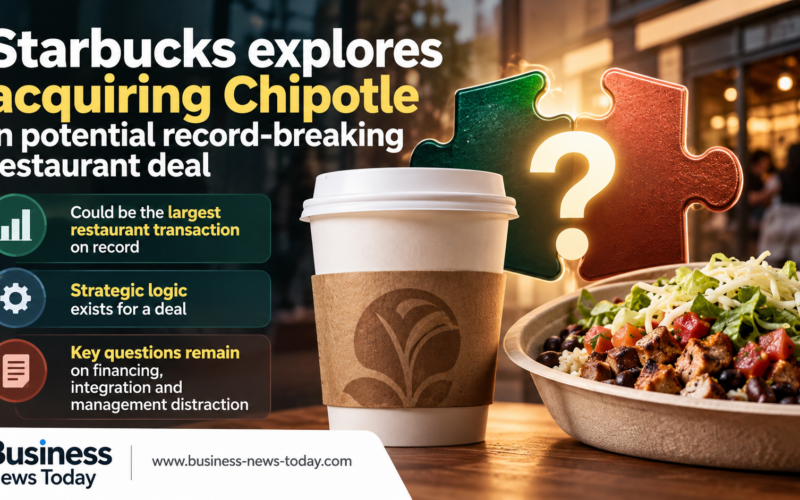
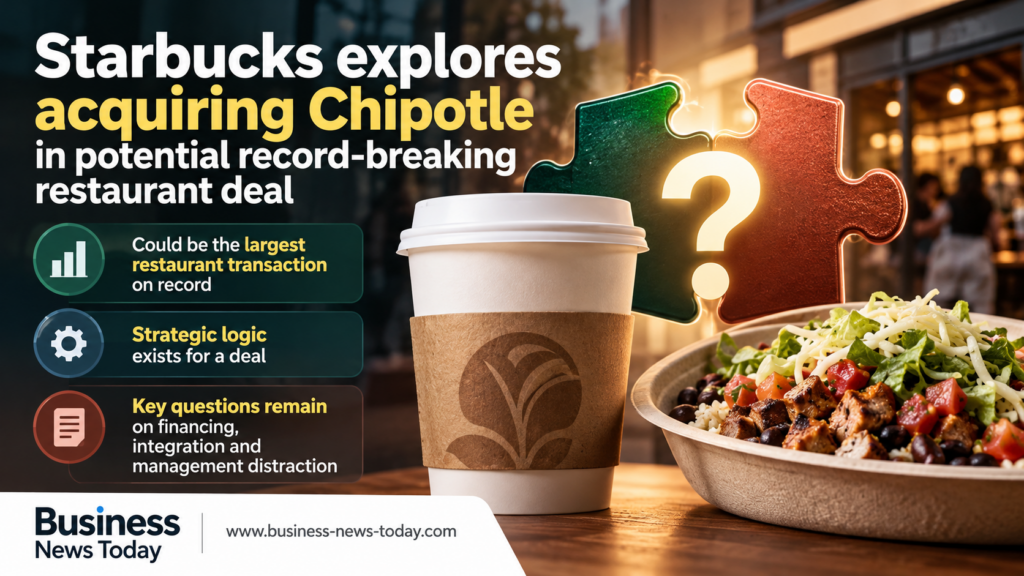
Starbucks Corporation (Nasdaq: SBUX) has reportedly explored a potential acquisition of Chipotle Mexican Grill, Inc. (NYSE: CMG), an extraordinary combination that would unite two of the most recognisable restaurant brands in the United States and could require well above $50 billion of equity consideration once a conventional takeover premium is included. Chipotle Mexican Grill was valued at roughly $41 billion after its shares surged 6.2% to $32.68 on October 8, while Starbucks Corporation closed at $93.21, down 0.4%, with a market value of roughly $106 billion. No formal offer has been announced, neither company has confirmed active transaction negotiations, and Starbucks Corporation has maintained that its immediate priority remains its ongoing turnaround. The strategic tension is nevertheless significant because Chief Executive Officer Brian Niccol spent six years running Chipotle Mexican Grill before joining Starbucks Corporation in 2024, giving him unusually deep knowledge of the potential target. The real question is not whether the combination produces an attention-grabbing headline, but whether enough financial and strategic value exists to justify one of the most ambitious acquisitions ever attempted in global restaurants.
Why would Starbucks consider buying Chipotle while Brian Niccol is still rebuilding the coffee chain?
The strongest strategic argument begins with familiarity. Brian Niccol led Chipotle Mexican Grill between 2018 and 2024, a period in which the company accelerated digital ordering, strengthened marketing, improved restaurant execution and expanded significantly. Few chief executives contemplating a transaction of this scale would possess comparable first-hand knowledge of the target’s culture, operating model, economics and management capabilities.
That familiarity could reduce some information risk, but it does not remove execution risk. Starbucks Corporation itself is only partway through a costly operational reset focused on customer experience, labour deployment, store formats and the broader Back to Starbucks programme. Global comparable sales increased 7.9% in the latest reported quarter and North American comparable sales rose 8.1%, signalling substantial improvement, yet management is still working to convert stronger traffic into sustainably higher profitability.
A Chipotle transaction would therefore represent a major shift in the nature of the turnaround. Instead of concentrating management resources almost entirely on making Starbucks Corporation work better, Niccol would potentially be asking the organisation to absorb another large restaurant system with its own culture, supply chain, digital platform and expansion programme.
That raises a capital-allocation question that may matter more than the strategic familiarity. Buying a company because management knows it well is not the same as buying it at a price capable of producing attractive shareholder returns. The higher Chipotle Mexican Grill shares trade on takeover expectations, the more demanding that calculation becomes.
How large could a Starbucks takeover of Chipotle become once a realistic acquisition premium is included?
Chipotle Mexican Grill finished October 8 at $32.68 after gaining 6.2%, putting its equity value at roughly $41 billion. That figure is only the starting point because a successful takeover would normally require shareholders to surrender control at a premium to the unaffected market valuation.
A purely illustrative 25% premium to a $41 billion equity valuation would put potential consideration around $51 billion. A 30% premium would take the figure toward $54 billion. Those are scenario calculations rather than reported offer terms, since no confirmed proposal or price currently exists.
The scale becomes clearer when compared with Starbucks Corporation itself. A transaction around $50 billion would equal almost half of Starbucks Corporation’s current equity market capitalisation. Even if the eventual structure relied heavily on Starbucks shares rather than cash, the amount of new equity required would be substantial enough to make dilution one of the central issues for existing Starbucks shareholders.
The restaurant industry has seen major combinations before, but a Starbucks-Chipotle transaction at those values would move into a different financial category. It would create a corporate group operating more than 45,000 locations globally, combining Starbucks Corporation’s 41,304 stores at the end of its latest reported quarter with more than 4,200 Chipotle Mexican Grill restaurants.
Scale alone cannot justify the premium. Starbucks Corporation would need to demonstrate that ownership creates incremental cash flows large enough to offset the takeover premium, financing costs, integration expenses and opportunity cost of deploying tens of billions of dollars somewhere other than the existing Starbucks business.
Could Starbucks finance a $50 billion-plus Chipotle deal without weakening its balance sheet?
This may be the hardest practical question. Starbucks Corporation reported approximately $3.45 billion of cash and cash equivalents at June 28, together with about $160 million of short-term investments. Current and long-term funded debt totalled roughly $13.3 billion, leaving the company with a meaningful existing debt burden before contemplating any major acquisition.
A predominantly cash-funded Chipotle Mexican Grill acquisition would therefore require substantial new borrowing or another source of capital. Adding tens of billions of dollars of debt would radically change Starbucks Corporation’s leverage profile and potentially constrain future investment in stores, labour, technology, dividends and other priorities.
An all-stock or heavily stock-funded transaction would solve part of the financing problem but create another one. Issuing approximately $50 billion of Starbucks Corporation equity at current valuations would require new shares worth nearly half the company’s present market capitalisation. Existing shareholders would effectively be asked to transfer a significant portion of the combined company to Chipotle Mexican Grill shareholders in exchange for the target.
A mixed cash-and-stock structure could moderate both problems but would not eliminate them. Financing costs remain particularly relevant because Starbucks Corporation is already absorbing significant transformation expenditure, including restructuring and additional labour investment.
Chipotle Mexican Grill brings a relatively clean financial structure to the table. It had approximately $228 million of cash, roughly $547 million of short-term and long-term investments and an undrawn $500 million revolving credit facility at June 30. Its major contractual liabilities are connected primarily to restaurant leases rather than conventional funded corporate debt.
That clean balance sheet makes Chipotle Mexican Grill a financially attractive asset, but it does not make the acquisition cheap. The burden of financing would still sit predominantly with Starbucks Corporation and its shareholders.
What strategic synergies could actually justify combining Starbucks and Chipotle under one company?
The most compelling synergies are unlikely to involve coffee beans and burrito ingredients. The businesses use substantially different food supply chains, production processes and restaurant layouts, limiting the procurement efficiencies that often make same-sector mergers financially attractive.
Instead, the potential value would sit in areas such as real estate development, technology infrastructure, digital ordering, loyalty programmes, payments, delivery relationships, corporate overhead and international market development. Both companies invest heavily in finding locations, constructing restaurants, processing enormous volumes of digital transactions and maintaining consumer-facing mobile ecosystems.
Real estate could be particularly significant. Starbucks Corporation and Chipotle Mexican Grill frequently compete for high-traffic retail corridors, drive-through opportunities and suburban development sites. A combined organisation would have greater visibility into restaurant-level demand patterns across coffee, breakfast, lunch and dinner occasions, potentially improving site selection and lease negotiations.
International expansion presents another possible opportunity. Starbucks Corporation has one of the restaurant industry’s deepest global development networks, with approximately two-thirds of its worldwide stores operated by licensees. Chipotle Mexican Grill remains overwhelmingly concentrated in North America but has started expanding through partner-operated arrangements in markets including the Middle East, Mexico and Asia.
Starbucks Corporation could theoretically accelerate that international learning curve. However, Chipotle Mexican Grill’s food preparation model is operationally more complex than licensing a coffee shop, particularly because ingredient sourcing, kitchen preparation and food safety standards are central to its brand proposition.
Consumer data and loyalty provide another possible angle. Both companies have substantial digital customer bases, but merging loyalty programmes simply because both exist would not automatically produce value. A Starbucks customer buying coffee at 8 a.m. does not necessarily become a Chipotle customer at lunchtime because two apps share an owner.
The credible synergy case therefore depends on back-end efficiency and development capability rather than forcing the consumer brands together. Any attempt to blur their identities could destroy precisely the brand equity Starbucks Corporation would be paying a premium to acquire.
Why might Chipotle shareholders welcome a bid even though operating growth has started improving?
Chipotle Mexican Grill is not a broken company. Second-quarter revenue increased 9.3% to approximately $3.35 billion, while comparable restaurant sales rose 2.2% and transactions increased 1%. The company opened 100 company-owned restaurants during the quarter and expects 350 to 370 new locations during 2026, including international partner-operated restaurants.
The problem lies more in the market’s expectations than in outright business deterioration. Restaurant-level operating margin declined to 25.2% from 27.4% a year earlier as beef costs, freight, labour and other expenses increased. Net income slipped to approximately $404 million from $436 million even though revenue continued growing.
Chipotle Mexican Grill shares also remain well below levels reached during the previous year. The October 8 close of $32.68 sits inside a 52-week range of approximately $28.04 to $42.82 and remains about 9% below the $36.03 closing price recorded one month earlier, despite the takeover-driven rally.
That creates an interesting environment for shareholders. A sufficiently attractive cash or stock premium could crystallise value after a period in which the company’s valuation has compressed, while rejecting an approach would amount to a bet that the Recipe for Growth strategy can eventually restore a substantially higher standalone valuation.
The board would need to assess far more than the headline premium. Chipotle Mexican Grill generated $1.33 billion of operating cash flow during the first six months of 2026 and continues funding aggressive restaurant expansion internally. A buyer would therefore be purchasing a growth platform rather than rescuing a capital-constrained business.
That bargaining position could push any serious acquisition price considerably above where Starbucks Corporation might initially prefer to transact.
What would a Starbucks and Chipotle combination mean for McDonald’s, Yum Brands and restaurant consolidation?
A completed transaction would change the competitive reference point for the global restaurant industry. Starbucks Corporation and Chipotle Mexican Grill occupy different categories, but together they would create a consumer platform spanning coffee, breakfast, snacks, lunch, dinner, digital ordering and a huge physical real estate network.
McDonald’s Corporation, Yum! Brands, Inc. and Restaurant Brands International Inc. already operate enormous multi-brand or globally diversified restaurant systems. Starbucks Corporation is unusual because it has historically concentrated overwhelmingly on a single consumer brand. Buying Chipotle Mexican Grill would move it closer to a portfolio logic without adopting the franchise-heavy conglomerate model used by several peers.
The deal could also reignite debate about whether restaurant scale increasingly matters beyond food. Technology investment, delivery economics, loyalty infrastructure, artificial intelligence, automation, real estate data and global development systems all carry substantial fixed costs. Larger restaurant groups can potentially spread those investments across more transactions and brands.
There is also a counterargument. Restaurant history contains plenty of examples where corporate owners assembled unrelated concepts only to discover that consumers saw less synergy than executives did. Coffee and Mexican fast casual may share customers, but their kitchens, dayparts, labour requirements and operating rhythms remain distinctly different.
Competitive response would therefore depend on whether Starbucks Corporation actually demonstrated improved economics after a transaction. A giant deal that produced disappointing returns could discourage consolidation just as easily as a successful one could accelerate it.
Traditional antitrust concentration may not be the biggest obstacle because the two companies compete in highly fragmented restaurant markets and are not direct substitutes across most occasions. Regulatory scrutiny would still be expected for any transaction of this size, particularly around labour, consumer data, supplier relationships and local market effects.
What does the October 8 stock reaction reveal about investor confidence in a possible deal?
The market reaction was sharply asymmetric. Chipotle Mexican Grill gained 6.2% to $32.68 as investors priced in at least some probability of a takeover premium, while Starbucks Corporation finished only 0.4% lower at $93.21 after trading unusually heavily.
Chipotle Mexican Grill volume exceeded 70 million shares, several times its normal recent activity, demonstrating that the report immediately changed how the market priced the target. Starbucks Corporation also traded more than 30 million shares, compared with a recent daily pattern often closer to roughly five million to ten million.
The longer trend adds important context. Starbucks Corporation shares are down roughly 1.6% over the five sessions from October 2 and about 6.8% from the September 9 close. The stock remains inside a 52-week range of $77.99 to $110.51, suggesting investors have acknowledged progress in the turnaround but have not awarded management an unlimited strategic mandate.
Chipotle Mexican Grill has experienced an even weaker one-month trajectory. Its October 8 close remained about 9% below the September 9 level despite the takeover rally, while the stock is still well below its 52-week high.
That helps explain why takeover speculation can attract such an immediate bid into Chipotle Mexican Grill shares. Investors receive the possibility of a premium at a time when the standalone valuation has already compressed.
The buyer reaction is more complicated. Starbucks Corporation shareholders would need evidence that acquiring Chipotle Mexican Grill produces better long-term returns than continuing to invest in Back to Starbucks, reducing debt, returning capital or pursuing smaller growth initiatives.
The fact that Starbucks Corporation did not collapse on the report suggests the market is not treating the scenario as obviously destructive. It does not indicate endorsement either. Until a price and financing structure exist, investors are largely reacting to an idea rather than an executable transaction.
What should executives and investors watch before treating the Starbucks Chipotle report as a real transaction?
The first threshold is whether Starbucks Corporation moves from exploratory work to a formal approach. Advisers examining a transaction does not mean a board has approved a bid, financing has been arranged or Chipotle Mexican Grill has agreed to engage.
The second is price. Even a strategically coherent transaction can destroy shareholder value when the control premium exceeds the realistic value of synergies. Chipotle Mexican Grill’s share-price jump has already increased the reference point against which any future proposal would be judged.
The third is financing. A credible proposal would need to explain the balance between cash, debt and Starbucks Corporation shares, together with the resulting leverage, dilution and effect on capital returns.
The fourth is governance. Brian Niccol’s history with Chipotle Mexican Grill provides unusual operational knowledge, but the board would still need a robust process around valuation, strategic rationale and management capacity. Familiarity with an asset should strengthen due diligence, not replace it.
Finally, investors will receive important operating information before the end of October. Chipotle Mexican Grill reports third-quarter results on October 28, followed by Starbucks Corporation’s fourth-quarter and full-year results on October 29. Those releases will provide fresh evidence on comparable sales, margins, restaurant economics and cash generation just as the market debates whether a transaction between the two companies is financially credible.
For Starbucks Corporation, that timing is particularly important. The company has spent two years persuading shareholders that Brian Niccol can restore traffic, service and profitability without losing focus. Exploring Chipotle Mexican Grill suggests management may also be thinking about what comes after the turnaround.
That ambition is not inherently problematic. The danger would be attempting to answer tomorrow’s growth question before today’s operating work is finished.
A Starbucks Corporation acquisition of Chipotle Mexican Grill could create one of the most formidable restaurant platforms in the world. It could also become an enormously expensive distraction. Until there is a formal proposal, the most useful conclusion is therefore not that the megadeal is coming, but that Starbucks Corporation appears willing to contemplate strategic moves on a scale few investors expected.
Key takeaways on what a possible Starbucks acquisition of Chipotle could mean for the restaurant industry
- Starbucks Corporation has reportedly explored a Chipotle Mexican Grill acquisition, but no formal offer or confirmed transaction has been announced.
- Chipotle Mexican Grill’s roughly $41 billion market value means a normal takeover premium could push potential equity consideration above $50 billion.
- Starbucks Corporation has only about $3.45 billion of cash against roughly $13.3 billion of current and long-term funded debt, making an all-cash approach difficult without a major increase in leverage.
- A stock-heavy structure would reduce financing pressure but could require equity issuance equivalent to a substantial portion of Starbucks Corporation’s existing market value.
- Brian Niccol’s previous six-year tenure at Chipotle Mexican Grill gives Starbucks Corporation unusually deep knowledge of the target but also intensifies scrutiny of management focus and governance.
- The strongest potential synergies are likely to come from real estate, technology, digital infrastructure, international development and corporate overhead rather than food procurement.
- Chipotle Mexican Grill remains an expanding, profitable business with more than 4,200 restaurants, strengthening its negotiating position in any serious transaction.
- Chipotle Mexican Grill shares jumped 6.2% on October 8, while Starbucks Corporation closed almost flat, reflecting immediate enthusiasm for a takeover premium but greater uncertainty for the potential buyer.
- Third-quarter Chipotle Mexican Grill results on October 28 and Starbucks Corporation’s full-year results on October 29 will provide the next fundamental tests of whether a megadeal could make financial sense.
- A completed combination would reshape restaurant-sector consolidation, but its success would depend on maintaining two distinct brands while proving that corporate scale creates measurable economic returns.
Discover more from Business-News-Today.com
Subscribe to get the latest posts sent to your email.