




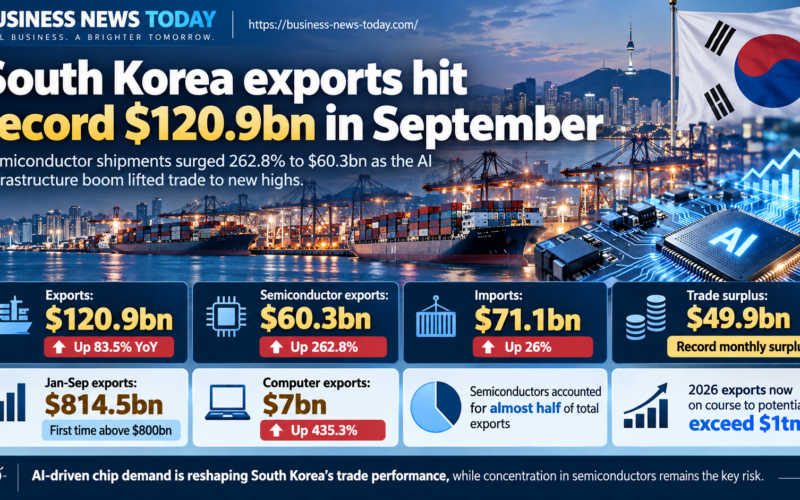
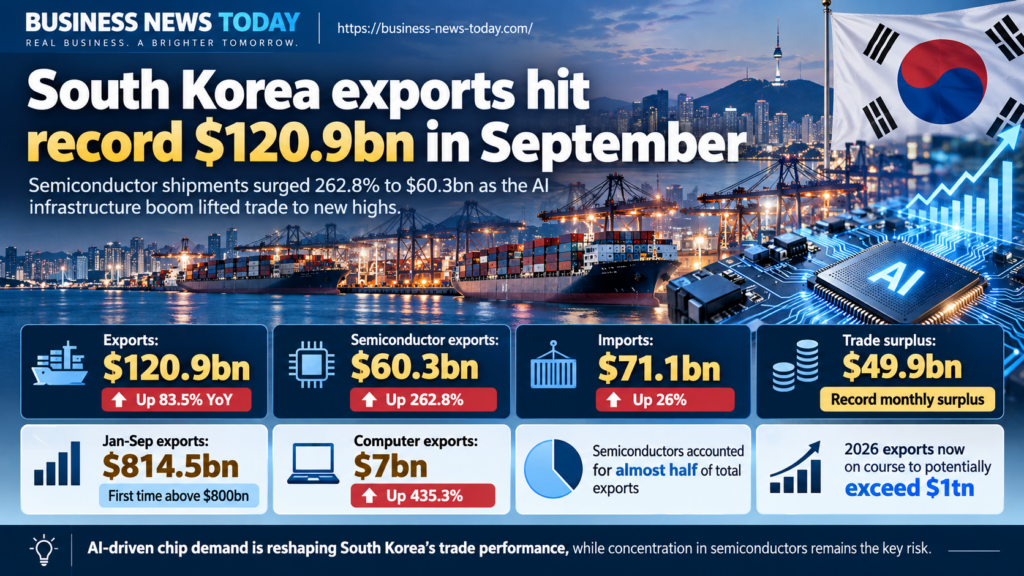
South Korea’s exports surged 83.5% from a year earlier to a record $120.9 billion in September, breaking the $120 billion monthly threshold for the first time as semiconductor shipments more than tripled. Customs data released on October 1 showed chip exports increasing 262.8% to $60.3 billion, meaning semiconductors accounted for almost half of the country’s total outbound shipments during the month.
Imports rose 26% to approximately $71.1 billion, producing a record trade surplus of about $49.9 billion. January-September exports reached $814.5 billion, surpassing $800 billion for the first time over that period and already exceeding South Korea’s previous full-year export record of $709.3 billion. The extraordinary September performance has put the country on course to potentially exceed $1 trillion of annual exports for the first time.
Why did South Korea’s September exports rise by an extraordinary 83.5% year on year?
The single largest factor was semiconductors. Chip exports climbed almost 263% to $60.3 billion as global investment in artificial-intelligence infrastructure continued driving demand for memory, servers and computing systems. South Korea hosts some of the world’s most important memory-chip producers and is especially exposed to demand for high-bandwidth memory and advanced server components.
The increase was not simply a calendar distortion. Average exports per working day were also 104.9% higher than a year earlier, according to the September data, indicating strong underlying shipment momentum even after adjusting for differences in working days.
Computer exports provided another remarkable data point, increasing 435.3% to $7 billion amid demand for agentic AI and broader computing infrastructure. That suggests South Korea is benefiting not only from raw chip demand but from a wider investment cycle spanning servers and related hardware.
Why are South Korean semiconductor companies benefiting so strongly from the AI infrastructure boom?
Generative and agentic AI systems require enormous memory bandwidth alongside specialised processors. High-bandwidth memory has consequently become one of the most valuable parts of the semiconductor supply chain because advanced accelerators need rapidly accessible memory to process enormous data volumes.
South Korean manufacturers possess major positions in memory technology, creating direct exposure to data-centre capital expenditure by companies across the United States, China and other markets. The impact is visible in export statistics because semiconductor shipments can scale rapidly when prices and physical volumes rise simultaneously.
The current cycle differs from the traditional smartphone or personal-computer semiconductor cycle. AI infrastructure involves large, concentrated purchases of high-value equipment and memory, enabling export revenue to grow much faster than consumer-electronics unit volumes alone would suggest.
Is South Korea really on track to export more than $1 trillion in 2026?
September’s numbers put that possibility within reach. Exports for the first nine months reached $814.5 billion, already more than the entire previous record year, leaving only $185.5 billion needed during October through December to reach $1 trillion.
Industry Minister Kim Jung-kwan said reaching $1 trillion was expected, while cautioning that protectionism and Middle Eastern instability remain significant risks. Those caveats matter because an export economy as globally integrated as South Korea can be affected rapidly by trade restrictions, energy costs or weaker demand in major markets.
The trillion-dollar threshold would be economically symbolic rather than transformative by itself, but it would illustrate how quickly the AI capital-spending cycle has altered South Korea’s export base. The more important question is whether this level of semiconductor demand persists after the current infrastructure buildout matures.
What does the record $49.85 billion trade surplus mean for the Korean economy?
A large trade surplus brings more foreign currency into the economy through exports than leaves through merchandise imports. That can support the won, improve the external balance and provide a buffer against periods of financial-market volatility.
The scale of September’s surplus is particularly unusual because imports themselves rose 26%. South Korea therefore achieved the record not through collapsing domestic demand for foreign products but because exports expanded dramatically faster.
Strong exports can also support corporate profits, investment and employment across logistics, industrial equipment and technology. However, concentration around semiconductors creates vulnerability if the AI investment cycle slows abruptly or customers begin reducing inventory.
How could the export boom affect the Bank of Korea’s interest-rate decisions?
South Korea’s central bank has already been tightening. The Bank of Korea raised its key policy rate to 3% in August, its second consecutive increase, and lifted its 2026 economic growth forecast from 2.6% to 3.3%. Policymakers’ median projection suggests another quarter-point increase may be needed, although Governor Shin Hyun Song has indicated tightening should remain gradual.
Record exports strengthen the argument that the economy can tolerate higher borrowing costs because external demand is providing substantial support. The central bank may therefore have more room to concentrate on inflation and financial stability without worrying that modest additional tightening will immediately push the economy into contraction.
The counterargument is that higher rates can eventually affect domestic investment and households even when exporters are booming. Policymakers must therefore determine whether exceptionally strong technology exports are broad enough to support the wider economy or concentrated in a relatively small number of globally competitive companies.
What are the key takeaways from South Korea’s record September trade numbers?
September exports reached $120.9 billion, up 83.5% from a year earlier, while semiconductor exports hit an unprecedented $60.3 billion after increasing almost 263%. Imports were approximately $71.1 billion, leaving South Korea with a record trade surplus approaching $50 billion.
The numbers confirm that the global AI infrastructure boom has become a macroeconomic force for South Korea rather than simply a technology-sector story. Chips and computers are now lifting national export growth strongly enough to influence currency, monetary-policy and GDP expectations.
The risk is concentration. South Korea is benefiting enormously while AI capital expenditure accelerates, but dependence on semiconductors means any correction in memory pricing or data-centre investment could eventually produce an equally visible slowdown.
Discover more from Business-News-Today.com
Subscribe to get the latest posts sent to your email.

