

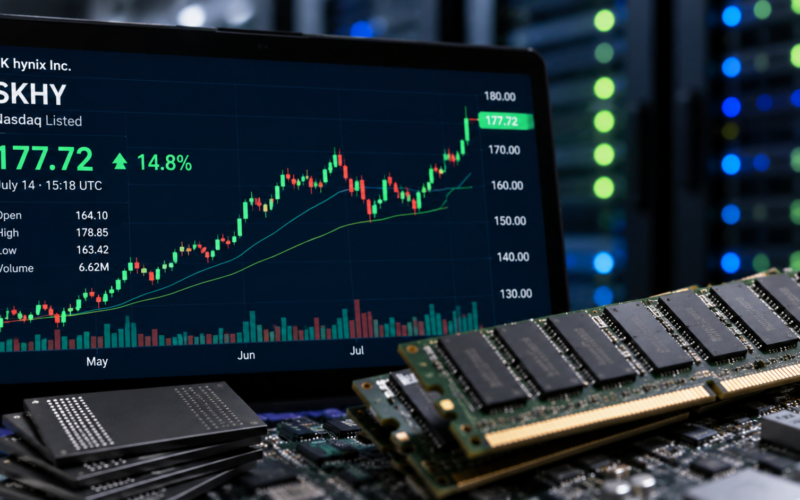
SK hynix Inc. (NASDAQ: SKHY) shares rebounded sharply on July 14, trading at US$177.72 at 15:18 UTC, approximately 14.8% above the previous close and 19.3% above the US$149 offering price. The South Korean semiconductor manufacturer is a leading producer of high-bandwidth memory, dynamic random-access memory and NAND flash products used across artificial intelligence servers, data centres and consumer electronics. However, the central question surrounding SK hynix stock is no longer whether the company is benefiting from the artificial intelligence infrastructure boom. It is whether United States investors are paying too large a premium for Nasdaq access to an equity already traded in South Korea.
The next major operating test is expected on July 23, when SK hynix is scheduled to report its second-quarter 2026 results. Until then, the stock may remain caught between exceptional earnings momentum, intense enthusiasm for artificial intelligence memory and an unusual pricing gap between the Nasdaq American depositary shares and the underlying Korean ordinary shares.
What exactly does an SK hynix American depositary share represent?
SK hynix sold 177.9 million American depositary shares at US$149 each, raising approximately US$26.5 billion before fees and expenses. Ten American depositary shares represent one ordinary SK hynix share traded on the Korea Exchange under ticker 000660.
The offering therefore involved 17.79 million newly issued ordinary shares, representing roughly 2.5% of the company’s enlarged share capital. The transaction creates dilution for existing shareholders, but it also delivers a substantial pool of growth capital without materially weakening a balance sheet that was already in a net cash position.
Trading began on July 10 on a when-issued basis under the temporary ticker SKHYV. Regular trading under the permanent SKHY ticker started on July 13, while settlement of the offering was scheduled for July 14. The United States trading record is consequently too short to provide meaningful five day, one month or conventional 52-week performance comparisons. The displayed 52-week range is effectively only the range established during the first few trading sessions.
SK hynix plans to direct the proceeds towards semiconductor production capacity and advanced manufacturing equipment. The company’s disclosed priorities include the first fabrication facility at the Yongin Semiconductor Cluster, the P&T7 advanced packaging facility in Cheongju and purchases of extreme ultraviolet lithography equipment. These investments are intended to support future high-bandwidth memory and advanced dynamic random-access memory production rather than fund ordinary operating losses.

Why is SKHY trading at such a large premium to the Korean shares?
SK hynix’s Korean shares closed July 14 at 1.913 million won, up 3.7% for the session but approximately 36% below their June 25 record of 2.987 million won. Based on the prevailing currency conversion reported during the session, that Korean closing price was equivalent to roughly US$1,279.90 per ordinary share, or about US$127.99 for each one-tenth share represented by a Nasdaq American depositary share.
Against that reference value, the US$177.72 SKHY price implied a premium of approximately 39%. The percentage will move with the Nasdaq price, the Korean share price and the exchange rate, but the gap is large enough to become a separate component of the investment case.
Part of the premium reflects demand from United States investors seeking direct exposure to SK hynix without purchasing shares in Seoul. Conversion restrictions and the lack of complete fungibility between the two securities make it difficult for arbitrageurs to eliminate the difference immediately. The rapid appearance of leveraged exchange-traded products linked to SKHY may also be contributing to short-term price swings.
However, the Nasdaq American depositary shares and the Korean ordinary shares represent economic exposure to the same company. The premium does not provide SKHY holders with a separate claim on SK hynix’s high-bandwidth memory operations or United States revenue.
That distinction is critical. A narrowing premium could occur through a rise in the Korean shares, a decline in SKHY or some combination of both. Strong company results do not automatically protect the Nasdaq security if the access premium compresses independently of the underlying business.
Is SK hynix’s operating momentum strong enough to support investor enthusiasm?
SK hynix enters its Nasdaq era with exceptionally strong financial momentum. The company reported 2025 revenue of 97.1467 trillion won, operating profit of 47.2063 trillion won and net profit of 42.9479 trillion won. Revenue increased 47% from 2024, while operating profit more than doubled.
The acceleration continued during the first quarter of 2026. SK hynix reported revenue of 52.5763 trillion won, operating profit of 37.6103 trillion won and net profit of 40.3459 trillion won. Its operating margin reached 72%, reflecting strong memory pricing, artificial intelligence demand and an increasingly favourable mix of high-value products.
The balance sheet also strengthened considerably. Cash and short-term financial investments reached approximately 54.3 trillion won at the end of the quarter, while interest-bearing debt declined to around 19.3 trillion won. That left the company with net cash of approximately 35 trillion won before receiving the Nasdaq offering proceeds.
These figures explain why SK hynix is attracting institutional and retail attention. This is not an early-stage artificial intelligence company promising future demand. It is an established semiconductor manufacturer already converting the artificial intelligence investment cycle into revenue, profit and cash.
Nevertheless, a 72% operating margin should not automatically be treated as a permanent baseline. Memory semiconductors have historically experienced pronounced pricing cycles, and first-quarter net income also benefited from non-operating items. The more useful question is whether SK hynix can maintain attractive returns as new capacity enters production and customers gain additional sourcing options.
Which SK hynix catalysts could determine the next share-price move?
The second-quarter results expected on July 23 represent the nearest measurable catalyst. Investors will be looking beyond headline revenue and profit to examine dynamic random-access memory pricing, NAND pricing, shipment growth, high-bandwidth memory product mix and the pace of capital expenditure.
Guidance surrounding HBM4 will be particularly important. SK hynix has moved into large-scale production of HBM4 and announced in June that it had shipped samples of its next-generation 12-layer HBM4E product to major customers. HBM4E is intended to deliver higher bandwidth for future artificial intelligence accelerators, with commercial production planned after customer qualification and manufacturing preparation.
Management’s commentary on supply will also matter. Chief Executive Kwak Noh-jung has indicated that memory demand could continue exceeding supply beyond 2030, with particularly severe constraints possible in 2027. That outlook supports the case for aggressive expansion, but it remains management’s assessment rather than a guaranteed industry outcome.
A proposed South Korean legislative amendment could provide another longer-term catalyst by allowing strategically important technology groups to establish factory joint ventures with outside investors under specified ownership conditions. The change could give SK hynix additional financing flexibility, although the proposal has not yet become final law.
Does the low forward valuation make SK hynix stock inexpensive?
At the July 14 Korean closing price, SK hynix carried a trailing price-to-earnings ratio of approximately 18 times. Published forward estimates placed the Korean shares closer to five times forecast earnings, reflecting expectations of another major increase in 2026 profit.
Applying the Nasdaq premium produces a different picture. At US$177.72, the American depositary shares implied an equity valuation of approximately US$1.3 trillion if the entire company were valued at the Nasdaq price. The corresponding trailing earnings multiple would be closer to the mid-20s, while the forward multiple would move towards approximately six to seven times, depending on the earnings estimate and exchange rate used.
A six to seven times forward multiple can appear inexpensive beside many artificial intelligence-linked companies. Yet memory producers often appear cheapest when industry profits are close to a cyclical high. The denominator in the price-to-earnings calculation is unusually large because pricing, product mix and capacity constraints are currently working in SK hynix’s favour.
The valuation debate therefore cannot be settled by quoting a single forward multiple. Investors need to decide whether the present earnings surge represents a structurally longer artificial intelligence memory cycle or an exceptionally profitable phase that will eventually attract enough capacity and competition to reduce margins.
What are the principal risks facing the SK hynix investment case?
The first risk is specific to SKHY rather than SK hynix itself. Nasdaq investors are paying a substantial premium over the underlying Korean shares. Even if the company continues performing well, compression of that premium could limit the American depositary shares’ returns.
The second risk is the memory cycle. SK hynix and its competitors are committing enormous sums to new production capacity, packaging facilities and advanced equipment. If artificial intelligence capital expenditure slows or additional capacity arrives faster than demand, memory pricing and operating margins could weaken. The same operating leverage that has produced extraordinary profits can work in the opposite direction during an oversupplied market.
The third risk combines technology execution and customer exposure. SK hynix must maintain its lead as Samsung Electronics and Micron Technology advance competing high-bandwidth memory products. Revenue is also concentrated among major technology customers and United States-facing sales channels, making qualification delays, order changes or export-control developments potentially material.
None of these risks invalidates the company’s current strength. They establish the evidence required for the valuation to remain credible: successful HBM4 qualification, disciplined capacity deployment, durable pricing and a return on new investment that exceeds the cost of the added capital.
What evidence would strengthen or weaken the SKHY investment case?
The bullish interpretation is supported by record earnings, a strong net cash position, technological leadership in high-bandwidth memory and direct exposure to artificial intelligence infrastructure spending. The US$26.5 billion Nasdaq raise gives SK hynix additional capacity to finance projects that could reinforce its competitive position.
The more cautious interpretation begins with the price being paid for that exposure. SKHY has already experienced a 52-week-style trading range of roughly US$151 to US$179 despite being listed for only a few sessions. It surged on debut, fell sharply during its first regular trading session and then rebounded by double digits. That is not enough history to establish a stable market valuation.
The July 23 results should provide the first substantial operating checkpoint for Nasdaq investors. Strong revenue alone may not be sufficient. The market will need evidence that margins remain durable, HBM4 production is progressing, capital expenditure is being deployed efficiently and customer demand supports the company’s ambitious expansion.
SK hynix has earned its position near the centre of the artificial intelligence supply chain. The unresolved issue is whether Nasdaq investors are valuing the semiconductor business or paying an additional scarcity price for easier access to it. For SKHY, the answer to that question may matter almost as much as the next earnings report.
Key takeaways for investors following SK hynix stock after its Nasdaq debut
- SK hynix raised approximately US$26.5 billion by selling 177.9 million American depositary shares at US$149 each.
- SKHY traded at US$177.72 at 15:18 UTC on July 14, around 19.3% above its offering price.
- Ten SKHY American depositary shares represent one SK hynix ordinary share listed in South Korea.
- The Nasdaq security was trading at an estimated premium of approximately 39% over the Korean shares during the session.
- Record first-quarter earnings and a 35 trillion won net cash position support the operating case.
- The July 23 second-quarter results and HBM4 progress are the next measurable catalysts.
- Premium compression, memory-cycle reversal and execution across SK hynix’s expansion programme remain the principal risks.
Discover more from Business-News-Today.com
Subscribe to get the latest posts sent to your email.