




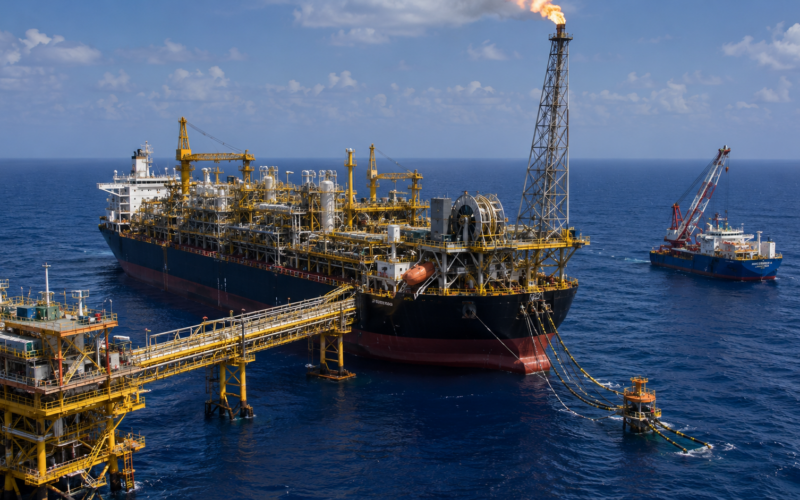
The Greater PAJ Project is a $5.1 billion Azule Energy-operated deepwater oil development located about 200 kilometres offshore Angola across Blocks 31 and 31/21. The project brings together five ultra-deepwater fields, with Palas, Astraea and Juno in Block 31, and Urano and Dione in Block 31/21. Block 31 is operated by Azule Energy with partners Sonangol, SSI Thirty-One and Equinor, while Block 31/21 is operated by Azule Energy with Equinor as its partner.
Azule Energy and its partners reached final investment decision for Greater PAJ on June 22, 2026, moving Angola’s first integrated cross-block offshore development into execution. The project is designed to sustain Angola’s offshore oil production through a coordinated model that combines fields, infrastructure and investment allocation across two adjacent concessions instead of developing each discovery as a separate standalone project.
The project’s core production asset will be a new floating production storage and offloading (FPSO) with nameplate oil production capacity of 95,000 barrels per day. The development will also include 17 wells and gas export capacity of 70 million standard cubic feet per day, with gas to be delivered to the Angola LNG plant through a new gas export line tied into the existing Block 31 gas export network. First oil is expected in the first half of 2029.
Greater PAJ matters because Angola is a mature offshore producer that needs new deepwater developments to offset natural decline from older fields. The country has significant offshore resources, but sustaining production increasingly depends on complex projects that combine subsea tiebacks, FPSOs, shared infrastructure, local fabrication and international contractor execution. Greater PAJ is one of the clearest examples of that new development model.
Where is the Greater PAJ Project located and what fields are being developed?
The Greater PAJ Project is located approximately 200 kilometres offshore Angola in ultra-deepwater conditions. The development spans Blocks 31 and 31/21 and brings together five fields: Palas, Astraea and Juno in Block 31, and Urano and Dione in Block 31/21.
The project sits in water depths generally described as ranging from around 1,500 metres to 2,000 metres. That deepwater setting shapes almost every technical and commercial element of the development. Wells, pipelines, umbilicals, risers, installation vessels, subsea controls and intervention systems must be designed for remote operations, high pressure and challenging offshore logistics.
The cross-block structure is the defining feature of the Greater PAJ Project. Instead of developing each discovery through separate facilities, Azule Energy and its partners are using a shared FPSO and export systems for the wider cluster. This allows the project to pool resources from adjacent concessions and improve development efficiency.
That model is especially relevant in mature offshore basins. As fields become smaller, deeper or more complex, the economics of standalone developments become harder. Shared infrastructure can improve project viability by spreading facility, pipeline, installation and operating costs across multiple reservoirs.
Who owns and operates the Greater PAJ Project?
The Greater PAJ Project is operated by Azule Energy, the Angola-focused independent joint venture owned equally by Eni S.p.A. and bp p.l.c. Azule Energy is one of Angola’s largest upstream operators and has become central to the country’s current offshore development cycle.
The ownership structure differs by block. Block 31 is operated by Azule Energy Exploration (Angola) Limited with a 26.67% interest. Its partners are Sonangol Exploração & Produção with 45%, SSI Thirty-One Limited with 15% and Equinor Angola Block 31 AS with 13.33%.
Block 31/21 is operated by Azule Energy Angola B.V. with a 50% interest. Equinor Angola Block 31/21 AS holds the remaining 50% interest. The Block 31/21 production-sharing agreement was signed in 2023, creating the framework for the newer part of the integrated development.
Angola’s National Agency for Petroleum, Gas and Biofuels, known as ANPG, is the national concessionaire and regulatory authority involved in the project framework. Its role is important because Greater PAJ is not just a corporate investment. It is also part of Angola’s national strategy to promote efficient resource management, optimise infrastructure and sustain oil production.
The ownership and regulatory model make Greater PAJ a hybrid of commercial project execution and national resource strategy. Azule Energy leads development and operations, international and national partners share resource interests, and ANPG provides the concession and regulatory framework through which the cross-block model can proceed.
What is the production capacity and reserve base of the Greater PAJ Project?
The Greater PAJ Project will use a new FPSO with nameplate production capacity of 95,000 barrels of oil per day. Public tender material has also described the FPSO as having storage capacity of 1.4 million barrels, which is material because offshore oil developments need enough storage to manage production, cargo scheduling and export operations.
The overall development concept includes 17 wells connected to the FPSO. These comprise 10 oil producers and seven water injectors. Four of the oil producers and three of the water injectors are in Block 31/21, while the rest are associated with Block 31.
The reserve base associated with the Greater PAJ development is estimated at 252 million barrels, with approximately 144 million barrels in Block 31 and 108 million barrels in Block 31/21. This reserve base helps explain why the project can support a dedicated new FPSO rather than relying only on small tiebacks to existing facilities.
The development also includes gas export capacity of 70 million standard cubic feet per day. That gas is expected to flow to Angola LNG through a new gas export line tied into the existing Block 31 gas export network. This element is important because modern offshore oil developments are increasingly assessed not only by oil production but also by how associated gas is handled.
The project’s capacity should be understood as nameplate and development capacity, not guaranteed daily output throughout the field life. Actual production will depend on reservoir performance, well productivity, water injection efficiency, FPSO uptime, maintenance cycles, weather, subsea system reliability and export logistics.
How will the Greater PAJ Project be developed and monetised?
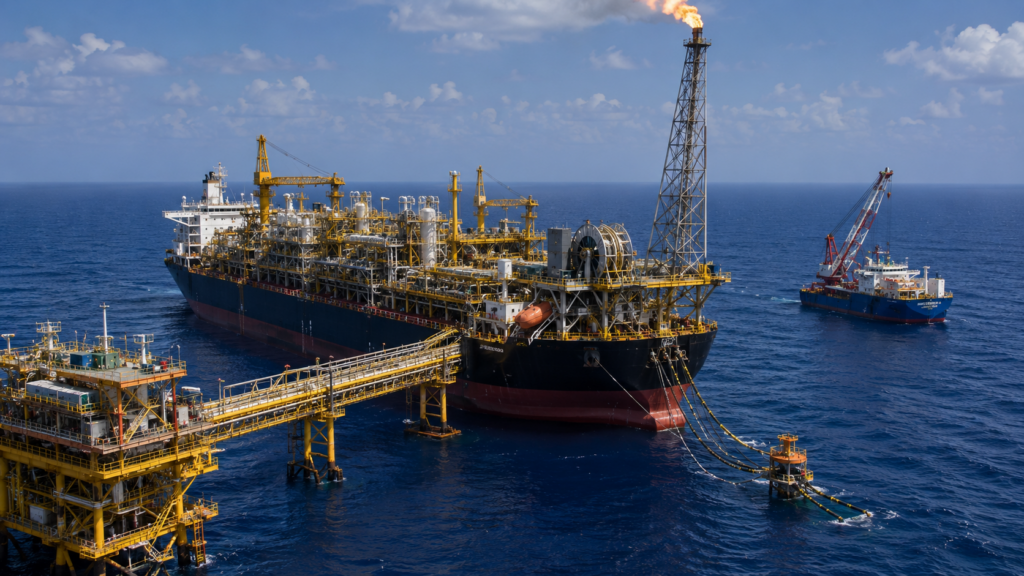
The Greater PAJ Project will be developed through an ultra-deepwater subsea-to-FPSO system. Oil from the five fields will flow from subsea wells through production systems, flexible flowlines, risers and rigid pipelines to the new FPSO. The FPSO will process, store and offload crude oil to export tankers.
Water injection will support reservoir pressure management and help sustain production. This is especially important in deepwater oil developments because field economics depend not only on initial production rates but also on recovery efficiency and decline behaviour over time.
The FPSO will perform the central offshore processing role. It will receive produced fluids, separate oil, gas and water, stabilise the oil, store crude on board and offload cargoes to shuttle or export tankers. Gas export infrastructure will connect the development to Angola LNG, giving the project a route to monetise or manage associated gas.
The use of common infrastructure across two concessions is the commercial heart of the project. Shared FPSO capacity, shared export systems and integrated subsea architecture can reduce duplication and improve capital efficiency. At the same time, cross-block development requires careful allocation of investment, production, operating costs and revenues across different ownership groups.
This makes Greater PAJ a technically and commercially complex development. Its success depends on reservoir performance, FPSO delivery, subsea installation, contractor coordination, regulatory alignment and the ability to operate common facilities in a way that works for both concessions.
Which companies won major contracts for the Greater PAJ Project?
The Greater PAJ Project has a deep contractor ecosystem because the development requires a new FPSO, subsea production systems, umbilicals, risers, flowlines, rigid pipelines, transportation, installation and local fabrication.
CIMC Raffles signed the EPCIC contract for the Greater PAJ FPSO. Its scope covers the full floating production vessel workflow, including FEED, basic and detailed design, procurement of materials and equipment, construction, towage, offshore installation and commissioning. The FPSO will carry out oil and gas reception, processing, storage and offloading functions and is designed for production capacity of up to 95,000 barrels per day.
Baker Hughes was awarded a subsea production systems contract for the development. Its scope includes deepwater horizontal tree systems, subsea control modules, intervention workover control systems and associated connection, distribution and topside equipment. Delivery of subsea trees is expected to begin in 2027.
SLB OneSubsea was awarded the umbilical systems and associated services contract. The scope includes approximately 46 kilometres of dynamic and static umbilicals, topside and subsea ancillaries, and offshore installation support for the Palas, Astraea, Juno, Urano and Dione fields.
TechnipFMC was awarded a significant flexible pipe contract to supply flexible flowlines and risers. The company will design and manufacture flexible systems to connect wells in water depths approaching 2,000 metres to the new floating production unit.
Vallourec was awarded a major line pipe contract by Azule Energy. The contract covers more than 26,000 tonnes of seamless carbon steel line pipes, representing approximately 210 kilometres of pipeline, including advanced heavy thermal insulation coating. Deliveries are expected to begin in July 2027 and continue through December 2027.
Saipem was awarded a $1 billion offshore transportation and installation contract with a duration of around 40 months. Its scope includes engineering, fabrication, transportation and installation of approximately 180 kilometres of rigid pipelines and subsea facilities in water depths reaching up to 2,000 metres. Saipem’s scope also includes transportation and installation of 38 kilometres of flexible flowlines and jumpers and 54 kilometres of umbilicals. Fabrication work will be carried out at Saipem’s Ambriz yard in Angola, while the offshore campaign will use vessels including FDS and Castorone.
These contracts show why Greater PAJ is one of the most contractor-intensive offshore projects sanctioned in Africa in 2026. It is not simply an FPSO award. It is a full subsea, pipeline, riser, umbilical, installation and fabrication programme.
How did the Greater PAJ Project evolve before the 2026 final investment decision?
The Greater PAJ Project evolved from a need to develop adjacent deepwater resources more efficiently. The fields involved sit across two blocks with different ownership structures. A conventional approach could have led to separate development concepts, but Greater PAJ uses common infrastructure to unlock resources across both concessions.
The Block 31 fields, including Palas, Astraea and Juno, sit within a block with a longer operating history. The Block 31/21 fields, including Urano and Dione, became part of the integrated concept after the 2023 production-sharing framework for Block 31/21. The project’s cross-block structure was designed to align these resources under a shared development model.
The final investment decision in June 2026 marked the point at which years of reservoir appraisal, concept selection, commercial alignment, partner approval, regulatory coordination and contractor tendering moved into execution. The FID also included the signing of six main contracts covering the FPSO, subsea production systems, umbilicals, flexible flowlines and risers, rigid pipes, and transportation and installation.
The development has strong local-content relevance. Official project materials state that Greater PAJ is expected to generate around 1.8 million hours of local-content work, combining large-scale fabrication with onshore and offshore support, training and mobilisation of Angolan workers.
That local-content component matters because Angola wants deepwater projects to support domestic industrial capability, not only offshore production volumes. The use of Saipem’s Ambriz yard and local workforce participation shows how part of the project value chain is expected to remain within Angola.
What are the latest Greater PAJ Project developments and operational updates in 2026?
The most important 2026 update is the final investment decision announced on June 22. The FID confirmed the development of five fields across Blocks 31 and 31/21, a new FPSO, 17 wells, first oil expected in the first half of 2029 and an integrated infrastructure model.
The FID ceremony also confirmed the signing of major contracts across the project lifecycle. The FPSO contract went to CIMC Raffles, subsea production systems to Baker Hughes, umbilicals to SLB OneSubsea, flexible flowlines and risers to TechnipFMC, rigid pipes to Vallourec, and transportation and installation to Saipem.
Subsequent contractor disclosures in late June and July 2026 added more execution detail. Vallourec confirmed that deliveries under its line pipe contract are scheduled from July to December 2027. Baker Hughes confirmed that delivery of subsea trees is expected to begin in 2027. SLB OneSubsea confirmed its umbilical scope in July 2026, while Saipem detailed the scale of its pipeline and installation work.
These updates make 2026 the transition year from sanction to execution. The project is no longer only a development concept or resource opportunity. It has entered the contracting, fabrication, engineering and procurement stage that will determine whether first oil can be delivered in the first half of 2029.
The schedule is ambitious but not unusual for a deepwater FPSO project that has already reached FID with major contracts signed. The critical path is likely to involve FPSO engineering and construction, subsea hardware delivery, line pipe manufacturing, offshore installation readiness and coordination between vessel delivery and well connection.
What regulatory and geopolitical factors affect the Greater PAJ Project?
The Greater PAJ Project is governed by Angola’s petroleum concession framework and the oversight of ANPG. The project’s integrated model required alignment across two adjacent concessions, which makes the regulatory structure more complex than a single-block development.
The cross-block approach is strategically important for Angola because it supports efficient resource development. By allowing common infrastructure to serve fields across different blocks, the country can reduce duplication, improve economics and unlock reserves that might otherwise remain stranded or delayed.
Geopolitically, Greater PAJ supports Angola’s effort to remain a major African oil supplier. Angola has faced natural production decline from mature offshore fields, making new deepwater investment essential for maintaining crude output, export revenue and fiscal stability.
The project also comes at a time when global oil markets continue to value deepwater barrels from politically and geographically diversified sources. Angola’s offshore sector competes for capital with Brazil, Guyana, the United States Gulf of Mexico, Namibia and other deepwater regions. A sanctioned project of more than $5 billion signals that Angola can still attract large-scale investment when resources, regulation and operator execution align.
The project is also relevant to Angola’s national energy and industrial policy. Local fabrication, workforce training and offshore services can support domestic capacity, especially when major contractors use Angolan yards and suppliers. The challenge is ensuring that local-content commitments translate into lasting industrial capability rather than only temporary construction work.
What environmental and operational risks shape Greater PAJ?
Greater PAJ is an ultra-deepwater oil development, which means environmental and operational risks are significant. Operations in water depths up to around 2,000 metres require robust subsea systems, reliable controls, high-integrity flowlines and detailed emergency response planning.
The gas export system is an important part of the environmental profile. Associated gas from the FPSO is expected to be exported to Angola LNG through a new line tied into the existing Block 31 gas export network. This can support better gas utilisation compared with developments that lack a gas export route, although the project remains a hydrocarbon development with lifecycle emissions from production, transportation, processing and eventual fuel use.
Subsea flow assurance is another operational consideration. Deepwater pipelines and flowlines must manage pressure, temperature, wax, hydrates and other production risks. Vallourec’s heavy thermal insulation scope highlights the technical demands of maintaining safe and efficient hydrocarbon flow in ultra-deepwater conditions.
FPSO reliability will also be central to project performance. A 95,000 barrels-per-day nameplate facility can materially support Angola’s production profile, but only if uptime, maintenance, offloading, water injection, gas export and subsea reliability are sustained.
The project’s risk profile is therefore typical of major deepwater developments: high capital intensity, long execution cycles, complex offshore installation, production uncertainty and environmental scrutiny. The advantage is that Azule Energy and its partners are using established deepwater technologies and experienced contractors rather than relying on unproven operating concepts.
How does the Greater PAJ Project affect Azule Energy and Angola’s production strategy?
For Azule Energy, Greater PAJ is a major growth and sustaining-production project. The company already operates important offshore assets in Angola, and Greater PAJ strengthens its position as one of the country’s central upstream investors.
The project is also strategically important for Eni and bp because Azule Energy is their shared vehicle for upstream growth in Angola. The FID demonstrates that the joint venture can move major projects from concept to execution while coordinating with Sonangol, Equinor and the Angolan authorities.
For Sonangol, participation in Block 31 gives Angola’s national oil company exposure to a major deepwater redevelopment and production-sustaining project. For Equinor, the project provides a continuing role in Angola’s deepwater sector across both Block 31 and Block 31/21.
For Angola, the project supports a national strategy of sustaining oil production through infrastructure optimisation rather than only frontier exploration. The integration of five fields, common FPSO capacity and shared export systems creates a more efficient route to monetising deepwater resources.
Greater PAJ also supports Angola LNG through planned gas export. That connection matters because associated gas can become an additional value stream when export and processing infrastructure are available. It also reinforces the importance of linking upstream oil projects with gas monetisation routes.
What could limit the Greater PAJ Project’s output or expansion potential?
The main near-term limitation for Greater PAJ is execution risk. The project depends on the timely delivery of a new FPSO, subsea trees, umbilicals, flexible flowlines, risers, rigid pipelines and offshore installation campaigns. Any delay in one major component can affect the wider first-oil schedule.
FPSO delivery is likely to be one of the most important schedule drivers. The vessel must be engineered, built, equipped, tested, towed to Angola, installed, commissioned and integrated with the subsea production system. FPSO projects can face delays from yard productivity, equipment delivery, commissioning complexity and integration challenges.
Subsea hardware and pipeline delivery are also critical. Baker Hughes, TechnipFMC, SLB OneSubsea, Vallourec and Saipem all have major roles that must converge before first oil. In deepwater projects, integration between supplier packages is often as important as each package’s standalone delivery.
Reservoir performance is another risk. The reserve base supports the development, but actual production will depend on well results, reservoir connectivity, water injection performance and decline behaviour. Multi-field developments can improve diversification, but they also require careful reservoir management across different fields and blocks.
Commercially, oil prices and fiscal terms will influence long-term value. The FID indicates that partners see the project as viable, but the economics of future expansions or debottlenecking would depend on market conditions, production data and operating costs.
What is the future outlook for the Greater PAJ Project?
The future outlook for the Greater PAJ Project is positive but execution-sensitive. The project has reached FID, secured major contracts, identified a 95,000 barrels-per-day FPSO concept and established a first-oil target in the first half of 2029. Those are strong development anchors.
The next phase will be dominated by engineering, procurement, fabrication and offshore installation. The FPSO will be the central asset, but subsea production systems, pipelines, flexible risers, umbilicals and gas export infrastructure must all be delivered in sequence.
The project’s long-term relevance lies in its integrated cross-block model. If Greater PAJ performs well, it could become a template for developing smaller or more complex resources across adjacent offshore concessions in Angola and other mature deepwater basins. Shared infrastructure can make projects more economic, reduce duplication and sustain production from areas where standalone developments might struggle.
For Angola, the project is a timely addition to the offshore pipeline. It will not reverse all decline from mature fields by itself, but it can contribute meaningful production capacity, local-content work, gas export volumes and contractor activity.
For Azule Energy and its partners, the key test is execution. A successful first oil in the first half of 2029 would reinforce Azule Energy’s role as a major offshore operator in Angola and demonstrate that Eni and bp’s joint-venture model can deliver large capital projects. Delays or cost pressure would not remove the project’s strategic value, but they would increase scrutiny of deepwater execution risk.
In 2026, Greater PAJ stands at the moment when project ambition becomes delivery obligation. The reserves, fields, contracts and FPSO plan are now defined. The hard part is turning five ultra-deepwater fields across two blocks into a reliable production hub that can help sustain Angola’s offshore oil future.
Discover more from Business-News-Today.com
Subscribe to get the latest posts sent to your email.
