



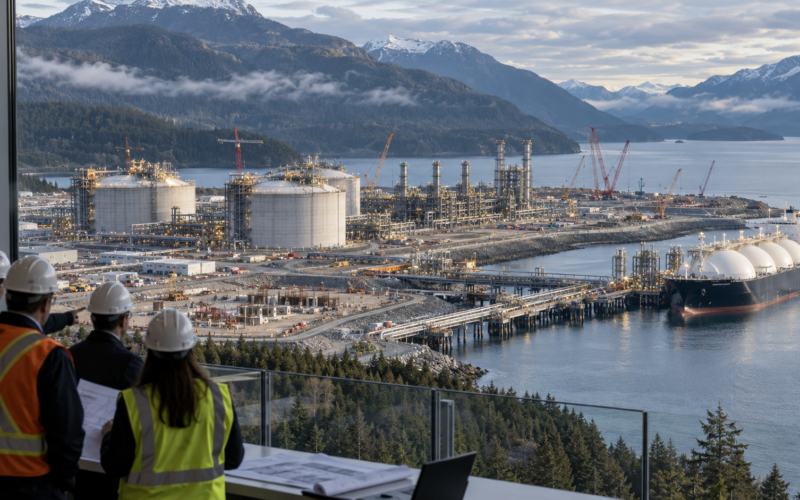
Shell plc (LSE: SHEL; NYSE: SHEL) and its partners in LNG Canada are moving closer to a decision that could transform Canada’s position in the global liquefied natural gas market only months after the project began commercial exports. Reuters reported, citing three people familiar with the matter, that the joint venture could approve Phase 2 as early as October 2026, although commercial, fiscal, regulatory and governance conditions still need to be satisfied before a final investment decision is made. The expansion would add another 14 million tonnes per annum of LNG capacity at Kitimat, British Columbia, doubling total capacity to 28 mtpa.
Shell holds the largest interest in LNG Canada at 40%, alongside PETRONAS with 25%, PetroChina with 15%, Mitsubishi Corporation with 15% and Korea Gas Corporation with 5%. Shell also lists the proposed 14-mtpa LNG Canada expansion among its key pre-final-investment-decision Integrated Gas opportunities, making the project a potentially significant contributor to the company’s longer-term LNG portfolio rather than a peripheral Canadian asset.
Why would Shell double LNG Canada so soon after Phase 1 entered service?
The logic begins with geography. LNG Canada is located on Canada’s Pacific coast, giving cargoes substantially more direct access to Asian customers than exports originating on the United States Gulf Coast. The route avoids the Panama Canal and does not require tankers to move through some of the longer Atlantic-to-Asia shipping corridors, which can reduce voyage times, shipping costs and exposure to congestion.
Those advantages have become more commercially valuable as energy buyers focus more heavily on supply security. Reuters reported that Middle East conflict, Red Sea shipping disruption and uncertainty surrounding the Strait of Hormuz have increased Asian interest in diversified LNG sources. Canada can offer an additional production region outside the traditional Middle East, US Gulf Coast and Australian supply centres.
Phase 1 already represents a major energy investment. The two initial LNG trains provide combined nameplate capacity of 14 mtpa, with the first cargo leaving the Kitimat facility in June 2025. Shell described LNG Canada at that time as an important addition to its Integrated Gas business and emphasised the project’s ability to supply Asian markets.
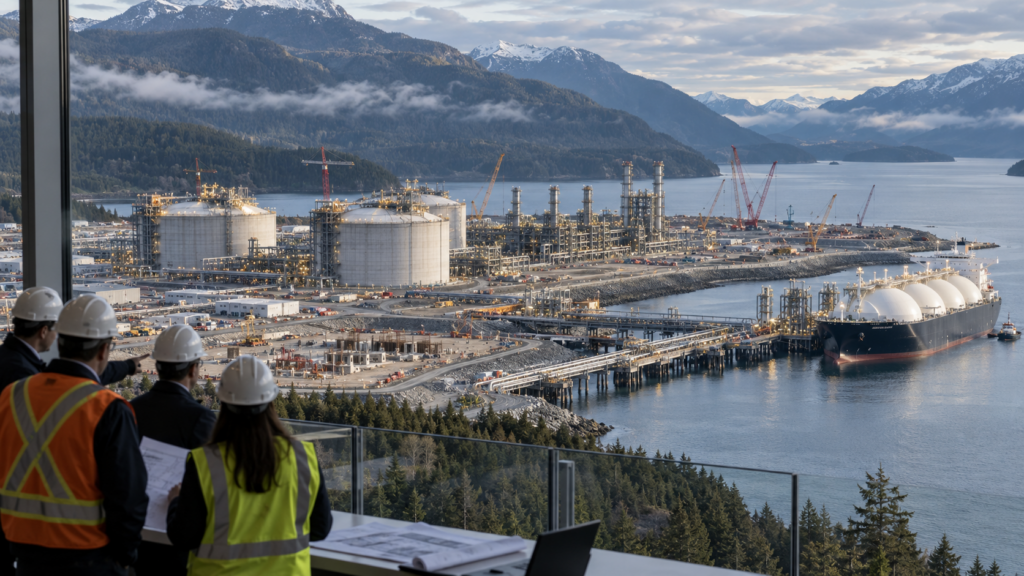
A Phase 2 sanction would therefore not represent an entirely new operating model. LNG Canada would be expanding an existing site whose export route, upstream gas supply, operating organisation and customer relationships are already being established. Brownfield-style expansion can often provide better economics than developing a completely new LNG terminal, although the additional trains would still require billions of dollars of capital and supporting infrastructure.
How large could the LNG Canada Phase 2 investment become?
The Canadian government’s Major Projects Office estimates that Phase 2 could attract approximately C$33 billion of private-sector capital if developed. That figure illustrates how much additional infrastructure sits behind another 14 mtpa of liquefaction capacity, including plant construction, upstream gas production, pipeline expansion and associated logistics.
The project has been moving toward investment readiness throughout 2026. In May, the governments of Canada and British Columbia reached an enhanced investment co-operation agreement with LNG Canada intended to close remaining issues required for a possible final investment decision during 2026. LNG Canada’s partners had already approved hundreds of millions of dollars of incremental spending to complete engineering and other critical work ahead of a potential sanction.
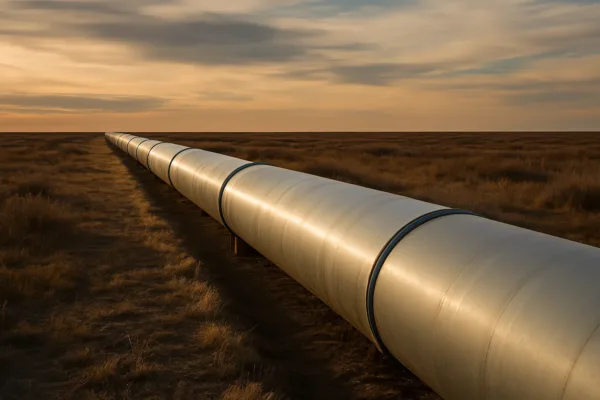
Pipeline capacity is another essential element. LNG Canada and the owners of the Coastal GasLink pipeline agreed in March to cooperate on an expansion capable of supplying the proposed second phase. Without additional gas transportation capacity, doubling liquefaction equipment at Kitimat would not translate into doubled export volumes.
These investments illustrate why a final investment decision matters more than headlines around prospective capacity. LNG developments can spend years in planning while partners negotiate engineering, fiscal arrangements and customer commitments. A formal sanction would move the project from an option in Shell’s portfolio toward committed construction capital.
Why does Phase 2 matter to Shell’s global LNG strategy?
Shell remains one of the world’s largest LNG portfolio players, combining production interests, long-term supply contracts, trading operations and shipping. Its Integrated Gas portfolio includes projects in Qatar, Nigeria, Australia, the United Arab Emirates, Trinidad and Tobago and Canada. That geographic diversity lets Shell redirect cargoes among markets as prices and customer requirements change.
LNG Canada has particular strategic value because Shell owns 40%, considerably more than its economic interest in several other major LNG projects. At full Phase 2 capacity, the Shell-equity share of the facility’s nameplate production would be equivalent to about 11.2 mtpa before considering operational performance and commercial arrangements.
The expansion would also reinforce Shell’s argument that LNG can remain an important part of the global energy system as Asian countries balance electricity demand, coal displacement and intermittent renewable generation. The eventual climate impact depends heavily on methane emissions, upstream production, shipping and which fuels LNG replaces, making the environmental debate more complicated than simply describing natural gas as lower-carbon than coal.
From a corporate perspective, however, the attraction is clearer. LNG projects can produce long-duration cash flows under contractual structures that provide greater revenue visibility than some shorter-cycle oil investments. They also feed Shell’s trading network, allowing the company to capture value beyond production alone.
What role could Indigenous investment play in LNG Canada Phase 2?
Phase 2 also contains a potentially important ownership innovation. LNG Canada and its partners have granted MNT Investments LP, representing the economic-development organisations of five neighbouring First Nations, an option to invest as much as C$1 billion in an entity that would own the planned new LNG storage tank. The special-purpose vehicle would lease the infrastructure back to LNG Canada while the project continued to operate and maintain it.
The arrangement could become one of Canada’s larger Indigenous equity stakes in energy infrastructure. It gives participating First Nations potential exposure to long-term infrastructure income rather than limiting economic participation to construction employment or service contracts.
For Shell and the other partners, local ownership may strengthen alignment around a project expected to operate for decades. It does not eliminate questions around environmental effects or broader Indigenous views, but it creates a more direct financial link between neighbouring communities and the expansion.
What are the biggest risks before Shell approves Phase 2?
Capital discipline remains the first risk. LNG Canada Phase 1 was developed at an estimated cost around C$40 billion, and another large investment must compete with Shell’s other opportunities for shareholder capital. Management must therefore believe the returns available in Canada justify committing billions of dollars for several years before full production begins.
Global LNG supply is another variable. The United States, Qatar, Canada and other exporters are adding substantial capacity, meaning projects sanctioned during today’s relatively tight market could enter service in a more competitive environment later in the decade. Asian gas demand must grow sufficiently to absorb new production without causing prolonged price weakness.
Construction inflation, labour availability and pipeline execution can also change project economics. Canadian megaprojects have historically faced high construction costs, and a development of this size would require large workforces and sophisticated supply chains.
The counterargument is that supply security has become more valuable. Buyers may be prepared to sign long-term agreements with geographically diversified suppliers even when cheaper spot cargoes are periodically available.
What does the latest Shell share performance suggest?
Shell shares were broadly stable around the Reuters report, with London market data showing the stock approximately 0.15% lower during the September 17 session. That modest movement is unsurprising because Phase 2 has not yet been sanctioned and Shell is a very large diversified energy company whose daily valuation is driven by oil prices, LNG markets, shareholder distributions and multiple global projects.
The more meaningful investor event would be a formal investment decision accompanied by updated capital requirements, expected start-up timing and return expectations. Shell has already identified the expansion as a key pre-FID option, so investors know the opportunity exists.
What may be changing is urgency. LNG Canada began as a project designed to open Canadian gas to Asian markets. Phase 2 could turn it into one of the most strategically important Pacific LNG export platforms just as buyers are putting a larger premium on supply diversification.
Discover more from Business-News-Today.com
Subscribe to get the latest posts sent to your email.