
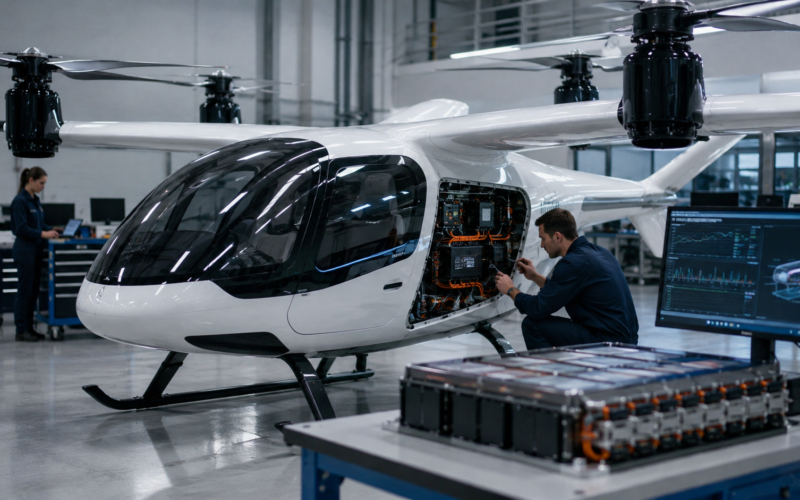
SES AI Corporation (NYSE: SES) has entered into a framework agreement with Doroni Aerospace to design, develop, test and deliver a battery pack for the H1-X two-seat personal electric vertical takeoff and landing aircraft. The agreement carries a potential aggregate value of up to $1.09 million, but only an initial $65,000 tranche is currently committed. Work is planned across several stages during 2026 and 2027, with each additional stage dependent on Doroni Aerospace issuing a purchase order. The programme gives SES AI a route into a visible personal aviation project, although its immediate financial contribution remains modest. The central question is whether this early engineering assignment can progress from a conditional development framework into recurring battery-system revenue and eventual serial production.
What is actually committed under the SES AI and Doroni Aerospace framework agreement?
The framework covers the design and development of battery systems intended to support the H1-X ground-testing and flight-testing programme. SES AI said the work could help Doroni Aerospace begin H1-X testing as early as 2027, while the agreement also contains options for additional test systems and eventual serial production.
However, the headline ceiling of $1.09 million should not be treated as secured revenue. Doroni Aerospace is not obligated to place purchase orders for every stage, and SES AI has explicitly identified the possibility that the framework may generate less revenue than currently contemplated. The committed amount is therefore $65,000, not $1.09 million, with the balance representing conditional commercial potential.
This distinction matters because framework agreements can create a pathway to larger business without producing a conventional backlog on day one. The initial tranche is likely to fund early engineering, requirements definition and battery-system design work. Later orders would probably depend on Doroni Aerospace reaching its own aircraft development milestones, securing sufficient capital and confirming that the proposed SES AI system meets the H1-X’s evolving technical requirements.
At the midpoint of SES AI’s current 2026 revenue guidance of $30 million to $35 million, the entire $1.09 million ceiling would be equivalent to approximately 3.4 percent of annual revenue. The committed $65,000 tranche represents only about 0.2 percent of that midpoint. Even the maximum contract value is scheduled across 2026 and 2027, meaning the near-term earnings impact could be substantially smaller than the headline figure suggests.
Why does a small H1-X battery programme matter to SES AI’s broader aerospace strategy?
The strategic value is potentially greater than the initial revenue. Aviation battery programmes require suppliers to address energy density, weight, safety, thermal behaviour, power delivery, monitoring and traceability as an integrated system. Successfully supporting an aircraft test campaign could provide SES AI with operating data and engineering credibility that may be reusable across drones, robotics, defence platforms and other advanced-mobility applications.
SES AI plans to build the H1-X pack around cells developed through its Molecular Universe artificial-intelligence platform. The company said those cells are approaching energy densities of 400 watt-hours per kilogram and have undergone abuse testing involving nail penetration, overcharging and external short circuits. The proposed pack would also incorporate SES AI’s battery-health monitoring capabilities.
For SES AI, the programme creates an opportunity to demonstrate that its artificial-intelligence platform can produce more than promising materials candidates. It must show that discoveries can be translated into manufacturable cells, cells can be integrated into functional packs, and packs can perform consistently within the operating and safety constraints of an aircraft.
That commercial bridge is important. Battery companies frequently demonstrate strong laboratory performance, but customers purchase qualified systems rather than isolated cell metrics. The H1-X programme could therefore become a useful validation project even if its initial revenue remains immaterial.
The opportunity also carries customer concentration and programme-timing risk. Doroni Aerospace is a development-stage aircraft company rather than a mature aerospace manufacturer with an established production schedule. SES AI’s potential revenue is consequently tied to the progress of a customer that must still complete engineering, testing, certification and production preparation.

How could cells approaching 400 Wh/kg influence the H1-X range and payload equation?
Doroni Aerospace is marketing the H1-X as a two-seat personal aircraft with a targeted top speed of 120 miles per hour, a range of 100 miles and fast charging in approximately 25 minutes. The proposed design uses eight vertical electric ducted fans and two horizontal ducted fans, creating a demanding combination of takeoff power, cruise efficiency and energy-storage requirements. These performance figures remain company targets rather than demonstrated capabilities of a production-certified aircraft.
Higher cell-level energy density could help Doroni Aerospace allocate more of the aircraft’s weight allowance to passengers, safety systems, structure or usable range. Personal eVTOL aircraft face a particularly difficult energy equation because vertical takeoff consumes substantial power, while the battery must also retain sufficient reserves for contingencies and landing.
The approaching 400 watt-hours-per-kilogram figure should nevertheless be interpreted as a cell metric, not a completed pack metric. A battery pack also requires structural protection, electrical connections, thermal management, control electronics, containment and monitoring systems. Those components reduce system-level energy density even when the underlying cells perform strongly.
The real engineering test will therefore be the pack’s usable energy density after all safety and integration requirements are included. Doroni Aerospace will also need predictable power delivery across repeated takeoff, transition, cruise and landing cycles. A battery that performs well in a controlled test cell must still prove that it can manage temperature, degradation, vibration, charging and emergency conditions inside an aircraft.
SES AI’s monitoring technology may become as important as the underlying chemistry. An aircraft operator needs reliable estimates of battery health, available power and remaining useful capacity. Incorrect state-of-charge or state-of-health information could create operational constraints even when the cells themselves remain technically functional.
What does Doroni Aerospace’s development roadmap reveal about funding and execution risk?
Doroni Aerospace is a pre-revenue aerospace engineering and manufacturing company developing the H1-X as a two-seat personal eVTOL. Its regulatory filings state that the aircraft remains under development and is the successor to the Y6, XS and H1 P1 prototypes. Doroni Aerospace has targeted completion of a fully functional H1-X prototype during 2026, followed by testing and certification work, with initial commercial deliveries currently anticipated in 2028 or possibly early 2029.
The company has also stated that its certification and production schedule is subject to successful financing. Doroni Aerospace has been raising capital through private and Regulation A securities offerings, including a qualified offering covering up to 14 million Series Seed-3 preferred shares before bonus shares. Its filings acknowledge that the company has not yet established the manufacturing facilities or processes required for commercial H1-X production.
That funding dependency directly affects SES AI. If Doroni Aerospace cannot finance subsequent prototypes, testing or certification, it may not issue the purchase orders needed to activate later stages of the battery framework. Conversely, successful fundraising and prototype progress could turn the initial engineering assignment into a larger testing and production opportunity.
The agreement therefore links two development stories. SES AI must prove that its cells and pack architecture can meet aviation requirements, while Doroni Aerospace must prove that it can complete the aircraft, finance the certification programme and establish a credible manufacturing system.
This does not make the partnership commercially insignificant. Early supplier selection is valuable because battery architecture can influence aircraft structure, cooling, controls, charging and performance. A battery supplier that becomes embedded during detailed engineering may be difficult to replace later. The value of that position, however, will emerge only if the H1-X advances through measurable development gates.
Why does the FAA’s MOSAIC framework help the H1-X without eliminating certification hurdles?
The Federal Aviation Administration’s Modernization of Special Airworthiness Certification rule has widened the range of aircraft eligible for light-sport category certification. The rule allows powered-lift aircraft, electric propulsion systems and more performance-based aircraft designs to enter the light-sport certification framework. The aircraft-certification provisions became effective on July 24, 2026, shortly before the SES AI agreement was announced.
This is potentially supportive for Doroni Aerospace because the H1-X is being developed as a powered-lift personal aircraft rather than a conventional transport-category air taxi. The Federal Aviation Administration has also accepted a consensus integration standard for light-sport powered-lift and multicopter aircraft, providing a clearer technical framework for manufacturers seeking certification under the revised rules.
MOSAIC should not be interpreted as automatic certification. Doroni Aerospace must still demonstrate that the H1-X complies with applicable design, production and airworthiness requirements. The battery system will form part of that evidence, particularly around reliability, electrical safety, thermal behaviour and continued airworthiness.
There is also an important distinction between aircraft certification and pilot privileges. Doroni Aerospace’s annual filing described a potential pathway in which the H1-X could be operated by a pilot holding a sport-pilot certificate with an appropriate powered-lift category or class rating. The Federal Aviation Administration’s final MOSAIC rule, however, said it had not extended powered-lift operating privileges to sport pilots because powered-lift designs and their associated pilot-certification requirements were still developing.
This means the H1-X may have an emerging aircraft-certification route while its intended mass-market pilot-qualification model requires further regulatory clarity. The issue is material because Doroni Aerospace’s personal-aircraft proposition depends partly on making the H1-X easier to access than conventional helicopters or complex aircraft.
How does the Doroni agreement fit SES AI’s shift towards commercial battery markets?
SES AI entered 2026 with a broader business model than its original focus on lithium-metal batteries for electric vehicles. The company is now generating revenue from energy-storage systems, drone cells and artificial-intelligence-enabled battery materials and services.
In the first quarter of 2026, SES AI reported revenue of $6.7 million, up 47 percent from the fourth quarter of 2025. Gross margin improved to 18.1 percent from 11.3 percent, while the GAAP net loss narrowed to $12.1 million from $17 million. The company reported approximately $178 million in liquidity and reaffirmed full-year revenue guidance of $30 million to $35 million.
SES AI also completed the conversion of its Chungju, South Korea production line from electric-vehicle pouch cells to drone-format cells, targeting annual capacity of approximately one million cells. That move illustrates how management has been redirecting resources towards markets where qualification periods may be shorter and near-term customer demand more accessible than in passenger electric vehicles.
The Doroni Aerospace agreement extends the same strategy into crewed aviation. It provides a small but potentially visible test of whether SES AI can move from supplying cells for drones to engineering complete battery systems for aircraft carrying people.
The balance sheet gives SES AI room to pursue such development programmes, but investors are likely to demand commercial discipline. The company’s liquidity is substantial relative to the initial Doroni contract, and engineering expenditure will need to produce repeatable customer programmes rather than a collection of isolated demonstrations.
What does SES AI’s share-price performance reveal about investor confidence in the catalyst?
SES AI shares closed at $0.5504 on July 31, 2026, before the Doroni Aerospace announcement, and were indicated at $0.5691 in premarket trading on August 3, approximately 3.4 percent above the previous close. The premarket movement coincided with the announcement, although early trading indications do not establish a durable market reaction.
The stock had recovered by roughly 10 percent over the five trading sessions to July 31, but remained approximately 43 percent below its level at the beginning of July. Its 52-week trading range stood at approximately $0.4909 to $3.73, leaving the shares close to the bottom of that range despite the recent rebound. SES AI’s market capitalisation was approximately $203 million based on the July 31 closing price.
Sentiment remains constrained by more than the pace of commercial announcements. SES AI received a New York Stock Exchange continued-listing notice after its average closing price remained below $1 for 30 consecutive trading days. The company can regain compliance during the permitted cure period if its closing price and 30-day average return to at least $1 under the exchange’s conditions. Its shares continue to trade while the compliance process remains open.
The Doroni Aerospace agreement supports the bullish interpretation that SES AI is finding additional applications for its cell technology. The cautious interpretation is that only $65,000 is committed and the larger opportunity depends on a pre-revenue customer completing an ambitious aircraft programme.
Both views can be true. The agreement is strategically relevant because it places SES AI inside an aircraft-development programme, but it is not yet evidence of material aviation revenue or serial-production demand.
What are the next measurable proof points for SES AI and the Doroni H1-X programme?
The first proof point will be the issuance of additional purchase orders. Those orders would show that the programme is progressing beyond the initial engineering tranche and would provide greater visibility into the timing of the $1.09 million framework.
The second will be technical disclosure. Investors and industry customers will need evidence of the completed pack’s energy density, power output, safety performance, charging behaviour and integration with the H1-X. Cell-level figures alone will not answer whether the aircraft can achieve its advertised range and payload targets.
Doroni Aerospace must then complete a flight-capable H1-X test aircraft and begin the planned testing campaign. Progress towards a defined certification basis, accepted means of compliance and a viable pilot-training pathway would materially reduce the regulatory uncertainty surrounding the programme.
For SES AI shareholders, the most immediate corporate catalyst is the company’s second-quarter results scheduled for August 11, 2026. Those results should show whether SES AI remains on course to deliver its $30 million to $35 million revenue guidance, expand gross margin and convert its drone, energy-storage and Molecular Universe pipelines into sustained commercial growth.
The Doroni agreement has improved SES AI’s aerospace positioning, but the investment thesis requires more than a framework headline. The strongest evidence would be additional funded stages, delivery of functioning flight-test packs and a credible path to production orders. Failure to obtain follow-on purchase orders, prolonged H1-X funding delays or unresolved certification issues would leave the agreement as a limited engineering engagement rather than a meaningful new revenue platform.
Key takeaways from the SES AI and Doroni Aerospace H1-X battery agreement
- SES AI Corporation has been selected to design and develop a battery pack for Doroni Aerospace’s H1-X personal eVTOL.
- The framework carries a potential value of up to $1.09 million, but only $65,000 is initially committed.
- Every subsequent stage requires a separate Doroni Aerospace purchase order.
- SES AI plans to use cells approaching 400 watt-hours per kilogram alongside battery-health monitoring technology.
- The programme could provide valuable aerospace qualification data even if its near-term revenue contribution remains small.
- Doroni Aerospace remains pre-revenue and must fund prototype completion, testing, certification and manufacturing preparation.
- The Federal Aviation Administration’s MOSAIC rules support light-sport powered-lift certification, but they do not automatically certify the H1-X.
- Pilot privileges for powered-lift aircraft remain a significant regulatory question for Doroni Aerospace’s personal-aircraft model.
- SES AI shares remain near the bottom of their 52-week range and below the New York Stock Exchange’s $1 continued-listing threshold.
- Additional purchase orders, flight-test battery delivery and Doroni Aerospace’s prototype progress will determine whether the agreement develops into production revenue.
Discover more from Business-News-Today.com
Subscribe to get the latest posts sent to your email.